

NCLEX practice questions are the most universally used preparation resource among nursing candidates — and the most commonly misused. The pattern is the same across thousands of candidates every year: complete 75 questions, check the score, feel relief or anxiety, move on to the next session. Repeat daily for six weeks. Arrive at the exam with a high question count and an accuracy that has barely moved from where it started. Not because the candidate lacked effort or intelligence, but because completing NCLEX practice questions and learning from them are two entirely different activities — and the majority of candidates are doing only the first one.
The research on retrieval practice and clinical reasoning development is clear: the educational value of a practice question is not in the answer — it is in the reasoning process before the answer and the rationale analysis after it. A candidate who reads a stem twice, generates their own clinical answer before seeing the options, commits to a selection, and then reads every rationale including the explanations for each incorrect option has extracted the maximum available learning from that question. A candidate who reads the stem once, scans the options, selects the most familiar one, and moves on has extracted almost none of it. Both candidates completed the same question. Only one of them prepared.
This guide provides the complete framework for using NCLEX practice questions effectively in 2026 — from the moment before reading the options to the weekly analytics review that drives preparation decisions. It covers the pre-answer engagement discipline, the full rationale review protocol, the session structure that maximizes learning per hour, the analytics metrics that reveal what the score alone cannot, how to use NCLEX practice questions to specifically prepare for NGN formats, and the progression from content-filtered sessions to mixed-content simulation that builds the clinical reasoning competency the CAT algorithm measures.
Why Most Candidates Misuse NCLEX Practice Questions
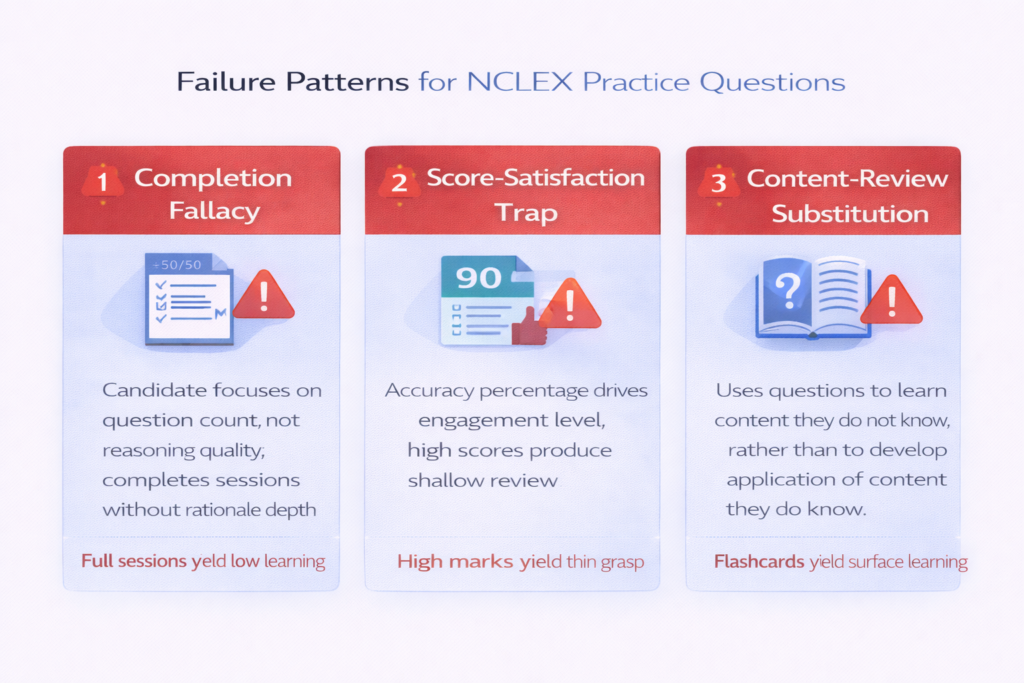
Understanding the specific ways candidates underuse NCLEX practice questions is the first step toward using them correctly — because the failure patterns are predictable, named, and correctable once they are identified.
The Completion Fallacy
The completion fallacy is the belief that the value of NCLEX practice questions is proportional to how many have been completed. It produces the preparation behavior of treating question sessions as a volume exercise — the goal is to finish the session and check the box rather than to extract clinical reasoning development from each question. Candidates operating under the completion fallacy measure their preparation progress in question count: I have done 2,000 questions; I am ahead of where I was last week. The problem is that completed questions and learned-from questions are not the same quantity, and the exam measures clinical reasoning competency, not question familiarity. A candidate who completes 3,000 NCLEX practice questions with shallow engagement will perform worse on the actual exam than a candidate who completes 1,500 with deep rationale analysis, active error categorization, and deliberate weak-area targeting — because the first candidate has built question-completion habits, not clinical reasoning capacity.
The Score-Satisfaction Trap
The score-satisfaction trap occurs when a candidate uses their session accuracy percentage as the primary signal of preparation progress and allows that signal to determine whether they engage deeply with the session’s content. A 68 percent session produces mild satisfaction and superficial rationale review — things went well, nothing urgent to address. A 54 percent session produces anxiety and slightly more attentive rationale checking — but still focused primarily on the missed questions rather than on the clinical reasoning patterns producing them. Neither response extracts the full preparation value from the session. High-scoring sessions contain as many preparation opportunities as low-scoring ones: questions answered correctly with low confidence reveal fragile reasoning that harder questions will expose, and questions answered correctly for the wrong reason — selecting the right option via a different clinical logic than the rationale teaches — represent preparation gaps that accuracy metrics make invisible. The score tells you where accuracy currently sits. It does not tell you why, which is the only information that drives improvement.
The Content-Review Substitution Error
The content-review substitution error occurs when candidates use NCLEX practice questions as their primary content review activity rather than as their primary clinical reasoning development activity. Questions are not the most efficient way to learn content you do not know — they are the most efficient way to develop the ability to apply content you already know. A candidate who encounters a question on digoxin toxicity they cannot answer because they do not know what digoxin toxicity looks like will learn more by stopping, reading a targeted content review on digoxin toxicity, and then returning to NCLEX practice questions on cardiac medications than by completing 20 additional questions on the same topic and hoping that repeated exposure produces understanding. When a rationale review reveals a genuine knowledge gap — not a reasoning error but a content fact that was simply not known — the correct response is content review before additional question practice, not more questions from the same inadequate knowledge base.
Before the Answer Options: The Pre-Engagement Protocol

The most valuable improvement a candidate can make to their NCLEX practice questions methodology happens before reading a single answer option. The pre-engagement protocol transforms each question from a recognition exercise into a clinical reasoning development event.
The Two-Read Discipline
Every NCLEX practice questions stem deserves two complete reads before the answer options are engaged. The first read builds clinical situational awareness: who is this patient, what is their condition or clinical context, what assessment data is provided, what has changed or is happening right now? The second read is analytical: what is the action verb in the question, and what type of nursing decision is being tested? The nurse should first tests prioritization. The nurse recognizes tests assessment interpretation. The nurse anticipates tests clinical prediction from pathophysiology. The nurse evaluates tests outcome assessment. Identifying the action verb precisely on the second read prevents the most common NCLEX practice questions error — answering the question as if it is asking for a different type of nursing decision than what the stem specifies. A prioritization question answered as if it were an assessment question, or an evaluation question answered as if it were an implementation question, produces an incorrect selection regardless of the candidate’s clinical knowledge on the topic.
Generate Before You See
After the two-read discipline, generate your own clinical answer in a single sentence before reading any option. What would the nurse do, assess, or prioritize in this specific situation? Write it on scratch paper or state it mentally — but commit to a specific answer before the options appear. This generate-before-you-see habit produces two preparation benefits simultaneously. First, it builds genuine clinical reasoning rather than option recognition — the brain is generating from clinical data rather than scanning for a familiar-sounding selection. Second, it makes the rationale review substantially more informative: when your generated answer matches the correct option, the rationale confirms your reasoning chain; when it does not, the gap between what you generated and what the correct answer explains reveals precisely where your clinical reasoning diverged and what specific correction is needed. This gap is the highest-value learning unit in the entire NCLEX practice questions process, and it is only visible when pre-generation has occurred.
The Confidence Tag
Before submitting each answer, apply a three-level confidence tag: certain, reasoned, or uncertain. Certain means you identified the correct answer through a clear clinical reasoning chain with no meaningful doubt. Reasoned means you applied frameworks, narrowed to two options, and selected the more defensible one with moderate confidence. Uncertain means you applied frameworks but remained genuinely unclear about the correct selection. This tag takes two seconds per question and transforms the subsequent rationale review session from a generic check into a precision diagnostic. Certain answers that turn out to be wrong reveal confident clinical misconceptions — the highest-priority review items. Uncertain answers that turn out to be correct reveal accidental correct answers — reasoning that worked coincidentally rather than logically, which harder questions will expose. The confidence tag makes these two categories visible and prioritizable in review.
The Full Rationale Review Protocol
The rationale review session after a block of NCLEX practice questions is where the majority of clinical reasoning development occurs — not in the question session itself. The four-question protocol applied to every question, regardless of whether it was answered correctly, extracts the maximum available learning from each rationale.
Question 1: What Clinical Principle Does the Correct Answer Teach?
The first question in every NCLEX practice questions rationale review is the most foundational: what specific clinical principle, applied to this specific patient in this specific scenario, justifies the correct answer? Read the correct-answer rationale and extract the transferable clinical rule — not just confirmation that the option is right but the underlying logic that would apply to any similar clinical situation. A rationale explaining why the nurse assesses the patellar reflex before administering magnesium sulfate is teaching the principle that deep tendon reflexes are the earliest clinical indicator of magnesium toxicity and must be present to proceed safely. That principle — not the fact that option B was correct — is what will help answer future NCLEX practice questions involving magnesium sulfate, eclampsia, or neuromuscular toxicity assessment. Extract the principle, state it in one sentence in your own words, and consider whether it warrants an Anki card for spaced retrieval review.
Question 2: Why Does Each Incorrect Option Fail?
The second and most time-intensive NCLEX practice questions rationale analysis question is applying a specific clinical explanation to each incorrect option: why does this option fail for this specific patient in this specific scenario? This is not asking why the option is clinically wrong in general — many incorrect options describe clinically reasonable actions that are simply wrong for this specific moment. It is asking what specific clinical reasoning error would lead a candidate to select this option, and why the scenario’s clinical data makes it inapplicable here. A cardiac monitoring option in a scenario asking about priority post-operative assessment after thyroid surgery is not wrong because cardiac monitoring is bad nursing — it is wrong because the highest risk in the immediate post-thyroid surgery period is hypocalcemia from parathyroid disruption, and options addressing that priority correctly represent better clinical reasoning for this specific scenario. Articulating the specific failure reason for each incorrect option is what closes the reasoning gap the distractor exploits and prevents the same error on future NCLEX practice questions with similar distractors.
Question 3: What Reasoning Error Produced My Wrong Answer?
For every question answered incorrectly, the third NCLEX practice questions rationale question is the most diagnostically valuable: at which step of my reasoning did I go wrong? Four primary error categories cover the vast majority of NCLEX practice questions mistakes. Process step error: I selected an implementation option when the question was testing assessment, or an assessment option when the question was testing evaluation. Priority framework error: I selected a psychosocial option when a physiological priority was present, or a safety action when an ABC emergency was the correct priority. Patient context error: I applied correct clinical knowledge to a different patient presentation than the one described — correct treatment for the wrong condition. Knowledge gap: I did not recognize the clinical significance of a specific finding because the underlying principle was not in my knowledge base. Naming the specific error category rather than simply noting the question was wrong converts each NCLEX practice questions session from an accuracy report into a clinical reasoning diagnostic that drives targeted correction.
Question 4: How Does This Rationale Change How I Will Approach Similar Questions?
The fourth and most forward-looking NCLEX practice questions rationale question is the transfer question: does the clinical principle this rationale teaches change how I will approach a future question with a similar presentation, similar distractors, or a similar clinical decision point? If yes, write the principle as an Anki card front-and-back before moving to the next rationale. If no, confirm the principle is already consolidated and move forward. This transfer question is what converts individual NCLEX practice questions rationale reviews into a cumulative clinical reasoning library rather than a series of one-off corrections that are forgotten by the next session. The candidates who improve most rapidly across a preparation period are not completing the most questions — they are extracting the most transferable clinical reasoning from each question they complete.
Session Structure: From Content-Filtered to Mixed-Content Simulation
The way NCLEX practice questions sessions are structured across a preparation period determines whether clinical reasoning development builds systematically or plateaus at an early level. The progression from content-filtered to mixed-content to full simulation represents the three phases of session structure that optimally develop the competency the exam measures.
Phase 1: Content-Filtered Sessions With Parallel Review
In the first two to three weeks of preparation, NCLEX practice questions sessions should be filtered by content area — cardiac nursing questions paired with the day’s cardiac content review, pharmacology questions paired with the day’s pharmacology study block. This pairing reinforces clinical associations between content knowledge and clinical application immediately within the same session, creates immediate accountability for content review quality (you will know within the same session whether content was genuinely understood or only felt familiar), and begins building the performance analytics data that will drive content priority decisions in subsequent weeks. Content-filtered sessions should be followed immediately by the full four-question rationale protocol for every question in the session — the clinical associations are freshest immediately after completing the questions, and the rationale review is most productive when content review is still in active memory.
Phase 2: Mixed-Content Sessions With Increasing Volume
From week three or four onward, NCLEX practice questions sessions should transition from content-filtered to mixed-content — drawing questions from all content areas without filtering. Mixed-content sessions develop two capacities that content-filtered sessions cannot: the ability to shift clinical reasoning frameworks rapidly between different content areas within a single session (the same cognitive flexibility the actual exam requires), and the detection of content area interactions — questions where a cardiac medication affects renal function, or a respiratory emergency has neurological implications — that filtered sessions by definition cannot produce. Session volume should increase progressively across this phase: 50 questions per day in phase one, 60 to 75 in phase two, building toward 75 to 100 in the final phase. The full rationale protocol continues across all sessions; the depth of rationale review should not decrease as question volume increases.
Phase 3: Full Simulation Sessions
Weekly full simulation sessions — 100 to 150 NCLEX practice questions completed under timed, uninterrupted, exam-realistic conditions — are the culminating phase of session structure and the most important single preparation activity for building the cognitive stamina and pacing discipline the actual exam requires. Full simulation sessions differ from daily practice sessions in three critical ways: no mid-session rationale review (rationale review happens after the full session, not after each question), timed pace (90 seconds per question average), and no content filtering (fully mixed content drawn from all test plan categories). The rationale review session after a full simulation — applying the four-question protocol to every question in a 100 to 150 question set — is the most intensive and most valuable review session of the preparation week. It should be scheduled as a separate block of equal length to the simulation itself, not compressed into 20 minutes at the end of a long study day.
The Diagnostic Before Everything Else
Before the content-filtered phase begins, a single diagnostic NCLEX practice questions session of 75 to 100 questions drawn from all content areas with no preparation establishes the baseline performance profile that makes every subsequent session decision evidence-based rather than intuitive. Complete the diagnostic without any content review beforehand — its value is in revealing current performance, not in measuring post-review improvement. After the diagnostic, apply the full rationale protocol, rank content area accuracy from lowest to highest, and build the phase one content-filtered schedule around that ranking. The lowest-accuracy categories receive the earliest and most intensive attention; the highest-accuracy categories receive maintenance-level practice. Without the diagnostic, the content priority order is determined by intuition rather than by data — which produces a preparation schedule optimized for comfort rather than for gap closure.
Using NCLEX Practice Questions for NGN Format Preparation
The Next Generation NCLEX formats require specific adaptations to the standard NCLEX practice questions methodology — because the cognitive operations each format tests are structurally different from traditional multiple choice and require format-specific engagement habits to develop correctly.
Unfolding Case Studies: Sequential Reasoning, Not Independent Questions
Unfolding case study sets in NGN-aligned NCLEX practice questions platforms present six questions that follow a single evolving patient scenario. The most important preparation habit for this format is treating each question as a new clinical judgment decision based on the current state of the scenario — not as an independent question with a correct answer derivable from clinical knowledge alone. Each question maps to one of the six CJMM cognitive skills: recognize cues, analyze cues, prioritize hypotheses, generate solutions, take action, evaluate outcomes. Before reading answer options for each question in an unfolding case study set, identify which CJMM skill the question is testing from its action verb — the nurse recognizes (recognize cues), the nurse analyzes (analyze cues), the nurse prioritizes (prioritize hypotheses) — and generate your answer using the reasoning process appropriate for that specific cognitive skill. This CJMM-aware engagement habit develops the clinical judgment architecture that NGN formats directly assess and that standard multiple choice practice alone does not build.
Extended Multiple Response: Independent Evaluation Practice
Extended multiple response NCLEX practice questions require selecting all correct options from a list, with partial credit awarded based on the number of correct selections. The preparation habit that builds accuracy on these items is independent option evaluation — asking of each option individually whether it is clinically appropriate for this specific patient in this specific scenario, yes or no, before moving to the next option. Candidates who evaluate options comparatively — ranking which seems most correct across the full list — consistently miss correct options that seem less dramatic than the most obvious ones and select incorrect options that seem more significant in comparison. Practicing the independent yes-or-no evaluation during NCLEX practice questions sessions builds the habit that partial credit scoring rewards on the actual exam. After completing an extended multiple response item, the rationale review should identify which options you incorrectly excluded (false negatives) and which you incorrectly included (false positives) separately — because these two error types often reflect different clinical reasoning gaps requiring different corrections.
Bow Tie Questions: Center-First Preparation
Bow tie NCLEX practice questions develop clinical judgment at the level of connecting assessment data to clinical condition to nursing action to monitoring parameters in a single integrated reasoning sequence. The preparation habit that builds accuracy on bow tie items is center-first commitment: identify the central condition or problem most supported by the clinical data before selecting any actions or monitoring parameters. Candidates who attempt to complete all three sections of a bow tie question simultaneously create a circular reasoning loop where action selection and condition identification become confused. During NCLEX practice questions bow tie practice, apply the generate-before-you-see protocol specifically to the center section: given the clinical data in the stem, what is the single most likely condition or problem? Commit to that determination before engaging the actions or monitoring sections. The actions and monitoring parameters that correctly follow from the identified condition are then derivable from clinical knowledge of that specific condition rather than from general nursing knowledge applied globally.
Analytics-Driven Preparation: Reading Your Question Bank Data
The performance analytics generated by a NCLEX practice questions platform are only valuable if they are read correctly and acted upon. The following analytics reading framework extracts the maximum preparation intelligence from available data.
Content Area Accuracy as a Priority Map, Not a Report Card
The correct way to read content area accuracy data from your NCLEX practice questions platform is not as a report card to feel good or bad about — it is as a priority map for the coming week’s preparation. Rank every content category from lowest to highest accuracy and treat this ranking as your study schedule for the next seven days. Lowest-accuracy categories receive the most preparation time and the earliest placement in the week. Highest-accuracy categories receive maintenance-level question sessions — enough to prevent decay but not the intensive targeted practice that weak areas require. This data-driven priority allocation is the most direct mechanism for closing preparation gaps efficiently, and it requires overriding the intuitive tendency to study comfortable content areas where accuracy is already strong.
Accuracy Trend vs. Accuracy Level
The more informative analytics metric from NCLEX practice questions data is not the absolute accuracy level — the current percentage — but the accuracy trend: is performance in this content area improving, stable, or declining over the past two weeks? A content area with 47 percent accuracy trending upward toward 55 percent is responding to targeted practice and needs continued attention. A content area with 53 percent accuracy that has been flat for two weeks despite targeted NCLEX practice questions sessions has plateaued — which signals that the preparation approach for that area needs to change, not that more of the same question volume is needed. Plateau performance almost always indicates that a content review session is needed before additional question practice: the clinical knowledge foundation is insufficient to support further reasoning development from questions alone.
Tracking NGN Accuracy Separately
Many candidates have an overall NCLEX practice questions accuracy that masks significantly weaker NGN-specific performance — strong traditional format scores raise the aggregate average above where NGN accuracy alone would place it. If the question bank platform reports NGN accuracy separately from traditional format accuracy, review both metrics weekly and treat them as independent performance indicators. A candidate with 62 percent overall accuracy and 44 percent NGN accuracy is not as prepared for the 2026 exam as their overall number suggests. If the platform does not separate NGN accuracy, create your own tracking by recording NGN question results in a dedicated column of the performance log and calculating weekly NGN accuracy separately. The hidden NGN gap is one of the most common preparation blind spots in 2026 NCLEX preparation, and it is only visible when NGN and traditional performance are tracked independently.
- Weekly analytics review checklist: Rank content areas by accuracy lowest to highest and update the priority study schedule. Identify any area that has plateaued despite two weeks of targeted practice and schedule a content review session before more questions. Check NGN accuracy separately and compare to traditional format accuracy. Identify the most common reasoning error type from the week’s incorrect answers and plan a targeted correction session.
- Monthly analytics review: Review questions answered correctly with low confidence — the uncertain-correct category — and apply the four-question rationale protocol to a representative sample. These reveal fragile correct answers that harder questions will expose. Identify whether any reasoning error type that appeared in month one is still appearing in month two, indicating a persistent pattern that requires a different correction approach rather than more practice.
Conclusion
NCLEX practice questions are the most powerful clinical reasoning development tool available in nursing exam preparation — when they are used as a reasoning development tool rather than as a question completion exercise. The pre-engagement protocol builds genuine clinical reasoning before options are seen. The four-question rationale review protocol extracts the maximum transferable learning from every question completed. The session progression from content-filtered to mixed-content to full simulation builds the specific clinical reasoning competency the CAT algorithm measures. Analytics-driven preparation decisions replace intuition-based comfort-area study with evidence-based gap closure.
The candidates who improve most efficiently across a preparation period are not the ones who complete the most NCLEX practice questions. They are the ones who use each question they complete to its full instructional potential — generating before seeing, reading every rationale including incorrect options, naming their reasoning errors precisely, converting clinical principles into spaced retrieval cards, and letting their performance data drive every major preparation decision. Study smarter means using every question you complete as the learning event it was designed to be, rather than as the completion event that feels like progress. That distinction is what separates preparation that produces a passing result from preparation that produces a high question count.
