

NCLEX repeat test takers face a specific trap that first-time candidates never encounter: the temptation to fix a not-passing result with more of exactly what already failed. More hours with the same question bank. More re-reads of the same review book. More repetitions of a study routine that already produced a below-passing-standard outcome once. Intensity is not the variable that needs to change. The approach is.
This is the piece most retake guidance skips. General NCLEX advice is written for someone who has not yet sat for the exam. Repeat test takers need something different: a diagnostic look at why a first, second, or even third attempt did not reach the passing standard, and a specific set of structural changes — not motivational encouragement — for the attempt ahead.
The Repeat-Taker Trap: Why Studying Harder Fails Twice
A not-passing result on the NCLEX almost never means insufficient effort. Most candidates who fail have already put in real hours. What it usually means is that effort was misapplied relative to what the Computerized Adaptive Testing (CAT) model and the current test plan are actually measuring. Repeating the same misapplied effort at higher volume produces the same failure mode, just with more fatigue attached to it.
This matters because the instinct after a not-passing result is almost always to escalate: study longer days, add a second question bank on top of the first, revisit every content area at equal depth regardless of where the actual gap was. None of these responses are wrong in isolation, but none of them start from a diagnosis. Without a diagnosis, added effort has no target to correct toward.
Start With the Candidate Performance Report, Not a New Question Bank
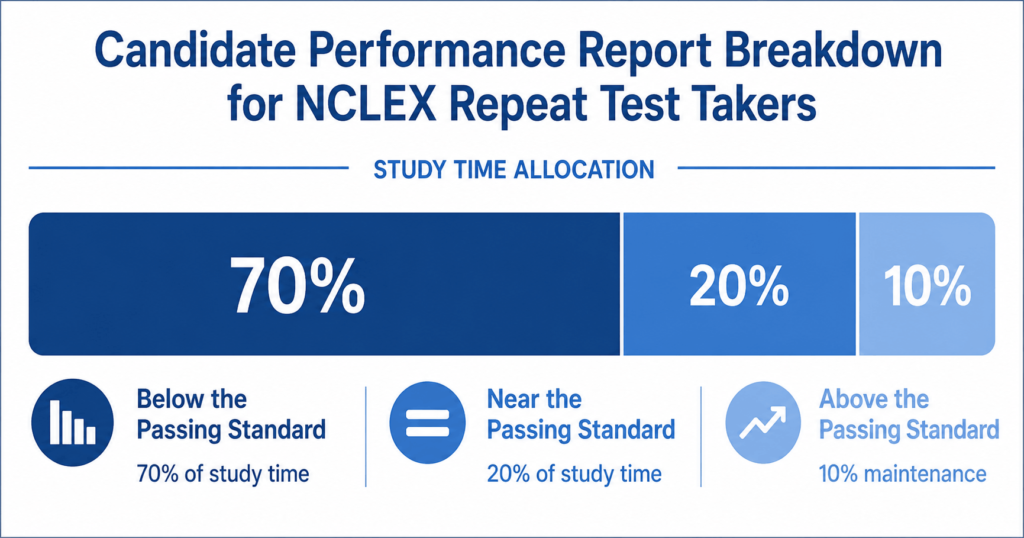
Every candidate who receives a not-passing result also receives a Candidate Performance Report, commonly abbreviated CPR. This report rates performance across the NCLEX test plan’s content areas using a three-category system: above the passing standard, near the passing standard, and below the passing standard. It is the single most specific piece of information a repeat test taker has about where the exam actually ended, and it is skipped or skimmed far more often than it should be.
Three ways candidates misread the CPR and lose its value entirely:
- Treating “near the passing standard” as functionally the same as passing. It is not. It means borderline, not close enough to leave alone.
- Treating every category marked below standard as equally weak, then splitting study time evenly across all of them regardless of how far below standard each one actually was.
- Reading the report once immediately after results arrive, while emotions are highest, and never returning to it again during the actual retake preparation period.
A more useful allocation: roughly seventy percent of preparation time directed at categories marked below the passing standard, twenty percent at categories marked near the passing standard, and the remaining ten percent maintaining categories already above standard so they do not slide. This is not an arbitrary split. It mirrors where the exam itself indicated the gap was.
The Four Structural Changes That Matter More Than Intensity

These four changes are not about doing more. Each one redirects existing preparation time toward a different target.
1. Change the Primary Question Bank — Only If the Diagnosis Calls for It
The Problem
Switching question banks is often the first thing repeat test takers do, whether or not it is the right move. If the CPR shows content-area gaps that a bank’s coverage does not adequately address, or if a prior bank’s difficulty calibration was clearly too far below NCLEX-level difficulty, changing banks is justified.
The Fix
If the gap was actually in reasoning application rather than content coverage, a new bank with the same content will not fix a reasoning problem. Confirm which one it is against the CPR before switching anything.
2. Change the Rationale Review Protocol
The Problem
Reading a rationale after seeing whether an answer was correct is not the same activity as analyzing a rationale to extract the reasoning pattern behind it. This gap is invisible from the inside — it still feels like studying.
The Fix
For every practice question, correct or incorrect, identify what clinical judgment step was actually being tested, why the correct option satisfied it, and specifically what made each incorrect option wrong rather than simply noting that it was wrong.
3. Change NGN Allocation If the First Attempt Predates Full Exposure
The Problem
Candidates who tested before the April 2026 test plan update, or who under-prepared for Next Generation NCLEX item types the first time, are working from an outdated calibration of what the exam actually looks like now.
The Fix
Build in deliberate daily exposure to unfolding case studies, bow-tie items, and extended multiple response formats from the start of retake preparation, not as a token review session in the final week.
4. Change Test-Day Conditioning, Not Just Content Review
The Problem
A repeat test taker is walking back into a room that has already produced one not-passing result. Content review alone does not address that.
The Fix
Re-expose yourself to timed, simulated testing conditions — a quiet desk, a visible timer, no notes, an interquestion reset habit — well before exam day, not for the first time on exam day itself.
The 45-Day Wait Is a Runway, Not a Punishment
The NCSBN requires a minimum of 45 test-free days between NCLEX attempts, though some state boards of nursing extend this further, so it is worth confirming the specific requirement with the relevant board directly. Rather than treating this period as dead time to get through, it works better as a structured three-phase runway.
- Weeks one and two: read the CPR carefully, allow deliberate rest after the emotional weight of a not-passing result, and reapply to the nursing regulatory body and Pearson VUE so the new Authorization to Test is ready when the wait period ends.
- Weeks three through eight: the structural rebuild — CPR-weighted content review, rationale-analysis practice, and daily NGN exposure.
- Final two to three weeks: taper volume, increase timed full-length simulation, and shift toward test-day conditioning rather than adding new content.
The Psychological Layer Repeat Test Takers Carry That First-Timers Do Not
First-time candidates walk into the testing center without a prior result attached to that room. Repeat test takers often carry anticipatory anxiety specific to the testing center itself, along with a background worry running underneath the exam experience about whether the same outcome is about to repeat. This is a real and specific psychological load, and it deserves a direct response rather than generic test-anxiety advice.
A useful reframe: a prior not-passing result was information about a specific gap at a specific point in time, not a predictor of the next attempt. Candidates who go into a retake having actually addressed the CPR-identified gap are working from a materially different position than the one they tested from previously, even though the room and the format may feel the same.
What Not to Do
- Do not switch question banks reflexively without first identifying why the last attempt did not pass.
- Do not skip the Candidate Performance Report or read it only once.
- Do not simply repeat the previous preparation routine at a higher volume.
- Do not withdraw from peer or academic support out of embarrassment about a not-passing result — a failed attempt is common and not a reliable predictor of long-term competence.
Conclusion
Repeat test takers are not candidates who lack the capability to pass. They are candidates whose first attempt revealed a specific, identifiable gap that a repeated version of the same preparation approach will not close. The Candidate Performance Report names where that gap was. The four structural changes — diagnosing before switching banks, replacing answer-checking with full rationale analysis, integrating NGN daily, and conditioning for test-day conditions rather than just reviewing content — address it directly.
The 45-day wait period is long enough to make these changes if it is used as a structured runway rather than dead time. And the psychological weight of walking back into that room is real, but it is not a predictor of the outcome. A retake prepared this way is a materially different attempt from the one before it, even when the room, the format, and the exam itself look the same.
