

The question most nursing candidates search at the beginning of NCLEX preparation — what is the best way to study? — deserves a direct, complete, and honest answer rather than a hedge about how it depends on the individual or a list of generic tips that leave the candidate no more directed than before they asked. This guide provides that direct answer. Not a menu of options to choose from. Not a framework for building your own approach. The best NCLEX study techniques in 2026, synthesized from what preparation behavior analysis consistently shows produces first-attempt passing results, presented in enough detail to implement immediately.
The caveat worth stating upfront: best does not mean easiest, fastest, or most comfortable. The NCLEX study techniques that produce the strongest first-attempt passing rates are also the techniques that most candidates find more cognitively demanding per session than the approach they were using before — because they are designed to extract maximum clinical reasoning development from each study event rather than to produce the highest number of study events per hour. A candidate who implements these techniques will likely complete fewer questions per session than before while developing significantly more clinical reasoning competency per question. That trade — fewer questions, more development per question — is what the evidence consistently supports.
This guide is organized as a complete preparation system: the foundational principle that makes everything else work, the daily session structure that applies it, the weekly management system that tracks progress, the NGN-specific additions that the 2026 examination requires, the physiological infrastructure that sustains preparation quality, and the exam-day application that converts preparation into performance. Each section is specific enough to implement directly without interpretation.
The Foundational Principle: Quality of Engagement Over Quantity of Exposure
Every effective NCLEX study technique in 2026 is an application of one foundational principle: clinical reasoning development is produced by the quality of engagement with each study event, not by the quantity of study events. This principle is non-intuitive because it contradicts the most visible preparation metric — question volume — that nursing student communities treat as the primary preparation adequacy indicator. It is, however, the principle that best explains the performance difference between candidates who complete 1,500 questions and pass and candidates who complete 4,000 questions and do not: the first group extracted more clinical reasoning development per question through higher engagement quality; the second group accumulated more question exposure without proportionally higher clinical reasoning development.
The NCLEX study techniques in this guide are all implementations of this principle. Every technique is designed to increase the depth of clinical reasoning development per study event rather than to increase the number of study events per unit of time. Understanding this foundational principle is what makes the techniques coherent rather than arbitrary — each one makes sense as a quality-maximizing choice once the principle is understood, and each one is tempting to skip precisely because it requires more cognitive effort per event than the lower-quality alternative.
The Daily Session: The Core NCLEX Study Technique
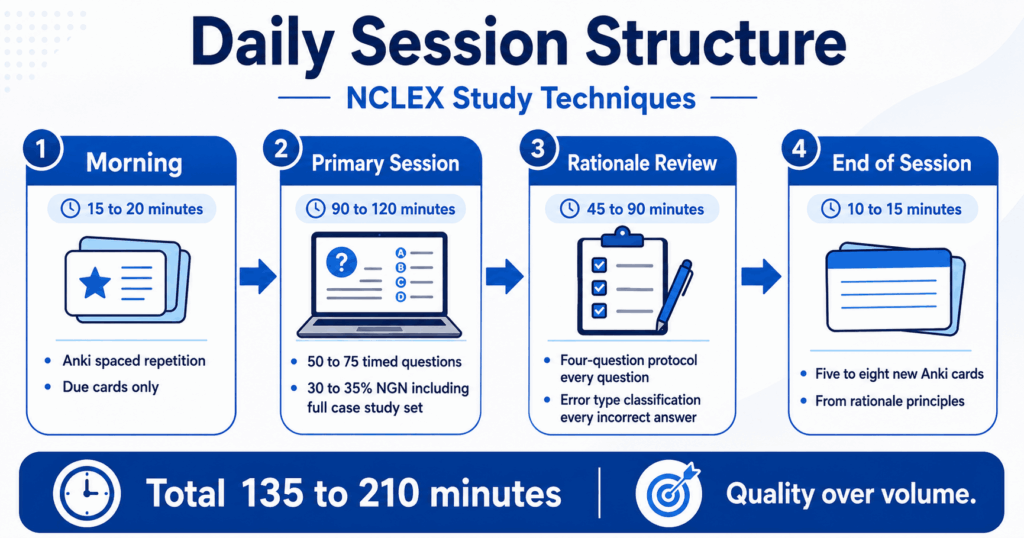
The Session Structure
The best daily NCLEX study session in 2026 has a specific, non-negotiable structure that applies to every study day. The session begins with 15 to 20 minutes of Anki spaced repetition review — due cards only, no new card creation, completed before any other preparation activity. The primary practice session follows immediately: 50 to 75 questions under timed conditions (90 seconds per question average, milestone clock check at every 25 questions), with 30 to 35 percent of questions being NGN format items including at least one full six-question unfolding case study set. After the question session, the rationale review phase begins — the most important part of the session and the one most commonly abbreviated or skipped. The session concludes with five to eight new Anki card creations from the rationale review’s clinical reasoning principles. Total active session time: 90 to 120 minutes for the question session plus 45 to 90 minutes for rationale review, for a total of 135 to 210 minutes per full daily session.
The Four-Question Rationale Protocol — Applied to Every Question
The single NCLEX study technique that produces the largest measurable accuracy improvement per preparation behavior change is applying the complete four-question rationale review protocol to every practice question — correct and incorrect. For every question, the protocol produces four specific analytical outputs: first, what specific clinical principle did the correct option apply to this specific patient in this specific scenario (not the principle in general, but its application to the patient details the stem provided); second, why does each incorrect option fail for this specific patient (not why it is wrong in general, but why it is the wrong choice for this patient given this scenario’s specific clinical context); third, what reasoning error type would lead a candidate to select each distractor (knowledge gap, priority framework error, patient context misreading, NGN cognitive skill misidentification); fourth, what clinical principle transfer does this question teach — how would this reasoning apply to a different patient in a different scenario testing the same underlying framework. These four outputs take approximately three to five minutes per question for incorrect answers and two to three minutes for correct answers — which is why a 50-question session with full protocol takes 135 to 175 minutes total rather than the 75 minutes that question completion alone requires. The additional time is the highest-return investment in the entire preparation system.
Error Type Classification — The Preparation Direction Signal
For every incorrect answer in every session, 30 seconds of error type classification before any preparation response produces the preparation intelligence that accurate gap analysis requires. The four error types each have a specific, different preparation response: knowledge gap (the clinical content was genuinely absent — a targeted content review session in that area is appropriate), reasoning pattern error (the content was present but misapplied through wrong priority framework, wrong nursing process step, or psychosocial priority before physiological — behavioral correction practice is appropriate, not content review), patient context error (correct clinical reasoning was applied to a misread of the specific patient’s scenario details — deliberate stem reading practice with the physiological urgency scan is appropriate), and NGN cognitive skill error (the wrong CJMM skill was applied to an NGN format question — skill-specific practice and action verb identification practice are appropriate). Maintaining an error type log across the preparation period reveals which error type is most frequent — which is the highest-priority correction target for the following week’s targeted practice.
The NGN Study Technique Layer: What 2026 Specifically Requires
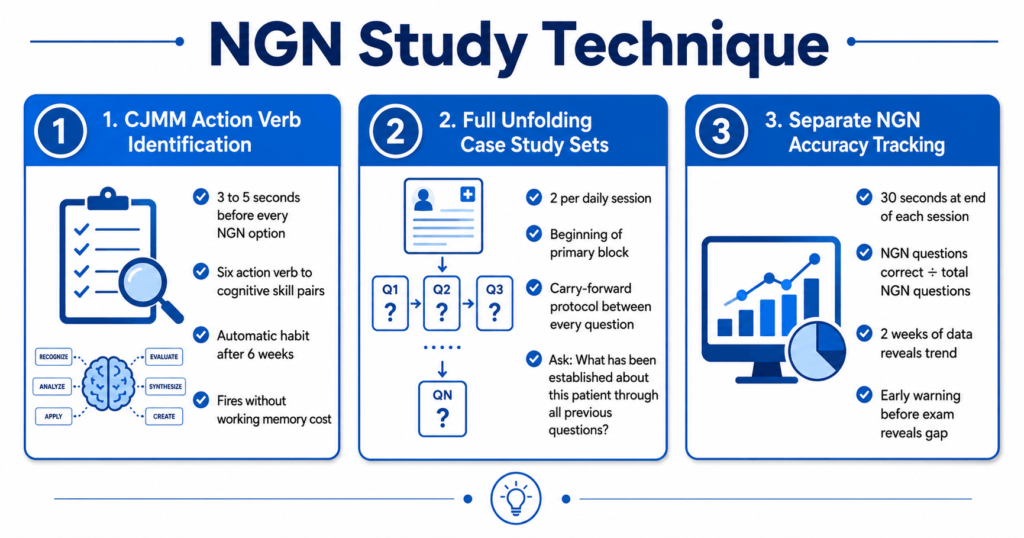
CJMM Action Verb Identification — Built Into Every NGN Question
Every NGN question in every practice session requires one specific NCLEX study technique addition that takes three to five seconds per question and produces the largest single return on time invested in NGN preparation: identifying the CJMM cognitive skill from the action verb in the question stem before reading any answer option. The identification sequence: read the question stem’s action verb, name the cognitive skill it indicates, use that skill identification to determine what the correct answer must demonstrate before any option is engaged. Identify or select → recognize cues. Interpret or explain → analyze cues. Prioritize or rank by urgency → prioritize hypotheses. Generate or plan → generate solutions. Implement or initiate → take action. Determine effectiveness or identify improvement → evaluate outcomes. This habit, applied consistently to every NGN question across six weeks of preparation, fires automatically on exam day without requiring deliberate cognitive effort — which preserves working memory capacity for clinical reasoning rather than consuming it on technique application.
Unfolding Case Study Sets — The Full-Set Requirement
The best NCLEX study technique for NGN unfolding case study preparation is completing full six-question sets with the carry-forward protocol applied between every question — not practicing individual NGN items extracted from their case context. The carry-forward protocol requires a brief review before each question after the first: what has been established about this patient’s clinical situation through all previous questions in this set? This accumulated clinical picture is the reference frame for all subsequent questions, and missing it produces answers that are clinically plausible in isolation but incorrect relative to the specific clinical trajectory the case has established. Two complete unfolding case study sets per daily session — one at the beginning of the primary question block when cognitive resources are freshest — builds the narrative integration skill that the NCLEX’s NGN format specifically and most heavily tests.
Separate NGN Accuracy Tracking
The best NCLEX study technique for monitoring NGN-specific preparation progress is tracking NGN accuracy as a separate metric from overall accuracy in every session and in the weekly micro-audit. NGN accuracy is invisible within aggregate accuracy numbers — a candidate with 60 percent overall accuracy composed of 67 percent traditional and 44 percent NGN has not met the NGN readiness benchmark and is significantly underprepared for the format that constitutes approximately 30 percent of the 2026 examination session, but this gap is invisible in the aggregate number. Manual NGN accuracy tracking takes 30 seconds at the end of each session: count the NGN questions completed, count the NGN questions correct, calculate the percentage, record it. After two weeks of separate tracking, the NGN-specific trend reveals whether the NGN preparation is working — and provides the early warning that allows targeted NGN-specific intervention before the exam reveals the gap at a higher cost.
The Weekly Management System: Keeping Preparation on Track

The Sunday Micro-Audit
The best NCLEX study technique for preparation management is a 20-minute Sunday micro-audit that reviews four specific data points and produces the following week’s preparation prescription. Data point one: overall accuracy trend across the week’s sessions compared to the previous week — is it upward, stable, or declining? Data point two: content category breakdown from the week’s analytics identifying any category below 50 percent accuracy. Data point three: NGN accuracy tracked separately — is it above 50 percent and trending correctly? Data point four: error type frequency from the week’s error log — which error type appeared most often? The following week’s preparation is determined by this data: the lowest-accuracy content category receives 70 percent of daily question allocation, the most frequent error type receives a specific behavioral correction applied to every session, and the NGN trend determines whether additional NGN-specific intervention is needed. This weekly micro-audit is the preparation management system that converts daily quality effort into progressive readiness development rather than undifferentiated question accumulation.
The Four Readiness Benchmarks — The Goal Each Week
Every week of NCLEX preparation has a concrete success criterion: how close is the current preparation data to meeting all four readiness benchmarks simultaneously? The four benchmarks that correlate with first-attempt passing are: overall accuracy above 55 to 60 percent on a well-calibrated question bank with upward trend across at least three consecutive weeks, no content category below 50 percent in the most recent full simulation’s breakdown, NGN accuracy above 50 percent tracked separately, and a passing-range full simulation (100-plus questions under timed exam-condition requirements) within two weeks of the exam date. The micro-audit uses these four benchmarks as the weekly progress measurement. When all four are met for three consecutive weeks, the data-based proceed signal is confirmed. When any benchmark is unmet, the micro-audit’s data identifies specifically which gap requires the following week’s targeted intervention.
Saturday Full Simulation — The Weekly Calibration
Saturday is the weekly full simulation day — a 100-question timed session under exam-realistic conditions (desk not couch, devices removed, cooler room temperature, visible timer, interquestion reset applied after every question throughout the session). The simulation is followed by the five-metric scorecard review: overall accuracy versus benchmark and versus last week’s simulation, content category breakdown for below-50-percent identification, NGN accuracy calculated separately, pacing data from the milestone clock checks, and reasoning quality in the final 30 questions compared to the first 30. The weekly simulation serves two functions: it provides the most integrated readiness assessment available from practice data, and it conditions the clinical reasoning process to exam-length cognitive demands and exam-condition environmental requirements so that the actual testing center is a familiar preparation context rather than a novel stressor.
The Physiological Infrastructure: What Makes Everything Else Work
The 90-Minute Session Maximum
The best NCLEX study technique for session length management is ending every intensive practice session at 90 minutes regardless of motivation level or session progress. Clinical reasoning quality declines measurably after 90 minutes of intensive engagement — working memory capacity, prefrontal processing speed, and hippocampal encoding efficiency all begin declining at this point. A 90-minute session of high-quality four-question rationale protocol engagement produces more clinical reasoning development than a 180-minute session where quality declines in the second half. The 90-minute maximum is not an aspiration — it is the quality management threshold that protects the preparation value of every session minute. Two 90-minute sessions with a 60-minute non-NCLEX break between them produce more total clinical reasoning development per day than one 180-minute session.
Two Rest Days Per Week — Non-Negotiable
The best NCLEX study techniques cannot produce their full preparation value without the two weekly rest days that enable the hippocampal memory consolidation those techniques generate. Memory consolidation — the process by which the clinical reasoning principles extracted through four-question rationale protocol are converted from short-term to long-term retrievable knowledge — occurs primarily during sleep and during rest periods when the HPA axis returns to baseline. A preparation schedule without rest days maintains stress response activation continuously, impairing the consolidation mechanism that makes each session’s learning durable. Two complete preparation rest days per week — no questions, no rationale review, no Anki — are not preparation sacrifices. They are the physiological infrastructure that makes the other five days’ preparation developmentally productive rather than developmentally depletive.
Physical Activity as Preparation Support
Thirty minutes of moderate aerobic physical activity before the morning Anki review on five of seven preparation days is the highest-return non-study preparation investment available. Aerobic exercise directly addresses the three physiological mechanisms that NCLEX preparation degrades: it reduces the cortisol elevation that preparation stress accumulates and that impairs hippocampal function, it increases BDNF (brain-derived neurotrophic factor) that supports hippocampal neurogenesis and memory consolidation, and it improves sleep quality which is the primary memory consolidation window. A candidate who walks or runs for 30 minutes before each study session is not trading preparation time for fitness — they are establishing the neurobiological conditions that make the subsequent study session’s clinical reasoning development more efficient than it would be without that investment.
The Exam-Day Application: Where Study Techniques Become Performance
The Pre-Option Sequence — The Single Most Transferable Technique
The NCLEX study technique that transfers most directly from preparation to exam-day performance is the pre-option sequence — a 10-second habit applied before reading any answer option in any question. The sequence: identify the question layer (what clinical decision is requested — first action, priority assessment, therapeutic response, patient teaching), activate the relevant clinical reasoning framework (three-tier priority hierarchy for priority questions, nursing process sequence for process questions, therapeutic communication criteria for communication questions, CJMM skill for NGN questions), scan the clinical context specifically for the physiological urgency signal embedded in the stem, and form a preliminary answer prediction from the framework application before any option is read. This sequence, practiced in every daily session across six weeks of preparation, fires automatically on exam day — directing clinical reasoning before distractor engineering can create competing associations.
The Interquestion Reset — Momentum Management
The interquestion reset is the exam-day NCLEX study technique that maintains clinical reasoning quality across the full session rather than allowing it to degrade as question count, difficulty, and anxiety accumulate. After submitting each answer and before reading the next question: eyes briefly closed, one slow exhale, hands flat, the reset complete. This five-second sequence clears the cognitive residue of the previous question — was that right, was it too hard, what does this question count mean — and returns attention to the process-focused present-question orientation. Practiced after every question in every daily session and simulation, the interquestion reset becomes a conditioned response by exam day — firing automatically without working memory cost rather than requiring deliberate initiation under cognitive load.
The Process-Focus Mantra — The Anxiety Anchor
The process-focus mantra — this question, this reasoning, now — is the exam-day NCLEX study technique that prevents the outcome-monitoring tendency (am I passing, how many questions left, what does this difficulty mean) from competing with clinical reasoning for working memory resources. Applied during the commute to the testing center and at each interquestion reset throughout the session, the mantra is an attentional anchor that redirects from outcome evaluation to process engagement. Its effectiveness depends on having been practiced during preparation — not introduced on exam day as a new technique requiring deliberate construction under cognitive load but deployed as a conditioned verbal response whose repetition automatically activates the process-focused attentional orientation that exam-day clinical reasoning requires.
- The one technique to implement first if your current approach is not producing improvement: Apply the complete four-question rationale protocol to every incorrect answer in tomorrow’s session. Not the easier version (just reading the correct answer rationale and moving on) but the full protocol: why each incorrect option fails for this specific patient, what reasoning error type each distractor targets, what clinical principle transfer this question teaches. One week of this single change produces more measurable accuracy improvement than any other single technique adoption because it converts the highest-value preparation events (incorrect answers) from information-checking moments into clinical reasoning development events.
- The preparation resource selection principle: Select one primary question bank that reflects the current April 2026 test plan, includes all five NGN format types with CJMM alignment, and produces practice accuracy in the 55 to 65 percent range on well-calibrated questions. Complete the NCSBN official sample questions at ncsbn.org at the beginning, midpoint, and final week of preparation as the authoritative format calibration reference. Resist the urge to add a second question bank based on peer recommendations — depth with one quality bank using full four-question rationale protocol outperforms breadth across multiple banks with answer-checking review in every comparison.
- What to do in the week before the exam: Final simulation day 7. Targeted consolidation days 6 and 5. Error log crystallization and logistics confirmation days 4 and 3. Physiological recovery days 2 and 1 — Anki morning review only, no practice questions, no content review, no rationale reading. Exam morning: protein breakfast, 10 minutes of physical movement, read the confidence activation paragraph written three days before, process-focus mantra during commute, pre-first-question grounding sequence in the waiting area. The preparation is done. The last week is for protecting it.
Conclusion
The best way to study for the NCLEX in 2026 is a specific, complete, implementable system — not a menu of options, not a vague commitment to studying harder, and not the volume-maximization approach that social media amplifies and that the preparation evidence consistently fails to support. It is the quality-of-engagement-over-quantity-of-exposure principle applied through a daily session structure that extracts maximum clinical reasoning development from each practice event, a weekly management system that tracks progress against objective readiness benchmarks, an NGN-specific technique layer that develops the clinical judgment skills the 2026 examination’s format specifically measures, a physiological infrastructure that sustains the cognitive quality those techniques require, and an exam-day application that converts the preparation into the performance the testing center requires.
These are the best NCLEX study techniques in 2026 because they align with what the examination actually measures, they extract more clinical reasoning development per preparation hour than any alternative approach, and they produce first-attempt passing results at rates the evidence consistently supports. They are not easy to execute with full discipline across six weeks of preparation — the four-question rationale protocol is cognitively demanding, the error type classification requires deliberate attention, the NGN integration requires resisting the comfort of familiar traditional question formats, and the 90-minute session maximum requires ending sessions that feel productive. But the preparation that is easiest to execute is never the preparation that produces the best results. The best NCLEX study techniques are the ones that require the most from each study hour — and produce the most clinical reasoning development from each study hour in return.
