

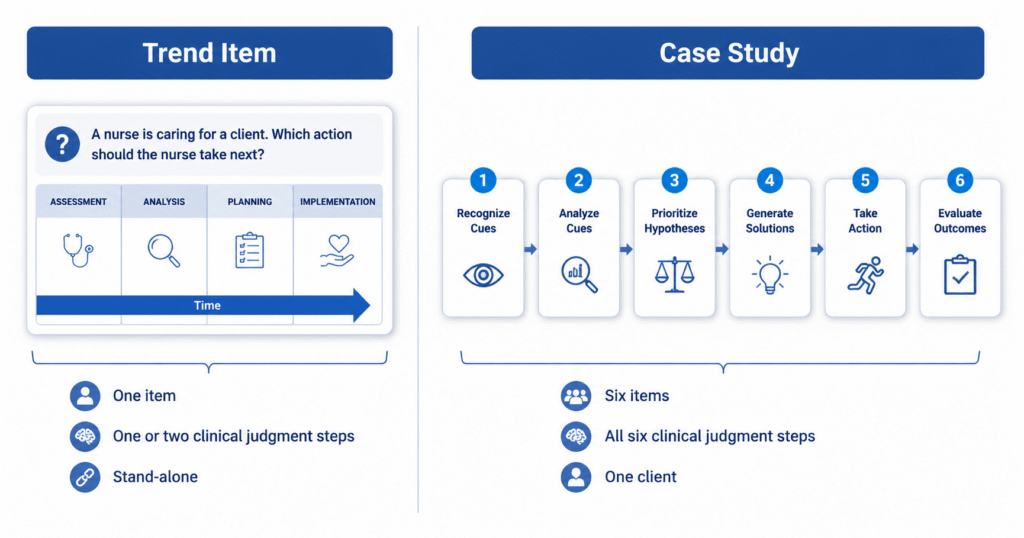
NGN trend questions and case studies both measure clinical judgment, both involve one client, and both present chart data in tabs. That shared surface is why students mix them up. Structurally they are not similar at all.
A trend item is one question. A case study is six. That single difference drives everything else about how each one is built, what it measures, and how you should work through it.
Quick Answer
A trend item is a single stand-alone question that presents one client’s data at several points in time and asks you to interpret the change. A case study is a set of six linked questions about one client that moves through all six steps of the clinical judgment model in order, from recognizing cues to evaluating outcomes. Trend items measure one or two of those steps. Case studies measure all six.
The Difference in One Table
| Trend Item | Case Study | |
|---|---|---|
| Number of questions | One | Six |
| How it appears | Stand-alone | A linked set on one client |
| Clinical judgment steps measured | One or more, not all six | All six, in order |
| What changes | The client’s data across time points | The clinical situation across the six items |
| Where the data sits | Usually one flow sheet or serial record | Chart tabs that update as the case unfolds |
| How many appear on the exam | Part of roughly 10% stand-alone clinical judgment items | 18 items total, in three sets of six |
| Can you go back | No | No |
| Scored independently | Yes, it is one item | Yes, each of the six is scored on its own |
What Is an NGN Trend Question?
Understanding NGN Trend Questions
A trend item presents information about one client gathered at different points in time and asks you to interpret what the change means. The interval can be minutes, hours, or days, depending on the clinical situation.
The data usually arrives as a flow sheet: columns for each time point, rows for each measurement. Vital signs, laboratory values, intake and output, neurologic assessments, wound appearance. Your job is to read across the columns rather than judging any single column on its own.
Trend items are stand-alone items, which means they are administered independently rather than as part of a linked set. Under the 2026 NCLEX-RN Test Plan, stand-alone clinical judgment items make up approximately 10% of the exam, selected depending on how long your exam runs. Bow-tie items come from that same group.
What a trend item measures is narrower than what a case study measures. A stand-alone clinical judgment item targets one or more of the six steps, not the full arc. Most trend items sit heavily in recognizing and analyzing cues, because interpreting a direction of change is exactly what those two steps describe.
What Is an NGN Case Study?
A case study is a set of six items built around one client. NCSBN describes each case study as following Layer 3 of the Clinical Judgment Measurement Model in sequential order, working through each step from recognizing cues to evaluating outcomes.
The six items map to the six steps:
- Recognize cues. Which findings matter?
- Analyze cues. What do those findings mean?
- Prioritize hypotheses. What is most likely, and what is most urgent?
- Generate solutions. What are the appropriate options?
- Take action. What do you do, and in what order?
- Evaluate outcomes. Is it working?
The scenario unfolds. New information appears in the chart tabs as you move through the items, so the client at item six is not in the same state as the client at item one. This is why case studies are often called unfolding case studies.
Every NCLEX-RN exam includes 18 case study items, arranged as three sets of six. This number does not change with exam length, unlike the stand-alone items.
The item formats used inside a case study vary. You may answer one step with a matrix, the next with a cloze, the next with a highlight item. The format is just the response mechanism. The step is what is being measured.
Do Case Study Items Affect Each Other?

No. Each item within a case study is independent of the others and scored accordingly.
This is the most useful fact in this article, because the opposite belief is widespread and causes real damage on exam day. Students who think they misread item one spend the next five items rattled, convinced the whole set is already lost. It is not. Six items, six independent scores.
Two related points from NCSBN’s own guidance:
Care is taken to avoid cuing within a case study. A later item is not designed to reveal the answer to an earlier one, and an earlier item is not designed to give away a later one. So you cannot mine item four for the answer to item three, and you also do not need to worry that a wrong answer earlier has poisoned the reasoning the exam expects later.
You cannot go back to view previous responses. Once you confirm an item and move forward, that item is closed. This applies within a case study exactly as it does across the rest of the exam.
Put together, the practical instruction is simple. Answer each item on the evidence in front of you at that moment, then let it go.
A 5-Step Method for Reading Serial Data
This method is written for trend items, but it works anywhere the exam gives you a flow sheet, including inside case studies.
Step 1: Read the time column first and note the interval
Before anything else, find out how far apart the readings are. A change across four hours means something different from the same change across four days.
The interval also tells you what kind of problem you are looking at. Minutes suggest an acute event. Days suggest a developing complication or a response to treatment.
Step 2: Read across one row at a time, not down the whole table
Most students read a flow sheet the way it is printed, taking in each column as a snapshot. That produces a series of impressions rather than a pattern.
Take one row and follow it across every time point. Blood pressure across all four columns. Then heart rate across all four. You are looking for direction, and direction only shows up along a row.
Step 3: Name the direction of each row
Rising, falling, or stable. Say it, or write it in the margin when you practise.
Do not judge whether the value is normal yet. A row can be entirely within the reference range and still be the most important row on the sheet, because it has moved steadily in one direction the whole time.
Step 4: Group the rows that are moving together
Now look for rows changing in a coordinated way. Two or three rows moving together usually describe one physiological process, and that process is what the item is about.
Rows moving independently are often there to test whether you can tell a pattern from noise.
Step 5: Ask what the pattern means and what it needs now
Only at this point do you name the condition. Then ask what the pattern requires: escalation, an intervention, continued monitoring, or a change to the current plan.
A trend item almost always ends with a decision, not just an interpretation. Identifying the trend is half the item.
Worked Example 1: A Trend Item
The following is an original teaching example written for this article. It is not an actual exam item.
Scenario: A client was admitted following a fall with a closed head injury. The nurse reviews the flow sheet.
| 0800 | 1200 | 1600 | 2000 | |
|---|---|---|---|---|
| Blood pressure | 118/76 | 128/74 | 142/68 | 158/58 |
| Pulse pressure | 42 | 54 | 74 | 100 |
| Heart rate | 88 | 78 | 64 | 52 |
| Respiratory rate | 16 | 16 | 14 | 10, irregular |
| Level of consciousness | Alert, oriented ×4 | Alert, oriented ×3 | Drowsy, oriented ×2 | Difficult to arouse |
Working through it:
The interval is four hours between readings, over twelve hours total. That is a developing process rather than a sudden event.
Reading across each row: blood pressure is rising. Pulse pressure is widening sharply, from 42 to 100. Heart rate is falling steadily. Respiratory rate is falling and has become irregular. Level of consciousness is declining at every single reading.
All five rows are moving together, and they describe one process. Rising systolic pressure with a widening pulse pressure, bradycardia, and irregular respirations is the classic pattern of increasing intracranial pressure. The declining level of consciousness confirms it.
Where students go wrong on this item. Two errors are common.
The first is reading only the last column. At 2000 the numbers are alarming and most students will notice. But the item is testing whether you saw the direction establish itself at 1200, when every value was still inside the normal range. A blood pressure of 128/74 and a heart rate of 78 are unremarkable numbers. They are not unremarkable when the previous reading was 118/76 and 88.
The second is treating the rising blood pressure as the problem. A student who sees 158/58 and thinks about lowering the pressure has misread the physiology. The hypertension is the body’s response to rising intracranial pressure, and treating it as primary hypertension would be dangerous. The pattern, not the value, tells you what is happening.
What the item wants next. Recognising the trend is not the whole answer. The item will ask what you do about it, and the answer involves urgent escalation rather than continued monitoring.
Worked Example 2: How a Case Study Unfolds
Original teaching example. This shows the shape of a six-item set rather than six complete items.
Client: A 72-year-old admitted two days ago with community-acquired pneumonia.
Item 1, recognize cues. The chart opens with a nurses’ note, vital signs, and laboratory results. You are asked to highlight the findings that require immediate follow-up. The note contains a mix of expected post-admission findings and several that are not.
Item 2, analyze cues. A matrix asks you to sort those findings according to which condition each supports. Sepsis and fluid volume overload both fit some of the data, which is the point of the item.
Item 3, prioritize hypotheses. A cloze sentence asks you to commit: the client is most likely experiencing a specific condition based on a specific set of findings.
Item 4, generate solutions. A select-all-that-apply item asks which interventions are indicated for that condition.
Item 5, take action. New information appears in the chart. You are asked which action to take first, or to place several actions in order.
Item 6, evaluate outcomes. More time has passed and new values are available. A matrix asks you to classify each finding as indicating improvement, indicating deterioration, or unrelated.
What this structure tells you:
The client changes between items. The findings at item six are not the findings at item one, and answering item six by recalling item one will fail.
Each item is scored on its own. A student who chose fluid overload at item three and sepsis was correct still earns full credit at items four, five and six if their reasoning there is sound. The set does not collapse.
The formats vary but the reasoning does not. You saw a highlight item, a matrix, a cloze, and a SATA in a single set. Learning the six steps is more valuable than learning six formats, because the formats rotate and the steps do not.
Common Mistakes on Trend Items and Case Studies
Judging a single column instead of the direction. The most frequent trend item error. A value inside the reference range can still be the most concerning row on the sheet.
Believing a wrong answer ruins the case study. It does not. Each item is scored independently. Carrying anxiety from item two into item five costs more points than the original error did.
Trying to use a later item to figure out an earlier one. Case studies are built to avoid cuing between items, so this does not work and it wastes time.
Ignoring the time interval. The same change over four hours and four days points to different problems.
Answering a case study item from memory of the opening scenario. New information appears as the case unfolds. Re-open the tabs.
Treating a compensatory sign as the primary problem. The rising blood pressure in a client with increasing intracranial pressure is a response, not the disease.
Studying formats instead of steps. Case study items rotate through many response formats. The six clinical judgment steps are constant.
How to Practice Trend Items and Case Studies
These two formats need different practice, and treating them the same is why students plateau on one while improving on the other.
For trend items, practise the margin-arrow habit. Take any flow sheet, cover the question, and write an arrow beside each row for rising, falling, or stable. Then group the arrows. Only then read the question. This forces the reading pattern that trend items reward and breaks the habit of scanning for whichever number looks worst.
For case studies, practise naming the step. Before answering any item in a set, say which of the six steps it is asking for. Students who lose points on case studies often lose them by answering the wrong step: giving an intervention when the item asked for an interpretation, or naming a condition when the item asked what to do about it. Naming the step first prevents that, and it takes a few seconds.
When you review, sort your case study errors by step rather than by item. Errors clustered at recognize and analyze cues point to a content gap. Errors clustered at take action point to a prioritisation problem. Errors at evaluate outcomes usually mean you are not comparing new data against the earlier baseline. Three different failures needing three different fixes.
If you are working through NGN formats systematically, a review program that teaches the clinical judgment process rather than answer-selection tricks fits both formats better than a question bank alone. Programs like NCLEX High Yield that build instruction around the six-step model address the reasoning both item types measure.
Key Takeaways
- A trend item is one stand-alone question presenting one client’s data at several time points.
- A case study is six linked items on one client, moving through all six clinical judgment steps in order.
- Trend items measure one or more steps. Case studies measure all six.
- Every NCLEX-RN exam includes 18 case study items in three sets of six. Stand-alone clinical judgment items, including trend and bow-tie, make up roughly 10% of the exam.
- Case study items are scored independently. A wrong answer on one does not affect the others.
- Care is taken to avoid cuing between case study items, so later items will not reveal earlier answers.
- You cannot return to a previous item in either format once you advance.
- On trend items, read across rows to find direction rather than judging single columns.
