

Failing the NCLEX can leave you with one overwhelming question:
Where do I even start?
Do you buy another question bank? Watch more videos? Start your notes over? Answer hundreds of questions every day? Change your study schedule? Find a tutor?
For many repeat NCLEX test takers, the immediate reaction is to simply study more.
But more studying isn’t always the answer.
Sometimes, the problem isn’t how many hours you’re studying. It’s how you’re using those hours, what you’re studying, and whether you’ve actually identified what went wrong the last time.
I understand that feeling personally because I was a repeat test taker too.
I remember using different resources, trying different question banks, watching videos, answering questions, and still wondering:
What am I missing?
Eventually, I realized something that completely changed the way I approached my preparation:
I didn’t necessarily need to study MORE. I needed to change HOW I was studying.
If you’ve failed the NCLEX once—or multiple times—before you buy another resource or start answering another thousand questions, here are five changes I believe every repeat test taker should consider.
What Should You Do After Failing the NCLEX?
If you failed the NCLEX, your first step should be to evaluate your previous study approach before starting over.
Don’t automatically repeat the same schedule with more hours or more questions.
Instead, ask yourself:
- Where were my biggest knowledge gaps?
- Did I actually understand the content or was I memorizing questions?
- Was I using too many resources?
- Was my studying consistent?
- Did I have someone qualified helping me identify my weaknesses?
- What does my Candidate Performance Report suggest I need to improve?
Your next attempt shouldn’t simply be a repeat of your last attempt.
It should be a new plan built around what you learned from it.
Here are five places to start.
1. Stop Making Excuses and Start Making the NCLEX a Priority
This one may be uncomfortable to hear.
But sometimes that’s exactly what we need.
You made it through nursing school. You attended clinicals. You completed assignments. You studied for exams. You showed up when you were exhausted. You met deadlines even when life was busy.
Now you’re at the final step.
Getting licensed.
If the NCLEX is standing between you and becoming a licensed nurse, your preparation has to become a real priority.
That doesn’t mean life suddenly stops.
People preparing for the NCLEX have jobs, children, relationships, bills, responsibilities, emergencies, and countless other things competing for their time.
The goal isn’t perfection.
The goal is accountability and consistency.
There’s a major difference between:
“I’ll study when I have some extra time.”
and
“I have NCLEX study time scheduled from 9 AM to noon.”
One leaves studying up to chance.
The other makes it part of your schedule.
How many hours should you study for the NCLEX?

There isn’t one perfect number of hours that works for every student.
Someone who recently graduated and is performing strongly may need a very different plan from someone who graduated several years ago or has had multiple unsuccessful attempts.
Instead of obsessing over one magic number, focus on having:
Dedicated study blocks + specific goals + consistency + accountability.
For example, don’t write:
“Study NCLEX today.”
Write:
- 9:00–10:30 — Cardiac content review
- 10:30–11:30 — 40 practice questions
- 11:30–12:00 — Review incorrect answers
Now you know exactly what you’re supposed to accomplish.
NCLEX Takeaway:
Treat your preparation like something that has a deadline—because it does.
2. Stop Trying to Do Everything Alone
One of the biggest mistakes repeat test takers can make is hiding.
Sometimes students are embarrassed to tell people they didn’t pass.
Sometimes they don’t want classmates to know.
Sometimes their family has been asking when they’re finally going to take the exam.
And sometimes they’ve failed multiple times and they’re simply tired of talking about it.
So they isolate themselves and decide:
“I’ll figure it out myself.”
But if you’ve already attempted the NCLEX multiple times, there is nothing wrong with bringing in another set of qualified eyes.
In fact, it may be exactly what you need.
Should you get an NCLEX tutor after failing?
An NCLEX tutor or qualified educator may be helpful when you’re struggling to determine why you’re not passing, especially after multiple attempts.
The goal isn’t simply to have someone sit beside you while you answer questions.
A good educator should help identify patterns.
Are you:
- Missing questions because you don’t know the content?
- Changing correct answers?
- Struggling with prioritization?
- Misreading what the question is asking?
- Having difficulty eliminating distractors?
- Weak in specific NCLEX Client Needs categories?
- Memorizing rationales instead of understanding concepts?
- Struggling with Next Generation NCLEX case studies?
- Using question-taking strategies when the real problem is knowledge?
Those are very different problems.
And they require different solutions.
That’s why the right guidance can be so valuable.
You don’t need someone to judge your previous attempts. You need someone who can help you understand them.
Bring your Candidate Performance Report
If you’ve received a Candidate Performance Report (CPR), don’t ignore it.
Your CPR can help you understand how you performed across NCLEX Client Needs categories and can provide another piece of information when developing your next study plan.
Instead of saying:
“I failed, so I need to study everything again.”
You want to start asking:
“What specifically needs to improve before my next attempt?”
That’s a much better question.
3. Learn the Content—Don’t Rely on Test-Taking Strategies Alone
This is one of the most important lessons for repeat NCLEX test takers.
Strategies cannot replace content knowledge.
You can learn how to identify priority words.
You can learn elimination techniques.
You can learn frameworks for answering questions.
You can learn how to approach SATA and NGN questions.
Those tools can be extremely helpful.
But eventually, you still have to know what you’re looking at.
If a question gives you four patients and asks which patient requires immediate intervention, a prioritization strategy can help organize your thinking.
But you still need to recognize:
- What findings are expected versus unexpected
- What findings indicate deterioration
- Which medications can cause dangerous adverse effects
- What laboratory values matter
- What constitutes an emergency
- What complications can occur after procedures
- What nursing intervention is appropriate
That’s content.
How do you know if content is your problem?
Ask yourself what happens when you review an incorrect question.
Do you think:
“Oh! I knew that. I just misunderstood what they were asking.”
Or do you think:
“I didn’t know that at all.”
Those are two completely different problems.
If you’re repeatedly reading rationales and discovering information you didn’t know, you may have a content gap, not simply a question-strategy problem.
And if you’ve had multiple unsuccessful NCLEX attempts, it’s worth seriously evaluating whether your foundational content is strong enough.
Don’t memorize the question. Learn the concept.
Suppose you miss a question about digoxin.
Don’t simply memorize:
“Hold digoxin when the heart rate is low.”
Go deeper.
Ask:
- What does digoxin do?
- Why does heart rate matter?
- What findings suggest toxicity?
- What electrolytes can increase the risk of toxicity?
- What would the nurse assess before administration?
Now you’re learning a concept that can help you answer multiple variations of the question.
That is much more valuable than memorizing one rationale.
NCLEX Takeaway:
Strategies help you navigate questions. Content helps you recognize the answer.
You need both.
4. Limit Your NCLEX Study Resources
This may sound strange coming from an NCLEX education company, but:
You do not need every resource.
One of the easiest ways to overwhelm yourself is to use too many.
A repeat test taker’s study routine can quickly turn into:
- One question bank.
- Then another question bank.
- Then YouTube.
- Then TikTok.
- Then AI.
- Then a review book.
- Then notes from nursing school.
- Then someone else’s study guide.
- Then screenshots from a group chat.
- Then advice from a friend who passed six months ago.
Suddenly, you’re spending more time figuring out what to study from than actually studying.
And even worse, the information may conflict.
How many NCLEX resources should you use?
There is no required number, but your resources should have a clear purpose.
You generally need a reliable way to:
- Learn content.
- Practice NCLEX-style questions.
- Review your mistakes.
- Track your progress.
You don’t necessarily need five different tools for each category.
The goal is not to collect resources.
The goal is to master the information.
Be careful where your NCLEX information comes from
Social media and AI can be useful educational tools, but neither should automatically be treated as authoritative simply because the information sounds convincing.
The same goes for random study guides, screenshots, group chats, and advice online.
Before relying on something for your NCLEX preparation, ask:
- Who created this?
- Is the information accurate?
- Is it current?
- Does the person teaching it understand nursing education and the NCLEX?
- Can I verify it?
Your exam is too important to build your entire preparation around unverified information.
NCLEX Takeaway:
Choose a small number of trusted resources and use them consistently.
5. Commit Real Time to Studying
This was another major change for me.
Many students say they’re studying for the NCLEX every day.
But when we really break down the day, it might look like this:
- 20 minutes of questions.
- Check Instagram.
- Watch half of a lecture.
- Answer a text.
- Do another 10 questions.
- Make lunch.
- Come back later.
- Read two rationales.
- Stop for the day.
Technically, you “studied.”
But did you have a focused study session?
Not really.
Study like you’re preparing for test day
Think about what the actual NCLEX requires from you.
You have to sit down.
Focus.
Read carefully.
Make decisions.
Manage stress.
Stay engaged.
And continue doing it without constantly reaching for your phone or walking away every few minutes.
Your preparation should help build that mental endurance.
That doesn’t mean you can never take a break.
Of course you should take appropriate breaks during long study sessions.
The difference is whether the breaks are planned or whether every distraction becomes an excuse to stop studying.
Create protected NCLEX study time
Put your phone away.
Tell the people around you that you’re studying.
Choose your start time.
Choose your stop time.
Know what you’re accomplishing during that block.
Then sit down and do it.
If you’re scheduled to study from 9 AM to noon, protect those three hours as much as reasonably possible.
Study time should be intentional—not whatever time happens to be left over.
What If You’ve Failed the NCLEX Multiple Times?
If you’ve failed the NCLEX more than once, the answer is usually not to panic and start everything over immediately.
First, analyze.
Look at:
- Your content knowledge.
Where are the actual gaps? - Your Candidate Performance Report.
Are there patterns in your performance? - Your question performance.
Why are you getting questions wrong? - Your study schedule.
Are you truly consistent? - Your resources.
Are you using too many? - Your strategy.
Do you understand how to approach different NCLEX question types? - Your support system.
Do you have someone qualified who can help identify what needs to change?
Then create a new plan.
Depending on where you are in your preparation, that might mean a 30-day, 60-day, or 90-day NCLEX study plan.
But the length of the plan matters less than whether the plan addresses the actual reason you’re struggling.
Should You Keep Doing More NCLEX Questions?
Practice questions are important.
But more questions aren’t automatically better.
If you answer 100 questions and barely review the rationales, you may learn less than someone who answers 40 questions and thoroughly understands why every answer was right or wrong.
When reviewing questions, don’t only ask:
“What was the correct answer?”
Ask:
Why did I choose the wrong answer?
Was it because:
- I didn’t know the content?
- I misread the question?
- I didn’t recognize the priority?
- I missed an important word?
- I couldn’t eliminate the distractors?
- I knew the answer and changed it?
- I didn’t understand the disease or medication?
- I rushed?
Your incorrect answers are giving you information.
Use them.
How Do You Know When You’re Ready to Retake the NCLEX?
Don’t base your decision entirely on how long you’ve been studying.
Studying for 60 days doesn’t automatically make someone more prepared than studying for 30.
Instead, look for evidence that your preparation is working.
You should be seeing improvement in areas such as:
- Understanding core nursing content
- Recognizing priority and safety issues
- Applying knowledge instead of memorizing answers
- Explaining why incorrect options are wrong
- Performing consistently on practice questions
- Identifying your own weak areas
- Maintaining focus during longer question sets
- Feeling comfortable with NGN-style questions
Most importantly:
You should be able to explain WHY you’re choosing an answer—not simply say that it “looks right.”
The Biggest Mistake After Failing the NCLEX
The biggest mistake isn’t failing.
It’s repeating the exact same preparation and expecting a different outcome.
If your last approach didn’t get you the result you wanted, something needs to change.
Maybe it’s your content.
Maybe it’s your consistency.
Maybe you’re overwhelmed by too many resources.
Maybe you need guidance.
Maybe you’re doing hundreds of questions without actually learning from them.
Maybe it’s a combination of several things.
Whatever it is, your job isn’t to beat yourself up over your previous attempt.
Your job is to identify the problem and build a better plan for the next one.
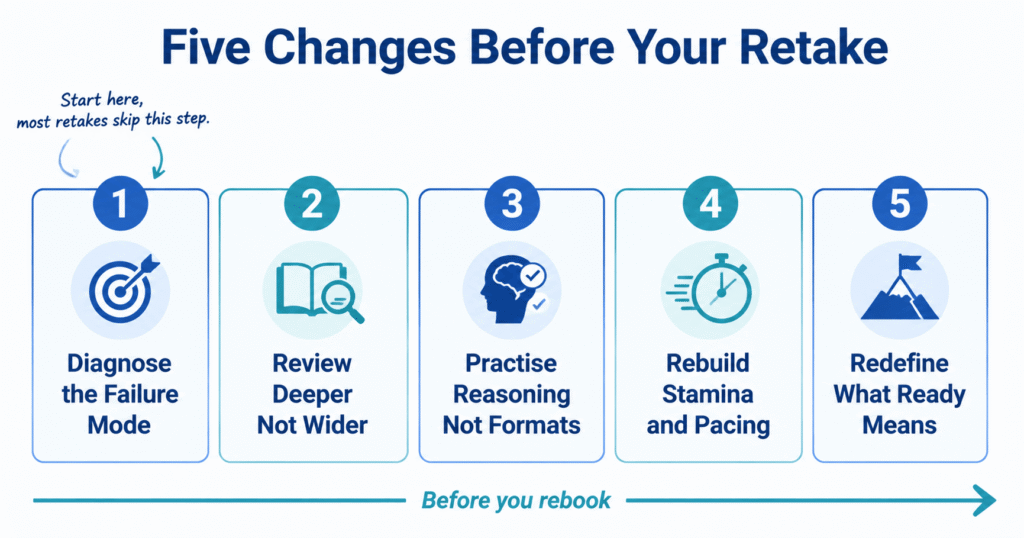
The 5 Changes to Make Before Your Next NCLEX Attempt
If you’re a repeat NCLEX test taker and you’re wondering where to start, remember these five things:
- Stop making excuses and make your NCLEX preparation a priority.
- Don’t be afraid to ask for qualified help.
- Learn the content instead of relying only on strategies.
- Limit yourself to trusted NCLEX resources.
- Commit focused, consistent time to studying.
That’s it.
You don’t need 15 question banks.
You don’t need to spend every waking hour studying.
And you don’t need to completely reinvent your life.
You need to figure out what wasn’t working, change it, and follow a plan consistently.
I know how frustrating being a repeat test taker can feel because I’ve been there too.
But your previous NCLEX result does not have to determine your next one.
Don’t just study more this time. Study differently.
— Dr. Zee
Frequently Asked Questions About Retaking the NCLEX
What should I do first after failing the NCLEX?
Review your previous preparation before immediately starting another study plan. Look at your Candidate Performance Report, identify content weaknesses, review why you’re missing practice questions, evaluate your study consistency, and determine whether your resources and strategies are actually helping you improve.
Should I change question banks after failing the NCLEX?
Not necessarily. Switching question banks doesn’t automatically solve the problem. Before changing resources, determine whether the issue is the question bank or how you’re using it. Thoroughly reviewing incorrect answers and identifying knowledge gaps can be more valuable than continually starting new question banks.
Is failing the NCLEX multiple times usually a content problem?
There isn’t one cause that applies to every repeat test taker. However, repeated attempts should prompt a careful evaluation of content knowledge along with test-taking strategy, prioritization, question interpretation, consistency, and study habits. If you frequently encounter concepts you simply don’t know while reviewing questions, content remediation should be part of your preparation.
How many NCLEX questions should I do per day?
There is no single number that guarantees success. The quality of your review matters. A smaller number of questions followed by detailed review of the content and reasoning behind each answer may be more useful than completing large numbers of questions without understanding your mistakes.
Do I need an NCLEX tutor after failing?
Not every repeat test taker needs tutoring, but individualized help can be useful when you cannot determine why you’re struggling or when you’ve had multiple unsuccessful attempts. The goal should be to identify your specific weaknesses and create a study plan based on them.
How long should I study before retaking the NCLEX?
The appropriate timeline depends on your individual performance, content knowledge, previous attempts, available study time, and areas requiring remediation. Rather than choosing a retest date solely based on the calendar, build a realistic study plan and evaluate whether your performance is improving before your next attempt.
What is the best way to study for the NCLEX after failing?
Start by determining why your previous preparation didn’t work. Strengthen weak content areas, use a limited number of reliable resources, practice NCLEX-style questions, carefully review your mistakes, follow a consistent study schedule, and seek qualified guidance when you need it.
Not Sure Where to Start?
If you’ve failed the NCLEX and aren’t sure whether you need more content review, a different study schedule, tutoring, better question strategy, or a completely new approach, we can help you figure out your next step.
Get started with NCLEX High Yield and build a study plan based on what you actually need—not just more studying.
