

NCLEX prep apps have become an essential component of modern nursing exam preparation — not as a replacement for a primary question bank or structured study sessions, but as the preparation layer that converts previously wasted time into productive clinical reasoning practice. Commute time, lunch breaks, time between shifts, and the twenty minutes before bed that previously disappeared from the preparation calendar become accessible study opportunities when a high-quality NCLEX prep app is on the phone in a candidate’s pocket.
The quality difference between NCLEX prep apps in 2026 is significant and matters more than it did before the Next Generation NCLEX launched. Apps that have not meaningfully updated their question pools to reflect NGN formats, that provide shallow rationale systems designed for a simpler exam, or that deliver question content at a cognitive level below what the current CAT algorithm targets are not just less helpful than better options — they are actively preparing candidates for an exam that no longer exists. A candidate who completes hundreds of questions on an app that does not reflect current exam difficulty and format is building false confidence alongside a pattern of clinical reasoning that the actual exam will not reward.
This guide evaluates the best NCLEX prep apps available in 2026 against the criteria that determine genuine preparation value: question quality and clinical authenticity, NGN format coverage, rationale depth, mobile-specific usability, offline access, analytics on mobile, and overall value relative to cost. For each app, it explains what the platform does best, where its limitations lie, and which candidate profile gets the most preparation benefit from it. It also covers how to integrate NCLEX prep apps into a complete preparation system rather than using them as a standalone study strategy.
What Separates High-Quality NCLEX Prep Apps From the Rest
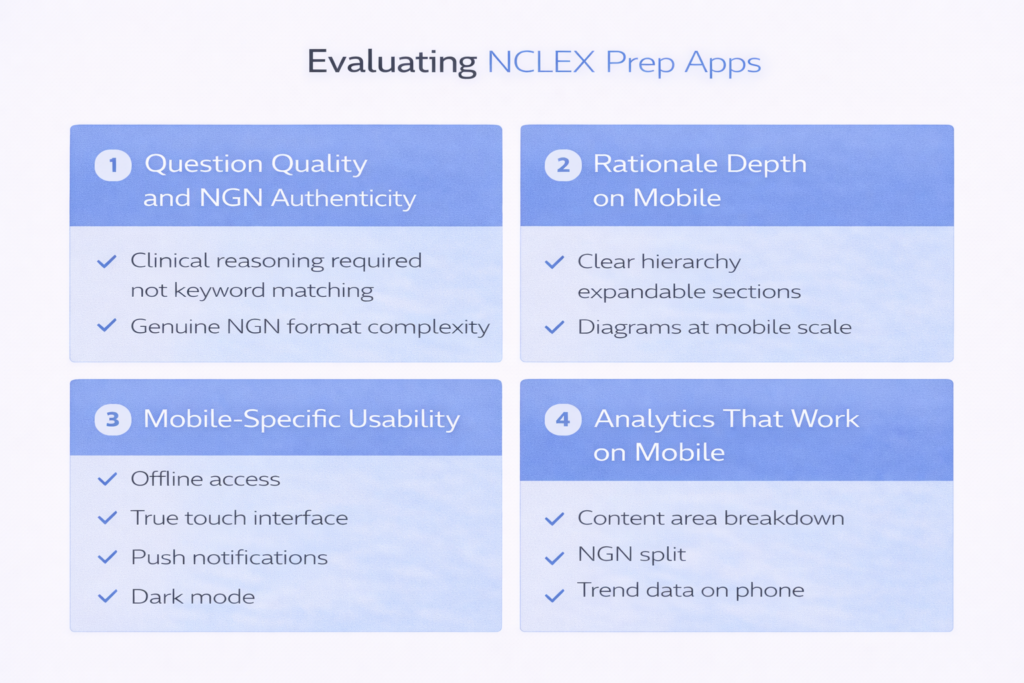
Not all NCLEX prep apps deliver equivalent preparation value, and the differences that matter most are not always visible from an app store listing. Understanding the criteria that define genuine mobile preparation quality makes every subsequent app comparison more useful.
Question Quality and NGN Authenticity
The most important quality criterion for any NCLEX prep apps platform in 2026 is whether its question content reflects the current exam — both in clinical reasoning complexity and in NGN format coverage. High-quality questions present realistic clinical scenarios requiring genuine clinical judgment, not keyword recognition or pattern matching. The distractors are constructed from real clinical misconceptions rather than obviously incorrect options. For NGN formats, authentic coverage means that unfolding case studies follow the CJMM six-skill sequence, that bow tie questions use the genuine three-section structure, and that extended multiple response items reflect the partial credit scoring mechanics of the actual exam. NCLEX prep apps whose questions can be answered by recognizing familiar content rather than reasoning through clinical complexity are producing false preparation confidence that collapses on exam day.
Rationale Depth on a Mobile Screen
Rationale quality in NCLEX prep apps faces the additional challenge of a mobile interface — explanation depth that would be appropriate in a desktop platform can become unreadable text walls on a phone screen, and apps that simply compress desktop rationales into mobile displays produce rationales that candidates skip rather than read. The best NCLEX prep apps are designed for mobile rationale reading: clear hierarchy between the correct answer explanation and incorrect option explanations, expandable sections that allow candidates to read at whatever depth the current study session supports, clinical illustrations and diagrams that render clearly at mobile scale, and a reading experience that does not require pinching and zooming to extract the clinical reasoning the rationale teaches. A mobile rationale system that candidates skip because of poor design is not improving clinical reasoning regardless of its content quality.
Mobile-Specific Usability Features
NCLEX prep apps that are truly designed for mobile study — rather than desktop platforms adapted for phone screens — provide specific features that make mobile preparation sessions productive rather than frustrating. Offline question access allows study to continue without Wi-Fi during commutes or in low-signal environments. True mobile-native question interfaces that respond naturally to touch navigation without lag or misregistration make question sessions feel fluid rather than effortful. Push notification systems that send daily question reminders or streak accountability alerts keep preparation habits consistent across a busy preparation period. Dark mode availability reduces eye fatigue during evening or early morning study sessions that make up a significant portion of mobile NCLEX prep app usage.
Analytics That Work on Mobile
Many question bank platforms provide granular desktop analytics but deliver a stripped-down analytics experience on mobile — basic accuracy percentages without the content area breakdown, trend data, and NGN versus traditional format splits that make analytics actionable. High-quality NCLEX prep apps provide the same analytics depth on mobile as on desktop, with interfaces designed for touch navigation that make it easy to review content area performance, identify weekly trends, and check NGN-specific accuracy without switching to a desktop device. Analytics that require a desktop login to access are not genuinely mobile analytics — they are desktop analytics with a mobile question delivery layer on top.
The Best NCLEX Prep Apps for 2026: Platform-by-Platform Analysis

The following platforms represent the highest-quality and most widely used NCLEX prep apps among nursing students preparing for the 2026 exam. Each analysis covers question quality, NGN coverage, rationale system, mobile usability, analytics, offline access, and the candidate profile that benefits most from each platform.
UWorld Nursing — Best Overall Mobile Experience
UWorld is the most widely used of all NCLEX prep apps and the platform most consistently credited by recent passers as their primary preparation resource. Its mobile app delivers the same clinical-grade question quality and comprehensive rationale system as its desktop platform — realistic clinical scenarios, distractors built from genuine clinical misconceptions, and option-level rationale explanations that teach the underlying clinical principle rather than simply confirming the correct selection. Pathophysiology diagrams and clinical illustrations render clearly at mobile scale and are integrated directly into rationale explanations rather than linked separately. NGN coverage is distributed throughout the question pool rather than segregated into a separate section, with all five NGN formats present at complexity levels that reflect the current exam. Mobile analytics include content area accuracy breakdown, NGN versus traditional format split, performance trending, and peer percentile comparison — all accessible without switching to desktop. The app supports offline question access after initial download. UWorld’s primary limitation as a mobile NCLEX prep app is cost — it is among the more expensive platforms in the category. For candidates who can afford one primary platform, UWorld delivers the strongest overall mobile preparation value.
Nurse Achieve — Best for NGN-Focused Mobile Study
Nurse Achieve was designed with explicit NGN alignment from the ground up, making its mobile app the strongest option for candidates whose primary preparation gap is NGN format competency. The platform includes robust unfolding case study sets — with six questions mapped to the six CJMM cognitive skills in sequence — authentic bow tie questions, extended multiple response with partial credit mechanics, and matrix items that accurately reflect the current exam format complexity. The mobile interface handles the structural complexity of NGN formats well — unfolding case studies render correctly across multiple question screens with the evolving clinical scenario clearly visible, and bow tie questions display the three-section structure in a mobile-native format that does not require horizontal scrolling or zooming. Rationale quality is solid for both NGN and traditional items. Analytics include separate NGN format performance tracking on mobile, which is the specific metric most candidates need to identify whether their NGN accuracy is lagging behind their traditional format performance. Nurse Achieve is priced below UWorld, making it a strong value choice for candidates who prioritize NGN coverage at a lower mobile app cost.
Kaplan NCLEX-RN Qbank — Best for Strategy Integration on Mobile
Kaplan’s mobile NCLEX prep apps experience stands apart through its integration of the Kaplan Decision Tree — a structured clinical reasoning framework for systematic answer elimination — directly into the question practice and rationale review interface. After each question, the decision tree is displayed alongside the rationale, reinforcing the strategic reasoning approach rather than only the content-based clinical principle. This integration is particularly valuable on mobile, where the visual decision tree provides a concrete reasoning scaffold that candidates can reference during rapid practice sessions without needing to recall the framework from memory. The Kaplan app includes a substantial question pool, adaptive delivery that adjusts difficulty based on performance, and NGN content that has improved significantly in recent updates. Analytics are accessible on mobile with content area breakdown and performance trending. Best-fit profile for this NCLEX prep app is candidates who have solid clinical knowledge but consistently struggle to translate that knowledge into correct answers under pressure — a reasoning pattern where the decision tree integration produces faster improvement than additional content exposure.
Archer Review — Best Value Mobile NCLEX Prep App
Archer Review has established a strong reputation as the highest-value option among NCLEX prep apps for candidates whose preparation budget is limited but who need a quality platform that goes beyond free resources. The mobile app delivers strong question quality — clinical scenarios are realistic, distractors reflect genuine clinical misconceptions, and rationales address the reasoning behind incorrect options with meaningful depth. NGN coverage has been updated for the current exam and includes all five NGN formats with authentic format complexity on mobile. Analytics include content area performance breakdown and performance trending accessible on the mobile interface. The app supports offline access for downloaded question sets. Archer’s interface is less polished than UWorld or Kaplan, and the question pool, while substantial, is smaller than the largest platforms. For candidates seeking a quality NCLEX prep app experience at a significantly lower price point than the premium platforms, Archer Review provides the strongest value-per-dollar preparation outcome.
Picmonic — Best for Visual Content Memorization on Mobile
Picmonic is a fundamentally different category of NCLEX prep apps from the question bank platforms above — it is a visual learning and memory consolidation tool rather than a clinical reasoning practice platform. Picmonic converts high-yield nursing content — drug classes, disease presentations, laboratory values, assessment findings — into illustrated visual stories with embedded audio mnemonics that leverage the picture superiority effect for memory consolidation. On mobile, the illustrated story format and audio component work naturally — candidates can review Picmonic content during commutes, between tasks, or in any environment where reading is inconvenient, using the audio component when visual attention is divided. Picmonic’s limitation as a NCLEX prep app is that it builds content knowledge for recognition rather than clinical reasoning for application — it consolidates what you know, not how you apply it. It is most effective when used alongside a primary question bank platform, with Picmonic mobile sessions dedicated to high-yield content memorization and the question bank platform dedicated to clinical reasoning practice.
SimpleNursing — Best for Concept Explanation on Mobile
SimpleNursing is a video-based NCLEX prep app built around simplified, accessible explanations of complex nursing content — pathophysiology, pharmacology, and clinical concepts explained in plain language with visual aids and memory techniques designed for candidates who find traditional textbook presentations difficult to retain. The mobile app provides access to a comprehensive video library organized by content area, with short-format videos (typically five to fifteen minutes) designed for mobile consumption during brief study windows. SimpleNursing includes a companion question bank but its primary value as a NCLEX prep apps platform is in its content explanation function rather than its question practice function. Best-fit profile is candidates who struggle with content comprehension in traditional formats, particularly for pharmacology and complex pathophysiology, who benefit from a simplified explanatory approach before moving to clinical scenario practice in their primary question bank platform.
Free NCLEX Prep Apps Worth Using in 2026
Not every high-value NCLEX prep apps resource requires a subscription. The following free options provide genuine preparation value when used correctly — not as replacements for a primary paid platform but as supplements that add specific preparation capabilities without additional cost.
Anki — Free Spaced Repetition for High-Yield Content
Anki is a free, open-source spaced repetition flashcard app that functions as one of the most powerful NCLEX prep apps in any candidate’s toolkit when used with well-constructed clinical scenario-level card decks. The mobile app is free on Android and available at a one-time purchase price on iOS. Anki’s algorithm schedules each flashcard for review at the optimal spaced retrieval interval — serving cards the candidate retrieved confidently less frequently and cards with retrieval difficulty more frequently — producing maximum long-term retention with minimum daily review time. The most effective use of Anki as a NCLEX prep app is creating cards from clinical principles identified during practice question rationale review: the front of the card states the clinical scenario prompt that produced the question, and the back states the clinical principle, correct reasoning chain, and the distractor type that exploits this principle. This transforms Anki from a generic memorization tool into a personalized clinical reasoning library built from the candidate’s own documented preparation gaps.
NCSBN Learning Extension Free Trial and Official NGN Samples
The NCSBN — the organization that writes and administers the NCLEX — provides official NGN sample questions through its website and Learning Extension platform. These are the only definitively accurate representations of NGN question format and complexity available from any source, and accessing them through mobile browsers or the Learning Extension mobile interface costs nothing beyond the Learning Extension’s own pricing for additional content. The official NGN samples should be completed on mobile or desktop at the beginning of any preparation period to establish the correct mental model for each NGN format before engaging any third-party NCLEX prep app’s NGN content. Return to them in the final week before the exam as a calibration check confirming that the candidate’s NGN reasoning aligns with the authoritative standard.
RegisteredNurseRN and YouTube Content
Several nursing educators provide high-quality free NCLEX content through YouTube channels and companion websites that are fully accessible on mobile — including RegisteredNurseRN and Nursing School of Success, which offer structured video content covering high-yield NCLEX topics with clinical reasoning frameworks embedded in the explanations. These free video resources function similarly to SimpleNursing as content explanation tools rather than clinical reasoning practice platforms, and their best use as mobile NCLEX prep app supplements is in brief concept review sessions during commutes or breaks when a full practice question session is not practical. The limitation of free video content as a preparation resource is the same as all passive video consumption — value is only realized when followed by active recall practice rather than treated as standalone preparation.
How to Integrate NCLEX Prep Apps Into a Complete Study System
The most important principle in NCLEX prep apps use is that mobile apps are a preparation supplement layer — not a primary preparation system. Candidates who rely exclusively on mobile app question sessions without a primary desktop question bank, structured study schedule, or active recall content review are building clinical reasoning practice on an incomplete foundation. The following integration framework positions mobile apps correctly within a complete preparation system.
The Mobile Study Session vs. the Primary Session
The clearest way to think about NCLEX prep apps is as a secondary question bank that serves a specific preparation function: converting fragmented, previously unusable time windows into productive clinical reasoning practice. Mobile app sessions are most valuable in windows of ten to thirty minutes — commute time, lunch breaks, waiting room time — where a complete primary desktop session is not feasible. They are not substitutes for the daily primary question bank session, which should occur on desktop with full rationale review, error logging, and analytics analysis at the 1:1 time ratio. A candidate who completes 30 to 50 questions on a NCLEX prep app during daily fragmented time in addition to their primary desktop session of 50 to 75 questions adds meaningful preparation volume without displacing the quality and depth of the primary session.
Mobile for Content Consolidation, Desktop for Reasoning Development
A useful functional split for NCLEX prep apps integration distinguishes content consolidation — which happens well on mobile through Anki spaced retrieval, Picmonic visual mnemonics, and brief video concept review — from clinical reasoning development, which requires the depth and reflection time that desktop sessions with full rationale review provide. Morning commute: Anki review of previously studied clinical principles. Lunch break: 20 questions on the primary mobile question bank app with brief rationale check. Evening: primary desktop session with full rationale review, error logging, and analytics analysis. This split makes mobile time consistently productive while protecting the depth and analytical focus that the primary desktop session provides.
Using Push Notifications for Habit Consistency
One of the most underused features of NCLEX prep apps is the push notification system — daily question reminders, streak alerts, and study goal progress notifications that create behavioral consistency across a multi-week preparation period. Preparation consistency is the variable most directly within a candidate’s control, and the days that fragmented time passes unused without any preparation activity are the days that compound over a preparation period into significant lost preparation volume. Setting a daily push notification from the primary mobile app at the specific time of the most consistently available fragmented study window — the 7:15 AM commute, the 12:30 PM lunch break — converts an ambient intention into a concrete behavioral trigger. Over a six-week preparation period, consistent mobile sessions of 20 to 30 questions per day in fragmented time add 840 to 1,260 additional practice questions to the preparation total — a meaningful supplement to the primary desktop question volume.
Avoiding Common Mobile Study Mistakes
- Skipping rationales on mobile: The most consequential misuse of NCLEX prep apps is answering questions without reading rationales — a temptation amplified on mobile where the next question is one swipe away. Every question is only complete after the rationale has been read, including the explanations for incorrect options. Set a personal rule before each mobile session: no next question until the rationale is fully read.
- Using mobile apps as the only preparation resource: NCLEX prep apps supplement primary desktop preparation — they do not replace it. Candidates who rely on mobile sessions as their sole preparation activity are not completing the depth of rationale review, error logging, or analytics analysis that the primary session provides. Mobile apps convert fragmented time into productive practice; they do not convert fragmented time into complete preparation.
- Selecting apps based on question quantity alone: A large question pool on a NCLEX prep app is only valuable if the questions are at the correct cognitive level and the rationale system is deep enough to produce clinical reasoning development. An app with 5,000 knowledge-level questions provides less preparation value than one with 2,000 application-level questions with comprehensive option-level rationales.
- Treating mobile sessions as passive consumption: Even on mobile, the pre-answer generation habit — reading the stem, generating your own answer before reading options — applies and produces stronger clinical reasoning development than scanning the options and selecting the most familiar one. The cognitive effort of generating before selecting is what builds the reasoning habit the exam rewards.
Choosing the Right NCLEX Prep App for Your Preparation Profile
The best NCLEX prep app is the one that fits your specific preparation profile, budget, and the role mobile study plays in your overall preparation system. The following matching framework maps candidate situations to the most appropriate app combination.
For the Candidate Who Needs One Primary App
Candidates looking for a single primary NCLEX prep app that can serve both desktop and mobile preparation with the same question quality, rationale depth, and analytics should choose UWorld. Its mobile experience is the closest to its desktop experience of any platform in the category, its analytics are equally granular on mobile, and its question quality and NGN coverage are the strongest available across both platforms. The cost is higher than alternatives, but for a candidate who will use one platform deeply across a six-week preparation period, UWorld’s preparation value justifies the investment relative to a lower-cost app that does not match its clinical reasoning development quality.
For the Candidate Who Prioritizes NGN Coverage
Candidates whose diagnostic assessment or CPR shows specific weakness in NGN formats — who need targeted NGN practice on mobile to close a performance gap that traditional question bank sessions have not addressed — should add Nurse Achieve as either a primary or secondary NCLEX prep app. Its NGN coverage is the most authentic and comprehensive available on mobile, its NGN analytics are separately tracked, and its price point is lower than UWorld, making it a viable primary app for budget-conscious candidates or an excellent secondary app for candidates using UWorld as their desktop primary.
For the Budget-Conscious Candidate
Candidates who need a quality paid NCLEX prep app at the lowest cost should use Archer Review as the primary paid platform alongside Anki for free spaced retrieval review and the NCSBN official NGN samples for format calibration. This combination provides a complete mobile preparation supplement layer — quality clinical scenario practice in Archer, high-yield content consolidation in Anki, and official NGN calibration from the NCSBN — at a total cost significantly below the premium platform alternatives. The preparation value of this combination, used consistently and with full rationale engagement, is competitive with more expensive single-platform options.
For the Visual or Auditory Learner
Candidates who retain clinical content most effectively through visual and auditory instruction should build a mobile preparation stack that includes Picmonic for content memorization, SimpleNursing for concept explanation, and Anki for spaced retrieval consolidation of the content both platforms teach — with a primary question bank app (UWorld or Archer) handling clinical scenario practice. Picmonic and SimpleNursing are not clinical reasoning practice tools; they are content learning tools. Their value as NCLEX prep apps is in preparing the content knowledge that clinical reasoning practice then applies — not in replacing that practice.
Conclusion
NCLEX prep apps in 2026 range from genuinely powerful clinical reasoning development tools to low-quality question collections that produce false preparation confidence. The difference lies in question clinical authenticity, NGN format coverage, rationale depth at mobile scale, analytics accessibility on a phone screen, and offline access for study continuity. UWorld delivers the strongest overall mobile preparation experience for candidates who can afford one premium platform. Nurse Achieve delivers the strongest NGN-specific mobile coverage for candidates with NGN performance gaps. Archer Review delivers the strongest value for budget-conscious candidates. Anki and the NCSBN official NGN samples deliver genuine preparation value at no cost when integrated correctly.
The most important principle in NCLEX prep apps use is that mobile study supplements primary desktop preparation rather than replacing it — converting fragmented, previously unusable time into productive clinical reasoning practice. Thirty questions per day in previously wasted time, reviewed with discipline and full rationale engagement, adds over a thousand questions to a six-week preparation period without displacing any primary session time. That is the value NCLEX prep apps are designed to deliver — and it is a meaningful, measurable contribution to readiness when the apps are chosen well and used correctly.
