

The difference between NCLEX prep that produces consistent clinical reasoning improvement and NCLEX prep that produces accumulated frustration is not primarily a question of resources, study hours, or content coverage. It is a question of how each incorrect answer, each difficult question, and each below-standard practice session is interpreted — and what the candidate does immediately after that interpretation. Two candidates can encounter identical practice session results: the same accuracy percentage, the same content category weaknesses, the same incorrect answer on the same pharmacology scenario. One candidate interprets the incorrect answer as evidence of their inadequacy for nursing and responds by studying the same content again with increasing anxiety. The other interprets the identical incorrect answer as a specific, correctable gap in their clinical reasoning and responds by extracting the precise clinical principle the rationale teaches and building it into a targeted correction practice. Six weeks later, their preparation outcomes are measurably different — not because their resources were different but because their relationship to failure was.
Growth mindset — the belief that abilities, intelligence, and clinical reasoning competency are developable through effort and strategy rather than fixed at birth — is not a soft motivational concept in NCLEX prep. It is a practical clinical reasoning development orientation with specific behavioral implications that determine whether the most valuable preparation events — the incorrect answers, the difficult questions, the below-standard practice sessions — are converted into clinical reasoning improvement or into preparation anxiety that accumulates without improving the outcome it generates. The nursing candidates who pass the NCLEX are not the ones who never make errors during preparation. They are the ones whose errors teach them something specific every time they occur.
This guide translates growth mindset from an abstract psychological concept into specific, actionable NCLEX prep behaviors: how passing nurses interpret incorrect answers, how they respond to below-standard practice sessions, how they maintain consistent preparation engagement despite the inherent frustration of the preparation process, how they use failure as a diagnostic instrument rather than as a performance verdict, and how to deliberately build growth mindset behaviors into the preparation approach from week one rather than attempting to adopt them after weeks of fixed mindset patterns have become entrenched.
Fixed Mindset vs. Growth Mindset in NCLEX Prep
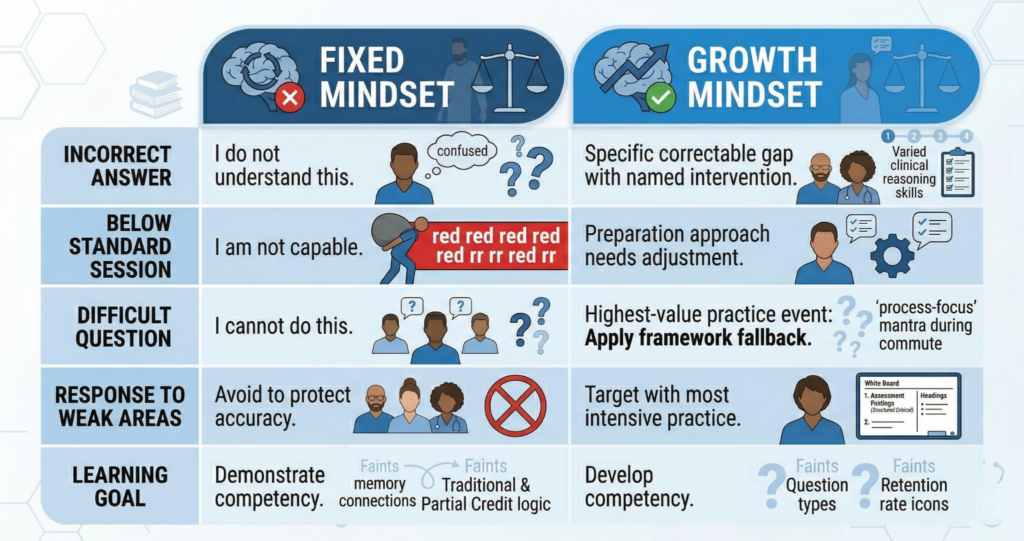
The fixed mindset and growth mindset orientations produce different behavioral responses to the same preparation experiences — and those behavioral differences compound across six weeks of NCLEX prep into significantly different preparation outcomes.
How Fixed Mindset Operates in NCLEX Prep
The fixed mindset in NCLEX prep interprets performance events as revealing fixed ability rather than current development status. An incorrect answer means I do not understand cardiovascular nursing rather than I have not yet developed the specific clinical reasoning application that this question tests. A below-standard practice session means I am not smart enough for this exam rather than my current preparation approach is not producing the improvement this content area needs. A difficult question that resists reasoning means I was not meant to be a nurse rather than this question type needs targeted correction practice that I have not yet applied. The fixed mindset response to difficulty is to avoid the areas where difficulty appears, to interpret difficulty as revealing a permanent ceiling, and to seek evidence of performance rather than evidence of learning. In NCLEX prep specifically, the fixed mindset produces a characteristic preparation pattern: studying the content areas where practice sessions feel productive and accurate while systematically avoiding the content areas where sessions produce high error rates — which is precisely the pattern that maintains preparation gaps rather than closing them.
How Growth Mindset Operates in NCLEX Prep
The growth mindset in NCLEX prep interprets performance events as providing diagnostic information about the current state of clinical reasoning development rather than as measuring a fixed underlying ability. An incorrect answer is a specific data point that reveals a gap with a specific correction available. A below-standard practice session is a signal that either the preparation approach or the content allocation needs adjustment. A difficult question that resists reasoning is an opportunity to practice the framework fallback that the exam will require on questions exactly like this one. The growth mindset response to difficulty is to engage it rather than avoid it, to extract the maximum diagnostic information from each failure, and to treat the correction of identified errors as the primary preparation activity rather than as a supplementary review. In NCLEX prep, the growth mindset produces the opposite of the fixed mindset pattern: the most below-standard content areas receive the most intensive preparation attention, difficult questions are welcomed as the highest-value practice events, and each incorrect answer is mined for the specific clinical reasoning improvement it enables.
The Practical Gap Between Mindsets
The practical gap between fixed and growth mindset NCLEX prep compounds dramatically across a full preparation period. A fixed mindset candidate who encounters a difficult pharmacology question, experiences the frustration of not knowing the correct answer, and moves quickly through the rationale to reach the next question has spent 90 seconds on the highest-value learning event of the session and extracted almost none of its preparation value. A growth mindset candidate who encounters the same question, applies the four-question rationale protocol, identifies the specific clinical principle the question tested, classifies the error type, creates an Anki card with the clinical reasoning chain, and notes the pattern in the reasoning error log has spent five minutes on the same event and extracted a preparation asset that will be consolidated through spaced repetition across the remaining weeks of NCLEX prep. Multiply this difference by 200 incorrect answers across a six-week preparation period, and the cumulative preparation value difference between the two orientations is the difference between a flat accuracy trend and a consistently improving one.
How Passing Nurses Think About Incorrect Answers

The single greatest behavioral differentiator between NCLEX prep approaches that produce consistent improvement and those that produce flat accuracy trends is what happens in the five minutes after an incorrect answer is identified. This moment — the response to failure — is where growth mindset manifests most tangibly in preparation behavior.
The Diagnostic Framing of Every Incorrect Answer
Nurses who pass the NCLEX during NCLEX prep treat every incorrect answer as a diagnostic event rather than as a performance verdict. The diagnostic question is not why did I get this wrong in general terms — the diagnostic question is specifically what type of clinical reasoning failure produced this selection. Was clinical knowledge absent from the accessible knowledge base (knowledge gap)? Was correct clinical knowledge present but misapplied to the specific patient in this scenario (patient context error)? Was the nursing process step the question required misidentified, leading to the selection of an action appropriate at a different clinical moment (nursing process error)? Was the priority framework applied to the wrong clinical context — psychosocial before physiological, or Maslow when an ABC emergency was present (priority framework error)? Each error type has a specific, targeted correction. Treating the incorrect answer as diagnostic rather than as a verdict activates the specific correction rather than the general additional studying that fixed mindset produces.
The Two-Minute Error Response Protocol
The two-minute error response protocol is the behavioral implementation of growth mindset in NCLEX prep rationale review. Within two minutes of identifying an incorrect answer, complete four steps. Step one: name the error type using the four-category framework rather than any evaluative language. Step two: state the specific clinical principle the correct answer teaches — the mechanism or reasoning chain that would have produced the correct selection. Step three: write the Anki card from the clinical scenario — the patient situation as the front, the three-component clinical reasoning chain as the back. Step four: record the error type in the reasoning error log. This protocol takes two minutes per incorrect answer and converts each failure into four preparation assets simultaneously: a classified error (for pattern analysis), a named clinical principle (for direct learning), a spaced repetition card (for consolidation), and a log entry (for cross-session pattern identification). The two-minute investment is the highest return preparation activity per minute available in any NCLEX prep session — and it is only available when incorrect answers are treated as diagnostic events rather than as performance failures to be moved past quickly.
The Error Log as a Learning Asset
The reasoning error log is the most direct manifestation of growth mindset in NCLEX prep — a document that treats every clinical reasoning failure as information worth recording, analyzing, and acting on rather than as a performance outcome worth forgetting. The error log converts the naturally negative experience of incorrect answers into a structured learning asset that becomes more valuable over time rather than more demoralizing. A candidate three weeks into NCLEX prep who reviews their error log and notices that nursing process errors — specifically, implementation selected when assessment was required — account for 11 of the previous 20 incorrect answers has obtained preparation intelligence that no content review session and no practice question volume can provide. They have identified a systematic reasoning pattern that, once corrected, will close a preparation gap affecting 55 percent of their recent incorrect answers. That identification was only possible because each incorrect answer was treated as diagnostic information rather than as a failure event to be minimized and moved past.
How Growth Mindset Transforms the Response to Difficult Questions
NCLEX prep delivers difficult questions throughout the preparation period — and a candidate’s consistent response to those questions determines whether they become clinical reasoning development events or confidence-eroding experiences that accumulate without contributing to preparation.
Redefining What a Hard Question Is
The growth mindset in NCLEX prep redefines difficult questions as the highest-value events in the preparation system rather than as the most threatening ones. A question that produces genuine reasoning uncertainty — where two options appear equally defensible and the clinical discrimination between them requires precise framework application — is testing the exact clinical judgment the exam measures. A question where the correct answer is immediately obvious after a single reading is testing a clinical principle that is already consolidated. The difficult question — the one that resists immediate resolution, that requires the framework fallback, that ends in a committed answer with some remaining uncertainty — is the question that produces the most clinical reasoning development per minute of engagement, regardless of whether the committed answer is ultimately correct. Fixed mindset NCLEX prep dreads difficult questions because they reveal potential inadequacy. Growth mindset NCLEX prep seeks them because they reveal the upper boundary of current clinical reasoning competency and provide the highest-value correction opportunity when the committed answer is incorrect.
The Productive Struggle Orientation
The productive struggle orientation is the specific growth mindset attitude toward the cognitive discomfort of genuinely difficult questions during NCLEX prep. When a question resists reasoning — when both the five-second reset and the framework fallback have been applied and genuine uncertainty remains — the productive struggle orientation interprets this as the exact cognitive challenge that builds clinical reasoning capacity rather than as evidence that the candidate cannot handle the exam. Cognitive struggle during NCLEX prep is the signal that the preparation system is operating at the candidate’s developmental edge — the zone where new clinical reasoning capacity is being built because the demand exceeds the currently automatic and requires effortful application of frameworks and principles. Questions that are too easy never build new capacity because no new cognitive demand is generated. Questions that are too hard never build capacity because the failure mode produces frustration without productive engagement. Questions at the productive struggle level build the most clinical reasoning capacity per session — and recognizing them as such, rather than as threats, converts the cognitive discomfort they produce from a preparation obstacle into a preparation signal.
The After-Action Review for Difficult Questions
The after-action review is a growth mindset NCLEX prep practice applied specifically to the questions that felt most difficult during a practice session — the questions where genuine uncertainty persisted through the committed answer. For each of these questions, regardless of whether the committed answer was correct or incorrect, conduct a three-part review after the session. First, reconstruct the reasoning process: what data in the stem was identified, which framework was applied, how the option evaluation proceeded, what produced the committed answer. Second, compare the reconstructed reasoning to the rationale’s reasoning: where did the processes diverge, and what clinical principle or framework application explains the divergence? Third, identify what the question would have required to be answered with less uncertainty: a stronger grasp of a specific clinical principle, a more automatic framework application, a more careful stem data extraction. This after-action review converts difficult questions into the most specific clinical reasoning improvement data available in any NCLEX prep session — but only when the growth mindset orientation treats them as learning events rather than as performance threats to be evaluated and moved past.
Maintaining Preparation Engagement Through the Frustration Arc
NCLEX prep has a predictable frustration arc — a period, typically between weeks two and four, where the volume of discovered gaps feels overwhelming, accuracy improvement feels stalled despite intensive effort, and the preparation motivation that felt natural in week one requires deliberate maintenance to sustain. Growth mindset navigation of this arc is what separates candidates who complete their preparation with increasing clinical reasoning competency from those who burn out or disengage at the arc’s most demanding point.
The Gap Discovery Paradox
The gap discovery paradox is one of the most important growth mindset principles for NCLEX prep: the number of clinical reasoning gaps a candidate can identify increases as their clinical reasoning competency improves — not as it declines. In week one of NCLEX prep, a candidate with genuinely low clinical reasoning competency may complete a 50-question session and identify five incorrect answers across three content categories. In week three, the same candidate with meaningfully improved clinical reasoning competency may complete an equivalent session and identify nine incorrect answers across five content categories — not because they have gotten worse but because their clinical reasoning is now operating at a level that makes previously invisible gaps visible. The preparation experience of discovering more gaps in week three than in week one feels like regression. It is actually progression. The growth mindset in NCLEX prep recognizes this paradox explicitly and uses it to reinterpret the week three frustration experience: the increasing gap visibility is evidence that the clinical reasoning development process is working, not evidence that it is failing.
Process Goals vs. Outcome Goals During Preparation
The most effective NCLEX prep motivation structure during the frustration arc is process goals rather than outcome goals. Outcome goals — passing the exam, achieving 65 percent accuracy by week four, completing 3,000 questions — are all-or-nothing measurements that produce anxiety when they are not met and fragile satisfaction when they are. Process goals — completing the four-question rationale protocol for every incorrect answer in today’s session, applying the physiological scan before reading every option in tomorrow’s session, creating five Anki cards from today’s rationale review — are achievable within each individual session regardless of the accuracy percentage the session produces. A candidate who did not meet their outcome accuracy target this week but completed the rationale protocol for every incorrect answer, applied the physiological scan consistently, and created five Anki cards has had a successful growth mindset NCLEX prep week regardless of the accuracy number. The process goals were met. The clinical reasoning development that meeting them produces will appear in the accuracy trend within two to three weeks — because process quality precedes outcome quality, and the growth mindset candidate invests in process quality rather than measuring outcome quality before the process has had time to produce it.
The Preparation Progress Recalibration
The preparation progress recalibration is a growth mindset NCLEX prep practice applied when the frustration arc feels most acute — when continued intensive effort is not producing the accuracy improvement the candidate expects and the temptation to abandon the systematic approach in favor of intensive cramming is strongest. The recalibration asks three questions. First, is the accuracy trend genuinely flat, or does it only feel flat because recent weeks produced smaller improvements than earlier weeks? Graph the actual weekly accuracy numbers rather than relying on the impression of them — the growth mindset requires data rather than feelings as the assessment instrument. Second, is the question volume sufficient to generate reliable trend data — fewer than 25 questions per week in a targeted area produces accuracy measurements with too much variance to distinguish genuine improvement from random session variation? Third, are the process goals being met — full rationale review, error log maintenance, Anki card creation — or has the frustration arc produced a drift toward volume without quality? Most apparent accuracy plateaus that feel like preparation failure during NCLEX prep are explained by one of these three factors, each of which has a specific correction that the growth mindset deploys rather than the global failure interpretation that the fixed mindset produces.
Applying Growth Mindset to a Failed NCLEX Attempt
Growth mindset in NCLEX prep is most consequential — and most tested — when the exam result is not passing. The response to a failed attempt determines whether the candidate returns to preparation with a more targeted, more informed, and more effective approach or whether the experience produces a fixed mindset spiral that makes the second attempt harder rather than better-prepared.
The CPR as a Diagnostic Document, Not a Verdict
The Candidate Performance Report issued to candidates who do not pass the NCLEX is the most valuable diagnostic document available for NCLEX prep planning — and the growth mindset orientation is required to use it that way rather than as a failure verdict. The CPR categorizes performance in each content category as near passing standard, above passing standard, or below passing standard based on actual exam performance. Read through a growth mindset lens, the CPR answers the most important preparation question for the second attempt: which specific content areas fell below the passing standard on the actual exam, measured against the actual exam’s difficulty and format, with the actual candidate’s clinical reasoning under actual exam conditions? This is more specific, more accurate, and more actionable preparation intelligence than any diagnostic practice assessment can produce — because it reflects actual exam performance rather than a third-party approximation of it. Growth mindset NCLEX prep for a second attempt begins with the CPR as the preparation prescription, not as an evaluation of inherent nursing competency.
The Structural Change Imperative
Growth mindset in NCLEX prep for a second attempt requires applying the most important growth mindset principle to the failed attempt itself: the same approach that produced a not-passing result will not produce a passing result if repeated without change. A fixed mindset second attempt studies harder using the same approach — more hours of the same content review, more questions from the same question bank, more weeks of the same preparation behaviors. A growth mindset second attempt analyzes what was different about the preparation approach that preceded the failed attempt — what was the dominant error type in the CPR below-standard categories, did the preparation address reasoning gaps or knowledge gaps with the correct intervention for each, was NGN format practice sufficient, was the preparation sustainable or did burnout impair the final preparation weeks — and makes structural changes to address each identified limitation. The growth mindset second attempt is not a harder version of the first attempt’s preparation; it is a specifically different version, designed from the CPR findings and the preparation approach analysis.
The Failed Attempt as Preparation Intelligence
The most radical and most functionally useful growth mindset reframe for a failed NCLEX attempt is treating it as the most specific and most accurate preparation intelligence available for the second attempt — more specific than any diagnostic assessment, more accurate than any practice performance trend, and more informative about the precise clinical reasoning gaps that need to be closed than any preparation period without actual exam feedback. The candidate who approaches the second attempt having sat the actual NCLEX — having encountered actual exam questions at the actual difficulty level, having experienced the actual exam’s cognitive and emotional demands, and having received the CPR’s direct evidence of which content areas fell below the passing standard — is in a fundamentally stronger preparation position than a first-attempt candidate who is preparing from diagnostic assessments alone. This is not denial of the cost of a failed attempt — the 45-day wait, the retesting fees, and the psychological impact are real. It is an accurate accounting of the preparation asset that the failed attempt represents when processed through growth mindset rather than fixed mindset. Every nurse who passed the NCLEX on a second or third attempt passed because they used the failed attempt as the preparation intelligence it is.
- The growth mindset self-talk shift: Replace evaluative language with diagnostic language in every preparation self-description. Not ‘I am bad at pharmacology’ but ‘pharmacology is a current gap that targeted practice is closing.’ Not ‘I always make prioritization errors’ but ‘prioritization is my most frequent error type and my correction practice is reducing its frequency.’ Not ‘I am not smart enough for this exam’ but ‘my current preparation approach is producing X result and these specific changes will improve it.’ Each language shift is small; the cumulative effect across six weeks of NCLEX prep is a preparation identity built on development rather than on fixed capacity.
- The effort-strategy distinction: Growth mindset is not the belief that effort alone produces improvement — it is the belief that effort combined with the right strategy produces improvement. A candidate who works harder on the same ineffective approach is applying effort without strategy, which produces fatigue rather than development. The growth mindset NCLEX prep question is not ‘am I working hard enough’ but ‘is my current strategy the right one for the specific gap I am trying to close?’ Effort directed by the wrong strategy produces burnout. Effort directed by the correct strategy — identified through systematic error analysis and gap type classification — produces measurable clinical reasoning improvement.
- The community of growth: Surrounding the NCLEX prep experience with peers who share the growth mindset orientation — who discuss preparation as a developmental challenge rather than as a performance evaluation, who treat each other’s incorrect answers as learning opportunities rather than as evidence of inadequacy, and who support each other through the frustration arc with accurate information rather than with social comparison — is a preparation environment decision. The preparation community a candidate chooses shapes the mindset that the preparation produces.
Conclusion
Growth mindset in NCLEX prep is not a motivational framework applied on top of preparation strategy — it is the cognitive orientation that determines whether preparation strategy is effective. The same practice question session, the same rationale review protocol, the same targeted content correction practice produces different clinical reasoning development outcomes depending on whether incorrect answers are treated as diagnostic events or as performance verdicts, whether difficult questions are approached as highest-value practice opportunities or as threatening evidence of inadequacy, whether the frustration arc is navigated with process goal focus or abandoned in favor of fixed mindset cramming, and whether a failed attempt is processed as the most specific preparation intelligence available or as a fixed measure of nursing competency.
The nurses who pass the NCLEX think about failure differently — not because they are more resilient as a personality trait but because they have adopted a specific, practical orientation toward the clinical reasoning development process that the NCLEX prep experience provides. Every incorrect answer teaches something specific. Every difficult question practices a skill the exam measures. Every below-standard session identifies a gap with a targeted correction. Every failed attempt, if it happens, provides the most accurate clinical reasoning gap data available and the most motivated second-attempt preparation foundation. Build this orientation from week one. Apply the two-minute error response protocol. Maintain the mastery moments log. Navigate the frustration arc with process goals. And treat every moment of genuine clinical reasoning struggle as the evidence that development is occurring — which is the only thing that makes passing possible.
