

NCLEX test anxiety is real, it is common, and if left unaddressed it can undermine months of hard preparation in a matter of hours. Many nursing students who are academically ready to pass the NCLEX find that fear, self-doubt, and panic responses on exam day prevent them from thinking clearly and accessing the knowledge they have worked so hard to build.
According to research in nursing education, test anxiety affects a significant proportion of NCLEX candidates and is associated with poorer performance outcomes even among students who demonstrate strong clinical knowledge during their preparation. The problem is not a lack of knowledge — it is the interference that anxiety creates between what you know and what you are able to demonstrate under pressure.
This guide addresses NCLEX test anxiety directly and practically. It covers what test anxiety actually is, why nursing students are particularly vulnerable to it, and the specific evidence-based strategies you can start using today to manage it — before, during, and after your exam. By exam day, the goal is not to eliminate all nervousness but to transform anxiety from something that blocks your thinking into something you can work through with confidence.
What NCLEX Test Anxiety Is and Why It Happens
NCLEX test anxiety is a psychological and physiological stress response triggered by the high-stakes nature of the licensing exam. It goes beyond ordinary nervousness before a test. When anxiety reaches a level that impairs cognitive function — making it difficult to concentrate, recall information, or reason through complex questions — it has crossed from healthy alertness into something that actively works against you.
The NCLEX is uniquely anxiety-provoking for several reasons. It is a high-stakes, one-time event with significant consequences for your career and identity as a nurse. The computer adaptive format means the difficulty of questions adjusts to your performance, which many students misinterpret as a signal that they are doing poorly. The exam can end anywhere between 75 and 145 questions for the NCLEX-RN, creating ongoing uncertainty about how you are performing throughout the test. These features combine to create an environment that is unusually fertile for test anxiety to take hold.
The Physical and Cognitive Symptoms of NCLEX Test Anxiety
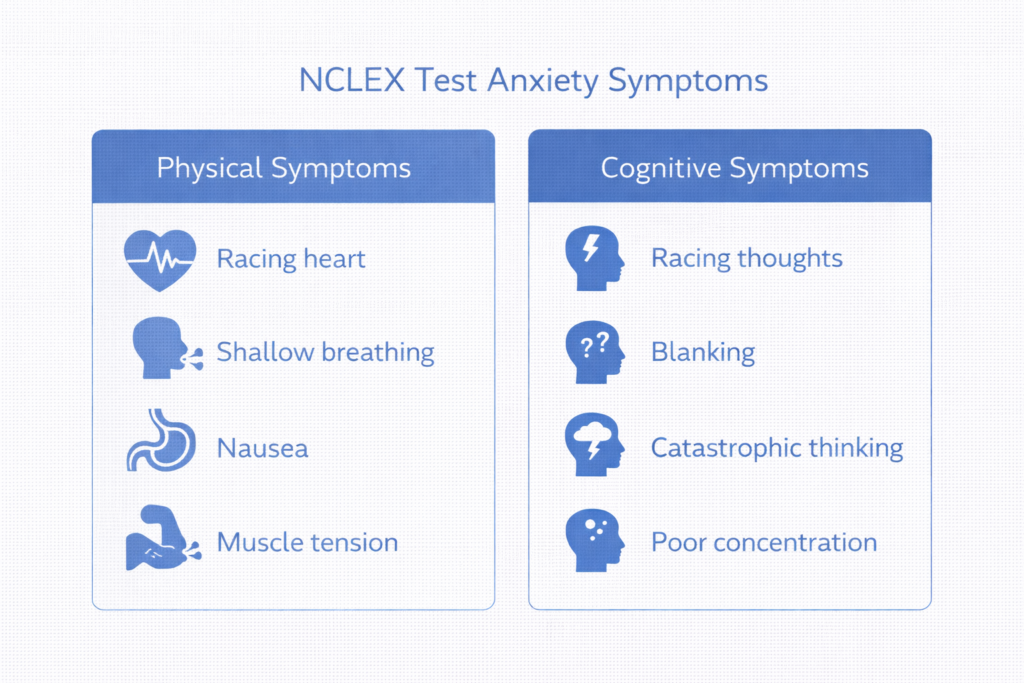
NCLEX test anxiety manifests in two overlapping ways. Physically, it can produce a racing heart, shallow breathing, sweating, nausea, muscle tension, and headaches. These are symptoms of the body’s fight-or-flight response, which diverts resources away from the prefrontal cortex — the part of the brain responsible for reasoning, decision-making, and memory retrieval. Cognitively, NCLEX test anxiety presents as racing thoughts, difficulty concentrating, blanking on material you know well, catastrophic thinking, and the inability to evaluate answer choices systematically. Recognizing these symptoms as anxiety responses — rather than evidence that you are failing — is the first step toward managing them effectively.
Who Is Most Vulnerable to NCLEX Test Anxiety
While any nursing student can experience NCLEX test anxiety, certain patterns increase vulnerability. Students who are perfectionists, who tie their self-worth closely to their exam performance, or who have a history of test anxiety in nursing school are at higher risk. Students who have previously attempted the NCLEX and not passed often carry a significant additional layer of anxiety about the repeat attempt. Understanding your own anxiety patterns honestly — without judgment — is a prerequisite for addressing them effectively.
How to Reduce NCLEX Test Anxiety During Your Preparation
The most powerful antidote to NCLEX test anxiety is not relaxation techniques alone — it is confident, well-organized preparation. When you trust your knowledge and your readiness, there is far less space for anxiety to fill. But the way you study matters as much as how much you study.
Simulate Exam Conditions Consistently
One of the most effective ways to reduce NCLEX test anxiety on exam day is to make the testing experience feel familiar before you ever sit in the testing center. Practice under timed, simulated exam conditions regularly during your preparation. Set a timer, work through blocks of 75 questions without pausing, and avoid using notes or references during practice sessions. The more your brain associates the testing format with a familiar, manageable experience, the less novel and threatening the actual exam day feels.
Focus on Progress, Not Perfection
Many students fuel their NCLEX test anxiety inadvertently by measuring their preparation only against perfect performance. Getting questions wrong during practice is not a failure — it is the mechanism through which learning happens. Shift your focus from the score on each practice session to the quality of your review afterward. Are you understanding why the correct answer is correct? Are you building reasoning patterns? That kind of progress is far more predictive of exam day performance than a high percentage score on a single practice test.
Establish a Structured Study Schedule and Stick to It
Anxiety thrives in uncertainty. A clear, realistic study schedule eliminates the low-grade anxiety that comes from not knowing whether you are covering the right material, covering it in time, or covering enough of it. Assign specific content areas to specific days, build in regular review days, and include planned rest. When you can look at your calendar and see that the material is covered, one significant source of anxiety loses its grip.
Limit Exposure to Other Students’ Anxiety
The week before the NCLEX is not the time to compare study progress with classmates, participate in group anxiety spirals, or read NCLEX forums filled with horror stories. Other people’s anxiety is contagious, and it is rarely useful. Protect your mental space in the final days before your exam by spending time on calm, focused review rather than social comparison.

Proven Techniques to Manage NCLEX Test Anxiety on Exam Day
Even with strong preparation, exam day brings its own intensity. Having a toolkit of in-the-moment anxiety management strategies means you can respond effectively when anxiety rises rather than being overtaken by it.
Controlled Breathing
Controlled breathing is the most immediately accessible tool for managing NCLEX test anxiety during the exam. When you notice your heart rate rising or your thinking becoming scattered, take a slow breath in for four counts, hold for four counts, and exhale for four counts. This technique — sometimes called box breathing — directly activates the parasympathetic nervous system and reduces the physiological arousal of the stress response within a few breath cycles. You can do this at any point during the exam without drawing attention to yourself, and it costs you only seconds.
Grounding Techniques
Grounding techniques interrupt the spiral of anxious thinking by redirecting your attention to your immediate physical environment. If NCLEX test anxiety peaks between questions or mid-scenario, briefly notice five things you can see in the room, feel the pressure of your feet on the floor, or place your hands flat on the desk and notice the temperature of the surface. These micro-interruptions pull your nervous system back into the present moment and away from the catastrophic future-thinking that anxiety generates.
Reframe the Difficulty of Questions
One of the most common anxiety triggers during the NCLEX is encountering a difficult question and interpreting it as evidence that you are failing. This misreading is both extremely common and demonstrably false. The computer adaptive format deliberately presents challenging questions to students who are performing well. A hard question is not a red flag — it is the exam working as designed. Reminding yourself of this explicitly when you hit a question that stumps you can prevent a single difficult item from cascading into a full anxiety response that affects the next ten questions.
Use the Optional Break Strategically
The NCLEX allows an optional break at the halfway point of your allotted testing time. If NCLEX test anxiety is elevated, use this break intentionally. Step outside if possible, breathe fresh air, drink water, eat a small snack if you brought one, and spend two or three minutes doing a brief breathing exercise before returning. Do not spend the break reviewing content, discussing the exam with others, or on your phone. The goal is nervous system reset, not more information.
The Night Before and Morning of the NCLEX: Managing Test Anxiety at Peak Moments
NCLEX test anxiety typically peaks in two windows: the night before the exam and the hour immediately before you begin. Having a specific plan for both of these moments can prevent anxiety from building to a level that impairs your performance.
The Night Before Your NCLEX
Stop studying by early evening the night before your exam. Additional content review at this stage provides minimal benefit and generates significant anxiety. Your brain needs consolidation time, not more input. Spend the evening doing something genuinely restful — a walk, a meal you enjoy, a calm conversation with someone supportive. Lay out everything you need for the exam: your identification, directions to the testing center, and any permitted items. Getting these logistics settled the night before eliminates a category of anxiety that shows up as early-morning scrambling. Aim for a consistent bedtime and give yourself a full night of sleep.
The Morning of Your NCLEX
Wake up with enough time to move through your morning routine without rushing. Eat a balanced meal that includes protein and complex carbohydrates — your brain needs glucose for sustained cognitive performance, and skipping breakfast will amplify the physiological effects of NCLEX test anxiety. Arrive at the testing center early enough to park, check in, and settle without feeling pressed for time. Bring water. Avoid caffeine in excess of your normal intake, as additional stimulants will heighten the physiological arousal that accompanies anxiety.
Your Pre-Exam Mental Reset
Before you begin the exam, take sixty seconds to do a deliberate mental reset. Sit in your chair, place your hands on the desk, and take three slow, controlled breaths. Remind yourself of a specific piece of evidence that you are ready: a content area you mastered, a practice test where your reasoning was sharp, or a clinical experience that showed you how to think like a nurse. Connecting to concrete evidence of your readiness is more effective than generic positive affirmations, which the anxious brain tends to dismiss.
Long-Term Strategies for Overcoming NCLEX Test Anxiety
For students whose NCLEX test anxiety is severe or persistent, short-term coping techniques may not be sufficient on their own. The following longer-term approaches address the underlying patterns that make anxiety so disruptive.
Cognitive Behavioral Techniques
Cognitive behavioral approaches to NCLEX test anxiety focus on identifying and restructuring the thought patterns that fuel it. The core technique is catching catastrophic thoughts — ‘I am going to fail,’ ‘I will never be a nurse,’ ‘Everyone else is better prepared than I am’ — and deliberately replacing them with more accurate, evidence-based statements. This is not about forced positivity. It is about accuracy. If you have completed your preparation, reviewed your weaknesses, and practiced consistently, a thought that says you are unprepared is simply not accurate. Challenging it with evidence is a clinically sound cognitive strategy.
Mindfulness and Consistent Sleep
Mindfulness practice — spending even ten minutes a day observing your thoughts without reacting to them — has a well-documented effect on reducing anxiety across clinical populations. For nursing students dealing with NCLEX test anxiety, a short daily mindfulness practice builds the same non-reactive awareness that helps you stay calm during difficult exam questions. Sleep is equally foundational: chronic sleep deprivation dramatically amplifies anxiety responses and impairs the memory consolidation that makes studying effective. Protecting your sleep schedule throughout your NCLEX preparation is not optional self-care — it is a clinical strategy.
Seeking Professional Support
If NCLEX test anxiety has significantly impaired your ability to study, caused repeated exam failures despite strong knowledge, or is producing symptoms that feel unmanageable, speaking with a mental health professional is a legitimate and important step. Cognitive behavioral therapy has strong evidence for treating performance anxiety, and many university counseling services offer support specifically for students preparing for licensing exams. Seeking help is not a sign of weakness — it is the same evidence-based approach to a clinical problem that you would recommend to any patient.
Building Confidence to Defeat NCLEX Test Anxiety for Good
The most durable solution to NCLEX test anxiety is not a single technique or a morning routine — it is the kind of deep, earned confidence that comes from knowing your material, trusting your reasoning, and having practiced under realistic conditions enough times that exam day feels familiar.
Review your progress regularly and acknowledge it honestly. Keep a record of the content areas you have mastered, the question types you have improved on, and the reasoning patterns you have developed. When anxiety tells you that you are not ready, having a concrete record of your preparation gives you something real to argue back with.
Build a personal anchor statement — a short, specific, evidence-based reminder of why you are ready for this exam — and repeat it during your preparation and on exam day. Something like ‘I have reviewed all the high-yield content, I have practiced my clinical reasoning, and I am ready to think like a nurse’ is far more effective than a vague affirmation because it is grounded in what you have actually done.
Finally, remember what the NCLEX is and is not. It is not a measure of your worth as a person or your potential as a nurse. It is a competency assessment designed to confirm that you can practice safely. You have already demonstrated the ability to think clinically in nursing school, in clinical rotations, and in your preparation. The exam is an opportunity to show that — not a test of whether you deserve to be a nurse.
Conclusion
NCLEX test anxiety is one of the most common and least discussed challenges that nursing students face on the path to licensure. It is not a sign of weakness, a lack of intelligence, or an indication that you are not ready. It is a predictable stress response to a high-stakes situation — and like every other clinical challenge, it can be understood, prepared for, and managed with the right tools.
Start managing your NCLEX test anxiety now, before exam day. Build your preparation structure, practice under simulated conditions, develop your in-the-moment coping toolkit, and approach exam day with a clear plan for the morning, the opening minutes, and the moments when difficult questions arrive. The students who perform best on the NCLEX are not the ones who feel no anxiety — they are the ones who have learned to stay calm, think clearly, and trust themselves under pressure. With consistent effort, you can be one of them.
