

NCLEX time management is one of the most anxiety-producing aspects of exam preparation — and one of the most misunderstood. Candidates who have never sat a five-hour adaptive examination before arrive at the testing center uncertain whether they will have enough time, whether they are moving too quickly or too slowly through questions, and whether the cognitive stamina required to reason clearly through the final third of the exam is something they have actually built during preparation. These are legitimate concerns, and vague reassurance that the NCLEX gives you plenty of time does not address them usefully.
The good news is that NCLEX time management is a learnable, practicable skill — not a fixed cognitive trait that some candidates have and others do not. The exam provides a total of five hours for a maximum of 150 questions, which yields an average of two minutes per question. Most candidates who fail to complete the exam in time are not failing because the pace is inherently too fast — they are failing because they spend disproportionate time on specific question types, allow anxiety to slow their reading, or have not built the cognitive stamina through preparation that sustained reasoning across a long adaptive examination requires. Each of these causes has a specific correction, and applying those corrections during preparation is what converts NCLEX time management from a source of anxiety into a solved problem before exam day arrives.
This guide covers the complete NCLEX time management framework for the 2026 exam: the actual time structure and what it means for pacing, the specific question types that most commonly produce time overruns and how to handle them, the pacing strategies that keep momentum consistent across the full exam without sacrificing clinical reasoning quality, how NGN format questions affect time allocation, the cognitive stamina building that must happen during preparation rather than on exam day, and the mental reset techniques that prevent anxiety-driven slowdowns from compounding across the session.
The NCLEX Time Structure: What the Numbers Actually Mean
Effective NCLEX time management begins with an accurate understanding of the exam’s time structure — not an approximation, but the specific numbers that define the pacing target and what they mean for how fast the exam actually needs to move.
Five Hours, Up to 150 Questions
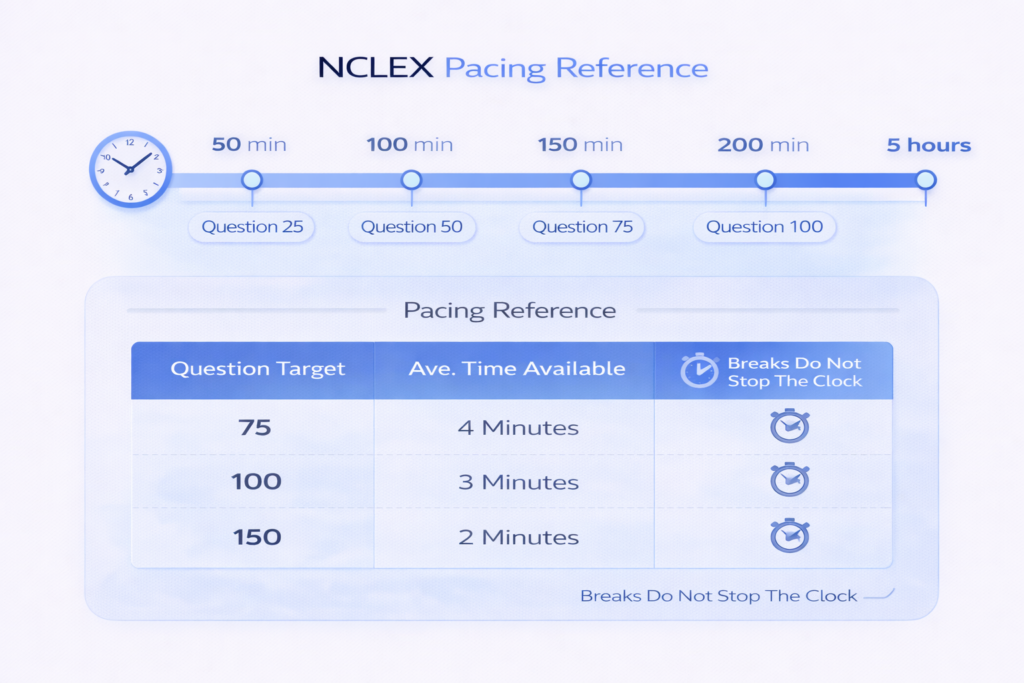
The NCLEX-RN in 2026 provides a maximum of five hours of testing time for up to 150 questions. Dividing five hours by 150 questions yields two minutes per question as the average pace required to complete the maximum item count. Most candidates will not receive 150 questions — the CAT algorithm ends the exam when statistical certainty about the result is achieved, which for most candidates occurs between 75 and 135 questions. For a candidate who receives 100 questions, the effective average time available is three minutes per question. For a candidate who receives 75 questions, it is four minutes per question. This means that NCLEX time management for most candidates is not actually about rushing — it is about maintaining a consistent, deliberate pace that prevents the specific time traps that cause individual questions to consume five, eight, or ten minutes while the majority of questions are answered in 60 to 90 seconds.
The On-Screen Timer and How to Use It
The NCLEX interface displays a running clock that candidates can monitor throughout the session. For NCLEX time management purposes, the most useful way to use the timer is not to watch it constantly — which generates anxiety without producing useful information — but to check it at defined milestone intervals. Check the timer at question 25, 50, 75, and 100. At each checkpoint, compare the elapsed time to the expected pace: at question 25, approximately 50 minutes should have elapsed for a 150-question exam at two minutes per question; at question 50, approximately 100 minutes. If elapsed time is significantly below the expected pace, you are moving too quickly and may be under-reading question stems. If significantly above, a specific question type or anxiety pattern is creating time overruns that need to be identified and managed. Using the timer as a checkpoint tool rather than a constant monitor keeps NCLEX time management active without allowing the clock to dominate attention during question processing.
The Break Time Accounting
Optional breaks during the NCLEX do not stop the exam clock — the five-hour timer continues running during any break taken. This is a critical NCLEX time management fact that many candidates do not know before exam day, and discovering it during a break produces significant anxiety. Planning break timing before the exam eliminates this surprise. A single short break of five to seven minutes used after the first two hours of testing — when the initial high-alert cognitive load has eased somewhat — consumes approximately four percent of the total exam time and is typically worth the cognitive and physiological reset it provides. A second break later in the session, if needed, consumes another four percent. Both are worth taking for candidates who need them, but both must be factored into the NCLEX time management calculation rather than treated as free time outside the exam clock.
The Question Types That Create Time Overruns

Effective NCLEX time management requires identifying the specific question characteristics that most commonly cause candidates to exceed their per-question time target — because these overruns are predictable, identifiable, and correctable with specific strategy adjustments.
Long Scenario Stems With Extensive Clinical Data
Questions with long stems — three to five sentences of clinical scenario data, extensive vital sign sets, medication lists, and laboratory values — require more reading time than straightforward two-sentence scenarios. The NCLEX time management trap with long stems is attempting to hold every detail in working memory simultaneously before engaging the answer options, which produces cognitive overload and extended reading time without proportional clinical reasoning benefit. The correct approach is the two-read discipline applied efficiently: first read for clinical situational awareness — who is the patient, what is the most urgent clinical finding — second read specifically for the action verb and the question’s decision point. After two reads, identify the single most abnormal clinical data point and engage the options from that anchor. Long stems contain more context than a single question requires; the skill is extracting the relevant data efficiently rather than processing every detail at equal depth.
NGN Unfolding Case Studies
Unfolding case study sets are the most significant NCLEX time management challenge introduced by the Next Generation NCLEX. A six-question unfolding case study set — where each question requires reading the full evolving clinical scenario before reasoning through the specific item — consumes substantially more reading time than six standalone questions of equivalent cognitive difficulty. The NCLEX time management strategy for unfolding case studies is to read the scenario introduction thoroughly on the first question, then read only the new clinical information introduced in subsequent questions rather than re-reading the entire scenario from the beginning for each item. The evolving scenario typically highlights or explicitly labels new information — focus reading attention on those additions while maintaining the clinical context established from the first question. This reading efficiency strategy can reduce unfolding case study set time by 30 to 40 percent without reducing clinical reasoning quality.
Extended Multiple Response Items
Extended multiple response questions — where candidates select all correct options from a list of six or more — require independent evaluation of each option against the clinical scenario, which takes more time than selecting one correct answer from four options. NCLEX time management for extended multiple response items requires a disciplined evaluation process: read each option independently, make a yes-or-no determination for each option before moving to the next, and commit to each determination without cycling back through previously evaluated options. Candidates who repeatedly re-read the entire option list — evaluating comparatively rather than independently — consume two to three times the necessary time on these items without improving accuracy. The independent evaluation discipline is the specific habit that keeps extended multiple response items within a manageable time budget.
Matrix Questions
Matrix questions require evaluating multiple rows and multiple columns simultaneously — which creates a specific NCLEX time management challenge because the grid interface can make it difficult to track which cells have been evaluated and which have not. The efficient matrix question strategy is to work row by row rather than cell by cell — evaluate the first row completely across all columns before moving to the second row, completing each row in sequence. This systematic approach prevents the disorientation of jumping between rows and columns that causes candidates to either rush through matrix questions without evaluating every cell or spend excessive time tracking where they are in the grid.
The Core NCLEX Time Management Strategies for Exam Day
With the time structure and time-overrun sources understood, the following strategies form the operational NCLEX time management system for the actual exam — concrete, actionable behaviors that keep pacing consistent without sacrificing clinical reasoning quality.
The 90-Second Commitment Rule
The most important single NCLEX time management rule is the 90-second commitment: after applying full clinical reasoning to a question for 90 seconds, commit to the best available answer and move forward. This rule does not mean guessing after 90 seconds — it means completing the two-read discipline, applying the clinical reasoning frameworks, evaluating the options through the best-answer test, and committing to the most defensible clinical selection within that window. Research on NCLEX performance consistently shows that time spent beyond 90 to 120 seconds on a single question produces diminishing reasoning returns — the candidate is not finding a better answer, they are cycling through the same reasoning loop with diminishing clarity. The 90-second rule prevents this cognitive drain from compounding across the full exam session. Practiced consistently during preparation through timed simulation sessions, it becomes a disciplined habit rather than a rushed one by exam day.
The Commit-and-Move Discipline
The commit-and-move discipline is the behavioral complement to the 90-second rule: once an answer is selected, do not return to change it unless a specific, identifiable error in initial reasoning is recognized. The most common NCLEX time management violation is not dwelling on a question before answering — it is returning to previously answered questions during a second-guess spiral that consumes significant time without improving accuracy. First responses grounded in clinical reasoning are correct more often than answers changed under doubt, and the time cost of systematic answer-changing is a direct subtraction from the time available for subsequent questions. On the NCLEX interface, flagging a question for review is possible but should be reserved for genuine clinical uncertainty — not for every question that felt difficult — and flagged questions should be revisited only if time clearly allows after completing the session.
The Milestone Check System
The milestone check system is the NCLEX time management monitoring approach that keeps pacing on track without requiring constant clock attention. Establish four checkpoint moments before the exam: questions 25, 50, 75, and 100. At each checkpoint, take a three-second glance at the elapsed time display and compare it to the expected pace benchmark. At question 25, approximately 40 to 50 minutes elapsed is on track for a comfortable pace. At question 50, approximately 85 to 100 minutes is on track. If elapsed time at any checkpoint is significantly above the benchmark, the next question block should be approached with conscious pacing awareness — applying the 90-second rule more deliberately. If significantly below, slow down: under-reading question stems is a common cause of below-benchmark pace and produces more incorrect answers than the time saved is worth. Between checkpoints, direct full attention to the clinical reasoning demands of each question without clock monitoring.
The Five-Second Interquestion Reset
Between questions — particularly after a difficult question that required extended reasoning — take a deliberate five-second pause before reading the next stem. This micro-reset serves two NCLEX time management functions simultaneously: it prevents cognitive residue from a difficult question from contaminating the fresh read required for the next one, and it provides a brief physiological reset through a single slow breath that reduces the anxiety accumulation that progressively slows clinical reasoning across a long session. Five seconds between questions is negligible in total time cost — 150 resets of five seconds each consumes 12.5 minutes total — but its benefit in maintaining consistent reasoning quality across the full exam is significant. Candidates who skip this reset and move immediately from question to question accumulate cognitive fatigue and anxiety faster, which directly impairs the clinical reasoning speed and accuracy that NCLEX time management depends on.
Building NCLEX Time Management Skills During Preparation
NCLEX time management cannot be developed on exam day — it must be built through deliberate, structured practice during the preparation period. Candidates who complete untimed practice sessions and then attempt to suddenly impose exam-pace timing on exam day will find that the pacing constraint disrupts their clinical reasoning rather than channeling it. Pacing must become automatic through practice before it can function reliably under exam pressure.
Timed Practice Sessions From Week Two Onward
From week two of preparation onward, every practice question session should be completed under timed conditions that approximate the actual exam pace. Set a session timer at the beginning of each practice block — 90 seconds per question for a 50-question session yields 75 minutes total. Complete the session without pausing the timer, without mid-session rationale review, and without looking up content between questions. The timed condition is not about rushing — it is about habituating the clinical reasoning process to operate within the time constraint so that it does so naturally rather than effortfully on exam day. Candidates who complete all practice sessions untimed and then switch to timed conditions in the final week of preparation will find the constraint genuinely disruptive to reasoning patterns that have developed without it.
Weekly Full Simulation With Exam-Realistic Timing
The most important NCLEX time management preparation activity is the weekly full simulation — a 100 to 150 question session completed under exam-realistic conditions without interruption. Full simulations build four preparation capacities simultaneously: cognitive stamina across a long reasoning session, time management habit under full exam length, identification of the specific question blocks within the session where pacing slows or reasoning quality degrades, and realistic exam-day preview that converts the unknown into the familiar. Without weekly full simulations, candidates arrive at exam day without ever having sustained clinical reasoning for the duration the actual exam requires — which is the single most predictable preparation gap for NCLEX time management performance.
Identifying Your Personal Time Overrun Patterns
Effective NCLEX time management preparation requires identifying which specific question types consume disproportionate time in your own practice sessions. After each timed practice session, review the session duration and identify whether any question type — long stems, NGN formats, pharmacology calculations, prioritization questions — consistently appears at timestamps significantly above the 90-second target. This pattern identifies your personal time overrun sources, which may be different from the typical patterns described in general NCLEX time management guidance. A candidate who spends four minutes on prioritization questions but 60 seconds on NGN formats has a different time management correction target than one who breezes through prioritization but struggles with extended multiple response pacing. Identify your personal pattern and address it specifically rather than practicing time management generically.
Pharmacology Calculation Pacing
Medication dosage and IV rate calculations are a specific NCLEX time management category that requires its own pacing strategy because they involve a computational process that is qualitatively different from clinical reasoning question processing. For calculation questions, use the on-screen calculator provided in the NCLEX interface — do not attempt mental arithmetic to save time, as calculation errors are more costly than the seconds the calculator requires. Establish a consistent calculation sequence before exam day: identify what is given, identify what is asked, set up the dimensional analysis or formula, enter values into the calculator in the same sequence every time, and verify the unit of the answer matches what the question requires. A consistent calculation sequence is faster than an improvised one because the sequence itself is automated — the computational steps follow a memorized order rather than being reconstructed from scratch for each question.
Managing Anxiety’s Effect on NCLEX Time Management
Anxiety is the most significant indirect threat to NCLEX time management — not because it directly prevents answering questions but because it slows every component of the reasoning process in ways that compound invisibly across a long exam session. A candidate who is mildly anxious throughout a 100-question exam may spend an average of 20 seconds longer per question than they would in a relaxed state — adding 33 minutes of exam time that is entirely attributable to anxiety rather than question difficulty or content gaps.
How Anxiety Slows Clinical Reasoning
Anxiety produces a well-documented cognitive narrowing effect — the attentional focus contracts under elevated stress, making it harder to hold multiple clinical data points in working memory simultaneously, harder to reason through competing answer options in sequence, and harder to access clinical knowledge that is clearly known in a low-anxiety state. For NCLEX time management purposes, anxiety most commonly manifests as re-reading the same sentence multiple times without processing it, cycling through answer options repeatedly without committing to a selection, and second-guessing committed answers even when no new reasoning has been applied. Each of these behaviors consumes exam time without improving answer quality. Recognizing them as anxiety behaviors — rather than as legitimate uncertainty that requires more reasoning time — is the first step toward correcting them with a specific intervention rather than simply trying to think harder.
The Physiological Regulation Toolkit
NCLEX time management preparation should include deliberate practice of at least one physiological anxiety regulation technique that can be applied during the exam in under ten seconds without disrupting the testing environment. The 4-7-8 breathing pattern — inhale for four counts, hold for seven, exhale for eight — activates the parasympathetic nervous system and physiologically reduces acute anxiety within two to three complete cycles. Applied between questions at a milestone checkpoint or after a series of particularly difficult questions, this technique produces measurable cognitive clarity restoration within the 30 to 45 seconds it takes to complete. The five-second interquestion reset described earlier provides a brief version of this technique at every question transition. The key NCLEX time management principle is that a 30-second anxiety regulation pause that restores clear reasoning is worth more than the 30 seconds of question time it consumes — because anxiety-impaired reasoning on the subsequent ten questions is more costly in accuracy than the time pause represents.
Recognizing and Breaking Rumination Spirals
Rumination — dwelling on a completed question after moving forward, continuing to analyze a previous selection while attempting to read a new stem — is one of the most direct NCLEX time management threats in the latter portion of a long exam session. The intervention is a specific behavioral reset: when awareness of rumination arises during a question stem read, make a deliberate physical gesture — place both hands flat on the desk, take one full breath, and re-read the stem from the beginning as if encountering it for the first time. This gesture-breath-restart sequence interrupts the rumination loop with a physical and attentional reset that takes under ten seconds and clears the cognitive residue that was contaminating the new question read. Practiced during preparation simulations, it becomes a conditioned response to rumination rather than an effortful choice that itself consumes cognitive resources under exam pressure.
NCLEX Time Management for NGN Formats: Specific Strategies
The Next Generation NCLEX formats introduced in 2023 require specific NCLEX time management adaptations beyond the general strategies above. Understanding how each NGN format affects time allocation and applying the correct format-specific strategy prevents the time overruns that NGN questions most commonly produce.
Unfolding Case Studies: The Scenario Investment Model
The correct NCLEX time management model for unfolding case study sets is front-loaded scenario investment: spend more time on the first question of the set — up to two to two and a half minutes — to thoroughly establish the clinical scenario, the patient context, and the baseline assessment data. This investment pays dividends across all six questions in the set because the scenario comprehension established in question one reduces the re-reading required for questions two through six. Each subsequent question in the set should require less reading time than a standalone question of equivalent difficulty because the clinical context is already established. Without this front-loading approach, candidates re-read the entire scenario for each question and progressively accumulate reading time across all six items.
Bow Tie Questions: Center-First Efficiency
The NCLEX time management strategy for bow tie questions is center-first evaluation: identify the central condition or clinical problem before selecting any actions or monitoring parameters. Candidates who attempt to select all three sections of a bow tie question simultaneously — trying to find actions and monitoring parameters before the central condition is determined — create a circular reasoning loop that consumes significantly more time than the sequential center-first approach. Determine the central condition from the stem data, commit to it, then select the two priority actions that address that specific condition, then select the two monitoring parameters relevant to that condition and those actions. The sequential commitment approach produces faster and more accurate bow tie responses than simultaneous evaluation of all three sections.
Extended Multiple Response: The Yes-No Scan
The NCLEX time management strategy for extended multiple response items is the yes-no scan: read each option once and make an immediate binary determination — is this option clinically appropriate for this specific patient in this specific scenario, yes or no — before moving to the next option. Do not re-read options after making a determination unless you complete the full list and realize you may have misread one. The yes-no scan approach converts extended multiple response items from an open-ended evaluation into a structured binary checklist that moves at a consistent pace regardless of the number of options. Candidates who read options comparatively — asking which is most correct rather than evaluating each independently — take two to three times as long on these items and achieve no accuracy advantage from the additional time.
- Unfolding case study target: Two to two and a half minutes on question one for full scenario investment, 60 to 90 seconds on questions two through six reading only new clinical information.
- Bow tie target: Under two minutes total — 30 to 45 seconds identifying the central condition, 30 to 45 seconds selecting two actions, 30 seconds selecting two monitoring parameters.
- Extended multiple response target: 90 to 120 seconds total — one binary yes-or-no evaluation per option, no re-reading after initial determination, commit when all options evaluated.
- Matrix question target: 90 to 120 seconds total — complete each row sequentially across all columns before moving to the next row, no jumping between rows.
Conclusion
NCLEX time management is not a matter of moving faster through questions — it is a matter of moving consistently, deliberately, and without the time-consuming behaviors that anxiety and uncertainty produce when they are not specifically prepared for. The 90-second commitment rule, the commit-and-move discipline, the milestone check system, and the five-second interquestion reset form the operational pacing framework for the actual exam. Format-specific strategies for unfolding case studies, bow tie questions, extended multiple response, and matrix items address the specific time overrun sources that NGN formats introduce. Physiological regulation techniques and rumination interruption protocols address the anxiety-driven slowdowns that compound invisibly across a long exam session.
All of these strategies must be built during preparation rather than improvised on exam day. Timed practice from week two, weekly full simulations from week three, personal time overrun pattern identification, and deliberate pacing habit development convert NCLEX time management from an exam-day improvisation into an established cognitive discipline. Arrive at the testing center with the pace already automated, the NGN format strategies already habitual, and the physiological regulation techniques already conditioned — and the five hours the exam provides will be more than enough.
