

Effective NCLEX question review is one of the highest-leverage preparation activities available — and one of the most consistently underdeveloped. Most candidates review their practice questions for correctness, not for pattern. They identify which questions were wrong, note the content area, perhaps read the rationale for the correct answer, and move on. This approach generates accuracy data without clinical reasoning intelligence — it reveals what went wrong without explaining why, and without why, the same errors recur across session after session without improvement.
Pattern recognition in NCLEX question review is the analytical discipline that transforms individual incorrect answers into systemic preparation intelligence. A candidate who notices that seven of their last twelve incorrect answers involved implementation options selected in scenarios where assessment was the correct nursing process step has identified a specific, correctable reasoning error that is not visible in any single question’s rationale. A candidate who notices that every pharmacology question they miss involves a patient context they recognized — the drug, the side effect — but misapplied to the wrong patient presentation has identified a patient context reasoning error pattern that targeted correction practice will close within one to two weeks. These patterns are only visible through deliberate NCLEX question review analysis conducted across multiple sessions rather than within a single question’s rationale.
This guide provides the complete framework for systematic NCLEX question review that identifies and corrects recurring error patterns: the four primary question pattern types the NCLEX uses consistently, how to analyze individual questions for pattern membership, the cross-session pattern identification process that reveals systematic reasoning errors, the specific correction strategies for each identified pattern type, and how to build pattern recognition as an automatic reasoning skill that functions during the exam itself rather than only during preparation review.
The Four Primary NCLEX Question Patterns You Must Recognize
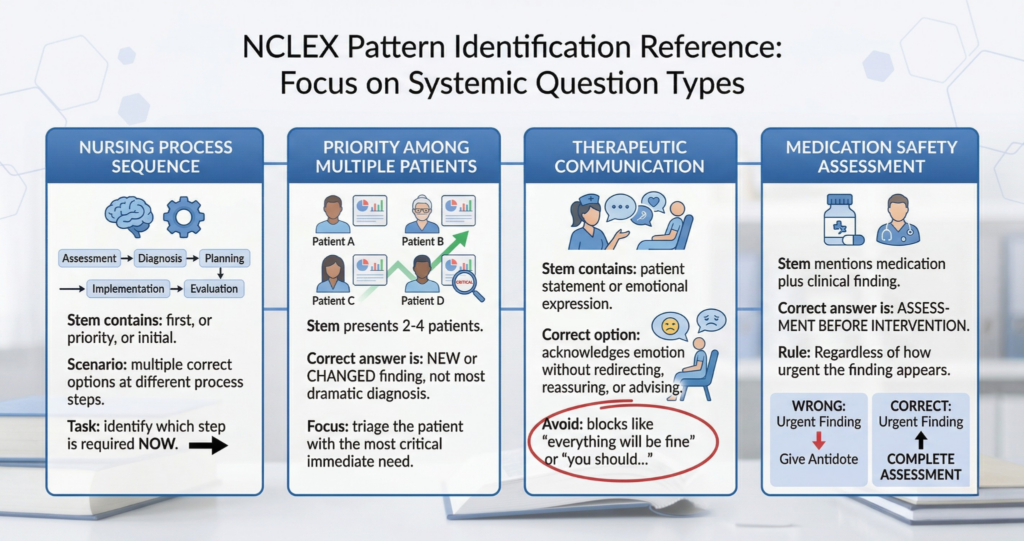
Before conducting systematic NCLEX question review for pattern identification, understanding the four primary question pattern types that the exam uses consistently across all content areas provides the analytical framework that makes individual question review most productive.
Pattern 1: The Nursing Process Sequence Pattern
The nursing process sequence pattern is the most frequently occurring structure in NCLEX question review — questions that test whether the candidate can correctly identify where in the assessment-diagnosis-planning-implementation-evaluation sequence a specific clinical situation requires action. These questions are identifiable by action verbs: the nurse should first, the nurse’s priority action, what does the nurse do initially. The distinguishing feature of this pattern is that multiple answer options are often clinically correct at some point in the nursing process — all four options may describe actions a competent nurse would take for this patient. The question tests which action is correct at this specific moment in the care sequence, not which action is generally correct. The most common error in this NCLEX question review pattern is selecting an implementation option when assessment is the correct first step, or selecting assessment when an identified ABC emergency makes immediate intervention the priority. Recognizing this pattern before reading options — through action verb identification — directs reasoning toward the correct process step question rather than toward which option describes the best clinical action in the abstract.
Pattern 2: The Priority Among Multiple Patients Pattern
The priority among multiple patients pattern tests triage reasoning — which patient in a group of two to four requires the nurse’s attention first. NCLEX question review of this pattern type reveals that it is consistently answered incorrectly through one of two errors: selecting the patient with the most medically complex or most emotionally compelling presentation rather than the patient with the most urgent unmet physiological need, or failing to identify a subtle physiological deterioration cue — early shock, a new respiratory change, a blood glucose at a dangerous level — because it is presented alongside more dramatic-sounding stable findings in other patients. The systematic NCLEX question review observation for this pattern is that the correct answer is almost always the patient with a new or changed finding rather than the patient with the most established or serious-sounding diagnosis. A patient with a documented history of heart failure whose symptoms are at baseline is not the priority over a post-operative patient whose blood pressure has dropped 30 mmHg from their one-hour post-op value — even though heart failure sounds more serious than post-operative monitoring.
Pattern 3: The Therapeutic Communication Selection Pattern
The therapeutic communication selection pattern consistently presents one correct therapeutic response and three responses that sound nursing-appropriate but commit specific communication errors: false reassurance, advice-giving, changing the subject, minimizing, or defensive responding. NCLEX question review of this pattern type reveals a systematic tendency among candidates to select the option that sounds warmest or most empathetic in everyday social terms rather than the option that applies the correct therapeutic communication technique for the clinical context. The pattern identification in NCLEX question review is straightforward: when a question stem contains a patient statement or emotional expression and the options are all nurse responses, this is the therapeutic communication pattern. The consistent correct-answer principle is that the option which acknowledges the patient’s expressed experience without redirecting, reassuring, or advising is almost always correct — and the option that sounds most proactively helpful in social terms is almost always wrong.
Pattern 4: The Medication Safety Assessment Pattern
The medication safety assessment pattern tests the specific pre-administration, during-administration, and post-administration assessments that make medication delivery safe for specific drug classes. NCLEX question review of this pattern type reveals that the most common error is selecting an intervention option (administering the medication, calling the provider, adjusting the dose) when the correct answer is a specific assessment that must precede any intervention decision. The pattern signature in any NCLEX question review session is a question that presents a patient about to receive or currently receiving a medication with a clinical finding mentioned in the stem — and asks what the nurse does next. If the clinical finding in the stem is a known contraindication, monitoring parameter, or safety threshold for that drug class, the correct answer is always the specific assessment that confirms or clarifies the finding before any intervention is taken or modified.
The Single-Question Analysis Protocol for NCLEX Question Review

Systematic NCLEX question review begins at the individual question level — applying a structured analytical protocol to each question that extracts both the content learning and the pattern identification information the question contains.
Step 1: Pattern Classification Before Reading the Rationale
The most valuable step in individual NCLEX question review happens before the rationale is read: classifying which of the four primary patterns the question belongs to based on the stem and action verb alone. Read the stem, identify the action verb, and name the pattern: nursing process sequence, priority among patients, therapeutic communication, or medication safety assessment. Then read the rationale and verify whether the pattern classification was accurate — whether the rationale explains the correct answer using the same pattern reasoning that the classification predicted. When the classification is accurate, the rationale confirms the pattern reasoning. When the classification is inaccurate — when the question seemed to be one pattern but the rationale reveals it tested another — the misclassification itself is a valuable NCLEX question review insight. It reveals that the candidate’s pattern recognition was triggered incorrectly by surface features of the stem rather than by the underlying clinical reasoning structure the question tested.
Step 2: Error Type Identification for Incorrect Answers
For every incorrect answer in an NCLEX question review session, identify the specific error type that produced the wrong selection using the four-category error framework. A nursing process error occurred if the candidate selected an option appropriate at a different process step than what the question required. A priority framework error occurred if the candidate applied the wrong priority hierarchy — Maslow’s psychosocial tier when a physiological tier was appropriate, or Maslow’s framework when an ABC emergency was present. A patient context error occurred if the candidate applied correct clinical knowledge to the wrong patient presentation — recognizing the condition correctly but mismatching the clinical data to a different patient’s situation. A knowledge gap error occurred if the clinical principle the correct answer required was genuinely absent from the accessible knowledge base. Recording this error type for every incorrect answer in the NCLEX question review session is what makes the subsequent cross-session pattern analysis possible.
Step 3: The Distractor Anatomy Analysis
For each incorrect option in an NCLEX question review session, conduct the distractor anatomy analysis — identifying what clinical scenario the distractor would be correct for, and what specific assumption about the question’s clinical context would make a reasonable candidate select it. A distractor that represents the correct intervention for a different patient presentation was designed to attract candidates who pattern-match on the condition name rather than reading the specific clinical data. A distractor that represents the correct action at a different nursing process step was designed to attract candidates who do not identify the process step the action verb requires. A distractor that addresses a real but non-priority clinical concern was designed to attract candidates who apply Maslow’s psychosocial tier before the physiological tier is fully addressed. Naming the distractor anatomy — this option would be correct if the patient had X, or if the question was asking for Y — makes the clinical discrimination visible that distinguishes the correct option from the plausible ones.
Cross-Session Pattern Identification: Finding Your Systematic Errors
Individual NCLEX question review reveals what went wrong in a specific question. Cross-session pattern analysis reveals what is going wrong systematically — the recurring error types and recurring pattern misidentifications that individual question review cannot surface because they require multiple data points to become visible.
The Weekly Error Pattern Review
The weekly error pattern review is a 15-minute analytical session conducted every Sunday using the NCLEX question review error log accumulated across the previous week’s sessions. The error log records, for every incorrect answer: the content category, the pattern type the question belonged to, and the error type that produced the wrong selection. After five to seven days of practice sessions, the error log contains 30 to 60 incorrect answer entries — sufficient to reveal patterns that any individual session cannot show. The analysis asks three questions. Which error type appears most frequently across the week’s incorrect answers? If nursing process errors dominate, the preparation correction is deliberate process step identification practice. If priority framework errors dominate, the correction is framework application practice. If patient context errors dominate, the correction is careful stem clinical data reading practice. Which question pattern type produces the most errors? If therapeutic communication questions dominate the error log, dedicated therapeutic communication practice sessions are indicated. Which content categories appear most frequently in the error log? These are the content priority targets for the following week’s filtered practice sessions.
The Persistent Pattern Alert
A persistent pattern in NCLEX question review is an error type or pattern type that appears in the top three error positions for three consecutive weekly reviews — an error that targeted preparation has not successfully corrected over three weeks. Persistent patterns are the highest-priority preparation targets because they represent clinical reasoning habits that have not responded to the standard correction approaches and require a different intervention. A nursing process error pattern that persists for three weeks despite deliberate process step identification practice in every session suggests that the error is more ingrained than conscious practice is correcting — which may require an external perspective to identify. A therapeutic communication error pattern that persists for three weeks despite dedicated communication question practice suggests that the candidate’s mental model of therapeutic communication has a specific misconception that additional questions are reinforcing rather than correcting. Both scenarios indicate that a tutoring session or a fundamental conceptual review of the relevant framework is needed rather than more question practice of the same type.
The Confidence Tag Pattern Analysis
A specific cross-session NCLEX question review analysis that surfaces the most dangerous preparation gap is the confidence tag pattern — reviewing the distribution of confidence tags (certain, reasoned, uncertain) across incorrect answers to identify the proportion of errors that were committed with high confidence. High-confidence wrong answers — questions tagged as certain before submission that turned out to be incorrect — represent confident clinical misconceptions rather than recognized uncertainties. These are systematically more dangerous than uncertain wrong answers because they are not recognized as errors during the exam, will not trigger the question reset behaviors that uncertain questions activate, and reflect deeply held incorrect clinical beliefs rather than acknowledged knowledge gaps. A NCLEX question review pattern showing that more than 30 percent of incorrect answers were tagged as certain indicates a significant confident misconception problem that deserves targeted attention — specifically reviewing all high-confidence wrong answers to identify which clinical beliefs they reflect and explicitly correcting those beliefs through content review and deliberate relearning.
Targeted Correction Strategies for Each Pattern Type
Identifying a recurring pattern through systematic NCLEX question review is only valuable if the identified pattern is addressed with the specific correction strategy that closes it. Each pattern type requires a different correction approach — applying the wrong correction to an identified pattern produces continued errors despite preparation effort.
Correcting Nursing Process Sequence Errors
The specific correction for a nursing process sequence error pattern identified through NCLEX question review is the mandatory action verb identification habit: before reading any answer option in every subsequent practice session, identify the action verb and explicitly name the nursing process step it requires. Write it on scratch paper if necessary — assessment step, implementation step, evaluation step — and use that process step identification as the filter for option selection. An option that does not match the identified process step cannot be the correct answer regardless of its clinical merit. Practice this mandatory identification across 25 consecutive questions in a dedicated correction session — asking not what the best nursing action is but what process step is required, then selecting only from options that match. After 25 questions with this deliberate identification habit, the habit begins to automate — and in a further 50 questions across the following two days it should be firing before options are read rather than requiring conscious initiation.
Correcting Priority Framework Errors
The specific correction for a priority framework error pattern in NCLEX question review is the pre-option physiological and ABC scan: before reading any option in every subsequent practice session, scan the stem for ABC threats (airway, breathing, circulation compromise) and unaddressed physiological needs (blood glucose, fluid balance, pain, oxygenation). Only after confirming the presence or absence of these findings does the framework selection occur: ABCs govern if present, Maslow’s physiological tier governs if ABCs are stable and physiological needs are present, Maslow’s safety tier governs if physiological needs are met, and psychosocial needs are only addressed when all higher tiers are satisfied. A dedicated 25-question correction session in which every question is preceded by a written physiological scan — literally listing the physiological and safety needs present before reading options — builds the habit faster than unfocused additional practice because it makes the correct framework selection step explicit rather than implicit.
Correcting Therapeutic Communication Pattern Errors
The specific correction for a therapeutic communication pattern error identified through NCLEX question review is applying the therapeutic communication technique identification test to every nurse-response option before selecting: what specific communication technique does this option use, and does that technique match the clinical goal the scenario requires? An open-ended option facilitates expression — appropriate when more information is needed. A reflective option validates experience without agreement — appropriate when the emotional content is the priority. A silent or present option creates space — appropriate immediately after significant disclosures. An advice-giving option is always non-therapeutic regardless of its clinical wisdom. A false reassurance option is always non-therapeutic regardless of its kindness. A dedicated 15-question therapeutic communication correction session where every option is technique-identified before selection — not by emotional response but by technique criteria — converts the intuitive empathy-driven selection habit into a technique-based clinical reasoning habit within two to three focused sessions.
Correcting Patient Context Pattern Errors
The specific correction for a patient context error pattern in NCLEX question review is the patient-specific clinical data extraction habit: before engaging any options, identify the two or three clinical data points in the stem that specifically characterize this patient and distinguish them from the most common presentation of the condition or medication named. A patient with known COPD whose oxygen saturation has dropped to 82 percent from their documented baseline of 90 percent is a different patient than a patient with new-onset respiratory distress at 82 percent — the clinical data of baseline comparison changes the correct answer. A patient receiving lithium whose sodium intake has significantly decreased is a different patient than a patient receiving lithium at a stable dose with consistent sodium intake — the clinical context of sodium change alters the lithium toxicity risk and the priority assessment. Extracting the distinguishing clinical data explicitly before option engagement prevents the pattern-matching on condition name that produces patient context errors.
Building Pattern Recognition as an Automatic Exam Skill
Pattern recognition identified through NCLEX question review only translates into exam performance improvement when it becomes automatic — when the pattern identification fires before options are read rather than being consciously retrieved after a question is already partially processed. Building automaticity requires deliberate practice of pattern recognition as an isolated skill before integrating it into full clinical reasoning sequences.
The Pattern Identification Drill
The pattern identification drill is a specific NCLEX question review practice that builds pattern recognition speed without requiring full clinical reasoning engagement. Present 20 question stems — without answer options — and for each stem name the pattern type and the framework it requires within five seconds. Nursing process sequence stems are identified by their action verbs: first, priority, initially. Priority among patients stems are identified by the multiple-patient presentation. Therapeutic communication stems are identified by the patient emotional expression plus nurse response options structure. Medication safety assessment stems are identified by the medication plus clinical finding combination. Time the drill and track how many correct pattern identifications are made without seeing the options. After two weeks of daily 20-stem drills, pattern identification should be consistently accurate at under three seconds per stem — fast enough to complete before the reading of options begins rather than during it.
The Transfer Test: Applying Patterns in Mixed Sessions
Pattern recognition built through dedicated NCLEX question review drill must be verified as transferring to mixed-content practice sessions — where patterns appear without warning within a clinical scenario context that may activate competing clinical reasoning associations. The transfer test is a 50-question mixed-content session completed with explicit pattern identification recorded for every question before any option is read. After the session, review the pattern identifications against the correct answers: what proportion of correct pattern identifications preceded correct answer selections? What proportion of incorrect answers were preceded by incorrect pattern identifications? A high correlation between incorrect pattern identification and incorrect answer selection confirms that the pattern recognition habit is driving selection accuracy — and that further drill practice will produce measurable accuracy improvement. A low correlation — incorrect answers despite correct pattern identification — indicates that the content knowledge or framework application within correctly identified patterns needs attention rather than the pattern identification skill itself.
Pattern Recognition During the Exam
The final preparation goal of systematic NCLEX question review is pattern recognition that functions automatically during the actual exam — where the pattern type fires as the stem is read, directing the clinical reasoning framework before options create distraction. This automation is the product of the preparation practices described in this guide rather than a skill that can be consciously applied for the first time under exam pressure. A candidate who has completed 200 pattern identification drills, applied explicit pattern identification in 500 mixed-content practice questions, and corrected the specific error patterns their NCLEX question review error log identified enters the exam with a pattern recognition system that operates below conscious deliberation — the pattern type is identified during the second read of the stem, the framework fires, and option evaluation begins from the correct clinical reasoning context. This automatic pattern-to-framework activation is what separates consistent performers across all exam question types from candidates whose performance is high on familiar question structures and unpredictable on unfamiliar ones.
- Daily practice integration: In every practice session from week two onward, record the pattern type and error type for every incorrect answer in the session error log before moving to the next question. This recording discipline takes 30 seconds per incorrect answer and produces the cross-session data that weekly pattern analysis requires.
- Pattern correction priority: When the weekly NCLEX question review analysis identifies a dominant error pattern, dedicate the following Monday and Tuesday’s practice sessions entirely to the correction protocol for that pattern — 25 questions with the explicit correction habit applied to every question, regardless of whether it belongs to the error pattern type. The explicit habit application builds the automaticity faster when it is required universally than when it is applied selectively to pattern-type questions only.
- NGN pattern recognition: The four primary patterns apply within NGN question formats as well as traditional multiple choice. Unfolding case study questions test nursing process sequence reasoning across the six CJMM skills — recognize cues questions are assessment-step items, take action questions are implementation-step items. Bow tie questions test priority framework reasoning — the center condition identification requires the same priority hierarchy as traditional triage questions. Recognizing these patterns within NGN formats reduces the NGN-specific cognitive load by applying familiar reasoning frameworks to unfamiliar format structures.
Conclusion
Systematic NCLEX question review transforms individual practice sessions from accuracy-generating activities into clinical reasoning intelligence-generating ones. The four primary question patterns — nursing process sequence, priority among multiple patients, therapeutic communication selection, and medication safety assessment — appear across all content areas and all difficulty levels, and recognizing them before engaging answer options directs clinical reasoning toward the correct framework before distractors create competing reasoning associations. The single-question analysis protocol — pattern classification before rationale, error type identification, distractor anatomy analysis — extracts the maximum analytical value from every incorrect answer. The weekly cross-session error pattern review surfaces the systematic reasoning errors that individual question review cannot reveal. And the targeted correction strategies for each pattern type address the root cause of each error rather than producing more questions of the same type without the specific behavioral correction that changes the reasoning pattern.
Pattern recognition built through this NCLEX question review methodology becomes automatic across three to four weeks of consistent practice — firing as the stem is read rather than being consciously retrieved after options have already activated competing clinical associations. On exam day, this automation means that the hardest questions are approached with the correct clinical reasoning framework already active rather than needing to be identified under cognitive pressure. The score that systematic NCLEX question review produces is not just higher accuracy — it is consistently high accuracy across all question types, including the ones that feel unfamiliar, because pattern recognition operates on question structure rather than on content familiarity.
