

Every significant NCLEX exam update generates the same pattern in the nursing candidate community: a wave of anxiety-driven speculation before the official announcement, a period of information fragmentation where partial truths and outright misinformation circulate through social media and nursing student forums, and a settling period in which candidates who relied on unofficial sources discover that what they prepared for and what the exam now tests are meaningfully different. The April 2026 NCLEX exam update has followed this pattern precisely — and the candidates most at risk from the resulting preparation confusion are those sitting the exam in the months immediately following the change, when the preparation ecosystem has partially but not fully adapted to the new specifications.
This guide addresses the April 2026 NCLEX exam changes with a direct, structured approach: what the NCSBN announced and when, what specifically changed in the test plan and examination format, what specifically did not change despite widespread reports that it did, what the changes mean for preparation strategy, and what candidates currently in preparation should do differently — and what they should continue doing exactly as before. The most important function of this guide is separating confirmed NCSBN official changes from the unverified speculation and amplified anxiety that accompanies every examination update, so that candidates can make preparation decisions based on what the exam actually requires rather than on what the nursing student social media ecosystem has reported that it requires. A note on sourcing: the information in this guide is drawn from the NCSBN’s official April 2026 NCLEX Examination Detailed Test Plans, the April 2026 Candidate Bulletin, and the official NCSBN press communications accompanying the update release. For any preparation decision involving the current examination format, the authoritative source is always ncsbn.org — not peer discussion, not preparation resource provider announcements, and not this guide if it has not been updated since the change you are researching. Verify directly with the primary source before making significant preparation decisions based on secondhand information about any NCLEX exam update.
What the NCSBN Actually Announced: The Official April 2026 Update
The April 2026 NCLEX exam update was the first significant test plan revision since the Next Generation NCLEX launch in April 2023. The NCSBN conducts practice analyses — surveys of newly licensed nurses and their employers to determine the knowledge, skills, and clinical judgment required for safe entry-level nursing practice — every three years, and the 2025 practice analysis produced the content and weighting updates that the April 2026 test plan reflects.
The Test Plan Content Category Adjustments
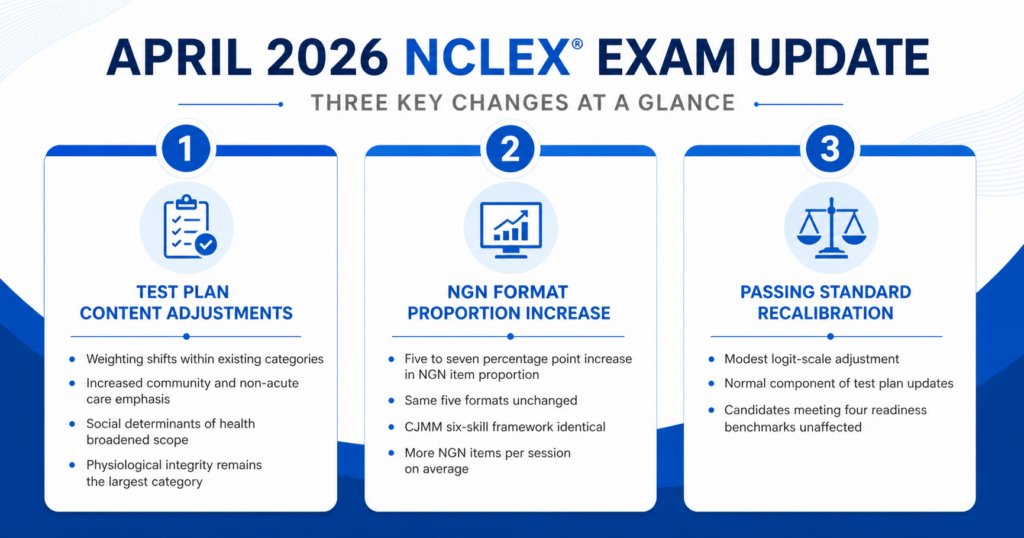
The most significant announced change in the April 2026 NCLEX exam update involved adjustments to the weighting of content categories within the test plan rather than the elimination or introduction of entirely new content domains. The NCSBN’s 2025 practice analysis identified shifts in the clinical priorities of entry-level nursing practice — specifically, an increased emphasis on care of populations across the lifespan in community and non-acute care settings, reflecting the documented shift in where newly licensed nurses are practicing in 2026 relative to 2022. The physiological integrity content area retained its position as the largest single test plan category. The safe and effective care environment category saw a modest weighting adjustment upward in management of care subcategory items, reflecting the increased care coordination and delegation demands identified in the practice analysis. Psychosocial integrity weighting remained stable. Health promotion and maintenance saw the most substantive content addition — a broadened scope of social determinants of health content reflecting the practice analysis finding that entry-level nurses in 2026 are expected to recognize and address social determinants in clinical practice more systematically than the previous test plan specified.
The NGN Format Updates
The April 2026 NCLEX exam update included adjustments to the NGN clinical judgment format specifications rather than new format types. The five NGN formats established with the 2023 launch — extended multiple response, matrix multiple response, bow tie, drop-down, and trend questions — remained unchanged. The update adjusted the proportion of NGN format items within the adaptive item pool upward by approximately five to seven percentage points relative to the 2023 launch proportion, reflecting the NCSBN’s stated intent to progressively increase the clinical judgment measurement proportion of the NCLEX exam as the candidate population and preparation ecosystem adapt to the format. This proportional increase means that candidates sitting the NCLEX exam in 2026 and beyond will encounter more NGN format items per session on average than candidates who sat in 2023 or 2024 — reinforcing the preparation imperative to treat NGN format fluency as a primary preparation target rather than a supplementary one. The Clinical Judgment Measurement Model cognitive skill framework governing NGN item construction remained identical to the 2023 specification — the six skills (recognize cues, analyze cues, prioritize hypotheses, generate solutions, take action, evaluate outcomes) and their mapped question type relationships are unchanged.
The Passing Standard Recalibration
The April 2026 NCLEX exam update included a passing standard recalibration — an adjustment to the logit-scale ability threshold at which the CAT algorithm’s 95 percent confidence determination places candidates in the passing category. Passing standard recalibrations are a normal component of test plan updates — they reflect the results of standard-setting panels that evaluate the entry-level competency required for safe nursing practice at the current date and calibrate the passing threshold to that evaluation rather than to the previous standard. The April 2026 recalibration was modest — within the range of previous standard adjustments — and its practical effect on well-prepared candidates is minimal. Candidates who are meeting the four readiness benchmarks developed against the pre-2026 standard are meeting the post-2026 standard as well, because the benchmark thresholds are calibrated against the clinical reasoning competency the exam measures rather than against the specific logit value of the passing threshold. The passing standard recalibration is not a change that requires candidates to study harder or differently — it is a psychometric adjustment that the CAT algorithm handles without candidate-facing implications for preparation strategy.
What Did NOT Change: Separating Fact from Forum Speculation

As significant as what changed in the April 2026 NCLEX exam update is what did not change — because the most preparation-damaging response to an exam update is redirecting preparation effort toward changes that did not occur.
The CAT Algorithm and Exam Length
The NCLEX exam’s Computerized Adaptive Testing algorithm, item selection methodology, and exam length parameters did not change in the April 2026 update. The exam continues to operate between 75 and 150 questions for the NCLEX-RN, with the CAT algorithm ending the session when 95 percent statistical confidence has been achieved that the candidate’s ability estimate is above or below the passing standard. The maximum information item selection principle is unchanged. The variable exam length interpretation — that exam length does not reliably indicate pass or fail direction — remains accurate and unchanged. Multiple social media posts in the weeks following the April 2026 update reported that the minimum exam length had been changed to 85 questions or that the maximum had been extended to 175 questions — neither report is accurate. The 75 to 150 question range remains in effect as of this guide’s publication.
The CJMM Cognitive Skill Framework
The Clinical Judgment Measurement Model cognitive skill framework did not change in the April 2026 NCLEX exam update. The six cognitive skills — recognize cues, analyze cues, prioritize hypotheses, generate solutions, take action, evaluate outcomes — and the mapping between cognitive skills and NGN question format types remain identical to the 2023 specification. Preparation for NGN formats using the CJMM framework developed for the 2023 launch remains fully applicable to the 2026 examination. Reports circulating in nursing candidate forums suggesting that new CJMM skills had been added or that the cognitive skill framework had been reorganized are not supported by the NCSBN’s official April 2026 documentation.
The Core Clinical Content Domains
The fundamental clinical content domains of the NCLEX exam — safe and effective care environment, health promotion and maintenance, psychosocial integrity, and physiological integrity — did not change in the April 2026 update. The subcategory structure within these domains was adjusted as described in the previous section, but the four-domain framework that has organized the NCLEX test plan since its establishment remains intact. The extensive clinical content preparation that well-prepared candidates have invested in across pharmacology, medical-surgical nursing, critical care, mental health nursing, maternal-newborn, and pediatric nursing remains relevant and appropriate for the current examination. The April 2026 update did not introduce new clinical specialty areas requiring significant new content preparation from candidates who have used current preparation resources. Reports suggesting that entirely new clinical content areas were added to the examination are not supported by the official test plan documentation.
The Registration and Scheduling Process
The NCLEX exam registration and scheduling process — applying to the state board of nursing, registering with Pearson VUE, receiving the Authorization to Test, and scheduling the appointment — did not change in the April 2026 update. The examination fee, the ATT validity period, the identification requirements at the testing center, and the Pearson VUE testing center network structure are unchanged. The Quick Results service, the post-exam Candidate Performance Report for not-passing candidates, and the 45-day waiting period between attempts are all unchanged. No new pre-examination requirements, no new identification specifications, and no changes to the testing center environment were introduced with the April 2026 update.
Preparation Implications: What to Do Differently and What to Continue
Understanding what changed and what did not change in the April 2026 NCLEX exam update is useful only insofar as it produces specific, actionable preparation adjustments. The following guidance distinguishes the preparation behaviors that the update warrants changing from those that remain optimal regardless of the update.
Increase NGN Format Practice Proportion
The confirmed increase in NGN format item proportion within the adaptive item pool is the most directly preparation-relevant change in the April 2026 NCLEX exam update. If your current preparation allocates less than 25 percent of daily practice questions to NGN format items, increase that proportion to 30 to 35 percent. The NGN accuracy tracking practice described throughout this series — tracking NGN accuracy separately from traditional format accuracy in the weekly micro-audit — becomes even more important with the higher NGN proportion. A candidate whose traditional format accuracy is 63 percent and whose NGN accuracy is 44 percent was already significantly at risk in the 2023 format proportion; in the April 2026 proportion, the below-standard NGN performance contributes to a larger proportion of the ability estimate. The preparation response is the same as it was before the update — deliberate NGN format practice with CJMM skill identification applied to every item — but the urgency of addressing an NGN gap has increased with the proportional change.
Address Social Determinants of Health Content
The expanded social determinants of health scope in the April 2026 NCLEX exam update’s health promotion and maintenance category is the one content addition that warrants specific preparation attention from candidates who have not previously prioritized this area. Social determinants of health — housing stability, food security, transportation access, social support, economic stability, and education access as factors affecting health outcomes — were present in the pre-2026 test plan but in a narrower scope. The 2026 update reflects the practice analysis finding that entry-level nurses are expected to recognize social determinants in clinical assessments, incorporate them into care planning, and connect patients with appropriate community resources. For the NCLEX exam, this means that health promotion and maintenance scenarios may present patient situations where the clinically correct nursing response involves recognizing and addressing a social determinant barrier rather than or alongside a physiological clinical intervention. Candidates whose preparation has focused exclusively on physiological and pharmacological clinical content should ensure that health promotion and maintenance including social determinants is represented in their final preparation weeks.
Continue All Established High-Value Preparation Behaviors
The April 2026 NCLEX exam update does not warrant changes to any of the core high-value preparation behaviors that this series has described throughout. The four-question rationale review protocol applied to every practice question remains the highest-return preparation activity per hour. The three-tier priority framework — ABCs, Maslow’s hierarchy, nursing process sequencing — remains the accurate clinical reasoning structure the exam tests. The weekly micro-audit tracking four readiness benchmarks remains the correct preparation management system. The spaced repetition consolidation system for clinical reasoning principles remains the most effective memory management approach. The 55 to 60 percent practice accuracy benchmark for readiness determination remains calibrated to the NCLEX exam’s passing standard despite the recalibration — the standard adjustment was within the range of normal variability that the benchmark thresholds already accommodate. Candidates who were on track for their exam date before the April 2026 update should continue their preparation on the same trajectory without significant disruption.
The Information Hygiene Problem: How to Evaluate NCLEX Exam Change Reports
Every NCLEX exam update produces a period of heightened misinformation risk in the nursing candidate community — and the April 2026 update has been no exception. Developing a reliable framework for evaluating the accuracy of NCLEX exam change reports protects preparation from the anxiety-driven adjustments that inaccurate information generates.
The Source Hierarchy for NCLEX Exam Information
NCLEX exam information exists at four levels of reliability that correspond directly to the source’s position in the official communication chain. Level one — the highest reliability — is the NCSBN official documentation: the Detailed Test Plan, the Candidate Bulletin, and the official NCSBN press releases published at ncsbn.org. Any change reported at this level is confirmed and should be acted on. Level two is official communications from the state board of nursing in the candidate’s licensure state — official correspondence about examination requirements, eligibility changes, or administrative updates. Level three is established NCLEX preparation resource providers (Kaplan, UWorld, ATI, Hurst, and equivalent organizations) who have direct NCSBN relationships and update their content based on official communications. Level four — the lowest reliability for accurate examination change information — is peer reports from nursing student forums, social media groups, and preparation community platforms. Level four sources are the fastest to publish and the most frequently inaccurate. The pattern with every NCLEX exam update is that level four reports circulate widely before level one documentation is available, generating preparation anxiety and behavior changes based on unverified information.
The Verification Protocol for Change Reports
When a NCLEX exam change report reaches a candidate through any channel other than a level one or level two source, apply the four-question verification protocol before acting on the information. First: what is the source? Is this NCSBN official documentation, a preparation provider update, a forum post, or a social media share? Second: is there a date? When was this information published relative to the claimed change date, and has sufficient time elapsed for official documentation to be available? Third: does the NCSBN documentation confirm this change? Navigate to ncsbn.org, locate the current Detailed Test Plan and Candidate Bulletin, and search for the specific change described in the report. Fourth: does the change match the preparation implication being claimed? Some accurate reports of NCLEX exam changes are paired with inaccurate preparation implications — the change is real, but what a candidate should do about it is incorrectly characterized. Applying this four-question protocol before adjusting preparation based on secondhand change reports protects preparation time from being redirected toward inaccurately reported changes.
The Preparation Stability Principle
A practical preparation principle for candidates preparing during an examination update period is the preparation stability principle: do not make significant preparation changes based on unverified change reports, and do not make any preparation changes based on the emotional urgency that update anxiety generates rather than on the specific preparation implications that confirmed changes require. A candidate who is three weeks from their exam date and encounters a social media report that the NCLEX exam has changed dramatically has two productive options: spend 20 minutes verifying the report against ncsbn.org and making the specific, minor adjustments the confirmed changes warrant, or — if the exam is within a week — trust that the well-established preparation that has met all four readiness benchmarks is already calibrated to the current examination. What is not productive is significantly restructuring preparation in the final weeks based on unverified reports, which disrupts the consolidation and calibration that the final preparation weeks are designed to provide and replaces it with the anxiety-driven construction that is the least effective final-week preparation behavior.
- How to check what version of the NCLEX test plan you are preparing against: Your question bank platform and preparation resource provider should specify which NCLEX Detailed Test Plan version their content reflects. Look for the test plan version date in the platform’s documentation or FAQ — it should reference the April 2026 test plan for current preparation. If your primary preparation resource was published before April 2026 and has not been updated, verify whether its content reflects the current test plan or the 2023 NGN launch specification by checking the NCSBN Detailed Test Plan directly.
- The official sources for April 2026 NCLEX exam changes: The NCSBN publishes the current NCLEX-RN Detailed Test Plan at ncsbn.org under the NCLEX section. The 2026 Candidate Bulletin — also available at ncsbn.org — covers examination procedures, registration requirements, and testing policies. The NCSBN’s official NGN resource page provides the current CJMM framework documentation and the official sample questions that reflect current examination specifications. These three documents together constitute the complete authoritative source for what the current NCLEX exam requires.
What to do if your exam date is within four weeks of the April 2026 update: Confirm your preparation resources reflect the current test plan. Add 30 to 35 percent NGN format content to daily sessions if not already there. Add at least one content review session specifically on social determinants of health and health promotion. Complete the NCSBN official NGN sample questions at ncsbn.org for format calibration against the current specification. Continue all established high-value preparation behaviors unchanged. Avoid restructuring the entire preparation approach based on forum reports of changes that the official documentation does not confirm.
The Bigger Picture: What the April 2026 Update Tells Us About the NCLEX’s Direction
Beyond the specific changes and non-changes of the April 2026 update, the update’s content provides a clear signal about the trajectory of the NCLEX exam that informs preparation for candidates whose exam date extends into 2027 and beyond.
Progressive Increase in Clinical Judgment Measurement
The NGN format proportion increase in the April 2026 NCLEX exam update is not a one-time adjustment — it is the continuation of a stated NCSBN trajectory of progressively increasing the clinical judgment measurement capacity of the examination as the preparation ecosystem and candidate population demonstrate full adaptation to the format. The 2023 NGN launch established the format. The 2026 update increased its proportional weight. Future test plan updates should be expected to continue this progression. The preparation implication is long-term: clinical judgment development — the deliberate building of CJMM cognitive skill fluency through scenario-format practice, CJMM skill identification, and NGN-specific rationale review — is not a preparation supplement that addresses a format novelty. It is the core preparation investment that the examination’s increasing clinical judgment emphasis will continue to reward.
Expanding Scope of Entry-Level Practice
The social determinants of health content expansion and the increased community and non-acute care weighting in the April 2026 NCLEX exam update both reflect the practice analysis finding that entry-level nursing practice in 2026 is broader in scope than it was in 2022. Newly licensed nurses are practicing in a wider range of settings — telehealth, community health, school nursing, long-term care, home health — and are expected to function competently in those settings’ specific clinical demands alongside traditional acute care competencies. Future test plan updates should be expected to continue tracking this broadened scope of practice. The preparation implication is that comprehensive clinical reasoning preparation — not exclusively acute care and medical-surgical focused — is increasingly representative of what the examination tests and what entry-level nursing practice requires.
Stability of Core Clinical Reasoning Requirements
The unchanged CJMM framework, unchanged four-domain test plan structure, unchanged CAT algorithm, and unchanged core clinical content areas of the April 2026 NCLEX exam update collectively signal that the examination’s fundamental clinical reasoning measurement architecture is stable. The specific weighting adjustments, format proportion changes, and content scope expansions occur within a stable structural framework that the examination’s design principles established with the 2023 NGN launch and that the NCSBN intends to maintain. For candidates in preparation, this stability means that the core preparation approach — clinical reasoning development through scenario-format practice, full rationale review, NGN format fluency, and framework-based priority reasoning — remains the correct preparation investment regardless of future test plan adjustments. The adjustments add and reweight content at the margins. The clinical judgment measurement architecture at the center is stable and will remain the primary preparation target for the foreseeable future of the NCLEX exam.
Conclusion
The April 2026 NCLEX exam update made three specific confirmed changes: test plan content category weighting adjustments with increased community and non-acute care emphasis and broadened social determinants of health scope, an approximately five to seven percentage point increase in NGN format item proportion within the adaptive pool, and a modest passing standard recalibration within normal adjustment range. Everything else that social media and nursing student forums reported as changed — the CAT algorithm, the exam length parameters, the CJMM cognitive skill framework, the core clinical content domains, the registration and scheduling process — did not change and is not supported by the NCSBN’s official April 2026 documentation.
The preparation adjustments that the confirmed changes warrant are specific and bounded: increase NGN format practice proportion to 30 to 35 percent of daily sessions, add social determinants of health content to health promotion and maintenance preparation, and verify that preparation resources reflect the April 2026 test plan rather than the 2023 specification. All established core preparation behaviors — four-question rationale review, three-tier priority framework application, four-benchmark weekly tracking, spaced repetition consolidation — remain optimal and unchanged. Candidates who were on a solid preparation trajectory before the update are on a solid preparation trajectory after it. The NCLEX exam is measuring the same clinical reasoning competency it was measuring before April 2026 — with a higher proportion of the items in the NGN format types that make that measurement most precise.
