

Passing the NCLEX 2026 requires understanding three things clearly before studying a single practice question: what the exam actually measures, what the current format requires that previous versions did not, and what preparation behaviors are most strongly associated with first-attempt passing versus those that feel productive but produce flat accuracy trends. Most candidates who struggle with the NCLEX are not struggling because they lack the clinical knowledge to be nurses. They are struggling because their preparation approach is misaligned with what the examination tests — accumulating question volume without building clinical reasoning quality, reviewing content without applying it to novel clinical scenarios, or practicing traditional multiple choice extensively while the NGN clinical judgment formats that now constitute a significant portion of the exam remain underdeveloped.
The NCLEX 2026 measures clinical judgment — the ability to recognize clinically significant data, analyze its meaning, prioritize the most urgent clinical hypothesis, generate appropriate nursing actions, select the correct action for the current clinical moment, and evaluate whether interventions achieved their intended outcomes. This clinical judgment framework, organized by the NCSBN’s Clinical Judgment Measurement Model, governs not only the NGN format questions but the underlying reasoning architecture that every question on the exam tests regardless of its format. A candidate who has developed systematic clinical judgment — who approaches every clinical scenario with a consistent framework rather than with pattern recognition on familiar presentations — performs at the upper range of their clinical knowledge regardless of which specific questions the adaptive algorithm selects. A candidate who has accumulated question volume without developing this framework consistently performs below what their clinical knowledge would predict.
This is the complete NCLEX 2026 guide — organized as a preparation framework from the first day of studying through exam morning. It covers the current exam format and what changed in 2026, the clinical reasoning framework that governs all preparation decisions, the preparation behaviors most strongly associated with passing, the readiness tracking system that confirms when exam readiness has been achieved, and the exam-day protocol that allows preparation to express itself as performance. Everything in this guide is actionable. Nothing requires resources beyond what most candidates already have access to. The preparation that produces a passing NCLEX 2026 result is not complicated — but it is specific, and specificity is what this guide provides.
What the NCLEX 2026 Actually Tests
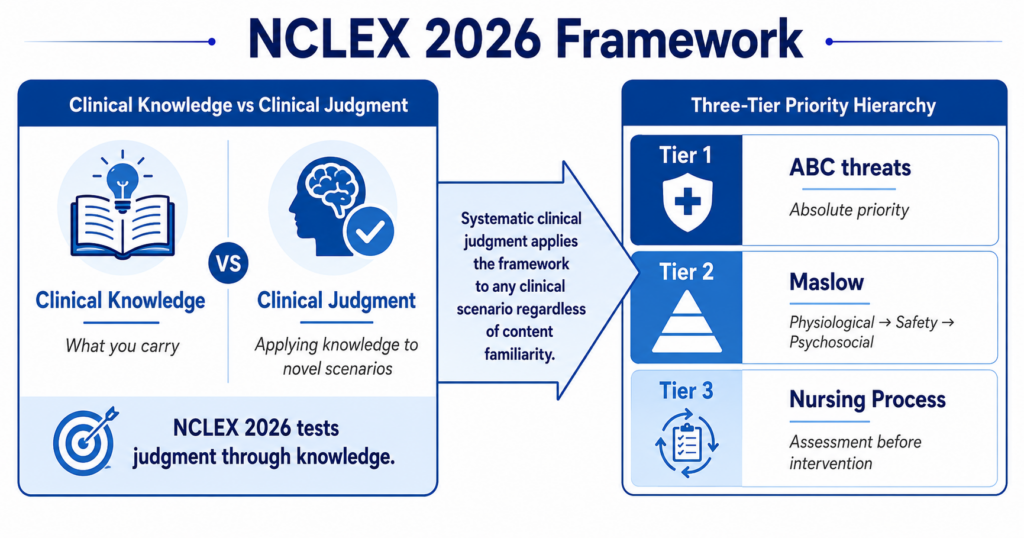
The foundational preparation insight for NCLEX 2026 is that the exam does not primarily test clinical knowledge recall — it tests clinical reasoning application. Understanding this distinction is the difference between a preparation approach that builds the competency the exam measures and one that builds recognition of correct answers when presented but not generation of correct answers from clinical data.
Clinical Judgment vs. Clinical Knowledge
Clinical knowledge is the body of information a nurse carries: drug mechanisms, disease presentations, normal laboratory values, nursing priority hierarchies, pathophysiology chains. Clinical judgment is the ability to apply that knowledge to a specific clinical scenario — recognizing which data in a patient presentation is clinically significant, determining what the significant data means about the patient’s condition, identifying the most urgent clinical priority, and selecting the appropriate nursing action for this specific patient at this specific clinical moment. The NCLEX 2026 tests clinical judgment. It tests it through clinical knowledge — the questions require clinical knowledge to answer — but the question format consistently presents clinical knowledge in novel scenarios that require application rather than recognition. A candidate who has memorized that digoxin toxicity presents with nausea, vomiting, and visual disturbances will answer a question correctly when those exact presentations are listed. A candidate who understands the mechanism of digoxin toxicity — that it involves Na-K-ATPase inhibition, that toxicity risk increases with hypokalemia, that the presenting symptoms reflect the clinical consequence of excessive digoxin effect — will answer correctly when the scenario presents the toxicity through a laboratory finding or a clinical context that the memorized list does not exactly match. The second candidate has clinical judgment; the first has clinical knowledge. NCLEX 2026 consistently tests the second.
The NGN Clinical Judgment Formats
The Next Generation NCLEX formats introduced in 2023 and expanded in proportion with the April 2026 test plan update measure clinical judgment through five question types that traditional multiple choice cannot replicate: unfolding case study sets (six questions following a single patient through a developing clinical situation, each testing a specific CJMM cognitive skill), bow tie questions (center condition identification driving action and monitoring selection), extended multiple response (all-that-apply format with partial credit scoring for each correct or incorrect selection), matrix questions (binary selections across a table of conditions and responses), and trend questions (clinical data across multiple time points requiring interpretation of change direction and significance). For NCLEX 2026, these formats collectively represent approximately 20 to 30 percent of the adaptive exam session — a proportion that makes NGN-specific preparation not supplementary but primary. A candidate whose NGN accuracy is 44 percent and whose traditional accuracy is 65 percent is not as prepared for NCLEX 2026 as their overall average suggests, and will not achieve a passing result as reliably as their preparation volume implies.
The Three-Tier Priority Framework
Every priority question on the NCLEX 2026 — whether traditional multiple choice or NGN format — is answered using the same three-tier hierarchy applied in sequence. Tier one: is there an active threat to airway, breathing, or circulation? If yes, this threat takes absolute priority over everything else regardless of how compelling other options appear. Tier two: if no ABC threat is present, are there unaddressed physiological or safety needs? Maslow’s hierarchy places physiological needs above safety needs above psychosocial needs — unaddressed physiological needs take priority over safety concerns and safety concerns take priority over any psychosocial option. Tier three: if the question involves multiple actions addressing the same identified priority need, the nursing process governs the sequence — assessment before diagnosis, diagnosis before planning, planning before implementation, with the assessment-before-intervention principle producing the most consistently tested NCLEX 2026 third-tier correct answers. This three-tier framework applies to every priority question in every content area. A candidate who applies it automatically — before reading any answer option — performs consistently above the passing standard across all content areas regardless of content-specific preparation depth.
The Six Preparation Behaviors That Most Strongly Predict Passing

Not all preparation behaviors are equally effective at building the clinical judgment that NCLEX 2026 measures. The following six behaviors are most strongly associated with first-attempt passing and are the behaviors that most commonly distinguish candidates whose accuracy improves consistently across a preparation period from those whose accuracy stagnates despite high study volume.
Behavior 1: Full Four-Question Rationale Review on Every Question
The single most consequential preparation behavior for NCLEX 2026 is completing the full four-question rationale review protocol on every practice question — correct and incorrect. The four questions are: what clinical principle does the correct answer teach, why does each incorrect option fail for this specific patient in this specific scenario, what reasoning error would lead a candidate to select each wrong option, and does this question change how I will reason about similar clinical scenarios in the future? Most candidates review the correct answer’s rationale and move on — which extracts approximately 25 percent of the available clinical reasoning development from each question. The complete four-question protocol applied to every option of every question extracts the full available clinical reasoning content. At 50 practice questions per session, the difference between answer-checking and full protocol review is the difference between 50 practice events and 250 clinical reasoning development units. This ratio, compounded across a six-week preparation period and 2,000 practice questions, is the largest single determinant of clinical reasoning quality improvement per hour of preparation invested.
Behavior 2: Timed Practice from Day One
Every practice session in NCLEX 2026 preparation should be conducted under the 90-second per question average that the exam’s five-hour clock produces. Open-ended practice — completing questions at whatever pace thinking requires — builds clinical reasoning habits that are calibrated to a different cognitive demand than the exam creates. A candidate who averages three minutes per question in practice and encounters the exam’s adaptive clock for the first time in the actual session will find that their clinical reasoning quality deteriorates significantly in the latter half of the exam as time pressure accumulates. Timed practice from day one calibrates the reasoning process to the exam’s temporal constraints — which means the reasoning quality that practice has built remains available under exam conditions rather than being impaired by the novel timing demand. Implement timed practice through the milestone clock check system: at questions 25, 50, 75, and 100, check elapsed time against the benchmark (approximately 37, 75, 112, and 150 minutes for a 150-question session at 90 seconds per question) and adjust pace accordingly.
Behavior 3: NGN Format Practice at 30 Percent of Daily Sessions
NCLEX 2026 preparation requires allocating 30 to 35 percent of daily practice questions to NGN format items — unfolding case study sets, bow tie questions, extended multiple response, matrix questions, and trend questions — with the CJMM cognitive skill identification applied to every NGN item before any option is engaged. The CJMM action verb identification habit — reading the question’s action verb, naming the cognitive skill it indicates, and using that skill identification to determine what the correct answer must demonstrate — is the most important NGN-specific preparation behavior. Complement daily NGN format practice with the NCSBN official NGN sample questions at ncsbn.org completed at the beginning, midpoint, and final week of preparation as the authoritative format calibration reference. Track NGN accuracy separately from traditional format accuracy in the weekly micro-audit — a candidate who does not separate these numbers will not know their NGN gap exists until the exam reveals it.
Behavior 4: Error Type Classification for Every Incorrect Answer
For every incorrect answer in every NCLEX 2026 practice session, classify the error type using the four-category framework: knowledge gap (clinical content genuinely absent from the knowledge base), reasoning pattern error (correct content present but misapplied — wrong priority framework, wrong nursing process step, wrong patient context), patient context error (correct clinical knowledge applied to the wrong patient in the scenario), or NGN cognitive skill error (wrong CJMM skill applied to an NGN format question). This classification takes 30 seconds per incorrect answer and produces the preparation intelligence that weekly cross-session pattern analysis requires. The weekly review of the accumulated error log identifies which error type is most frequently occurring — which is the specific preparation correction that the following week’s targeted practice should address. Candidates who track error types across their NCLEX 2026 preparation consistently identify systematic reasoning patterns that individual question rationale review cannot surface, and correcting those patterns produces the accuracy improvements that additional undifferentiated question volume cannot.
Behavior 5: Spaced Repetition Consolidation Daily
Clinical reasoning principles extracted from practice session rationale review — the clinical mechanisms, nursing priority chains, and distractor patterns that rationale analysis teaches — must be consolidated into long-term retrievable memory through spaced repetition review rather than through re-reading. Build an Anki deck from the clinical reasoning principles that practice sessions teach: five to eight new cards per session, each with a clinical scenario prompt on the front and a three-component clinical reasoning chain on the back (the clinical principle, the correct action sequence, and the distractor type that would lead to the wrong selection). Review due cards every morning for 15 to 20 minutes before any other preparation activity. By week four of a six-week NCLEX 2026 preparation period, this daily routine consolidates the clinical reasoning library built across the full preparation period into exam-ready retrieval strength — which is the maximum memory preparation state available for any preparation timeline.
Behavior 6: Weekly Readiness Tracking Against Four Benchmarks
NCLEX 2026 preparation requires a weekly measurement system that tracks progress toward the four readiness benchmarks that correlate most reliably with first-attempt passing. Benchmark one: overall practice accuracy above 55 to 60 percent across a minimum of 1,500 completed questions with an upward or stable trend across at least three consecutive weeks. Benchmark two: accuracy above 50 percent in every major content category in the most recent weekly full simulation’s content breakdown — no below-standard category exceptions regardless of overall accuracy. Benchmark three: NGN format accuracy above 50 percent tracked separately from traditional format accuracy. Benchmark four: a passing-range result on at least one full 100-plus-question timed simulation completed under exam-realistic conditions within two weeks of the exam date. The weekly micro-audit conducted every Sunday — 20 minutes reviewing the week’s accuracy data against these four benchmarks — is the preparation management system that converts effort into evidence-based readiness rather than into accumulated anxiety about whether preparation is sufficient.
The Complete NCLEX 2026 Preparation Timeline
The following preparation timeline translates the six behaviors and the NCLEX 2026 clinical judgment framework into a week-by-week preparation architecture that builds from diagnostic baseline through full readiness confirmation.
Week 1: Diagnostic Baseline and Framework Orientation
The first week of NCLEX 2026 preparation has two non-negotiable activities before any targeted content study begins. First, complete a full diagnostic assessment — 75 to 100 mixed-content questions under timed conditions without any references — and extract the content category accuracy breakdown from the platform’s analytics. This baseline diagnostic is the preparation prescription that all subsequent study allocation decisions are based on. Second, complete the NCSBN official NGN sample questions at ncsbn.org and study the CJMM six-skill framework documentation. The diagnostic baseline tells you where clinical content performance currently stands. The NGN orientation tells you how the current exam format works. Both are necessary before any preparation hour is allocated to specific content or format practice — because allocation without a diagnostic baseline produces preparation directed at assumed gaps rather than identified gaps, and NGN format practice without framework orientation produces format exposure without clinical judgment skill development.
Weeks 2 Through 5: Targeted Clinical Reasoning Development
Weeks two through five are the intensive preparation phase of NCLEX 2026 — four weeks of daily targeted practice that builds clinical judgment in the specific areas the diagnostic identified as below standard. The daily session structure for each weekday is: 15 to 20 minutes of morning Anki spaced repetition review (due cards only), followed by the primary 50 to 75 question practice session under timed conditions with 30 to 35 percent NGN format content, followed by full four-question rationale review of every question including error type classification for incorrect answers, followed by five to eight new Anki card creation from the session’s rationale-taught clinical principles. The content allocation within the primary session concentrates 70 percent of daily questions in the two below-standard content areas identified by the diagnostic, with the remaining 30 percent mixed content to maintain above-standard areas. Saturday is the weekly simulation day — a full 100-question timed simulation under exam-realistic conditions followed by the five-metric post-simulation scorecard. Sunday is the micro-audit and the week’s preparation prescription adjustment based on the week’s accuracy data and the simulation’s benchmark measurements.
Week 6 to Exam: Final Calibration and Readiness Confirmation
The final week of NCLEX 2026 preparation is a calibration and recovery week — not a construction week. The final full simulation is completed seven days before the exam date to confirm all four benchmarks are met and provide the last targeted intervention opportunity for any benchmark not yet reached. Days six and five before the exam are targeted consolidation days — Anki morning review, one 25 to 30 question targeted session if a below-standard category remains, and the NCSBN official NGN calibration session. Days four and three are error log crystallization, logistics confirmation, and a 40 to 50 question mini-simulation. Days two and one are physiological recovery — Anki morning review only, complete preparation disengagement for the remainder of both days, protected sleep of seven to eight hours each night. Exam morning is activation — protein breakfast, 10 minutes of physical movement, the confidence activation paragraph review, and the process-focus mantra during the commute. The preparation is complete. Exam morning is not preparation time — it is performance activation time.
The Four Readiness Benchmarks: Your Data-Based Go Signal
The proceed decision for NCLEX 2026 should be data-based rather than feeling-based. The feeling of readiness is unreliable — it is distorted by exam anxiety, by the accuracy expectation gap between nursing school standards and NCLEX passing standards, and by the CAT algorithm’s design that makes strong performance feel like struggling. The four readiness benchmarks provide the objective alternative.
Why Feeling Ready Is Not Enough
Every nursing candidate experiences the subjective sense of being underprepared before the NCLEX regardless of how thoroughly they have prepared — because the preparation process reveals clinical gaps continuously, because the CAT algorithm is specifically designed to keep questions at the candidate’s upper competency boundary, and because the exam carries professional stakes that the anxiety response system interprets as a threat regardless of preparation quality. The candidate who has met all four readiness benchmarks across three consecutive weeks and still feels underprepared is experiencing test anxiety, not preparation inadequacy. The candidate who feels confident but whose benchmark data shows a content category at 38 percent accuracy and NGN accuracy tracked at 43 percent has preparation inadequacy, not test anxiety. The feeling and the data can point in opposite directions — and for NCLEX 2026, the data is the reliable signal and the feeling is not. Build the habit of checking the benchmarks before consulting your feelings about whether you are ready.
Meeting All Four Benchmarks: The Proceed Decision
When all four readiness benchmarks are met for three consecutive weeks — overall accuracy above 55 to 60 percent with upward trend across 1,500 or more questions, no content category below 50 percent, NGN accuracy above 50 percent tracked separately, and a passing-range full simulation completed within the past two weeks — the NCLEX 2026 proceed decision is fully data-supported. Schedule the exam if not already scheduled. Shift to the final calibration week protocol immediately rather than continuing intensive preparation. Do not add new content, new question bank sessions, or new study methods in response to anxiety about the upcoming exam. The preparation has produced the readiness the benchmarks confirm — the final week is for consolidating and protecting that readiness, not for adding to it. Continuing intensive preparation after all four benchmarks have been met produces cognitive fatigue without additional clinical judgment development, which impairs exam day performance rather than enhancing it.
Not Yet Meeting Benchmarks: The Extend Decision
When benchmark data two or three weeks before the scheduled NCLEX 2026 exam date shows one or more benchmarks not yet met, the extend decision is data-supported. A one to two week extension targeted at the specific below-standard category or NGN gap identified by the benchmark data is more efficient and more likely to produce a passing result than proceeding to the exam with a known gap that the additional two weeks could specifically close. The comparison is not between passing and failing — it is between a two-week targeted preparation extension and a failed attempt with its 45-day wait period, retesting fee, and psychological cost. The data supports the extension. Proceed after the extended preparation has confirmed the remaining benchmarks are met. The NCLEX 2026 result is determined by the clinical reasoning competency demonstrated through the response pattern — and the preparation that builds that competency is worth the time it takes to confirm it has been built.
- The most common preparation mistake in NCLEX 2026: Completing high question volume with low rationale quality — reading the correct answer’s rationale and moving on without applying the full four-question protocol to every option. Question volume without rationale quality produces familiarity with question formats without the clinical reasoning development that the exam measures. 1,000 questions with full rationale quality produces more clinical judgment development than 3,000 questions with answer-checking review.
- The most underused free resource for NCLEX 2026: The NCSBN official NGN sample questions at ncsbn.org. These are the only questions written by the organization that administers the exam, making them the most accurate available calibration for the current NGN format complexity, CJMM cognitive skill mapping, and partial credit mechanics. Complete them three times across the preparation period — beginning, midpoint, and the final week.
The most important mindset shift for NCLEX 2026: Treating incorrect practice answers as the highest-value preparation events rather than as failures to be minimized and moved past quickly. The incorrect answer that is fully analyzed through the four-question protocol, classified by error type, logged for pattern analysis, and converted into an Anki card produces more clinical judgment development than 10 correct answers that are confirmed and moved past. The preparation that produces the best NCLEX 2026 outcomes is built from what went wrong, not from what went right.
Exam Day: Translating Preparation Into Performance
Exam day for NCLEX 2026 is not a preparation day — it is a performance activation day. Everything that happens between waking and submitting the last answer serves the single goal of allowing the clinical judgment built during preparation to express itself at its most accessible and most consistent level.
The Physical and Cognitive Preparation Protocol
The night before the NCLEX 2026 exam has one priority above all others: sleep. Seven to eight hours of sleep before the exam is the most important single preparation variable within the candidate’s control on exam morning — more impactful than any content review, any practice session, or any mental preparation activity that the night before would otherwise accommodate. Sleep is when hippocampal memory consolidation occurs — the nightly processing that converts the preparation period’s clinical learning into the long-term retrievable knowledge that the exam requires. A candidate who sacrifices one hour of sleep to review pharmacology notes is trading the memory consolidation of the preceding preparation period’s learning for an additional hour of content review that the sleep-deprived brain will not reliably retain. Protect the sleep. Exam morning: protein and complex carbohydrate breakfast for sustained glucose, 10 minutes of brisk walking or light movement for cortisol regulation, no nursing content after the brief morning Anki review of due cards, and the process-focus mantra during the commute — this question, this reasoning, now.
The In-Exam Performance Anchors
Three performance anchors maintain clinical judgment quality across the full NCLEX 2026 exam session. The interquestion reset — after submitting each answer, before reading the next question, a five-second sequence of one slow breath, hands flat on the desk, eyes briefly closed — clears the cognitive residue of the previous question and prevents the compounding anxiety that unmanaged difficult questions produce across a long session. The difficulty reframe — when a question feels hard, the internal acknowledgment this is hard, which means the algorithm is tracking strong performance, apply my framework and move forward — converts the adaptive difficulty experience from a performance-threat signal into an accurate performance-confirmation signal. The milestone clock checks at questions 25, 50, 75, and 100 — noting the elapsed time and comparing to the benchmark without allowing ahead-or-behind-pace information to produce anxiety about the remaining session — maintain pacing discipline without pacing anxiety. These three anchors, practiced across every preparation simulation, fire automatically on exam day rather than requiring conscious initiation under the cognitive load of a challenging adaptive exam session.
After the Exam: Results and Next Steps
Quick Results — an unofficial pass or fail result — is available through Pearson VUE approximately two business days after the NCLEX 2026 exam for a fee of approximately eight dollars, in most states. Official results from the state board of nursing follow within days to several weeks depending on the state’s processing timeline. Check the state board’s license verification database for active license confirmation before beginning nursing practice. If the result is passing: allow genuine acknowledgment of the achievement before moving to next steps — the clinical judgment, preparation discipline, and psychological resilience that passing the NCLEX 2026 represents is worth a moment of conscious recognition. If the result is not passing: allow three days of emotional processing before opening the CPR, then read it as the most specific preparation intelligence available for the second attempt — not as a verdict but as a prescription. Many nurses practicing today passed on a second or third attempt. The path to a nursing license runs through the NCLEX, and the path through the NCLEX runs through the preparation framework this guide describes.
Conclusion
Passing NCLEX 2026 is the product of three things aligned: preparation that builds clinical judgment rather than clinical knowledge recognition, a tracking system that confirms readiness objectively rather than relying on the subjective experience of preparation effort, and an exam-day protocol that allows the clinical judgment built during preparation to express itself without being degraded by anxiety, pacing failure, or physiological depletion. None of these requirements are beyond any candidate willing to execute them with genuine discipline and quality commitment.
The candidates who pass NCLEX 2026 on their first attempt are not the ones who studied the most hours or covered the most content. They are the ones who completed full rationale review on every practice question, applied the three-tier priority framework before every priority question option, tracked their NGN accuracy separately and addressed the format gap when they found it, maintained their weekly benchmark tracking with honest data-based assessment of readiness, protected their physiological recovery as preparation infrastructure, and arrived at the testing center with a process-focused orientation that trusted the clinical judgment framework to produce the best available answer to every question regardless of familiarity. That preparation is fully described in this guide. It is fully within reach. The NCLEX 2026 is testing clinical judgment that preparation can build — and the preparation that builds it is exactly what this guide describes.
