

The NCLEX 2026 exists in a landscape that is meaningfully different from the examination environment of even three years ago — not just in test plan specifications and question format proportions but in the broader context of nursing education, preparation resource quality, candidate population dynamics, and the examination’s trajectory toward an increasingly clinical-judgment-centered measurement model. A candidate who approaches the NCLEX 2026 with the assumptions, preparation strategies, and outcome expectations that would have been appropriate for the 2020 examination, or even the 2022 examination, is navigating a genuinely changed environment with an outdated map.
This guide provides the current map. It examines the new reality of the NCLEX 2026 across six dimensions that matter for any candidate currently in preparation: what the examination’s measurement architecture looks like after three years of NGN format development, what the current pass rate landscape reveals about the preparation approaches that are and are not working, what the preparation resource ecosystem looks like and how to navigate its quality fragmentation, what the role of clinical judgment has become relative to clinical content knowledge, how the current examination relates to actual nursing practice in a way that makes passing genuinely meaningful beyond the credential it confers, and where the NCLEX is heading in the next three to five years so that current preparation investments remain strategically sound. Understanding this full landscape is the orientation that makes every other preparation decision more efficient and more accurately targeted.
This is not a how-to-pass guide — those exist elsewhere in this series and go into the specific preparation behaviors, benchmarks, and session structures that produce passing results. This is the contextual orientation that makes those how-to guides make sense: the why behind the what, the landscape behind the strategy, and the accurate picture of what the NCLEX 2026 is — not what it used to be, not what anxiety makes it feel like, but what it actually is in the current moment.
Reality 1: The Examination Now Explicitly Measures What Nursing Actually Requires
The most significant and least discussed dimension of the NCLEX 2026 new reality is what the examination is now measuring and why that measurement represents a genuine improvement over the pre-2023 assessment architecture.
From Implicit to Explicit Clinical Judgment Measurement
Before 2023, the NCLEX measured clinical judgment implicitly — through single-best-answer questions that required candidates to apply clinical reasoning to arrive at the correct answer but never explicitly named the cognitive skill being tested or decomposed the reasoning into trainable, individually assessable components. The Clinical Judgment Measurement Model that governs the NCLEX 2026 made this measurement explicit: the six cognitive skills (recognize cues, analyze cues, prioritize hypotheses, generate solutions, take action, evaluate outcomes) are named, individually measurable, and individually practicable in ways that allow both candidates and educators to target specific skill development rather than hoping that general clinical content exposure will develop holistic judgment implicitly. This shift from implicit to explicit measurement is not a bureaucratic complexity addition — it is a genuine improvement in the examination’s ability to confirm that a passing candidate has the specific clinical reasoning architecture that entry-level safe nursing practice requires.
Why This Makes the NCLEX More Meaningful, Not Just Harder
The NCLEX 2026’s explicit clinical judgment measurement represents a closer alignment between what the examination tests and what nursing practice actually requires than any previous examination version achieved. The six CJMM cognitive skills are not arbitrary psychometric constructs — they reflect the actual cognitive sequence that clinical judgment requires in real patient care: recognizing which clinical data is significant, interpreting what it means, prioritizing among competing clinical concerns, generating appropriate interventions, acting correctly for the current moment, and evaluating whether actions achieved their intended outcomes. A passing NCLEX 2026 result confirms that these six cognitive skills are present at a minimum entry-level standard — which is a more meaningful clinical competency confirmation than a passing result on an examination that measured only whether candidates could identify correct answers to single-best-answer questions without explicitly confirming that the six underlying cognitive skills were operating at the required level. The examination is harder for some candidates in some ways. It is also more valid — and validity is what makes passing it mean something.
The Preparation Implication of This Alignment
The alignment between NCLEX 2026 measurement and actual nursing practice has a direct preparation implication: preparation that develops genuine clinical judgment — through the full rationale protocol, error type classification, CJMM skill identification practice, and framework internalization — is preparation that simultaneously develops the competency the examination measures and the competency that nursing practice will require. This is a different relationship between exam preparation and professional competency than the pre-2023 era produced. A candidate who developed pattern recognition through high-volume single-best-answer practice was preparing for an examination in a way that may or may not have developed the clinical reasoning that patient care requires. A candidate who develops explicit CJMM cognitive skill application through deliberate NCLEX 2026 preparation is preparing for the examination and developing the clinical reasoning architecture that nursing practice genuinely uses — a more coherent and more professionally meaningful preparation investment.
Reality 2: The Pass Rate Landscape Reflects Genuine Preparation Gaps
The NCLEX 2026 first-attempt pass rate data tells a story about the current candidate population that is more specific and more actionable than the general anxiety about declining performance that nursing student communities frequently generate.
Who Is Passing and Who Is Not — and Why
First-attempt pass rate data for the NCLEX 2026 consistently shows that the candidates most likely to pass on the first attempt share three preparation characteristics regardless of which specific resources they used: they completed substantial practice with the complete rationale review protocol rather than answer-checking, they integrated NGN format practice throughout their preparation rather than deferring it, and they tracked their preparation progress against realistic readiness benchmarks rather than against nursing school accuracy standards. The candidates most likely to produce a not-passing result on the first attempt consistently show the opposite profile: high question volume with incomplete rationale review, minimal NGN format practice, and accuracy expectations calibrated to nursing school standards that produce either premature exam scheduling (at below-threshold readiness) or extended unnecessary preparation (at above-threshold readiness with persistent anxiety that the 55 to 60 percent benchmark is insufficient). This is a preparation behavior story, not a candidate capability story — the difference between passing and not-passing cohorts reflects what they did during preparation more than any innate clinical ability difference.
The NGN Gap as the Most Addressable Current Performance Driver
Among all the preparation behavior factors associated with first-attempt not-passing results in the NCLEX 2026 data, the NGN format gap — a significant accuracy difference between traditional format performance and NGN format performance — is the most consistently identifiable and the most directly addressable. Candidates whose NGN accuracy is more than 10 percentage points below their traditional accuracy are carrying a specific, measurable preparation deficit whose contribution to the overall ability estimate the CAT algorithm builds from their response pattern is larger in 2026 than in any previous year, because the NGN item proportion has increased with the April 2026 test plan update. The preparation response is specific: deliberate NGN format integration from the beginning of preparation, CJMM cognitive skill identification applied to every NGN question, and unfolding case study complete-set practice with the carry-forward protocol. The NGN gap is not a fixed candidate characteristic — it is a preparation gap that closes with deliberate targeted practice in ways that content knowledge gaps sometimes do not close in the available preparation timeline.
What the Pass Rate Data Does Not Tell You
The NCLEX 2026 pass rate data is frequently misused in nursing student communities as a source of comparison anxiety rather than as preparation guidance — and understanding what the aggregate data does not tell any individual candidate prevents the most common misapplication of the statistics. First-attempt pass rates are population statistics that reflect the aggregate performance of all candidates in a given period across all preparation profiles, program types, and clinical backgrounds. They do not predict any individual candidate’s outcome — a candidate who meets all four readiness benchmarks has a preparation-evidence-based readiness confirmation that is more relevant to their individual outcome than any population statistic. The pass rate variation between nursing programs, geographic regions, and candidate populations reflects the variation in preparation quality and preparation approach across those populations — which is exactly the variation that deliberate individual preparation can address regardless of which cohort the candidate belongs to.
Reality 3: The Preparation Resource Ecosystem Is Fragmented and Uneven
The NCLEX 2026 preparation resource landscape is the most abundant in the examination’s history and also, in specific dimensions, the least reliably accurate — a combination that creates genuine navigation challenges for candidates trying to identify which resources reflect the current examination.
The Currency Problem at Scale
The NCLEX 2026 preparation resource ecosystem includes content created before the April 2023 NGN launch that remains in wide circulation across YouTube channels, review book editions, question bank content that has not been fully updated, and secondhand study materials passed between cohorts without currency verification. The April 2026 test plan update added a second currency layer: resources that were current for the 2023 NGN format but have not yet incorporated the 2026 proportional changes and content scope updates are one update cycle behind the current examination. A candidate navigating this ecosystem without a verification framework will inevitably encounter some combination of current and outdated content — potentially preparing for NGN formats at 2023 proportions rather than 2026 proportions, or covering social determinants of health in the narrower scope that predated the April 2026 content expansion. The currency verification framework — checking any resource against the NCSBN official April 2026 Detailed Test Plan and confirming NGN format coverage and content scope before investing significant preparation time — is the most important navigation tool available for the current resource ecosystem.
Social Media as Preparation Guidance: The Specific Risks
The NCLEX 2026 preparation environment includes an unprecedented volume of social media content — TikTok videos, Instagram posts, YouTube channels, Reddit threads, and nursing student Discord communities — that ranges from genuinely valuable clinical reasoning framework instruction to dangerously inaccurate examination advice that candidates share with confidence. The specific risks that social media preparation guidance creates in the NCLEX 2026 environment: outdated exam format advice presented as current (pre-2023 strategies presented by candidates who passed before the NGN launch and whose advice does not account for the format change), anecdotal performance signals presented as generalizable guidance (individual exam experiences shared as predictions for other candidates’ experiences when the CAT algorithm makes every exam session unique), comparison anxiety amplification (accuracy percentages, question counts, and preparation timelines shared in contexts that generate social comparison rather than preparation insight), and preparation strategy validation through peer consensus rather than examination authority (preparation approaches that have spread through nursing student communities because they resonate with common experiences, not because they reflect what the NCSBN’s measurement model requires). The verification principle for social media preparation guidance is the same as for any resource: verify against the official NCSBN documentation at ncsbn.org before acting on it.
What the Reliable Ecosystem Looks Like
The reliable NCLEX 2026 preparation resource ecosystem is narrower than the full resource market but covers every preparation need a candidate has. The authoritative foundation is the NCSBN official materials at ncsbn.org: the current Detailed Test Plan, the official NGN sample questions and tutorial, the CJMM framework documentation, and the Candidate Bulletin — all free, all current, and all produced by the organization that designs and administers the examination. Built on this foundation, the primary question bank platforms with established current-examination calibration (UWorld, Kaplan, ATI, the NCSBN Learning Extension) provide the practice question volume, rationale depth, and NGN format coverage that daily preparation requires. Supplementary content review — for candidates with specific content comprehension gaps rather than reasoning framework gaps — from established platforms with published content update documentation completes the ecosystem. Spaced repetition through Anki, physical activity and sleep as physiological preparation infrastructure, and weekly benchmark tracking through the question bank’s analytics round out a complete, reliable preparation system that does not require navigating the full fragmented resource landscape.
Reality 4: Clinical Judgment Has Become the Central Preparation Target
The NCLEX 2026 new reality most consequential for how candidates should think about preparation is the permanent shift of clinical judgment from an implicit preparation goal to the explicit central measurement target — a shift that changes what effective preparation looks like more fundamentally than any content addition or format change could.
What This Means for Content Review
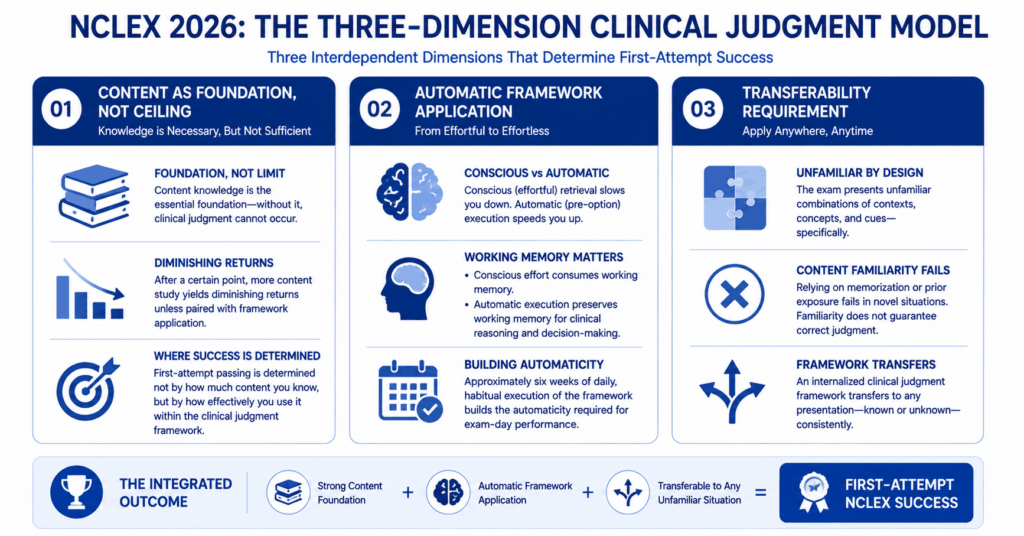
The centrality of clinical judgment in NCLEX 2026 does not mean that clinical content knowledge is unimportant — it means that clinical content knowledge is necessary but not sufficient, and that preparation investment in clinical content review produces diminishing returns beyond the point where content knowledge is adequate to support framework application to novel clinical scenarios. A candidate who completes comprehensive review of every cardiovascular nursing topic has built the content substrate that cardiovascular NCLEX 2026 questions require. That content review does not build the clinical reasoning framework application that converts cardiovascular knowledge into correct answers on cardiovascular questions the candidate has not specifically encountered before. Clinical content preparation is foundational. Clinical judgment preparation is where first-attempt passing is actually determined for the majority of well-prepared candidates whose content knowledge is adequate but whose framework application is inconsistent or insufficiently automatic under adaptive exam conditions.
What Automatic Framework Application Looks Like
The NCLEX 2026 new reality for clinical judgment means that the preparation goal is not conscious, effortful framework application — it is automatic framework application that does not consume the working memory resources that clinical reasoning under time pressure requires. A candidate who must consciously retrieve the three-tier priority hierarchy before every priority question and deliberately work through each tier before engaging any option is using working memory for framework retrieval rather than for clinical reasoning application — and this working memory competition degrades both the framework application and the clinical reasoning quality simultaneously. A candidate whose three-tier priority hierarchy fires automatically before every priority question — whose first cognitive response to a priority question stem is an immediate, unconscious scan for ABC threats before the question is fully read — has the automatic framework application that the NCLEX 2026’s adaptive difficulty and temporal pressure require. The preparation behavior that most directly builds this automaticity is consistent, deliberate application of the pre-option sequence (question layer identification, framework activation, physiological urgency scan, preliminary prediction) to every practice question across six weeks of preparation — not occasional conscious application but daily habitual execution that conditions the sequence into the automatic response pattern that exam-day conditions demand.
The Transferability Requirement
A third dimension of the clinical judgment centrality in NCLEX 2026 is the transferability requirement — the examination consistently presents clinical scenarios in unfamiliar combinations of content, patient populations, and clinical contexts specifically to test whether clinical judgment is transferable across novel presentations or only reliable in familiar ones. The candidate who has encountered a specific heart failure presentation 40 times in practice and learned the correct nursing priority for that presentation has content familiarity. If the NCLEX 2026 presents heart failure in an unfamiliar patient context — a postpartum patient, a pediatric patient with a congenital cardiac defect, an elderly patient with multiple comorbidities that complicate the standard priority sequence — the content-familiar candidate may miss the question because the familiar presentation pattern is not present. The candidate who has internalized the clinical judgment framework independently of specific presentation patterns will derive the same correct priority from the unfamiliar presentation as from the familiar one, because the framework is doing the work that pattern recognition cannot do in novel contexts. This transferability is the clinical judgment dimension that NCLEX 2026 preparation must specifically develop — and it is developed through deliberate framework internalization and novel scenario exposure, not through accumulated familiarity with specific scenario types.
Reality 5: Passing the NCLEX 2026 Is Genuinely Meaningful
In the anxiety and frustration that NCLEX 2026 preparation can generate, it is easy to lose sight of what passing the examination actually represents — and why the current examination’s explicit clinical judgment measurement makes that representation more meaningful than at any previous point in the examination’s history.
What a Passing Result Confirms
A passing NCLEX 2026 result confirms that the candidate demonstrated clinical reasoning ability above the entry-level minimum safe practice standard across a sufficient number of questions — including a substantial proportion of NGN format questions measuring the six CJMM cognitive skills — for the adaptive algorithm to reach 95 percent statistical confidence that their ability estimate is above the passing standard. In practical terms, this means: the candidate can recognize clinically significant data within complex patient presentations, analyze what that data means about the patient’s clinical condition, prioritize competing clinical concerns by urgency rather than probability, generate appropriate nursing interventions for identified clinical priorities, select the correct nursing action for the specific clinical moment, and evaluate whether nursing actions achieved their intended outcomes. These six capabilities are the foundational requirements of safe entry-level nursing practice in every clinical setting. A candidate who can demonstrate them at or above the passing standard across the adaptive algorithm’s item selection has confirmed a genuine clinical competency that professional nursing practice will require.
The License Is the Beginning, Not the End
The NCLEX 2026 result — whether passing or not-passing — is a clinical competency measurement at a specific point in a nursing professional’s development, not a permanent assessment of nursing potential or clinical capability. A passing result is the credential that enables the beginning of professional nursing practice and the clinical experience that builds on the entry-level clinical judgment the examination confirmed. A not-passing result is a specific preparation gap identified with precision that a structured second preparation can address — not a judgment on the candidate’s fitness for nursing as a profession. Both outcomes are preparation and development data rather than fixed measures of clinical potential, and both are best responded to with the same orientation: what does this result tell me about my clinical reasoning competency at this moment, and what preparation or professional development addresses the gap it identifies? This orientation converts the examination result from an anxiety-generating judgment into the clinical performance data it is designed to provide.
The Current Examination Reflects What Patients Need
The NCLEX 2026 represents the NCSBN’s evidence-based attempt to confirm that every nurse entering professional practice has the clinical judgment architecture that patient safety requires — not merely the content knowledge that nursing school examinations assess. The six CJMM cognitive skills were identified through research on the clinical judgment failures associated with adverse patient outcomes at the entry-level, and the NGN format types were designed to assess those skills in ways that single-best-answer questions could not. A candidate preparing for the NCLEX 2026 with the understanding that the examination is designed to protect patients — that every question in the adaptive session is attempting to confirm that the candidate has the cognitive architecture to make sound clinical decisions in patient care — approaches the examination with a professional orientation that is both more accurate and more motivating than the anxiety-driven examination avoidance that preparation pressure sometimes generates. The NCLEX 2026 is testing something real. Preparing for it develops something real. And passing it confirms something real — the beginning of clinical competency at the minimum standard required for the care of real patients.
- The most accurate single description of the NCLEX 2026: A clinical judgment measurement instrument that uses adaptive item selection, multiple question formats with partial credit scoring, and the CJMM six-skill framework to confirm with 95 percent statistical confidence that a candidate’s clinical reasoning ability is above the minimum standard required for safe entry-level nursing practice. Everything about how to prepare for it, how to sit it, and how to interpret its results flows from understanding this description accurately rather than from any of the characterizations — too hard, unfair, arbitrary, a gatekeeping obstacle — that anxiety and frustration sometimes substitute for it.
- The most important shift in how to think about the NCLEX 2026: From examination to avoid to competency to develop. A candidate who approaches the NCLEX 2026 as an obstacle to be strategically navigated will prepare differently from a candidate who approaches it as a clinical judgment standard to be genuinely developed. Both may pass, but the second candidate is developing the competency that nursing practice will require rather than the test-taking skill that examination navigation optimizes for — and the second candidate is better prepared for the clinical environment that awaits them after the credential is obtained.
- What the NCLEX 2026 trajectory means for current preparation investments: The NCSBN’s stated trajectory is toward progressively increasing clinical judgment measurement precision across future test plan cycles. The CJMM framework and NGN format architecture established in 2023 and expanded in 2026 are the stable foundation on which future updates will build rather than a transitional format that will be replaced. Preparation that builds genuine CJMM cognitive skill fluency is not just preparing for the 2026 examination — it is building the clinical judgment architecture that nursing practice requires and that future licensure measurement cycles will continue to assess.
Conclusion
The new reality of the NCLEX 2026 is, in its most essential form, a more honest examination than its predecessors — one that explicitly measures the clinical judgment that nursing practice requires, that uses an adaptive algorithm and partial credit scoring to gather more nuanced competency evidence than binary correct-or-incorrect scoring could provide, and that produces a passing result that confirms a specific, decomposable set of cognitive skills rather than a general impression of clinical preparedness derived from performance on single-best-answer questions.
Understanding this landscape — the explicit judgment measurement, the preparation behavior patterns that predict passing, the resource ecosystem and how to navigate it, the centrality of transferable clinical judgment over content familiarity, and the genuine professional meaning of the credential — is the orientation that makes every other preparation decision more efficient and more accurately targeted. The NCLEX 2026 is not a harder version of an old examination. It is a better measurement instrument for a real clinical competency that patients and the nursing profession need entry-level nurses to have. Preparing for it with that understanding is the orientation that produces the most efficient preparation trajectory, the most accurate readiness assessment, and the most professionally meaningful outcome when the passing result arrives.
