

NCLEX preparation produces a wide range of first-attempt outcomes across candidates who appear to have invested similar preparation effort — and the behavioral differences that explain the performance spread are more specific and more reproducible than the vague explanations of natural ability, intelligence, or clinical aptitude that most people reach for when they notice the variation. High-performing NCLEX candidates are not simply smarter than average-performing candidates or more naturally suited to clinical reasoning. They are candidates whose specific preparation behaviors extract more clinical reasoning development per hour of preparation time than the behaviors of average-performing candidates — and those specific behaviors are identifiable, describable, and learnable.
The behavioral analysis of what high-performing NCLEX candidates do differently from average candidates is not a study of exceptional people — it is a study of effective preparation behaviors that any candidate can adopt. The high-performing candidate who passes the NCLEX 2026 at 75 questions with an accuracy trend that was consistently above 62 percent across the final three weeks of preparation did not achieve that outcome through preparation volume that overwhelmed average candidates. They achieved it by consistently applying a specific set of preparation behaviors that extracted maximum clinical reasoning development from each practice session, each rationale review, and each weekly planning cycle. Every one of those behaviors is described in this guide.
This guide identifies eight specific behavioral differences that distinguish high-performing NCLEX preparation from average-performing preparation — not as aspirational principles but as concrete, actionable practices that can be adopted immediately and that produce measurable accuracy improvement within two weeks of consistent application. Each behavior is described with sufficient specificity to implement directly, with the mechanism that explains why it produces better clinical reasoning development than the alternative behavior that most candidates default to.
Behavior 1: They Treat Every Question as a Clinical Reasoning Development Event
What Average Candidates Do
Average-performing NCLEX preparation candidates use practice questions primarily as accuracy measurement events — completing sessions to generate the accuracy percentage that tells them how prepared they are, rather than as clinical reasoning development events that actively build the competency the examination measures. The behavioral signature of this approach is reading the correct answer rationale to confirm the answer and moving to the next question. This approach produces the subjective experience of preparation productivity while extracting approximately 20 percent of the available clinical reasoning development from each question — the 20 percent contained in reading the correct answer’s rationale alone.
What High-Performing Candidates Do
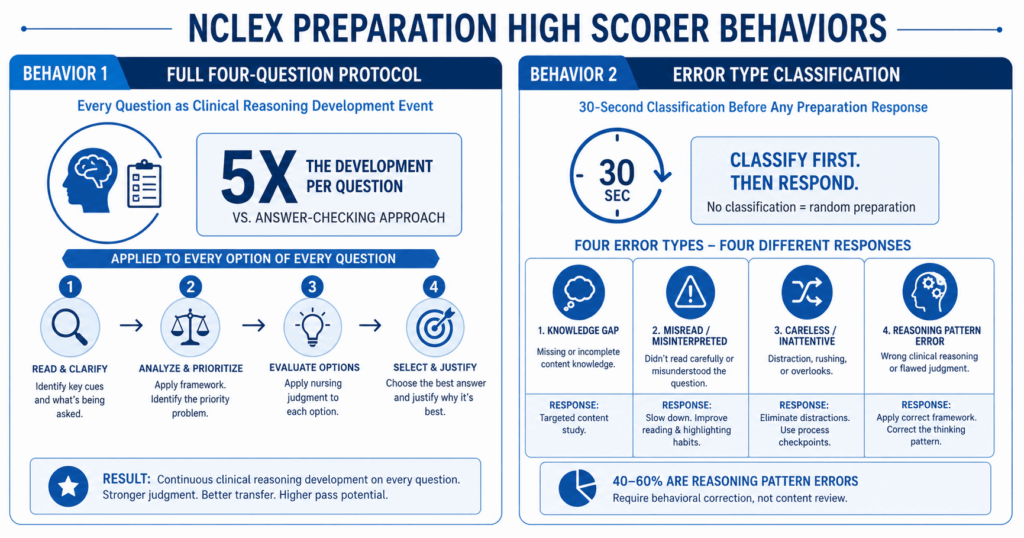
High-performing NCLEX preparation candidates treat every practice question as a clinical reasoning development event that is five times more valuable than the correct answer rationale alone. After every question regardless of whether it was correct or incorrect, they apply the complete four-question analytical protocol: what specific clinical principle did the correct option apply to this specific patient, why does each incorrect option fail for this specific patient in this specific scenario rather than in general, what reasoning error type would lead a candidate to select each distractor, and what clinical principle transfer does this question teach for novel scenarios the candidate has not yet encountered. This protocol is applied to every option of every question — which is why high-performing candidates consistently extract more clinical reasoning development from 1,200 questions than average candidates extract from 3,000. The question is not the unit of preparation value — the options within the question are the units of preparation value, and the full four-question protocol extracts all of them.
Behavior 2: They Classify Errors Before Deciding the Response
What Average Candidates Do
When average-performing NCLEX preparation candidates encounter an incorrect answer, their default response is to study the relevant clinical content more — returning to content review in the content area where the question fell. This default is reinforced by the subjective experience that incorrect answers reveal what the candidate does not know, and that knowing more clinical content would have produced the correct answer. This reasoning is accurate for the minority of incorrect answers produced by genuine knowledge gaps. It is inaccurate for the majority of incorrect answers produced by reasoning pattern errors, patient context errors, and NGN cognitive skill errors — error types that additional content review does not address because the clinical content was not absent, it was misapplied.
What High-Performing Candidates Do
High-performing NCLEX preparation candidates classify every incorrect answer by error type before deciding any preparation response: knowledge gap (content genuinely absent — content review is appropriate), reasoning pattern error (content present but misapplied through incorrect priority framework, wrong nursing process step, or psychosocial priority before physiological — behavioral correction practice is appropriate), patient context error (correct clinical reasoning applied to the wrong interpretation of the specific patient’s scenario data — deliberate stem reading practice with physiological urgency scan is appropriate), or NGN cognitive skill error (wrong CJMM skill applied to an NGN format question — skill-specific practice and action verb identification habit are appropriate). This 30-second classification per incorrect answer produces the preparation intelligence that accurate gap analysis requires. High-performing candidates consistently discover through their error logs that reasoning pattern errors account for 40 to 60 percent of their incorrect answers — which means that 40 to 60 percent of their preparation responses should be behavioral correction practice rather than content review. This discovery is only available through systematic error classification.
Behavior 3: They Build and Maintain a Personalized Anki Deck
What Average Candidates Do
Average-performing NCLEX preparation candidates rely primarily on repeated reading and re-reading of content review materials to consolidate clinical knowledge — reviewing the same review book sections, re-watching the same content videos, or re-reading rationale explanations from previous sessions. This passive review approach produces the subjective experience of familiarity with material (which feels like preparation) while producing significantly less durable long-term memory encoding than active retrieval practice (which produces the retrievable competency that the examination requires).
What High-Performing Candidates Do
High-performing NCLEX preparation candidates build a personalized Anki spaced repetition deck from their own practice session rationale reviews — creating five to eight new cards per session from the clinical reasoning principles that the session’s rationale analysis taught, and reviewing due cards for 15 to 20 minutes every morning before any other preparation activity. The cards are not generic content flashcards (drug name → side effects) but clinical reasoning chains (patient scenario with specific clinical context on the front, three-component reasoning chain including the clinical principle, the correct priority action, and the distractor type that would attract an incorrect answer on the back). This card format encodes not just clinical content but the reasoning application pattern that converts content into correct answers under exam conditions. After six weeks of consistent card creation and daily morning review, high-performing candidates arrive at their exam with a spaced-repetition-consolidated clinical reasoning library built from their own documented preparation gaps — which is the most personalized and most efficiently encoded preparation asset available.
Behavior 4: They Practice Timed from Day One

What Average Candidates Do
Average-performing NCLEX preparation candidates begin timed practice only in the final weeks of preparation — often only in formal simulation sessions — while conducting daily practice sessions at open-ended pace. The reasoning is that careful, unhurried reasoning during practice produces better clinical reasoning development than rushed timed reasoning. This is correct for the clinical reasoning development itself — but it calibrates the reasoning process to a temporal framework that the examination does not accommodate, producing a preparation-to-exam performance gap when the 90-second average clock becomes real for the first time.
What High-Performing Candidates Do
High-performing NCLEX preparation candidates apply timed conditions to every practice session from the first day of preparation — setting a visible 90-second per question timer and checking elapsed time against the milestone benchmarks (approximately 37 minutes at question 25, 75 minutes at question 50) in every session. The first one to two weeks of timed practice feel rushed and produce lower accuracy than untimed practice would — which is expected and temporary. By week three, the clinical reasoning process has calibrated to the examination’s temporal constraints, and timed practice accuracy approaches what untimed practice would have produced. High-performing candidates arrive at the exam with a clinical reasoning process that has been operating at exam pace for six weeks — which means the exam’s clock is a familiar preparation constraint rather than a novel stressor that degrades reasoning quality in the latter half of the session.
Behavior 5: They Integrate NGN Format From the Beginning
What Average Candidates Do
Average-performing NCLEX preparation candidates treat NGN format practice as a supplementary preparation activity deferred until traditional multiple choice practice is well established — often allocating less than 15 percent of daily practice to NGN format items and completing NGN questions as standalone items rather than as full unfolding case study sets. The reasoning is that building traditional multiple choice competency first creates a foundation for NGN practice. This reasoning underestimates how different the cognitive skills NGN formats test are from traditional multiple choice pattern recognition — and underestimates the preparation time required to build NGN-specific fluency to exam-ready levels.
What High-Performing Candidates Do
High-performing NCLEX preparation candidates allocate 30 to 35 percent of every practice session to NGN format items from the first week of preparation — and complete unfolding case study sets as full six-question integrated narratives rather than as individual extracted questions. They apply the CJMM action verb identification habit to every NGN question before reading any option (identifying the action verb, naming the cognitive skill, using the skill identification to determine what the correct answer must demonstrate). They track NGN accuracy separately from traditional format accuracy in every weekly micro-audit, treating it as an independent benchmark requiring above 50 percent performance. High-performing candidates who maintain this integrated approach from day one build NGN cognitive skill fluency over six weeks that improves incrementally and is fully exam-ready by the final simulation — rather than discovering in the final week that NGN format remains structurally confusing despite weeks of traditional practice.
Behavior 6: They Use Weekly Data to Drive Preparation Decisions
What Average Candidates Do
Average-performing NCLEX preparation candidates make preparation allocation decisions based primarily on the subjective experience of which content areas feel weakest — studying the content that generates the most anxiety, spending more time in areas that feel uncertain, and avoiding areas that feel comfortable. This subjective-experience-driven allocation produces preparation that addresses anxiety rather than gaps — because content areas that generate high anxiety are not always the content areas with the lowest accuracy, and content areas with the lowest accuracy are not always the ones generating the highest anxiety.
What High-Performing Candidates Do
High-performing NCLEX preparation candidates conduct a weekly 20-minute micro-audit every Sunday that produces data-driven preparation decisions for the following week. The micro-audit reviews four specific data points: the overall accuracy trend across the week relative to the 55 to 60 percent readiness benchmark, the content category breakdown from the week’s sessions identifying any category below 50 percent accuracy, the NGN-specific accuracy tracked separately, and the error type log showing which error type appeared most frequently. The following week’s preparation allocation is determined entirely by this data: the highest-error content category receives 70 percent of daily question allocation, the most frequent error type receives a specific behavioral correction practice applied to every session, and the NGN accuracy trend determines whether format-specific intervention is needed. High-performing candidates do not study what feels weakest — they study what the data shows is weakest. The distinction produces consistently more efficient preparation gap closure.
Behavior 7: They Apply the Pre-Option Sequence Before Every Question
What Average Candidates Do
Average-performing NCLEX preparation candidates read the question stem and immediately engage the answer options — evaluating options comparatively against each other and against their clinical knowledge before activating the clinical reasoning framework that the question requires. This option-first approach allows distractor engineering to create clinical associations before the framework has been applied, producing the experience of two options seeming equally correct and requiring an arbitrary final choice rather than a framework-derived confident selection.
What High-Performing Candidates Do
High-performing NCLEX preparation candidates apply a consistent 10-second pre-option sequence to every question before reading any answer option: read the question layer first (what clinical decision is being requested — first action, priority assessment, patient teaching, therapeutic response), identify the relevant clinical reasoning framework the question layer activates (physiological hierarchy for priority questions, nursing process for sequence questions, therapeutic communication criteria for communication questions), scan the clinical context specifically for the physiological urgency signal embedded in the stem (the highest-tier clinical finding the framework should be applied to), and form a preliminary answer prediction from the framework application before reading any option. This sequence prevents distractor engineering from creating competing clinical associations before the framework produces its answer — which is why high-performing candidates are significantly less susceptible to the almost-correct distractor and the psychosocial-before-physiological distractor that account for the largest share of reasoning pattern errors in average-performing candidates.
Behavior 8: They Simulate Testing Center Conditions Weekly
What Average Candidates Do
Average-performing NCLEX preparation candidates conduct all daily practice in comfortable home environments — on a couch or in a chair with familiar surroundings, phone accessible, room temperature comfortable, no environmental replication of the testing center’s conditions. Weekly simulations, when conducted, are also done in these comfortable home environments rather than under conditions that approximate the testing center. The result is a significant environmental gap between preparation conditions and examination conditions — which produces the preparation-to-exam performance gap that many average-performing candidates report as the exam feeling harder than practice suggested it would.
What High-Performing Candidates Do
High-performing NCLEX preparation candidates deliberately simulate testing center conditions during every weekly full-length simulation: sitting at a desk (not a couch), removing all personal devices from the workspace before beginning, setting room temperature slightly cooler than comfortable, using only a visible timer for pacing, and applying the interquestion reset after every question throughout the session. They also apply the interquestion reset during daily practice sessions to condition it as an automatic habit rather than a deliberate technique that requires working memory resources on exam day. By exam day, the testing center’s physical demands and timing constraints are familiar preparation conditions rather than novel stressors — which is why high-performing candidates consistently show smaller gaps between their practice accuracy and their exam-day performance than average-performing candidates whose entire preparation occurred under comfortable home conditions.
The Common Thread: Deliberate Practice Over Volume Practice
Every behavioral difference between high-performing and average-performing NCLEX preparation candidates reflects the same underlying distinction: deliberate practice over volume practice. Deliberate practice is characterized by specific goals for each session (developing the pre-option framework habit, reducing the frequency of reasoning pattern errors, building NGN case study integration), immediate feedback on performance quality (error type classification after every incorrect answer, CJMM skill identification confirmed against rationale), and consistent operation at the upper boundary of current competency (timed conditions that challenge but do not overwhelm, question difficulty that probes current clinical reasoning limits). Volume practice is characterized by completion goals rather than quality goals, post-hoc rationale review rather than real-time performance feedback, and operating within familiar patterns rather than at competency boundaries.
The research on deliberate practice in skill acquisition consistently shows that deliberate practice produces expertise development at a rate that volume practice — regardless of the volume — cannot match. This principle applies to NCLEX preparation with specific force: the exam measures clinical judgment as a skilled, framework-applied cognitive competency rather than as a body of information to be recalled. Competency development through deliberate practice is the preparation investment that the examination rewards — and it is the behavioral distinction that separates high-performing NCLEX preparation from average-performing NCLEX preparation more reliably than any difference in intelligence, clinical experience, or preparation resources.
- The fastest single behavior adoption for most candidates: Apply the complete four-question rationale protocol to every incorrect answer in tomorrow’s preparation session — not just checking the correct answer rationale but analyzing why each distractor fails for this specific patient, naming the reasoning error type each distractor targets, and identifying the clinical principle transfer each question teaches. This single behavior, applied consistently for two weeks, produces more measurable accuracy improvement than any other single preparation behavior change because it converts the highest-value preparation events (incorrect answers) from information-checking to clinical reasoning development.
- The behavior that separates top-quintile from top-decile performers: Building a personalized clinical reasoning Anki deck from their own documented preparation gaps — not from a pre-built shared deck but from the specific clinical principles their own practice sessions identified as absent or misapplied. The personalization is the performance driver: a deck built from your own gaps addresses your specific preparation profile rather than the average candidate’s profile, which makes every card review session more efficiently targeted than any generic deck can be.
- How to start adopting these behaviors without overhauling your entire preparation approach: Adopt one behavior per week in order — week one: add the four-question protocol to incorrect answers only. Week two: add error type classification for every incorrect answer. Week three: shift all sessions to timed conditions. Week four: add Anki card creation from each session. Week five: increase NGN proportion to 30 to 35 percent and track separately. Week six: add the pre-option sequence to every question. By the end of week six, all eight behaviors are in place through gradual adoption that does not require an overwhelming overnight change.
Conclusion
The behaviors that distinguish high-performing NCLEX preparation candidates from average-performing candidates are not expressions of exceptional intelligence or natural clinical talent. They are specific, learnable, immediately adoptable preparation behaviors that extract more clinical reasoning development from each hour of preparation time than the default behaviors that most candidates use. Every question as a clinical reasoning development event rather than an accuracy measurement. Error classification before preparation response rather than automatic content review. Personalized Anki deck built from own gaps rather than passive repeated reading. Timed practice from day one rather than open-ended sessions. NGN integration as a daily primary requirement rather than a supplementary afterthought. Weekly data driving preparation allocation rather than anxiety and subjective experience. Pre-option sequence applied before every question rather than immediate option engagement. Testing center simulation weekly rather than comfortable home-only practice.
These eight behaviors are available to every candidate. They do not require additional resources, additional intelligence, or additional hours. They require replacing eight default preparation habits with eight more effective ones — and the two-week accuracy improvement that consistent adoption produces is the empirical confirmation that the replacement was worthwhile. Start with the four-question rationale protocol tomorrow. Build from there. The high-performing NCLEX preparation approach is not something candidates either have or do not have — it is something they do or do not do. Doing it is entirely within reach.
