

The readiness question — am I actually ready to sit the NCLEX? — is one that almost every nursing candidate answers incorrectly, in both directions. The candidate who is genuinely ready feels underprepared because exam anxiety is generating a subjective inadequacy signal that is not grounded in preparation data. The candidate who is not yet ready feels increasingly ready because the accumulation of preparation hours generates a subjective confidence signal that is not grounded in clinical reasoning development. Both feelings are unreliable guides to the readiness decision — not occasionally unreliable but systematically unreliable, produced by mechanisms that consistently distort the subjective experience of preparation adequacy in predictable directions.
The reliable readiness signal is not a feeling. It is a pattern in your NCLEX practice test data — a specific combination of accuracy, trend, format performance, and simulation performance that correlates with first-attempt passing far more reliably than any subjective experience of feeling ready. Understanding exactly what that pattern looks like, how to read it accurately from your own preparation data, and how to distinguish the reliable data signal from the unreliable feeling signal is the preparation decision-making skill that converts NCLEX preparation investment into a confident, data-supported proceed decision.
This guide builds the complete readiness assessment framework: why the feeling of readiness is unreliable in both directions, the four specific NCLEX practice test data benchmarks that correlate with first-attempt passing, how to read each benchmark correctly including the common misreadings that produce either premature proceed decisions or unnecessary preparation extensions, how the NCLEX practice test simulation specifically confirms exam-day readiness in ways that daily practice data cannot, and the decision framework that converts your data into a clear proceed or extend determination without the anxiety-driven ambiguity that most candidates experience.
Why the Feeling of Readiness Is the Wrong Signal
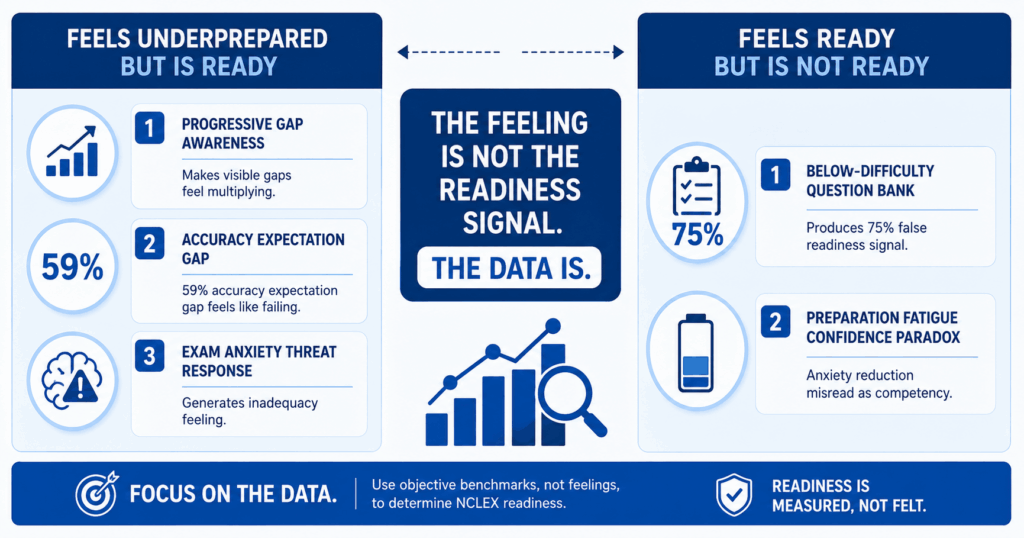
Before building the accurate readiness assessment, understanding why subjective readiness feelings are systematically unreliable in both directions prevents the most consequential readiness decision errors.
Why Ready Candidates Feel Unprepared
Three specific mechanisms systematically produce the feeling of being underprepared in candidates who have actually met all readiness benchmarks. The first is progressive gap awareness: as preparation develops, the candidate becomes increasingly aware of clinical gaps they could not previously identify — which creates the subjective impression that gaps are multiplying when they are actually becoming more precisely visible. A candidate who could not identify their pharmacology reasoning error pattern in week one has no subjective sense of a gap; a candidate who has identified and is actively correcting that error pattern in week four has a vivid, specific sense of remaining inadequacy. The more clinically aware the preparation has made the candidate, the more inadequate they feel — which is the exact opposite of the relationship the feeling implies. The second mechanism is the accuracy expectation gap: nursing school trains candidates to associate passing with 75 to 80 percent accuracy, but NCLEX readiness corresponds to approximately 55 to 60 percent on a well-calibrated NCLEX practice test bank. A candidate achieving 59 percent consistently feels significantly below the standard they have internalized from years of academic assessment, despite being at or above the actual readiness threshold. The third mechanism is exam anxiety’s threat response: the approaching examination activates a physiological threat response that the prefrontal cortex interprets as evidence of danger, producing feelings of unpreparedness as an emotional output of the threat activation rather than as an accurate assessment of clinical competency.
Why Underprepared Candidates Feel Ready
The opposite distortion — feeling ready without meeting readiness benchmarks — is produced by two different mechanisms. The first is practice question difficulty mismatch: a candidate using a question bank calibrated below the NCLEX’s actual difficulty level will achieve accuracy in the 70 to 80 percent range that matches the nursing school passing standard they have internalized, generating a subjective readiness signal from a difficulty discrepancy rather than from genuine NCLEX-level clinical reasoning competency. Every point of accuracy above 65 percent on a below-difficulty question bank is a false readiness signal — it reflects content familiarity in familiar scenarios rather than clinical judgment application at NCLEX difficulty. The second mechanism is the preparation-fatigue confidence paradox: candidates in the late stages of a long preparation period often report feeling increasingly confident not because their clinical reasoning is improving but because preparation fatigue has reduced the anxiety that was making them feel underprepared. This confidence-from-reduced-anxiety is indistinguishable subjectively from confidence-from-genuine-competency — which is precisely why the objective NCLEX practice test data must govern the readiness decision rather than the subjective experience of confidence.
The Four Readiness Benchmarks: What Your Data Must Show

Four specific NCLEX practice test data benchmarks correlate with first-attempt passing more reliably than any other available readiness signal. Meeting all four is the data-based proceed signal. Failing to meet any one is the data-based extend signal — regardless of how ready the candidate feels.
Benchmark 1: Overall Accuracy Above 55 to 60 Percent With Upward Trend
The first benchmark is overall practice question accuracy above 55 to 60 percent on a well-calibrated NCLEX practice test bank, maintained across at least three consecutive weeks with an upward or stable trend. Both components of this benchmark are necessary — the threshold and the trend. Accuracy above 55 to 60 percent confirms that current clinical reasoning performance is at or approaching the NCLEX passing standard on questions calibrated to the examination’s actual difficulty. The three-week trend confirmation ensures the accuracy is a stable performance indicator rather than a high-variance single session result — a single NCLEX practice test session above 60 percent could reflect a favorable question selection, a particularly well-rested session, or random variance rather than stable clinical reasoning competency at that level. Three consecutive weeks above threshold with stable or improving trend is the data pattern that indicates genuine, consistent clinical reasoning development at the passing level. A candidate whose accuracy is 62 percent but has been flat or declining for three weeks has a more concerning readiness signal than a candidate whose accuracy is 57 percent and rising steadily — because the trend reflects the trajectory of clinical reasoning development, which is a more reliable exam-day performance predictor than any single point-in-time accuracy measurement.
Benchmark 2: No Content Category Below 50 Percent
The second benchmark is accuracy at or above 50 percent in every content category in the most recent NCLEX practice test simulation’s content breakdown — no exceptions for categories where overall accuracy is high. This benchmark exists because the NCLEX’s adaptive algorithm selects questions from across all content categories, and below-standard performance in any single category contributes below-standard ability evidence to the cumulative ability estimate regardless of how strongly other categories perform. A candidate who is at 65 percent overall but has pharmacology at 38 percent and mental health at 41 percent is carrying two below-standard categories that will produce below-standard ability evidence whenever the algorithm selects items from those categories — which it will, across multiple content area touches throughout the adaptive session. The category-specific benchmark requires different diagnostic response depending on gap type: knowledge gaps in below-standard categories require targeted content review, while reasoning pattern errors producing below-standard performance in specific categories require behavioral correction practice applied specifically to those content areas.
Benchmark 3: NGN Accuracy Above 50 Percent Tracked Separately
The third benchmark is NGN format accuracy above 50 percent, tracked as a separate metric from overall accuracy in every NCLEX practice test session. This benchmark requires separate tracking because NGN format accuracy is invisible within aggregate accuracy numbers — a candidate with 60 percent overall accuracy composed of 68 percent traditional and 44 percent NGN has not met the NGN benchmark and is significantly underprepared for the format that constitutes approximately 30 percent of their exam session. NGN accuracy below 50 percent signals one or more specific preparation deficiencies: unfamiliarity with CJMM cognitive skill identification (which produces incorrect CJMM skill application across all NGN formats), failure to complete unfolding case study sets as integrated narratives (which produces correct individual question reasoning without the cumulative case narrative that the format tests), or misapplication of partial credit response strategy (selecting options based on general clinical plausibility rather than independent criteria evaluation against the specific patient context). Each of these produces NGN-specific below-standard performance that traditional question improvement will not address — which is why the separate tracking is essential.
Benchmark 4: Passing-Range NCLEX Practice Test Simulation Within Two Weeks
The fourth benchmark is a passing-range result on at least one full-length NCLEX practice test simulation — 100 or more questions under timed exam-realistic conditions — completed within two weeks of the scheduled exam date. This benchmark confirms two things that daily practice session performance cannot: that clinical reasoning quality is maintained across the cognitive stamina demands of a full adaptive exam session length, and that the clinical reasoning built during preparation survives the anxiety, pacing pressure, and environmental demands of an exam-condition simulation. A candidate whose daily 50-question sessions consistently produce above-threshold accuracy but whose 100-question simulations produce significantly lower accuracy has an exam-day performance gap that the daily practice data alone would not have revealed — and that the simulation benchmark specifically catches before the actual examination reveals it at the cost of a not-passing result. The passing-range simulation is not a celebration milestone — it is the final verification that preparation transfers to exam-condition performance.
How to Read Your NCLEX Practice Test Data Accurately
Meeting the benchmarks requires reading the data accurately — and several common misreadings produce either premature proceed decisions or unnecessary preparation extensions that both have real costs.
The Question Bank Calibration Check
The most important accuracy data accuracy check is verifying that your primary NCLEX practice test bank is calibrated to NCLEX difficulty rather than to below-NCLEX difficulty. A bank producing 70 to 80 percent accuracy for a candidate who has not yet built NCLEX-level clinical reasoning is producing a false readiness signal — and meeting the 55 to 60 percent benchmark on a below-difficulty bank does not constitute meeting the benchmark. The calibration check is simple and free: complete 25 to 30 of the NCSBN official sample questions available at ncsbn.org and compare your accuracy on those official samples to your accuracy on your primary bank. If your accuracy on the official NCSBN samples is significantly lower than on your question bank, your bank’s difficulty calibration does not match the current examination standard and your benchmark thresholds should be interpreted with that discrepancy in mind. The leading question banks with established current-examination difficulty calibration — UWorld, Kaplan, ATI — produce accuracy in the 55 to 65 percent range for well-prepared candidates rather than the 70 to 80 percent range that indicates below-NCLEX difficulty.
Trend vs. Point-in-Time Accuracy
A critical misreading of NCLEX practice test accuracy data is evaluating point-in-time accuracy rather than accuracy trend. A single session at 63 percent accuracy could reflect a favorable question selection, an unusually well-rested preparation day, or random variance rather than genuine stable clinical reasoning at that level — and making the proceed decision from a single high-performing session is the most common source of premature proceed decisions that produce not-passing results. The accurate readiness read requires plotting accuracy across consecutive weekly data points: is the trend upward, stable, or declining? An upward trend from 52 percent in week one to 57 percent in week three to 61 percent in week five represents consistent clinical reasoning development across the preparation period, regardless of what any single session in that period showed. A flat trend at 62 percent that has not moved in four weeks may indicate that preparation quality has plateaued and that a different preparation approach is needed despite the above-threshold accuracy number. Read the trajectory, not the latest data point.
The NGN Accuracy Split Calculation
Calculating the NGN accuracy split from NCLEX practice test session data requires manual tracking if the question bank does not automatically separate NGN accuracy from traditional accuracy in its analytics. The manual tracking method is straightforward: at the end of each session, note the total number of NGN format questions completed and the number answered correctly (this information is available in most platforms’ question-by-question review), calculate NGN accuracy as a separate percentage, and record it alongside the overall session accuracy in the weekly log. After three weeks of separate tracking, the NGN accuracy trend is visible and directly comparable to the traditional format accuracy trend — which immediately reveals whether a gap exists and whether targeted NGN-specific preparation is reducing it. Candidates who discover through this tracking that their NGN accuracy has been 15 to 20 percentage points below their traditional accuracy for three weeks of preparation have identified a readiness gap that the aggregate overall accuracy number was completely concealing.
What Your Full Simulation Is Really Telling You
The full-length NCLEX practice test simulation is the most information-rich readiness assessment available — but only when it is conducted and interpreted correctly. Most candidates misread their simulations in ways that either inflate or deflate the readiness signal the simulation is actually providing.
How to Conduct a Valid Readiness Simulation
A valid NCLEX practice test readiness simulation requires conditions that approximate the actual examination as closely as possible: a desk rather than a couch, all personal devices removed from the workspace, room temperature set slightly cooler than comfortable, a visible countdown timer providing the pacing reference, the interquestion reset applied after every question, and no access to rationale explanations during the session. These conditions matter because the simulation’s value as a readiness assessment depends on it measuring the clinical reasoning quality that exam-day conditions will produce — not the clinical reasoning quality that comfortable home preparation conditions produce. A simulation conducted on a couch with the phone beside you and no time pressure is measuring preparation-condition performance, not exam-condition performance. The gap between preparation-condition and exam-condition performance is what the environmental simulation specifically closes — which is why the simulation’s validity as a readiness assessment depends entirely on how closely it replicates the actual examination’s physical demands.
Reading the Simulation’s Five-Metric Scorecard
The complete readiness information from a full NCLEX practice test simulation requires reading five specific metrics rather than only the overall accuracy number. First, overall accuracy compared to the 55 to 60 percent threshold and to the previous simulation’s overall accuracy — is it at threshold and is the trend positive? Second, content category breakdown — does any category fall below 50 percent? Third, NGN-specific accuracy calculated separately — is it above 50 percent? Fourth, pacing data from the milestone clock checks — was the session on pace at each of the four milestone checkpoints, or did time pressure accumulate? Fifth, reasoning quality in the final 30 questions compared to the first 30 — is there measurable quality decline in the latter portion of the session that indicates insufficient cognitive stamina? These five metrics together provide a comprehensive readiness picture that the overall accuracy number alone cannot. A passing-range simulation that passes the overall accuracy threshold but shows a content category at 38 percent, NGN accuracy at 43 percent, and noticeable reasoning quality decline in the final 30 questions is not a go signal — it is a detailed prescription for exactly which preparation gaps remain.
When to Schedule Your Exam After a Passing Simulation
When a full NCLEX practice test simulation passes all five metrics of the scorecard and is the third consecutive week in which all four benchmarks have been met, the exam should be scheduled within the next two to three weeks — not extended for additional preparation and not scheduled for the following day. The two-to-three-week window after benchmark confirmation allows the final week taper protocol (simulation at day 7, targeted consolidation at days 6 and 5, error log crystallization and logistics at days 4 and 3, physiological recovery at days 2 and 1) to convert the prepared nervous system from a preparation state to a performance state. Scheduling too far beyond the benchmark confirmation window accumulates additional preparation without additional readiness and risks the cognitive fatigue that extended preparation without a near-term endpoint produces. Scheduling too close to the benchmark confirmation does not allow the taper to restore the cognitive freshness that exam-day performance requires.
The Proceed vs. Extend Decision Framework
Converting benchmark data and simulation performance into a clear proceed or extend decision requires a structured framework that prevents anxiety from overriding the data in either direction.
The Data-Based Proceed Decision
The proceed decision is data-supported when all four benchmarks are met for three consecutive weeks and the most recent full NCLEX practice test simulation passes all five scorecard metrics. A candidate in this position has objective evidence that their clinical reasoning is consistently performing at or above the NCLEX passing standard, that no content category is producing systematically below-standard ability evidence, that NGN-specific clinical judgment competency has been developed to the benchmark level, and that the clinical reasoning quality built during preparation survives the full cognitive demands of exam-condition simulation. This evidence base does not guarantee a passing result — no evidence base can guarantee an adaptive examination’s outcome — but it is the strongest available data-based readiness confirmation, and proceeding to the exam with this data in hand is the most informed and most justified decision available to any candidate. The feeling of unpreparedness that coexists with this evidence is exam anxiety, not accurate clinical assessment. The data is the reliable signal.
The Data-Based Extend Decision
The extend decision is data-supported when any of the four benchmarks is unmet with two or fewer weeks remaining before the scheduled exam date, or when the most recent full NCLEX practice test simulation fails any metric of the five-metric scorecard with one or fewer weeks remaining. A candidate who has met three of the four benchmarks but whose NGN accuracy has been at 43 percent for three consecutive weeks has a specific, identifiable preparation gap that targeted two-week NGN intervention can specifically address — and that proceeding to the exam without addressing will produce below-standard ability evidence from the NGN items that constitute approximately 30 percent of the exam session. The cost comparison is direct: the financial and timeline cost of a two-week extension plus additional NGN-specific preparation is consistently less than the combined cost of a not-passing result (45-day wait, retesting fee, second preparation period, psychological impact). The data supports the extension when the benchmarks identify a specific closeable gap within a realistic extension period.
Breaking Through Anxiety-Driven Decision Paralysis
The most common failure mode of the proceed-or-extend decision is anxiety-driven paralysis — the indefinite extension of preparation by candidates who have met all four benchmarks but cannot resolve the subjective sense of inadequacy that exam anxiety generates. This paralysis has real costs: accumulated cognitive fatigue from extended preparation, progressively diminishing returns from additional practice sessions after benchmarks are met, and increasing anxiety as the exam date recedes without a clear commitment. The framework resolution for anxiety-driven paralysis is explicit: if all four benchmarks are met for three consecutive weeks and the most recent simulation passes all five scorecard metrics, the extend decision is not supported by any available data. The anxiety is real and should be acknowledged — but it is not evidence of preparation inadequacy. Schedule the exam. Trust the benchmarks. The data says you are ready even if the feeling does not.
- How to track the four benchmarks without a formal tracking system: A simple weekly spreadsheet with five columns — Week, Overall Accuracy, Content Category Minimum, NGN Accuracy, Simulation Result — records all the data the four-benchmark readiness assessment requires. Fill in the column values every Sunday after the weekly micro-audit. When four consecutive rows show all four benchmarks met, the proceed decision is data-supported. This tracker takes five minutes per week to maintain and produces the most reliable readiness assessment available from preparation data.
- What a passing NCLEX practice test simulation score actually means: A passing-range simulation score from a well-calibrated question bank confirms that clinical reasoning quality at exam condition difficulty is at or above the passing level for a full session length. It does not guarantee an identical outcome on the actual NCLEX — the adaptive algorithm’s specific item selection, the testing center’s environmental conditions, and the candidate’s exam-day psychological state all influence actual performance. But a passing-range simulation on a well-calibrated bank under exam-condition environmental simulation is the single strongest available predictor of first-attempt passing — more reliable than any other preparation metric, including total question count, preparation timeline, and subjective readiness feeling.
- The one question that cuts through readiness ambiguity: If a trusted clinical mentor or experienced NCLEX tutor who had full visibility into your preparation data — your accuracy trend, your content category breakdown, your NGN accuracy, your simulation results — were to make the proceed or extend decision for you, what would they decide? This question removes the anxiety from the decision-making process by substituting a data-evaluating perspective for the feeling-evaluating perspective that anxiety distorts. In most cases, a candidate who asks this question honestly and reviews their data with the detachment it requires finds a clearer answer than their subjective experience was providing.
Conclusion
The readiness question — am I actually ready for the NCLEX? — has a reliable answer, and that answer is in your NCLEX practice test data rather than in your subjective experience of preparation adequacy. Overall accuracy above 55 to 60 percent on a well-calibrated question bank, maintained across three consecutive weeks with an upward trend. No content category below 50 percent in the most recent simulation’s content breakdown. NGN accuracy above 50 percent tracked separately from traditional format accuracy. A passing-range full simulation under exam-condition environmental requirements within two weeks of the exam date. When all four benchmarks are met for three consecutive weeks, the data says you are ready. The feeling of unpreparedness that coexists with this evidence is exam anxiety — real, valid, and entirely consistent with being genuinely prepared for a high-stakes professional examination.
The candidates who make the best proceed decision — who schedule at the right time, neither prematurely before readiness is confirmed nor indefinitely extended by anxiety that the data does not support — are the candidates who have built a weekly data tracking system, who read that data accurately against the correct benchmarks, and who trust the data over the feeling when they conflict. Build the tracker. Check the benchmarks every Sunday. Conduct valid simulations with all five metrics reviewed. And when the data says proceed — proceed, even if the feeling has a different opinion.
