

Nursing student social media communities have become the primary information source for NCLEX questions, exam format, preparation strategy, and result interpretation for an entire generation of nursing candidates — and the information those communities are generating and amplifying is unreliable, inconsistent, and in several specific cases so systematically wrong that acting on it directly harms first-attempt pass rates. This is not a critique of social media as a medium or of the nursing candidates who share their experiences honestly and with the best intentions. It is a specific critique of what happens when highly individual, non-generalizable exam experiences are presented as reliable information about a psychometrically sophisticated adaptive examination whose design specifically ensures that no two candidates’ exam experiences are meaningfully comparable.
The NCLEX’s adaptive algorithm selects questions from a calibrated item pool based on each individual candidate’s response pattern — which means the exam one candidate experiences is uniquely tailored to that candidate’s ability estimate at every point in the session. When that candidate describes their NCLEX questions on TikTok or in a nursing student forum, they are describing an experience that was specifically constructed for them — and that experience is not transferable as predictive information about any other candidate’s exam. The specific NCLEX questions they encountered, the difficulty level they experienced, the clinical content areas that appeared, and the number of questions they received before the exam ended are all products of their unique response pattern rather than features of a fixed examination that other candidates will encounter in the same form. Yet the social media ecosystem treats these individual experiences as generalizable examination characteristics and amplifies them to audiences of thousands of nursing candidates who use them as preparation and exam-day guidance.
This guide identifies the eight most damaging social media myths about NCLEX questions and the NCLEX examination that are actively harming nursing candidate preparation in 2026 — what each myth claims, why it is wrong, what the accurate information is, and what preparation decision changes when the myth is replaced with accurate information. The authoritative source for every correction in this guide is the NCSBN’s official documentation at ncsbn.org, which is the only reliable reference for current examination specifications.
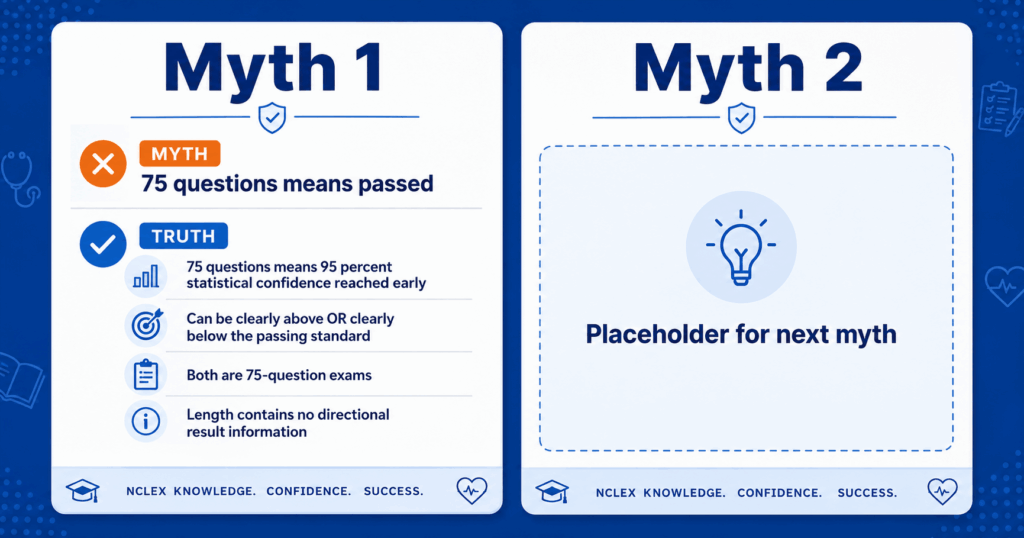
Myth 1: 75 Questions Means You Passed
What Social Media Claims
The most pervasive NCLEX myth on nursing student social media is that an exam ending at 75 questions indicates a passing result — that the minimum question count is a positive performance signal and that candidates whose exams end quickly have performed well enough that the algorithm was confident in a passing determination at the earliest opportunity. This claim appears in countless posts from candidates who received a 75-question exam and passed, who then attribute the passing result to the short exam length as evidence of strong performance.
Why It Is Wrong
The 75-question minimum exam length indicates that the algorithm reached 95 percent statistical confidence in a determination — either above or below the passing standard — with the minimum number of NCLEX questions. Both outcomes are possible. A 75-question exam ending in a passing result reflects a response pattern that rapidly and confidently placed the ability estimate above the passing standard. A 75-question exam ending in a not-passing result reflects a response pattern that rapidly and confidently placed the ability estimate below the passing standard. Both are 75-question exams. The question count at the minimum boundary is a measurement efficiency indicator — it tells you the algorithm was confident, not whether that confidence was in a passing or not-passing direction. The social media myth that 75 questions means passing has caused real harm: candidates who received 75 NCLEX questions and a not-passing result have been confused and distressed by the contradiction between what social media told them the length meant and what the result showed.
The Accurate Information
Exam length — whether 75, 100, or 150 questions — does not reliably indicate the pass or fail direction of the result. The only reliable signal about exam performance during an adaptive NCLEX session is the quality of clinical reasoning applied to each individual question. Exam length should be treated with complete informational indifference during and after the session. Candidates who receive 75 NCLEX questions and feel the session was too easy should not conclude they passed. Candidates who receive 150 NCLEX questions should not conclude they barely passed or failed. Both conclusions are drawn from data that contains no directional result information.
Myth 2: You Can Predict Your Result From How Hard the Questions Felt
What Social Media Claims
A second widespread social media myth about NCLEX questions is that the subjective difficulty of the session predicts the result — that a session that felt hard indicates strong performance (because hard questions reflect above-passing ability tracking) while a session that felt easy indicates concern (because easy questions reflect below-passing ability tracking). Versions of this myth appear as both reassurance (it felt really hard the whole time so I probably passed) and anxiety (it felt easy which is supposedly bad).
Why It Is Wrong
The subjective difficulty of NCLEX questions is not a reliable result predictor because question difficulty is perceived differently by different candidates for reasons unrelated to ability estimate position. A question that a pharmacology-strong candidate finds easy may be at the passing standard difficulty for a candidate with pharmacology gaps. A question that feels hard because of an unfamiliar clinical presentation may test a principle that is well within the candidate’s clinical reasoning competency when presented in a familiar format. Additionally, exam anxiety degrades the cognitive performance of clinical reasoning under pressure — which means a well-prepared candidate may find questions harder than their genuine competency would produce in a lower-anxiety environment, while an anxiety-habituated candidate may find the same difficulty level more manageable. Difficulty perception is an interaction of question difficulty, candidate familiarity with the clinical presentation, and exam-day anxiety state — none of which maps cleanly to ability estimate position.
The Accurate Information
The subjective experience of NCLEX question difficulty during the session is not useful as result-prediction information and should not be interpreted as such. The only preparation-relevant information available about exam performance before the official result is the four readiness benchmarks met during preparation — which predict first-attempt passing more reliably than any in-session experience report.
Myth 3: Specific Question Types Mean You Are Failing

What Social Media Claims
Several specific NCLEX questions format myths have circulated extensively on nursing student social media. Among the most damaging: that receiving many SATA (select all that apply) questions means the exam is tracking you above the passing standard and you are likely passing; that receiving NGN unfolding case study questions means you are doing well because they only appear for candidates performing strongly; and that receiving a large number of a specific clinical content area means the algorithm has identified weakness in that area and is targeting it.
Why Each Claim Is Wrong
None of these claims about specific NCLEX questions formats or content distributions is supported by how the adaptive algorithm works. The algorithm selects questions using the maximum information principle — choosing the question that provides the most evidence about whether the candidate’s ability is above or below the passing standard at that moment — not based on format type or content area in isolation. SATA questions, NGN case studies, and pharmacology-heavy question sequences appear because the algorithm’s information calculations selected them, not because the candidate is performing above or below a threshold in any specific category. The specific NCLEX questions format a candidate receives during the session reveals nothing reliable about their performance level or their likely result.
The Accurate Information
The adaptive algorithm’s question selection is driven entirely by information maximization relative to the passing standard — not by format quotas, not by content area targeting based on identified weaknesses, and not by any signal that should be interpretable by the candidate during the session. Every question, regardless of format or clinical area, is the question that provided the most available information about the ability estimate at that moment. Attempting to interpret question selection patterns as performance signals during an NCLEX session produces mid-session anxiety from information that contains no reliable performance signal.
Myth 4: High Question Volume in Practice Means You Will Pass
What Social Media Claims
Social media nursing communities have amplified the question volume myth to a remarkable degree — posts celebrating completing 3,000, 4,000, or 5,000 practice questions before the NCLEX generate thousands of likes and comments that normalize high volume as the primary preparation metric. The implicit and sometimes explicit message is that completing more NCLEX questions in preparation produces better first-attempt passing rates, and that candidates with the highest question counts have the most thorough and most effective preparation.
Why It Is Wrong
Question volume predicts preparation quality only when each question is accompanied by full analytical rationale review that extracts the clinical reasoning development available from every option of every question. The social media celebration of high question counts almost never mentions rationale review quality — which is the preparation behavior that actually determines how much clinical reasoning development each question produces. A candidate who completes 4,000 NCLEX questions with answer-checking review has built clinical content familiarity and pattern recognition that performs reliably on familiar scenario presentations and fails when the same clinical reasoning framework appears in an unfamiliar presentation. A candidate who completes 1,500 questions with full four-question rationale protocol has built transferable clinical judgment that applies to any presentation of the same underlying framework. The 1,500-question candidate consistently outperforms the 4,000-question candidate on the actual NCLEX because the examination tests transferable clinical judgment rather than the pattern recognition that high-volume answer-checking builds.
The Accurate Information
The preparation metric that correlates with first-attempt NCLEX passing is not question volume but clinical reasoning development per question — which is determined by rationale review quality rather than session length or question count. A candidate who celebrates completing 4,000 NCLEX questions with answer-checking review has not necessarily prepared more effectively than a candidate who completed 1,500 questions with full four-question protocol. Volume is a meaningful metric only as evidence that quality was present across a sufficient number of practice events — not as an independent preparation quality indicator.
Myth 5: Peers’ Preparation Timelines Are Reliable Guides
What Social Media Claims
Social media nursing communities create strong normative pressure around preparation timelines — how many weeks of preparation constitutes adequate preparation, what the minimum preparation period should be, and whether a candidate who is still preparing six weeks after peers have already sat the exam is dangerously behind. These norms generate comparison anxiety that influences preparation decisions in ways that the individual candidate’s actual preparation data should govern instead.
Why It Is Wrong
Every nursing candidate’s NCLEX preparation timeline is determined by the intersection of three factors unique to that individual: their starting clinical reasoning competency (which depends on nursing school quality, clinical experience, and preparation before the intensive period), their specific content category gaps (which the diagnostic assessment identifies and which vary enormously across candidates), and their preparation approach quality (whether the rationale review, NGN integration, and benchmark tracking are being executed at the quality level that produces clinical reasoning development). A peer who passed after four weeks of preparation had a starting point, a gap profile, and a preparation quality level that produced four-week readiness. Another peer who needs eight weeks has a different configuration of those same three factors. Neither timeline is a reference for any third candidate whose starting point, gaps, and preparation quality may be entirely different.
The Accurate Information
The correct NCLEX preparation timeline for any individual candidate is whatever number of weeks is required to meet all four readiness benchmarks with three-week consistency — regardless of what peers are doing, what social media posts suggest is normal, or what preparation resource marketing claims is standard. A candidate who meets all four benchmarks in four weeks should schedule promptly. A candidate who meets them in ten weeks should schedule promptly at that point. Both are prepared. Neither’s timeline is a reference for the other.
Myth 6: You Should Study What You Feel Weakest In
What Social Media Claims
Social media preparation advice consistently recommends that candidates identify their weak areas by feel — the content areas that generate the most anxiety, feel least familiar, or produce the most subjective uncertainty — and direct preparation attention there. This advice is offered by peers, by non-specialist content creators, and even by some preparation resource providers as self-evident guidance.
Why It Is Wrong
The content areas that feel weakest do not reliably correspond to the content areas that produce the lowest accuracy in practice NCLEX questions. Several consistent mismatches produce this discrepancy. Candidates often feel most anxious about content areas where they have some knowledge but recognize its incompleteness — which generates anxiety disproportionate to the actual performance gap. Candidates often feel least anxious about content areas where they have established enough familiarity to feel comfortable with familiar presentations — without recognizing that their performance on unfamiliar presentations in those areas is still below the passing standard. The diagnostic assessment that identifies actual content category accuracy is consistently more reliable than subjective anxiety ratings at identifying which content areas require the most preparation attention — which is why the weekly micro-audit exists and why data-driven preparation allocation consistently outperforms anxiety-driven preparation allocation.
The Accurate Information
Preparation allocation should be determined by the weekly micro-audit’s content category accuracy data — not by subjective feelings about content area weakness. The content category with the lowest accuracy in the most recent simulation receives the highest preparation intensity regardless of whether that category generates the most anxiety. Anxiety and actual performance gap are related but not identical, and when they diverge, the accuracy data is the reliable signal for preparation allocation decisions.
Myth 7: The NCLEX Tests the Same Things It Always Has
What Social Media Claims
A substantial amount of NCLEX preparation advice on social media — from peers who passed before 2023, from nursing school faculty who trained before the NGN transition, and from content creators whose preparation content was developed for the pre-2023 examination — implicitly or explicitly presents the NCLEX as a stable examination whose preparation requirements have not changed significantly. Study tips, resource recommendations, and exam-day advice from these sources are offered without the caveat that the examination they describe no longer exists in the same form.
Why It Is Wrong
The April 2023 Next Generation NCLEX launch introduced five new NCLEX question format types and an explicit clinical judgment measurement model that fundamentally changed what clinical reasoning skill the examination measures. The April 2026 test plan update increased the NGN format proportion by five to seven percentage points and added content scope changes in health promotion and community care. Preparation advice from before April 2023 is advice about a different examination — one that did not include unfolding case study sets, bow tie questions, partial credit scoring, or the CJMM cognitive skill framework that now governs a substantial portion of exam question design. Following pre-2023 preparation advice without understanding this distinction produces preparation that is incomplete for the current examination regardless of how thoroughly it is executed.
The Accurate Information
Any NCLEX questions preparation resource, peer recommendation, or study strategy should be evaluated for its test plan currency before being adopted. Resources that do not specify reflecting the April 2026 or later test plan may lack NGN format coverage, correct content scope, or updated difficulty calibration. The NCSBN official Detailed Test Plan at ncsbn.org is the authoritative specification of what the current examination tests and at what proportions — and it is the first document any candidate should read before selecting preparation resources.
Myth 8: 60 Percent Practice Accuracy Means You Are Failing
What Social Media Claims
Social media posts comparing practice accuracy percentages frequently generate alarm among candidates achieving 55 to 65 percent on well-calibrated question banks — because the nursing student comparison culture interprets these percentages as below-standard performance relative to the nursing school passing benchmark that most candidates have internalized as the general accuracy standard for adequate preparation. Posts from candidates achieving 70 to 80 percent on their question banks amplify this alarm by implying that below-70 percent performance represents preparation inadequacy.
Why It Is Wrong
Practice accuracy on a well-calibrated NCLEX question bank — one calibrated to the examination’s actual adaptive difficulty rather than to below-NCLEX difficulty — corresponds to approximately 55 to 65 percent for candidates at or approaching the readiness threshold. A candidate achieving 62 percent consistently on UWorld, Kaplan, or ATI is performing at or above the level that corresponds to first-attempt passing on the actual examination. A candidate achieving 78 percent on a below-difficulty question bank may be significantly underprepared for the actual examination’s difficulty — because the accuracy advantage they perceive reflects content familiarity in easier scenarios rather than clinical judgment application at NCLEX difficulty. The social media practice accuracy comparison is systematically misleading because it does not account for question bank difficulty calibration — which makes 62 percent on a quality bank and 78 percent on an easier bank incomparable figures that social media treats as directly comparable.
The Accurate Information
The readiness benchmark for NCLEX questions practice accuracy is 55 to 60 percent on a well-calibrated question bank — not 75 to 80 percent. Candidates who are achieving this range with an upward trend across three consecutive weeks, no content category below 50 percent, NGN accuracy above 50 percent tracked separately, and a passing-range full simulation are at readiness regardless of how their percentage compares to peers using different question banks at different difficulty calibrations.
- How to evaluate any NCLEX social media claim before acting on it: Apply the four-question evaluation protocol to every social media claim about NCLEX questions, exam format, preparation strategy, or result interpretation before acting on it. First: what is the source — an individual candidate’s personal experience or the NCSBN official documentation? Second: does the NCSBN official documentation at ncsbn.org confirm or contradict this claim? Third: does the claim generalize — does it describe a feature of the examination itself or an individual candidate’s unique adaptive experience? Fourth: does acting on this claim align with or distract from the preparation fundamentals (full rationale review, timed practice, NGN integration, weekly benchmark tracking) that underlie effective preparation? Claims that fail any of these questions deserve skepticism before action.
- The most useful social media content for NCLEX candidates: Not all nursing student social media is harmful. The most useful content includes clinical nursing education that builds the same knowledge as NCLEX preparation without the comparison dynamic (pathophysiology explanations, pharmacology mechanisms, clinical reasoning walkthroughs), peer support that provides emotional encouragement without exam experience comparison (study accountability partners, preparation milestone celebration without accuracy comparison), and official source summaries that accurately represent NCSBN documentation without distortion. The distinction is between content that builds preparation competency and content that describes individual exam experiences as generalizable examination characteristics.
- What to do with conflicting social media information about NCLEX questions: When social media claims about NCLEX questions conflict with each other — which they consistently do — the resolution protocol is straightforward: go to ncsbn.org and verify against the official documentation. The NCLEX Detailed Test Plan, the Candidate Bulletin, the NGN tutorial, and the CJMM framework documentation together answer every factual question about what the current examination requires. When they conflict with any social media claim, the official documentation is correct. Social media claims that cannot be verified against official documentation should not govern preparation decisions regardless of how many people have amplified them.
Conclusion
Social media has made NCLEX preparation information more abundant, more immediately accessible, and less reliable than at any previous point in the examination’s history. The specific harms this guide has addressed — the 75-question passing myth, the difficulty-as-result-signal myth, the format-type-as-performance-indicator myth, the question volume myth, the peer timeline myth, the feel-based preparation allocation myth, the examination stability myth, and the accuracy threshold myth — are not fringe misinformation. They are mainstream, widely amplified claims that nursing student communities treat as reliable preparation guidance and that directly produce preparation misalignment, unnecessary anxiety, and exam-day decision errors.
The protection against these specific harms is not avoiding social media entirely — though a deliberate comparison detox during active preparation is a genuine preparation quality investment. It is developing the habit of evaluating every NCLEX claim against the NCSBN’s official documentation before acting on it, treating individual exam experience reports as data about that individual’s unique adaptive session rather than as generalizable examination characteristics, and maintaining preparation decisions grounded in your own benchmark data rather than in the social media-generated comparison environment. The NCLEX questions your adaptive session presents will be uniquely tailored to your response pattern. Your preparation should be uniquely tailored to your performance data. Neither your exam nor your preparation has a reliable social media reference.
