

The most useful NCLEX wisdom is retrospective — the things that candidates understand clearly after sitting the examination that they wish someone had told them clearly before. Preparation guides, including this one, are written prospectively: here is what to do, here is how to do it, here is why it works. Retrospective wisdom is different in character: it is the specific, often surprising insight that only becomes obvious from the other side of the examination experience, where the gap between what candidates expected and what they encountered reveals itself with the particular clarity of hindsight.
This guide collects and organizes the most consistently reported NCLEX exam day and preparation insights from candidates who have sat the 2026 examination — what they found genuinely surprising about the exam itself, what they wish they had done differently in preparation, what about NCLEX exam day experience they had not adequately prepared for, and what they know now about the examination’s design and their own clinical reasoning that they would most want to have known before beginning preparation. These are not motivational observations. They are specific, actionable insights that translate directly into preparation decisions for any candidate who has not yet sat the examination.
A note on the source of these insights: they represent composite patterns across many nursing candidates’ reported experiences rather than any single individual’s account. Where preparation advice communities generate social comparison and anxiety, these insights are filtered for the preparation intelligence they contain rather than the emotional resonance they carry — what changes about your preparation approach when you know this, rather than how it feels to hear this.
What Students Wish They Had Known About the Exam Itself
The Exam Gets Harder as You Perform Better — and That Is Good News
The single insight most consistently reported as genuinely surprising on NCLEX exam day is how difficult the exam feels when it is going well. Candidates who understood the adaptive algorithm intellectually — the CAT selects progressively harder questions as performance improves — still reported being unprepared for the subjective experience of a session that felt harder with each passing question block. The expectation, even among candidates who knew the algorithm, was that a session that felt manageable early would continue to feel manageable. The reality was that genuinely good early performance triggered progressively more difficult questions that made the second half of the session feel significantly harder than the first half. This experience — the exam feeling increasingly difficult despite genuinely solid clinical reasoning — was interpreted mid-session by many candidates as performance deterioration when it was actually the algorithm’s response to performance that was above the passing standard. The candidates who knew this intellectually but were not emotionally prepared for it reported that mid-exam anxiety about apparent difficulty increase was the most disruptive unexpected NCLEX exam day experience they encountered.
The Questions Look Different From Practice — and That Is Also Good News
A second consistently reported NCLEX exam day surprise is the degree to which the actual examination’s clinical scenarios feel different from practice question scenarios even when the underlying clinical content is familiar. Practice questions, regardless of which bank they come from, develop a house style — a recognizable way of presenting clinical contexts, structuring distractors, and signaling the clinical reasoning the question requires. The actual NCLEX questions use different linguistic presentation, different patient demographic combinations, and different clinical scenario framings that can make familiar clinical content feel unfamiliar at first encounter. Candidates who had built deep clinical reasoning framework fluency — who had internalized the three-tier priority hierarchy, the nursing process sequencing, and the therapeutic communication criteria — reported that unfamiliar question presentations were navigable because the framework applied regardless of presentation style. Candidates who had built primarily pattern recognition were more disrupted by the presentation differences because their preparation had been format-calibrated rather than framework-calibrated.
NGN Case Studies Are Longer Than Practice Suggested
Candidates who had practiced NGN format questions in preparation for their NCLEX exam day consistently reported that the actual examination’s unfolding case study sets felt more clinically detailed and more cognitively demanding than any third-party preparation resource’s NGN questions. The opening scenarios were richer in clinical detail, the case development across the six questions tracked more subtle clinical trajectory changes, and the cognitive skills tested across the set were probed at a greater depth than the preparation resources had approximated. The candidates who felt most equipped for actual NGN case studies were those who had specifically completed the NCSBN official sample questions — which more accurately reflected the examination’s actual case study complexity than any third-party approximation — and those who had built the carry-forward narrative integration habit deliberately rather than treating each NGN question as a standalone item.
What Students Wish They Had Known About Preparation

Rationale Review Was More Important Than Question Volume
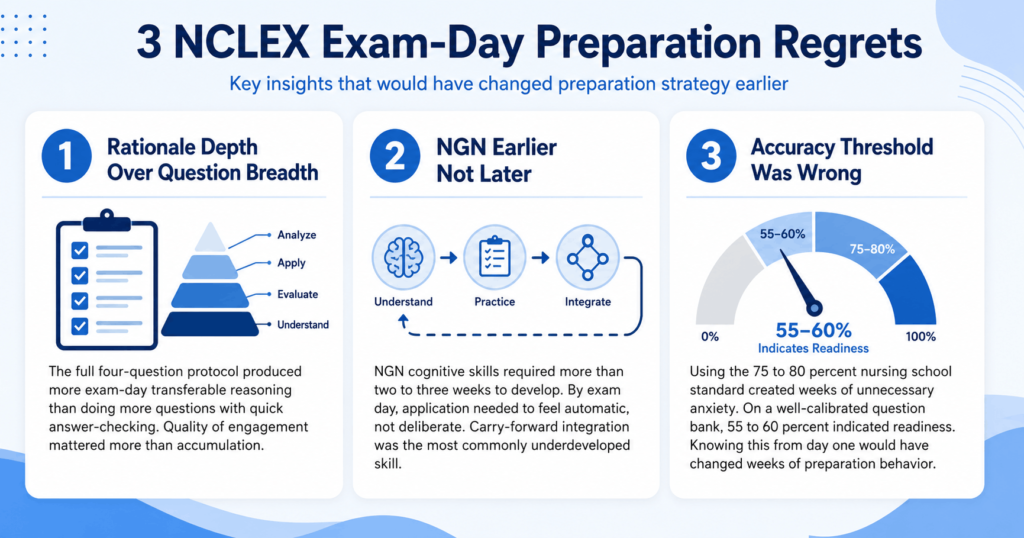
The most frequently reported preparation regret among candidates who sat the NCLEX is that they allocated too much of their preparation time to completing additional practice questions and too little to extracting the maximum clinical reasoning value from the questions they had already completed. In retrospect, candidates consistently reported that the preparation hours spent on full four-question rationale protocol — analyzing why each distractor failed for the specific patient, identifying the reasoning error type each distractor targeted, and extracting the clinical principle transfer for novel scenarios — produced more of the clinical reasoning competency that NCLEX exam day required than the preparation hours spent completing additional questions with answer-checking review. The insight, clearly visible in hindsight, is that the quality of engagement with each question matters more than the accumulation of questions engaged with — and that the candidates who invested in rationale depth over question breadth arrived at their NCLEX exam day with more transferable clinical reasoning than those who did not.
NGN Preparation Should Have Started Earlier
A second preparation regret reported with high consistency is beginning NGN-specific preparation too late in the preparation period — treating it as a final-week supplement rather than an integrated daily component from the beginning. Candidates who deferred NGN format practice until weeks three or four of preparation found that the NGN-specific cognitive skills — CJMM skill identification, carry-forward narrative integration, partial credit response strategy — required more than two to three weeks to build to exam-ready fluency. The cognitive skills that NGN formats test are distinct from the pattern recognition that traditional multiple choice practice develops, and building them to the level of automatic application rather than deliberate effort requires the deliberate practice repetitions that only consistent integration from the beginning of preparation can provide. The NCLEX exam day experience of encountering an NGN unfolding case study set with insufficiently developed carry-forward integration was reported as among the most cognitively jarring moments in an otherwise adequately prepared session.
The Accuracy Expectation Was Wrong From the Start
A third preparation insight reported with near-universal consistency is that candidates’ initial accuracy expectations — calibrated to nursing school passing standards of 75 to 80 percent — generated weeks of unnecessary preparation anxiety that impaired preparation quality before the correct readiness threshold was understood. Candidates who had been achieving 57 to 60 percent on well-calibrated question banks in weeks three and four of preparation reported feeling significantly underprepared relative to their internalized accuracy standard, seeking additional preparation resources, extending preparation timelines, and generating the cortisol-elevating anxiety that degrades hippocampal consolidation — all because the correct NCLEX readiness threshold of 55 to 60 percent on a well-calibrated bank was not understood until well into the preparation period. The insight, reported uniformly from the hindsight position of a completed NCLEX exam day, is that knowing the correct accuracy threshold from day one of preparation would have converted several weeks of anxiety-driven preparation behavior into confident, data-based preparation management.
What Students Wish They Had Known About NCLEX Exam Day Itself
The Testing Center Environment Was More Disruptive Than Expected
Candidates consistently reported being more affected by the testing center’s physical environment on NCLEX exam day than their preparation had prepared them for. Specific unexpected disruptors: the ambient noise from other candidates’ keyboard use and occasional proctor movement, which was more present than any simulation had approximated. The temperature, which most testing centers maintain at a level that many candidates found significantly cooler than their home preparation environment. The desk ergonomics — the workstation height and chair configuration that many candidates found less comfortable than their home setup, requiring deliberate posture attention to maintain the physical comfort that cognitive concentration requires. And the check-in process, which most candidates had intellectually prepared for but whose emotional weight — surrendering all personal belongings, being photographed and biometrically scanned before a high-stakes examination — generated a cortisol response that many candidates were not physiologically prepared for despite having known what to expect. The candidates most protected against these environmental disruptors were those whose weekly simulation practice had included deliberate environmental replication: desk instead of couch, cooler room temperature, no personal devices, formal start and end with the interquestion reset applied throughout.
The Anxiety Felt Different From Practice Anxiety
A second NCLEX exam day experiential insight reported frequently is that exam-day anxiety felt qualitatively different from the anxiety experienced during practice sessions and simulations — more physical, more sudden in onset, and less responsive to the anxiety management techniques that had been practiced. Candidates reported that their heart rate on NCLEX exam day at the moment the first question appeared was higher than any practice simulation had produced, and that the first five to ten questions required more deliberate application of the interquestion reset and process-focus mantra than the same techniques had required during preparation. The insight from the hindsight position is that anxiety management techniques that have been practiced until they are habits still require conscious activation under higher-stakes conditions than practice produces — and that the deliberate, careful first-question activation of the grounding sequence is more important than any preparation guidance typically emphasizes. Candidates who took a full slow breath and applied the pre-first-question grounding sequence deliberately before clicking to begin the exam reported managing the initial anxiety spike more effectively than those who began the exam without a deliberate transition ritual.
The Questions After 75 Are Not Evidence of Failure
A third NCLEX exam day experiential insight that candidates uniformly reported wishing they had internalized more deeply before the exam is the emotional reality of the exam continuing past question 75. Despite intellectual understanding of the CAT algorithm — that a longer exam reflects ability estimate proximity to the passing standard rather than poor performance — candidates reported that the emotional experience of reaching question 76 generated mid-session anxiety that the intellectual understanding did not prevent. The gap between knowing that exam continuation is not evidence of failure and experiencing a continuing exam without anxiety was larger than most candidates anticipated. The candidates who reported managing this most effectively were those who had specifically prepared a cognitive reframe for the moment question 76 appeared: the script this question means the algorithm is gathering additional evidence to confirm my passing result was pre-prepared and rehearsed, rather than requiring real-time construction under the cognitive load of an ongoing exam session.
What Students Wish They Had Known About Mindset and Expectation
Feeling Underprepared on Exam Morning Is Not Diagnostic
The single most consistent and most relieving NCLEX exam day insight that candidates wished they had known before sitting the examination is that the feeling of being underprepared on exam morning — the inability to remember specific clinical content, the sudden awareness of clinical areas that feel uncertain, the anxiety-driven conviction that preparation was insufficient — is universal and is not predictive of exam performance. Candidates who passed reported this feeling. Candidates who did not pass reported this feeling. The feeling is produced by exam anxiety’s activation of the threat response rather than by accurate self-assessment of clinical reasoning competency — and it is not distinguishable subjectively from genuine preparation inadequacy, which is why it is so consistently reported as distressing. The preparation insight that this generates is specific: knowing before NCLEX exam day morning that the feeling of unpreparedness is both universal and non-diagnostic allows it to be acknowledged and held rather than acted upon — neither dismissed nor surrendered to, but recognized for what it is.
The Process Focus Was Harder to Maintain Than Expected
Candidates consistently reported that maintaining process focus — attending to the quality of reasoning on each individual question rather than to the running performance narrative (am I doing well, how many more questions, what does this mean) — was significantly harder to maintain in the actual examination than in any preparation simulation. The process-focus orientation that felt natural after practice sessions required active, effortful maintenance on NCLEX exam day — because the stakes of the actual examination produced a natural pull toward outcome monitoring that the lower-stakes practice environment did not generate with the same intensity. The candidates who maintained process focus most effectively were those who had specifically practiced the process-focus mantra (this question, this reasoning, now) under progressively higher-stakes simulation conditions throughout preparation — conditioning the mantra as an automatic interrupt of the outcome-monitoring tendency rather than a technique that required fresh construction under exam pressure.
The Result Wait Was Its Own Experience
A post-exam insight that candidates wished they had been more prepared for is the emotional experience of the waiting period between the NCLEX exam day session and receiving the result. Candidates who had intellectually prepared for the outcome — who had reviewed the CPR process in case of a not-passing result and had the Quick Results service available — still reported finding the waiting period more emotionally demanding than anticipated. The specific insight candidates offered about this period: resisting the impulse to analyze the exam retrospectively (which question felt wrong, what I said during that unfolding case study, whether the exam ending at a specific number meant anything) was harder than any guidance had suggested it would be. The candidates who navigated the waiting period most effectively were those who had a specific, planned non-nursing activity scheduled to begin immediately after leaving the testing center — not because the activity resolved the anxiety but because having a plan prevented the default of retrospective exam analysis that almost universally amplified it.
The Insight That Changed How They Would Prepare If Starting Over
Start With the Framework, Then Add Content
When candidates who had sat the NCLEX were asked what they would do differently if starting preparation over from the beginning, the most frequently offered answer was: learn the clinical reasoning frameworks first — the three-tier priority hierarchy, the nursing process sequencing, the therapeutic communication technique criteria, the CJMM six-skill model — before beginning any content coverage. In their actual preparation, most candidates had begun with content coverage (reviewing cardiovascular nursing, learning pharmacology, studying medical-surgical conditions) and had encountered the clinical reasoning frameworks later in preparation when practice question rationale reviews introduced them. The insight from the other side of NCLEX exam day was that knowing the frameworks first would have made every content session more efficient — because each piece of clinical content encountered in content review would have been immediately contextualized within the framework that the examination uses to test it, rather than being learned as isolated clinical information that had to be mapped to the framework retroactively through practice question experience.
The Most Important Preparation Hour Is the One After a Wrong Answer
A second consistently offered start-over preparation insight is that the preparation investment most directly associated with NCLEX exam day clinical reasoning performance is the time spent on analytical rationale review after each incorrect answer — not the time spent on content review, not the time spent on additional question completion, and not the time spent on anxiety management about preparation adequacy. Candidates who had invested this time — who had spent five minutes per incorrect answer on the full four-question protocol, the error type classification, the Anki card creation, and the error log entry — reported that those preparation hours produced the specific clinical reasoning improvements they were most aware of deploying on NCLEX exam day. The question is not how many hours you studied but what you did in the hour after each wrong answer. That hour, more than any other single preparation investment, is where the clinical reasoning development that exam day requires is built.
Trusting the Preparation Required Active Work, Not Passive Confidence
A final and perhaps most surprising NCLEX exam day insight that candidates offered is that trusting the preparation — the conventional advice to trust the process and trust your preparation — was not a passive state that arrived automatically after adequate preparation but an active cognitive practice that required deliberate maintenance throughout the NCLEX exam day session. The candidates who reported trusting their preparation most effectively on exam day had done specific preparation work to make that trust possible: they had a concrete preparation evidence record (the weekly benchmark data showing consistent improvement), they had a written confidence activation paragraph they had reread on exam morning, and they had pre-prepared specific cognitive scripts for the three most anxiety-provoking exam-day moments (the first hard question, the exam continuing past 75, the awareness of uncertainty in the final question set). The trust was not the absence of doubt — it was the pre-prepared response to doubt that prevented doubt from disrupting the clinical reasoning the examination required.
- The one logistical thing most candidates underestimated: Arriving at the testing center and allowing enough time for the check-in process without rushing. Most candidates who reported being flustered in the first five to ten questions of their NCLEX exam day session identified rushed arrival — insufficient buffer between arrival and sitting at the workstation — as a contributing factor to the initial session anxiety. The 30-minute early arrival recommendation is not bureaucratic caution — it is the minimum buffer that allows the check-in process to complete without time pressure and provides the waiting area minutes for the pre-exam grounding sequence that the first question’s cognitive quality depends on.
- The preparation investment candidates most wished they had made earlier: Building the personalized Anki deck from practice session rationale reviews, beginning in the first week of preparation rather than discovering the technique midway through. Candidates who had built and maintained this deck reported that the morning Anki review in the final week of preparation — which took 15 to 20 minutes and covered clinical reasoning principles sourced from their own documented gaps — was among the highest-value preparation activities of the entire period. Candidates who had not built this deck had no equivalent for the consolidation and confidence that the morning review provided in the final days before NCLEX exam day.
- What candidates would say to themselves the morning of the exam: The preparation is done. The clinical reasoning is built. The frameworks are available. Every question gets the same clinical reasoning quality regardless of how the session feels. This one, this reasoning, now. These five statements, in this order, constitute the complete NCLEX exam day morning preparation that candidates most wished they had internalized before entering the testing center — not as inspiration but as the specific cognitive anchors that redirect attention from outcome monitoring to process focus at the moment the examination requires process focus most.
Conclusion
The insights that nursing students consistently wish they had known before their NCLEX exam day share a common thread: the gap between intellectual understanding of how the examination works and the emotional, physiological reality of the experience itself is wider than preparation guidance typically acknowledges. Knowing that the exam gets harder when you perform well does not fully prepare you for the subjective experience of a session that feels increasingly challenging. Knowing that exam morning anxiety is universal does not prevent the feeling. Knowing that exam length is not a result signal does not prevent the question-76 anxiety spike. The preparation that most effectively bridges this gap is deliberate practice of the cognitive and behavioral responses to these experiences — the pre-prepared scripts, the conditioned grounding sequences, the specifically scheduled post-exam plan — rather than additional intellectual knowledge about why these experiences occur.
Every insight in this guide is actionable before NCLEX exam day. Internalize the framework before the content. Invest the hour after wrong answers in full rationale protocol. Know the correct accuracy threshold from day one. Begin NGN integration in week one. Replicate testing center conditions in weekly simulations. Pre-prepare the cognitive scripts for the three most anxiety-provoking exam-day moments. Arrive 30 minutes early. Have a specific non-nursing plan for immediately after the exam. These are the things students wish they had known. They are yours to know now.
