

NCLEX study plan approaches have evolved faster in the three years since the Next Generation NCLEX launch than in the decade preceding it — and the candidates who are passing most efficiently in 2026 are not following the preparation frameworks their older nursing school peers used but a meaningfully updated set of approaches that have emerged as the preparation community has adapted to the current examination’s specific demands. Understanding which trends represent genuine improvements in preparation effectiveness and which represent social media-amplified fads that feel current without producing better outcomes is the preparation intelligence that separates trend-aware candidates from trend-reactive ones.
This guide identifies the eight most significant NCLEX study plan trends that are producing measurable first-attempt passing improvements among nursing candidates in 2026 — what each trend is, why it emerged, what preparation value it provides, and how to evaluate whether it belongs in your specific NCLEX study plan or whether a version of the trend that has been misapplied in the candidate community is actually counterproductive. Not every trend the nursing student social media ecosystem has amplified is an effective preparation approach. Several that feel innovative and current are either repackagings of established preparation principles or modifications that have optimized for shareability rather than clinical reasoning development. This guide identifies the genuine from the overhyped.
The honest framing of this guide: the most effective NCLEX study plan trends in 2026 are not dramatic departures from preparation fundamentals. They are refinements, additions, and emphasis shifts that adapt proven preparation principles to the current examination’s specific format demands and the current candidate population’s specific learning environment challenges. The candidate who adopts the genuine trends while maintaining the preparation fundamentals those trends build on will prepare more efficiently than either the trend-follower who abandons fundamentals for novelty or the fundamentalist who ignores evidence-supported improvements.
Trend 1: CJMM-First NCLEX Study Plan Architecture
What the Trend Is
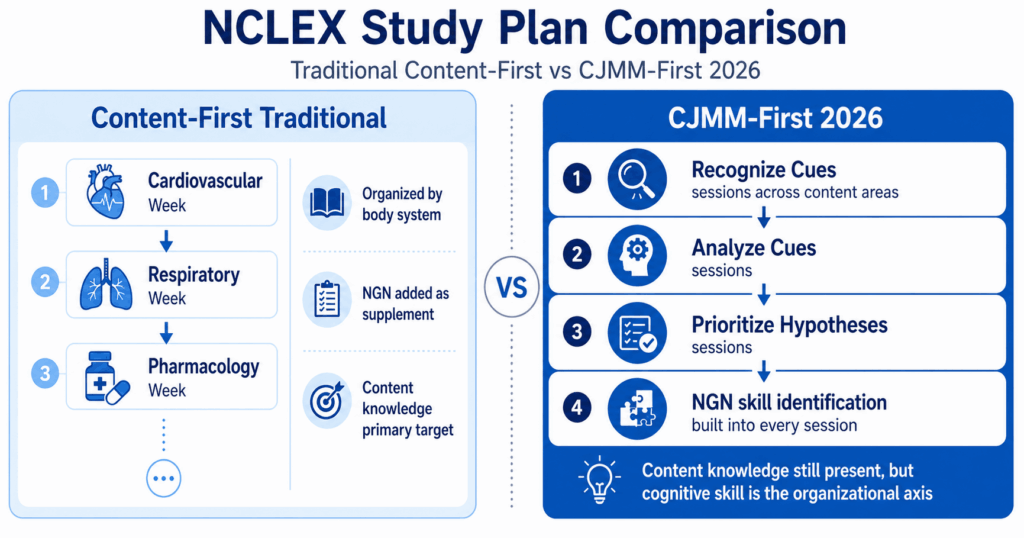
The most significant NCLEX study plan architectural shift among high-performing 2026 candidates is building the entire preparation structure around the Clinical Judgment Measurement Model’s six cognitive skills rather than around clinical content categories. Instead of organizing the study plan as cardiovascular week, respiratory week, pharmacology week — the body-system-sequenced approach that most review books and older preparation frameworks use — CJMM-first study plans organize preparation around deliberate practice of each cognitive skill: recognition sessions focused on cue identification across content areas, analysis sessions focused on clinical significance interpretation, prioritization sessions focused on urgency ranking across competing clinical hypotheses, and so on.
Why It Works
The CJMM-first NCLEX study plan architecture works because it aligns preparation with what the examination actually measures. The NGN format questions that constitute 30 to 35 percent of the 2026 examination explicitly test each of the six CJMM skills — and preparing by deliberately practicing each skill as an explicit target produces more direct NGN-format competency development than content-category preparation that develops clinical knowledge without directly targeting the cognitive skills through which that knowledge is assessed. Candidates who build their NCLEX study plan around CJMM skill development alongside content coverage consistently show higher NGN-specific accuracy improvement than those who add NGN format questions to a content-organized study plan as a supplementary activity.
How to Adopt It Without Abandoning Content Coverage
The CJMM-first approach does not require eliminating content coverage from the NCLEX study plan — clinical content knowledge remains the raw material that the cognitive skills process. The practical implementation is adding a CJMM skill identification habit to every practice session (identifying which skill each question tests before reading options) and designating one or two targeted sessions per week where the specific CJMM skill being practiced is identified in advance and tracked across the session’s questions. A candidate who practices 50 questions and identifies the CJMM skill for each one builds the action-verb-to-skill recognition that makes every NGN question navigable within the existing NCLEX study plan structure.
Trend 2: The Micro-Audit Weekly Rhythm
What the Trend Is
A growing proportion of high-performing 2026 NCLEX candidates are building a formal weekly micro-audit into their NCLEX study plan as a non-negotiable Sunday routine — a structured 20-minute data review that produces the following week’s preparation prescription. The micro-audit reviews four data points: overall accuracy trend, content category breakdown, NGN accuracy tracked separately, and error type frequency from the week’s error log. The following week’s question allocation, session structure, and targeted correction practice are determined entirely by the micro-audit’s output rather than by intuition or anxiety about which content areas feel weakest.
Why It Works
The weekly micro-audit trend works because it converts the NCLEX study plan from a fixed schedule into a responsive system — one that automatically allocates preparation intensity where the data shows preparation gaps rather than where anxiety directs attention. Candidates who implement this routine consistently discover that their intuitive sense of which content areas need the most attention frequently mismatches the actual content category data — they feel most anxious about areas where they are actually performing adequately and least anxious about areas where the data shows the most significant gaps. The micro-audit corrects this intuition-versus-data mismatch weekly, producing progressively more efficient preparation allocation across the preparation period.
The One Element Most Candidates Miss
The element of the micro-audit that most candidates implementing this trend omit is the error type frequency analysis — reviewing not just which content categories produced incorrect answers but which error type (knowledge gap, reasoning pattern error, patient context error, NGN cognitive skill error) produced the most incorrect answers across all content categories in the week. The error type frequency analysis is the data point that most directly determines the following week’s preparation behavior: a week dominated by reasoning pattern errors prescribes behavioral correction practice regardless of which content areas produced them, while a week dominated by knowledge gaps prescribes content review in the specific categories where those gaps appeared. Without this error type dimension, the micro-audit produces content allocation data without the intervention type data that determines which preparation activity addresses each identified gap.
Trend 3: Unfolding Case Study Sets as the Daily Anchor
What the Trend Is
A specific NCLEX study plan structural trend among 2026 candidates who are achieving above-average NGN accuracy is completing at least one full six-question unfolding case study set as the anchor activity of every preparation day — before traditional multiple choice practice rather than as an occasional supplement after it. This sequencing reversal places the highest-cognitive-demand, most clinically complex format at the beginning of the session when cognitive resources are freshest rather than at the end when cognitive fatigue has accumulated.
Why It Works
The unfolding case study first sequencing works for two specific reasons. First, cognitive resource allocation: the carry-forward integration skill that unfolding case study sets require — maintaining and building upon an accumulating clinical picture across six sequential questions — demands high working memory availability and prefrontal processing capacity that declines as a session progresses. Placing the case study set first ensures the full cognitive capacity is available for the format that most requires it. Second, CJMM skill priming: completing a case study set that explicitly sequences through recognize cues, analyze cues, prioritize hypotheses, generate solutions, take action, and evaluate outcomes at the beginning of the session primes the CJMM cognitive skill framework for the traditional multiple choice questions that follow — which means the framework is more readily activated during traditional question reasoning in the same session.
The Distinction Between This Trend and Just Adding NGN Questions
The key distinction of this trend from simply increasing the NGN proportion in a NCLEX study plan is the full six-question case set completion with deliberate carry-forward protocol rather than individual NGN question practice. Candidates who increase their NGN proportion by adding individual extracted bow tie or extended multiple response questions without completing full unfolding case study sets are developing partial-credit response mechanics without the narrative integration skill that the case study format specifically and most heavily tests. The daily case study anchor trend specifically requires full set completion with the carry-forward review between every question.
Trend 4: Personalized Anki Decks Over Shared Decks
What the Trend Is
The spaced repetition trend in 2026 NCLEX study plans has bifurcated into two populations: candidates using shared pre-built Anki decks downloaded from nursing student communities (which contain thousands of cards covering broad content) and candidates building personalized decks of 200 to 400 cards sourced exclusively from their own practice session rationale reviews. The performance data from high-passing-rate candidates in 2026 consistently shows the personalized deck approach producing more efficient clinical reasoning development per card review session.
Why Personalized Outperforms Shared
The personalized Anki deck outperforms shared decks in a 2026 NCLEX study plan for a specific and mechanistic reason: the cards in a personalized deck represent the exact clinical reasoning gaps identified from the candidate’s own preparation, which means every card review directly addresses a confirmed preparation deficit. A shared deck of 3,000 cards contains hundreds of cards covering content the candidate already knows reliably — which is wasted review time under the spaced repetition algorithm and dilutes the consolidation focus on genuine gaps. A personalized deck of 300 cards built from the candidate’s own incorrect answers and rationale-identified gaps has a 100 percent relevance rate to the candidate’s actual preparation profile — every card addresses a confirmed gap, and every review session is maximally efficient.
How to Build the Right Personalized Deck
The effective personalized Anki deck for a 2026 NCLEX study plan is not a content summary deck (drug name → side effect list) but a clinical reasoning chain deck: the front of each card presents a clinical scenario context extracted from a practice session question, and the back presents a three-component reasoning chain including the clinical principle that makes the correct answer correct, the priority action it produces, and the distractor type that would attract an incorrect selection. This card format encodes the reasoning application pattern that the NCLEX tests rather than the content recognition that shared decks typically encode.
Trend 5: Quality-Gated Session Endings
What the Trend Is
A behavioral trend among top-performing 2026 NCLEX study plan practitioners is ending practice sessions based on a quality gate rather than a time gate or question count target — stopping the session when rationale review quality has declined below the full four-question analytical protocol standard rather than continuing to the planned session length or question count. This trend represents a deliberate departure from volume-based session planning toward quality-based session management.
Why It Works
Quality-gated session endings work because the clinical reasoning development that NCLEX preparation requires occurs during high-quality analytical rationale review — and the returns on session continuation after quality has declined below the analytical standard approach zero. A candidate who completes 40 questions with full four-question rationale protocol and then ends the session because they notice rationale reading has become mechanical rather than analytical has produced more clinical reasoning development than a candidate who completes 75 questions with the last 35 at below-threshold quality. The quality gate is typically crossed at approximately 60 to 90 minutes of intensive preparation — which is why the 90-minute session maximum is the structural implementation of the quality-gate principle in most effective NCLEX study plans.
How to Implement It Without Using It as an Excuse
The quality gate requires an honest self-assessment rather than a subjective comfort threshold: the signal that quality has declined is that rationale review is no longer producing the four specific analytical outputs (clinical principle identification, distractor failure analysis, reasoning error type identification, clinical principle transfer identification) and has instead become confirmatory reading of the correct answer explanation. Ending a session because the questions are hard or because anxiety is increasing is not quality-gate session management — it is avoidance. Ending a session because the analytical protocol is no longer producing its four outputs is accurate quality-gate management. The distinction matters because the NCLEX study plan’s quality-gate implementation must be disciplined enough to be a genuine cognitive quality signal rather than a rationalization for shortened sessions.
Trend 6: NGN-Specific Error Logging
What the Trend Is
An NCLEX study plan tracking trend specific to the 2026 examination environment is maintaining a separate NGN error log alongside the traditional content error log — recording not just which NGN questions were incorrect but which specific CJMM cognitive skill the error reflected, what the error represented (wrong skill applied, partial credit option over-selected, partial credit option under-selected, carry-forward narrative missed), and what specific correction practice addresses that error type. This dual-log approach produces the granular NGN performance data that aggregate accuracy tracking cannot provide.
Why Generic Error Logging Is Insufficient for NGN
Generic error logging that records incorrect answers by content category without distinguishing the NGN cognitive skill dimension fails to produce the preparation intelligence needed for NGN accuracy improvement because NGN errors have multiple possible causes that require different corrections. An incorrect bow tie center selection is a different error from a correct bow tie center with incorrect left-side actions — the first reflects a prioritize hypotheses skill failure and requires urgency-over-probability practice, while the second reflects a generate solutions skill failure and requires nursing action appropriateness practice. An incorrect extended multiple response that selected an additional wrong option reflects over-inclusion from familiarity-based selection rather than criteria-based evaluation — a different correction from an incorrect extended multiple response that missed a correct option through under-inclusion. Generic error logging absorbs all of these into a single incorrect answer count with no intervention specificity.
The Practical NGN Log Format
The effective NGN error log within a 2026 NCLEX study plan records five fields per NGN error: the question format type (unfolding case study, bow tie, extended multiple response, matrix, trend), the CJMM cognitive skill the question tested, the specific error type (wrong skill applied, over-inclusion, under-inclusion, carry-forward missed, center selection incorrect), the clinical content area, and the correction practice assigned. After two weeks of this logging, the most frequent error type in the NGN log is the highest-priority NGN-specific correction target — which may be different from the highest-priority traditional question error type and requires a different intervention in the NCLEX study plan.
Trend 7: The Long-Runway Preparation Start
What the Trend Is
One of the most significant NCLEX study plan behavioral shifts among 2026 nursing students who achieve first-attempt passing with the shortest post-graduation preparation periods is beginning NCLEX-oriented practice in the second year of nursing school rather than immediately after graduation. The long-runway approach uses 10 to 25 questions per day, five days per week, beginning at least 12 months before the intended exam date — an investment of modest daily preparation that builds clinical reasoning habits, question bank familiarity, and NGN format orientation over time rather than requiring all of it to be built in a compressed post-graduation intensive.
Why This Is the Most Underutilized Preparation Trend
The long-runway preparation start is the most underutilized NCLEX study plan trend among nursing students because it requires acting on preparation urgency before the urgency feels natural — before graduation, before the ATT, before peers are discussing preparation strategies. The preparation value it provides is compounding: a nursing student who completes 10 questions per day five days per week for 52 weeks has accumulated 2,600 questions before post-graduation intensive preparation begins, with established rationale review habits, documented error patterns, and question bank familiarity that makes the post-graduation intensive far more efficient. The student who begins from zero at graduation invests the first two weeks of intensive preparation rebuilding these habits from scratch.
How to Implement It Without Overwhelming Nursing School
The long-runway NCLEX study plan for current nursing students has three implementation requirements that prevent it from competing with nursing school demands: a strict daily maximum of 25 questions (not expandable regardless of motivation), exclusive focus on full rationale review quality rather than question volume (all 25 questions reviewed with the full four-question protocol rather than 50 questions with answer-checking), and explicit scheduling alongside — not in competition with — nursing school study time. The long-runway preparation is not a nursing school supplement — it is a parallel clinical reasoning development track that uses different material from the same clinical knowledge the student is building in school.
Trend 8: Social Comparison Detox as a Study Plan Component
What the Trend Is
An explicitly behavioral NCLEX study plan trend among high-performing 2026 candidates is formally designating social media and nursing student forum consumption restrictions as a component of the study plan rather than as a peripheral personal decision. These candidates block NCLEX-related social media content, leave nursing student preparation forums, and mute peers’ preparation update posts for the duration of the active preparation period — treating comparison-generating information exposure as a preparation quality threat equivalent to inadequate rest or poor question bank calibration.
Why It Works
Social comparison in NCLEX study plan contexts damages preparation quality through several specific mechanisms that have intensified with the scale of nursing student social media communities in 2026. Exposure to peers’ question counts, accuracy percentages, and exam-day experiences generates social comparison anxiety that elevates baseline cortisol — impairing the hippocampal memory consolidation that preparation sessions depend on. It produces preparation decision-making based on what peers are doing rather than on individual benchmark data — which is reliably less efficient than data-driven allocation because no peer’s preparation profile matches any individual’s specific gaps. And it amplifies the universal feeling of unpreparedness by providing continuous reminders of others’ apparent progress, making the subjective inadequacy signal that exam anxiety already generates stronger and more persistent. The candidates who formally designate a comparison detox as a study plan component are treating this mechanism as the preparation quality threat it is rather than as a peripheral wellness consideration.
What to Do Instead
The social comparison detox in a NCLEX study plan is not isolation — it is deliberate substitution of comparison-generating information with progress-generating information. Instead of peer accuracy percentages and question counts, candidates in comparison detox review their own weekly benchmark tracker. Instead of nursing student forum prep discussion threads, they engage with the NCSBN official documentation and their question bank’s clinical rationale content. Instead of social media preparation accounts, they follow clinical nursing education content that builds the same knowledge without the comparison dynamic. The substitution maintains the social engagement that supports preparation quality (accountability, community, encouragement) while eliminating the comparison dynamic that degrades it.
- How to evaluate whether a preparation trend belongs in your NCLEX study plan: Ask three questions before adopting any preparation trend. First, does it align with or distract from the preparation fundamentals — full rationale review, timed practice, NGN integration, weekly benchmark tracking — that underlie all effective preparation? Second, does it produce measurable clinical reasoning development or does it optimize for the feeling of productivity without the substance? Third, has it produced first-attempt passing improvements among candidates with similar preparation profiles to yours, or is its evidence base primarily social media amplification of individual experiences? Trends that pass all three questions belong in an NCLEX study plan. Trends that fail any of the three deserve critical evaluation before adoption.
- The trend most worth adopting immediately regardless of preparation stage: The CJMM action verb identification habit — identifying the action verb in every practice question before reading any answer option and naming the cognitive skill it indicates. This habit takes three to five seconds per question, requires no additional resources, integrates into any existing NCLEX study plan without disruption, and begins producing measurable NGN accuracy improvement within two weeks of consistent application. It is the highest return-on-effort trend adoption available in any preparation context.
- The trend most candidates are adopting incorrectly: The NGN proportion increase trend — adding more NGN questions to the NCLEX study plan — is being implemented by many 2026 candidates as individual extracted NGN questions rather than full unfolding case study set completion. This implementation increases NGN question exposure without building the narrative integration skill that the unfolding case study format most specifically tests. The correct implementation requires full six-question case set completion with the carry-forward protocol applied between every question — not simply filtering for NGN question types and answering them as standalone items.
Conclusion
The NCLEX study plan trends producing the strongest first-attempt passing improvements in 2026 share a common characteristic: they are adaptations of preparation fundamentals to the current examination’s specific demands rather than departures from those fundamentals in favor of novelty. CJMM-first architecture adapts content coverage to the clinical skill framework the examination now explicitly measures. The micro-audit weekly rhythm adapts the general principle of data-driven preparation decisions to a specific structured weekly implementation. Unfolding case study set anchoring adapts the preparation sequence to the cognitive resource demands of the format that most differentiates 2026 performance. Personalized Anki decks adapt spaced repetition to the individual candidate’s specific gap profile. Quality-gated session endings adapt session management to the cognitive quality curve that clinical reasoning development requires. NGN-specific error logging adapts error analysis to the additional diagnostic dimension that NGN format errors require. Long-runway preparation start adapts the preparation timeline to the compounding value of early modest investment. Social comparison detox adapts preparation environment management to the specific distortions that the current scale of nursing student social media produces.
The candidates who will pass the NCLEX most efficiently in 2026 are those who adopt the genuine trends that adapt proven fundamentals to the current examination’s demands — while maintaining the underlying fundamentals that the trends are built on. Build the CJMM skill identification habit into your existing rationale review practice. Replace the intuition-driven preparation allocation with the micro-audit weekly rhythm. Put the unfolding case study set first in each session. Build your own Anki deck from your own gaps. End sessions at the quality gate. Log NGN errors by skill and error type. Start now if you are in nursing school. Detox from comparison. These eight shifts, applied consistently, are the 2026 NCLEX study plan that the evidence supports.
