

For most of the NCLEX’s history, the relationship between clinical knowledge and first-attempt passing was relatively direct: candidates who had learned their clinical content thoroughly, reviewed it systematically, and could recognize correct clinical actions in familiar scenario presentations were likely to pass. Strategy — the deliberate application of clinical reasoning frameworks to question-answering — mattered, but it supplemented content knowledge rather than substituting for it. A candidate who knew enough clinical nursing content and completed enough practice NCLEX questions could pass without ever developing an explicit strategic approach to the examination.
That relationship has changed. The April 2023 Next Generation NCLEX launch and the April 2026 test plan update have created an examination in which clinical knowledge remains necessary but is increasingly insufficient without a deliberate strategic layer that governs how that knowledge is applied to the specific cognitive demands the current format makes. Candidates who knew enough to pass the pre-2023 NCLEX but approach the 2026 examination without strategic framework development are encountering a content-sufficient but strategy-insufficient preparation that produces not-passing results despite adequate clinical knowledge. This is not a failure of clinical learning — it is a failure to develop the strategic cognitive layer that the 2026 examination’s format specifically requires alongside the clinical knowledge the examination has always required.
This guide makes the argument for why NCLEX strategy matters more in 2026 than at any previous point in the examination’s history — what specifically has changed to increase strategy’s importance, what the five strategic layers are that clinical knowledge alone cannot substitute for, and what implementing each strategic layer looks like in practice. The candidate who understands this argument and acts on it arrives at the examination with both the clinical knowledge and the strategic framework that the 2026 NCLEX questions require. The candidate who does not understands the clinical content and cannot reliably convert it into correct answers.
What Changed: The Three Shifts That Made Strategy Essential
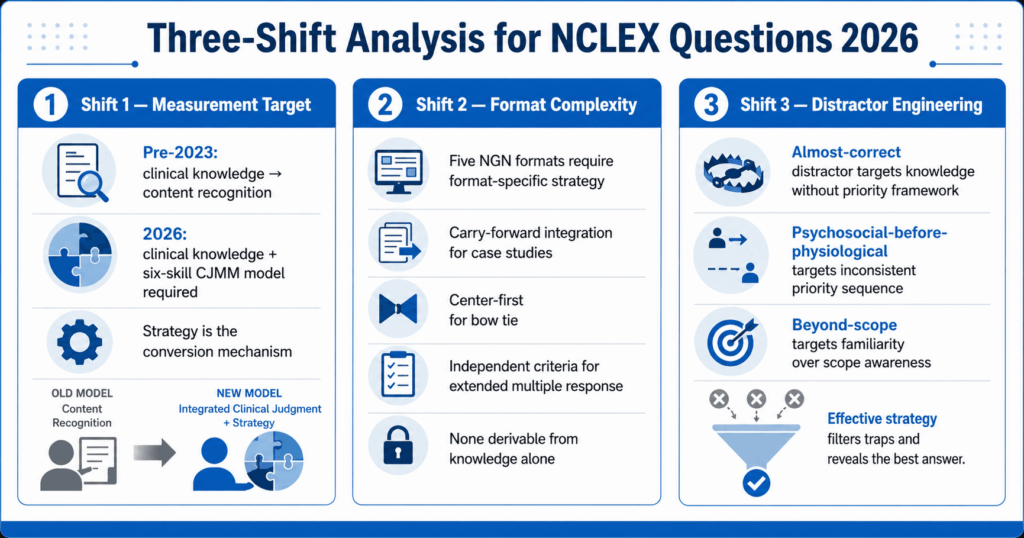
Shift 1: The Measurement Target Moved From Knowledge to Judgment
The pre-2023 NCLEX measured clinical judgment primarily through single-best-answer multiple choice NCLEX questions — a format in which clinical knowledge, when sufficiently comprehensive, could produce correct answers through content recognition even without explicit strategic framework application. A candidate who knew that furosemide causes potassium loss could recognize the correct potassium monitoring action without needing an explicit priority framework to organize the recognition. The 2026 NCLEX measures clinical judgment through a formal six-skill model — the NCSBN Clinical Judgment Measurement Model — that requires not just recognizing clinical content but applying six specific cognitive skills (recognize cues, analyze cues, prioritize hypotheses, generate solutions, take action, evaluate outcomes) to developing clinical narratives in formats specifically designed to test each skill independently. Clinical content knowledge is the input to this model. The strategic application of the model’s six skills is the process that converts that input into correct NCLEX questions answers. Strategy is no longer the complement to clinical knowledge — it is the conversion mechanism without which clinical knowledge cannot produce correct NGN answers regardless of how comprehensive it is.
Shift 2: The Format Complexity Increased the Strategic Demand
The five NGN format types introduced in April 2023 and expanded in proportion with the April 2026 update each require format-specific strategic approaches that traditional multiple choice NCLEX questions do not require and that clinical knowledge alone cannot substitute for. Unfolding case study sets require the carry-forward integration strategy — maintaining and building upon the accumulating clinical narrative across six sequential questions rather than treating each as a standalone item. Bow tie questions require the center-first strategy — identifying the correct central clinical hypothesis before engaging either side, because the center selection governs all subsequent correct selections. Extended multiple response questions require the independent criteria evaluation strategy — assessing each option against explicit clinical criteria rather than comparatively against other options, because partial credit scoring penalizes both over-inclusion and under-inclusion relative to the specific patient context. Each of these format-specific strategies is learnable and practicable. None is derivable from clinical knowledge without strategic instruction. The increased format complexity of the 2026 examination has directly increased the number of strategic approaches required alongside clinical knowledge.
Shift 3: The Distractor Engineering Became More Sophisticated
The distractor options in 2026 NCLEX questions are more precisely engineered than at any previous point in the examination’s design to attract candidates who have clinical knowledge but lack the strategic framework that organizes correct priority selection. The almost-correct distractor — a genuinely correct nursing action that is not the highest priority for this specific patient at this specific clinical moment — appears in almost every priority question and is specifically calibrated to attract candidates who recognize clinical correctness without applying the three-tier hierarchy to the specific patient context. The psychosocial-before-physiological distractor appears whenever a communication or emotional support option is presented alongside an unaddressed physiological need — specifically calibrated to attract candidates who do not consistently apply the physiological-before-psychosocial priority sequence. The beyond-scope distractor appears whenever a physician-initiated or order-requiring action is presented alongside independent nursing actions — specifically calibrated to attract candidates who answer from content familiarity rather than nursing scope awareness. These distractors do not fail candidates who lack clinical knowledge. They fail candidates who lack the strategic framework that organizes that knowledge into the correct priority selection.
Strategic Layer 1: The Pre-Option Sequence
What Clinical Knowledge Alone Does Without It
A candidate approaching NCLEX questions armed with excellent clinical knowledge but without the pre-option sequence engages options before activating the clinical reasoning framework the question requires. The clinical context in the stem creates associations with clinical content — the cardiovascular findings suggest cardiac priority, the patient’s anxiety suggests communication, the scheduled medication suggests administration — and those associations compete with each other and with the distractor options before the framework has organized which priority takes precedence. The distractor engineering exploits this pre-framework option engagement by presenting the almost-correct and psychosocial-before-physiological options first in many question constructions, creating immediate clinical associations that the framework would have resolved but that content-association-first engagement leaves unresolved.
What the Pre-Option Sequence Does
The pre-option sequence is a 10-second strategic habit applied before reading any answer option in any NCLEX question: identify the question layer (what clinical decision is being requested — first action, priority assessment, therapeutic communication, patient teaching), activate the specific clinical reasoning framework the question layer requires (three-tier priority hierarchy for priority questions, nursing process sequence for process questions, therapeutic communication criteria for communication questions, CJMM cognitive skill for NGN questions), scan the clinical context specifically for the physiological urgency signal embedded in the stem, and form a preliminary answer prediction from the framework application. This sequence ensures the framework is active before any option creates competing associations — which is precisely the strategic layer that distractor engineering is designed to bypass. A candidate who applies this sequence consistently across six weeks of NCLEX questions practice has it firing automatically on exam day at no working memory cost.
Strategic Layer 2: Error Type Classification

What Clinical Knowledge Alone Does Without It
A candidate who reviews incorrect NCLEX questions without error type classification defaults to treating every wrong answer as a content gap — returning to clinical content review in the area where the question fell. This default is accurate for a minority of incorrect answers (those produced by genuine knowledge absences) and inaccurate for the majority (those produced by reasoning pattern errors, patient context misreadings, and NGN cognitive skill misidentifications that clinical content review cannot address because the clinical content was present and unused rather than absent). The candidate who consistently responds to incorrect answers with content review is performing the wrong intervention for most of their errors — which produces more content familiarity without the reasoning correction that would close the actual gap.
What Error Type Classification Does
Error type classification — 30 seconds applied to every incorrect NCLEX question before deciding any preparation response — identifies which of four error types produced the incorrect answer and therefore which specific intervention will address it. Knowledge gap: content genuinely absent, content review is appropriate. Reasoning pattern error: content present but misapplied through incorrect priority framework, wrong nursing process step, or psychosocial-before-physiological selection, behavioral correction practice is appropriate. Patient context error: correct reasoning applied to a misreading of the specific patient’s scenario data, deliberate stem reading practice with physiological urgency scanning is appropriate. NGN cognitive skill error: wrong CJMM skill applied to an NGN format question, skill-specific practice and action verb identification are appropriate. Maintaining an error type log across the preparation period reveals the most frequent error type — which is the highest-priority intervention target regardless of which clinical content areas produced the errors.
Strategic Layer 3: The CJMM Action Verb Habit
Why It Only Matters for 2026 and Not Before
The CJMM action verb identification habit is a strategic layer that has no equivalent in pre-2023 NCLEX preparation because the cognitive skill framework it identifies did not exist as an explicit measurement model before the April 2023 NGN launch. Before 2023, clinical judgment was measured implicitly through single-best-answer format NCLEX questions that did not explicitly name the cognitive skill being assessed. The 2026 examination explicitly names the cognitive skill through the action verb in every NGN question stem — and the candidate who can identify that verb and name the skill has a strategic advantage in NGN questions that no amount of clinical content knowledge provides. This is the clearest example of why strategy matters more in 2026 than before: a specific strategic habit that literally did not exist as a relevant preparation investment before April 2023 is now one of the highest-return strategy additions for the 30 to 35 percent of the examination that NGN format questions constitute.
What the Habit Produces
The CJMM action verb identification habit — reading the action verb in every NGN question stem, naming the cognitive skill it indicates, and using that skill identification to determine what the correct answer must demonstrate before any option is read — produces three specific strategic advantages in NGN NCLEX questions. First, it prevents the most common NGN error: applying the wrong cognitive process to a question (selecting based on prioritize hypotheses skill when the question actually tests evaluate outcomes skill, or vice versa). Second, it directs the clinical reasoning approach before distractor options create competing process associations — functioning as the NGN-specific equivalent of the pre-option sequence for traditional questions. Third, it converts every NGN question from a format-ambiguous item into a skill-identified item whose correct answer requirements are determined before the options are read. The six action verb pairs that implement this habit: identify or select (recognize cues), interpret or explain (analyze cues), prioritize or rank (prioritize hypotheses), generate or plan (generate solutions), implement or initiate (take action), determine effectiveness or identify improvement (evaluate outcomes).
Strategic Layer 4: The Carry-Forward Protocol
The Unique Demand of Unfolding Case Study NCLEX Questions
Unfolding case study sets represent a strategic challenge that no other NCLEX questions format presents: six questions that collectively test a developing clinical narrative require each question to be answered not just from the opening scenario but from the accumulating clinical picture that all previous questions have established. A candidate who answers the fourth question of an unfolding case study set from the opening scenario alone — ignoring what the second question’s hypotheses assessment and the third question’s intervention selection established about the patient’s clinical trajectory — is answering a different question than the one being asked. The carry-forward failure is the most common cause of below-standard unfolding case study performance among candidates who otherwise have adequate clinical content knowledge for the scenario.
What the Carry-Forward Protocol Does
The carry-forward protocol is the strategic layer applied between every question in an unfolding case study set: before reading the current question, briefly review what all previous questions in the set have established about the patient’s clinical trajectory. After question one: what cues were identified? After question two: what do those cues indicate about the patient’s condition? After question three: what hypothesis was prioritized and why? After question four: what actions were generated for that hypothesis? This running narrative summary takes 15 to 20 seconds between questions and ensures that every subsequent question is answered from the accumulated clinical picture rather than from the opening scenario alone. In NGN NCLEX questions practice, this protocol is applied to every full six-question case set — which is why full case set completion (not individual NGN item practice) is the preparation technique that builds this specific strategic skill.
Strategic Layer 5: The Independent Criteria Evaluation
Why Partial Credit Requires a Different Strategy
Extended multiple response NCLEX questions with partial credit scoring require a response strategy that is explicitly counterintuitive for candidates whose test-taking instincts were built on single-best-answer traditional questions. The traditional strategy — compare options against each other, identify the most correct, eliminate the others — is actively counterproductive under partial credit conditions because it produces comparative reasoning where the scoring system rewards independent criteria evaluation. A candidate who selects option C because it seems more appropriate than options A and D (comparative reasoning) may be applying the correct clinical judgment to a flawed selection process — and may miss a correct option E that would have been selected under independent criteria evaluation but was not reached before the comparative selection was completed.
What Independent Criteria Evaluation Does
Independent criteria evaluation is the strategic approach to extended multiple response NCLEX questions that partial credit scoring specifically rewards: evaluating each option against an explicit clinical criteria question — does this specific option meet the clinical criteria the question specifies for this specific patient at this specific clinical moment — without reference to any other option’s appropriateness. The evaluation is binary for each option: yes (clearly meets criteria for this patient) → select; uncertain (possibly meets criteria but not clearly) → apply the criteria question more carefully before deciding; no (does not meet criteria or not specifically indicated for this patient) → do not select. This strategy prevents both failure modes that partial credit questions specifically test for: over-inclusion (selecting options because they are generally appropriate nursing actions rather than because they meet the specific criteria for this patient) and under-inclusion (missing correct options because comparative reasoning was completed before reaching them). Independent criteria evaluation takes more cognitive time per question than comparative elimination — which is why building it as a deliberate practice habit before exam day is essential.
How to Build Each Strategic Layer Into Preparation
The Layered Adoption Sequence
Building all five strategic layers simultaneously from the beginning of NCLEX preparation is possible but cognitively demanding for candidates whose preparation habits are not yet established. The layered adoption sequence builds each layer over two-week intervals: weeks one and two, add the pre-option sequence to every practice question; weeks three and four, add error type classification to every incorrect answer; weeks five and six, integrate the CJMM action verb identification habit into every NGN question and apply the carry-forward protocol to every unfolding case study set; weeks seven and eight if needed, focus independent criteria evaluation practice specifically on extended multiple response question sets. This sequence produces a fully integrated five-layer strategic system by the midpoint to end of a typical preparation period — through gradual adoption that builds each layer on the foundation the previous layer has established rather than requiring all five simultaneously from the start.
The Strategic Habit Confirmation Test
Each strategic layer has a confirmation test that verifies the habit has been built to the automatic level that exam-day performance requires rather than remaining a deliberate technique that consumes working memory when applied. Pre-option sequence confirmation: complete 25 NCLEX questions and for each one, write the question layer identification and preliminary prediction before reading any option — if you cannot complete this without options influencing the prediction, the sequence needs more practice. Error type classification confirmation: classify 20 consecutive incorrect answers by error type in under 60 seconds total without referencing a list — if you need the list, more practice is needed. CJMM action verb confirmation: for 20 consecutive NGN questions, name the cognitive skill before reading any option without hesitation — hesitation indicates the habit needs more repetitions. Carry-forward confirmation: summarize the clinical narrative established after each question in a case set in 15 seconds without re-reading previous questions — if re-reading is needed, the integration skill needs more practice.
Strategy in the Context of Clinical Knowledge — Not Instead of It
The argument that NCLEX strategy matters more than ever in 2026 is not an argument that clinical knowledge matters less. Clinical knowledge remains the necessary raw material that every strategic layer processes. The pre-option sequence identifies the physiological urgency signal but requires clinical knowledge to recognize which signals are physiologically urgent. The CJMM action verb habit directs the cognitive process but requires clinical knowledge to execute that process correctly. The carry-forward protocol maintains the clinical narrative but requires clinical knowledge to interpret what the narrative means. Strategy without clinical knowledge is a framework with nothing to process. Clinical knowledge without strategy is content that cannot reliably convert into correct NCLEX questions answers. The 2026 examination requires both — and the specific change in 2026 is that the strategic layer has become more explicitly required, more format-specifically complex, and more consequential for first-attempt passing than at any previous point in the examination’s history.
- The fastest strategic layer to build for immediate accuracy improvement: The pre-option sequence — apply it to every NCLEX questions practice session starting tomorrow. The 10-second investment before each option set prevents the distractor engineering from creating competing clinical associations before the framework has been activated, which addresses the most common question-reading error pattern directly. Candidates who add this layer to an existing preparation approach report measurable accuracy improvement within two weeks because the pre-option sequence produces the framework-first option engagement that converts clinical knowledge into correct priority selections more reliably than content-association-first engagement.
- The strategic layer most specific to 2026 and not required before: The CJMM action verb identification habit — this strategy literally did not exist as a relevant preparation investment before April 2023 and has become more important with the April 2026 proportional increase. Every NGN question in the 2026 examination communicates its required cognitive process through the action verb in the question stem. A candidate who can identify that verb and name the skill in three to five seconds before reading any option has a strategic advantage in approximately 30 to 35 percent of their exam session that no amount of additional clinical content knowledge provides. If you are preparing for the 2026 NCLEX and have not yet built this habit, build it today.
- What to do if your NCLEX questions accuracy is not improving despite consistent practice: Audit which strategic layers are present in your current practice approach. If you are answering NCLEX questions without the pre-option sequence, error type classification, or separate NGN tracking, the accuracy plateau is likely a strategy gap rather than a content gap. Adding the pre-option sequence alone typically produces measurable improvement within two weeks. Adding error type classification typically reveals that 40 to 60 percent of incorrect answers are reasoning pattern errors requiring behavioral correction rather than content review — which redirects preparation effort from the wrong intervention to the right one. Strategy gaps are more common causes of accuracy plateaus than content gaps in candidates who have completed comprehensive content coverage.
Conclusion
The 2026 NCLEX is an examination that has evolved beyond the point where clinical knowledge alone reliably converts into passing results. The shift from implicit holistic judgment measurement to explicit six-skill CJMM measurement, the five NGN format types each requiring format-specific strategic approaches, and the increasingly sophisticated distractor engineering calibrated to attract candidates with knowledge but without strategic framework — these three changes have collectively made the strategic layer of NCLEX preparation more consequential for first-attempt passing than at any previous point in the examination’s history.
The five strategic layers this guide has described — the pre-option sequence, error type classification, CJMM action verb identification, carry-forward protocol, and independent criteria evaluation — are not tricks or shortcuts that substitute for clinical reasoning. They are the structural framework within which clinical reasoning operates, organized to align with what the 2026 NCLEX questions specifically measure and specifically reward. Clinical knowledge is what flows through this framework. The framework is what ensures that knowledge reaches the correct answer rather than being redirected by distractor engineering toward the almost-correct, almost-in-scope, almost-prioritized option that the 2026 examination has been specifically designed to offer. Build the framework alongside the knowledge. Both matter. In 2026, both are required.
