

Every NCLEX preparation guide — including this one — devotes significant attention to what to study, how to structure a study schedule, which question banks to use, and how to manage exam-day anxiety. These are genuine preparation requirements. But there is one dimension of NCLEX preparation that almost every guide underemphasizes, that almost every candidate underinvests in, and that analysis of first-attempt passing versus not-passing outcomes consistently identifies as among the highest-leverage preparation investments available: the systematic analysis of what specifically produced each incorrect answer and the deliberate behavioral correction targeted precisely at that cause.
Most NCLEX preparation candidates treat incorrect practice answers as content signals — evidence of clinical knowledge that needs reinforcement — and respond by returning to clinical content review in the area where the question fell. This response is appropriate for a minority of incorrect answers: those produced by genuine knowledge absences where the clinical principle required for the correct answer was not in the candidate’s accessible knowledge base. It is the wrong response for the majority of incorrect answers, which are produced by reasoning pattern errors, patient context misreadings, and NGN cognitive skill misapplications that clinical content review cannot address because the clinical content was present and unused rather than absent.
The most overlooked part of NCLEX preparation is the systematic diagnostic analysis that distinguishes between these error types and deploys the specific intervention each one requires — rather than applying the single default intervention of content review to every incorrect answer regardless of what actually produced it. This guide explains what that systematic analysis looks like, why most candidates skip it, what each error type requires instead of content review, and how implementing it converts an accuracy plateau into measurable weekly improvement by redirecting preparation effort from the wrong intervention to the right one.
Why Incorrect Answers Are the Most Valuable Data in NCLEX Preparation
The Paradox of the Wrong Answer
The wrong answer in an NCLEX preparation session is simultaneously the most psychologically uncomfortable event in the session and the most diagnostically valuable. It is uncomfortable because it confirms a gap — something between the candidate’s current performance and the correct response that preparation has not yet closed. It is diagnostically valuable because it identifies precisely where that gap is and, when correctly analyzed, exactly what type of gap it is. A correctly answered question confirms competency that has already been built. An incorrectly answered question reveals a specific gap that preparation must close — and the specificity of that revelation is the most actionable preparation intelligence available. The candidate who mines every incorrect answer for its specific diagnostic information is extracting more preparation value from each wrong answer than the candidate who confirms the correct answer and moves on is extracting from every question in the session.
The Majority of Incorrect Answers Are Not Content Gaps
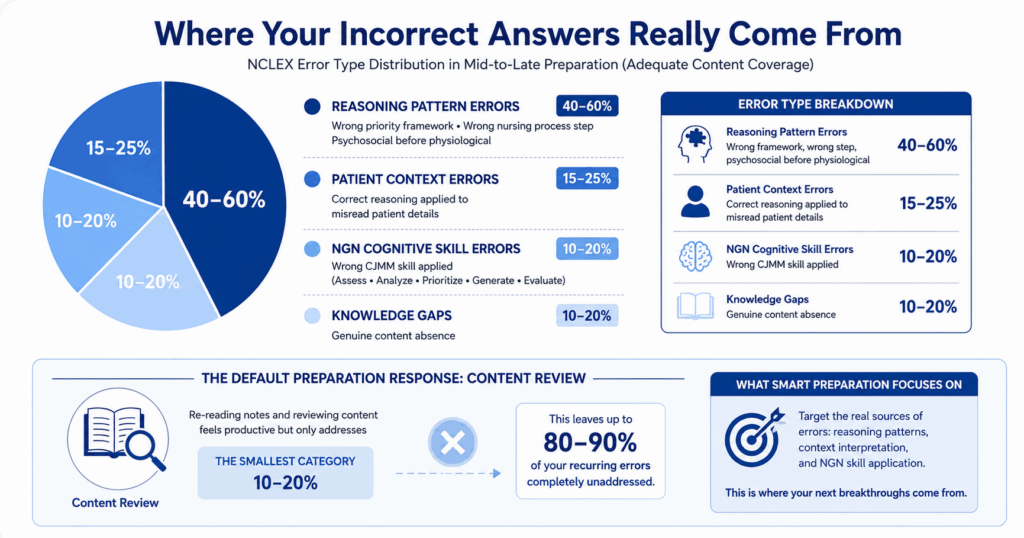
The most important and most consistently overlooked finding in NCLEX preparation error analysis is that the majority of incorrect answers among candidates with adequate clinical preparation are not produced by knowledge absences. Analysis of error patterns among candidates who have completed comprehensive content coverage consistently shows that 40 to 60 percent of incorrect answers in the mid-to-late preparation period are produced by reasoning pattern errors — applying the wrong priority framework, selecting the wrong nursing process step, or applying a psychosocial response before an unaddressed physiological need. An additional 15 to 25 percent are produced by patient context errors — correctly applying clinical reasoning to a misreading of the specific patient’s scenario details rather than to the actual scenario. And 10 to 20 percent in the 2026 examination context are produced by NGN cognitive skill errors — applying the wrong CJMM cognitive skill to an NGN format question. This distribution means that in a session producing 20 incorrect answers, perhaps four to six reflect genuine knowledge gaps requiring content review, while 14 to 16 reflect reasoning and context errors requiring specific behavioral corrections that content review cannot provide.
The Default Response Applies the Wrong Intervention to Most Errors
When the vast majority of incorrect answers are produced by reasoning pattern errors, patient context errors, and NGN cognitive skill errors — and when the default preparation response to every incorrect answer is content review — the default response is applying the wrong intervention to the majority of errors. This mismatch produces a specific and recognizable preparation pattern: an accuracy plateau in weeks three to five of NCLEX preparation where overall accuracy stops improving despite consistent daily practice and increasing content familiarity. The plateau is not produced by insufficient content review — additional content review is being applied consistently. It is produced by the reasoning pattern errors and patient context errors that are generating the majority of incorrect answers and that content review cannot correct. The plateau resolves when error type classification is added to the preparation approach and the reasoning pattern errors receive behavioral correction practice rather than content review.
The Four Error Types and What Each Requires

Error Type 1: Knowledge Gap
A knowledge gap error is produced when the clinical principle required for the correct answer was genuinely absent from the candidate’s accessible knowledge base — the candidate did not know that furosemide requires potassium monitoring, did not know the normal range for serum potassium, or did not know that potassium below 3.5 mEq/L constitutes hypokalemia requiring intervention. Knowledge gap errors are the error type for which content review is the appropriate intervention, and they are the error type that most NCLEX preparation candidates correctly identify and address. The diagnostic indicator of a knowledge gap error is the rationale revealing clinical content that was not previously known — information that, upon reading, is new rather than recognizable. Knowledge gap errors in the mid-to-late preparation period should represent a decreasing proportion of the error log as comprehensive content coverage progresses; if they remain high after comprehensive content review, the review approach itself may need examination.
Error Type 2: Reasoning Pattern Error
A reasoning pattern error is produced when the clinical content was present but was misapplied through a systematic reasoning habit that produces incorrect priority selections across multiple content areas. The three most common reasoning pattern errors in NCLEX preparation: the psychosocial-before-physiological pattern (selecting a therapeutic communication or emotional support option before the unaddressed physiological need the scenario contains), the intervention-before-assessment pattern (selecting a nursing intervention when the clinical scenario has not yet established what assessment data justifies the intervention), and the almost-correct priority pattern (selecting a correct nursing action that is not the highest priority for this specific patient given the specific clinical context). The diagnostic indicator of a reasoning pattern error is the rationale explaining why a clinically correct action was not the highest priority for this specific patient — information that, upon reading, is immediately comprehensible rather than revealing new clinical content. The intervention for reasoning pattern errors is not content review but deliberate behavioral correction practice: identifying the specific pattern, applying the corrective framework rule to the next 20 to 30 questions in that pattern’s trigger context, and self-monitoring for the pattern’s appearance across subsequent sessions.
Error Type 3: Patient Context Error
A patient context error is produced when the clinical reasoning framework was correctly activated but applied to a misreading of the specific patient’s scenario details rather than to the actual scenario. A candidate who correctly activates the ABC priority framework but misidentifies which finding in the scenario represents the physiological urgency signal — reading blood pressure as the priority finding when the respiratory rate and oxygen saturation in the same stem indicate the higher ABC priority — produces a patient context error rather than a reasoning pattern error or a knowledge gap. Patient context errors are particularly common in complex scenarios with multiple clinical findings where the physiological urgency signal is embedded among other findings rather than presented as the obvious clinical priority. The diagnostic indicator is a rationale that explains which specific patient detail established the correct priority — not new clinical content, not a different framework, but a different reading of the scenario’s specific clinical data. The intervention is deliberate stem-reading practice with the physiological urgency scan: reading the stem specifically to locate the highest-tier physiological signal before engaging any option, with attention to how urgency signals can be embedded in multi-finding scenarios.
Error Type 4: NGN Cognitive Skill Error
An NGN cognitive skill error is produced when the wrong CJMM cognitive skill was applied to an NGN format question — selecting based on the prioritize hypotheses skill when the question’s action verb (determine effectiveness) indicated the evaluate outcomes skill was required, or generating solutions options when the question’s action verb (identify) indicated recognize cues application. NGN cognitive skill errors are distinct from the other three error types because they reflect a format-engagement error rather than a clinical knowledge or clinical reasoning error — the candidate’s clinical reasoning may be entirely adequate for the correct cognitive skill but was deployed on the wrong cognitive process for this question. The diagnostic indicator is a rationale that explains which cognitive skill the question tested and how the correct option expressed that skill — information that reveals not new clinical content but the cognitive process the question required. The intervention is the CJMM action verb identification habit applied to every NGN question before reading options, ensuring the correct cognitive skill is activated before any option creates competing associations.
How to Implement the Systematic Error Analysis
The 90-Second Post-Answer Protocol
The systematic error analysis that most NCLEX preparation candidates overlook takes 90 seconds per incorrect answer and produces the preparation intelligence that distinguishes error-type-specific intervention from default content review. The protocol: after reviewing the rationale for an incorrect answer, ask three questions in sequence. First, was the clinical content in the correct option’s rationale genuinely new to me — information I did not have before reading the rationale? If yes, classify as knowledge gap and assign targeted content review. If no (the rationale was immediately comprehensible, confirming content I already had), continue to question two. Second, was the error produced by a systematic reasoning habit — selecting a psychosocial option before physiological, choosing intervention before assessment, or selecting an almost-correct but lower-priority action? If yes, classify as reasoning pattern error and assign behavioral correction practice for the specific pattern. If no, continue to question three. Third, was the clinical reasoning framework correctly applied to the wrong reading of the patient’s scenario details? If yes, classify as patient context error and assign stem-reading practice. If none of the above and the question was NGN format, classify as NGN cognitive skill error and assign action verb identification practice. Record the classification in the error log and proceed to the next question.
The Weekly Error Log Review
The error log review is the NCLEX preparation step that converts individual error classifications into preparation prescriptions for the following week. Every Sunday, review the week’s error log entries and calculate the frequency of each error type as a percentage of the week’s total incorrect answers. The error type with the highest frequency is the highest-priority correction target for the following week — regardless of which content areas produced it. A week in which reasoning pattern errors account for 55 percent of incorrect answers prescribes deliberate pre-option sequence practice and priority framework application drill across all content areas — not additional content review in whichever content area produced the most reasoning pattern errors. A week in which patient context errors account for 40 percent of incorrect answers prescribes physiological urgency scan practice across complex multi-finding scenarios — not additional content review in the content areas where those scenarios fell. The error type frequency, not the content area frequency, determines the following week’s primary intervention target.
Behavioral Correction Practice for Reasoning Pattern Errors
Reasoning pattern errors — the most common error type in mid-to-late NCLEX preparation and the most consistently undertreated — require a specific behavioral correction practice that is different from anything most preparation candidates are currently doing. For the psychosocial-before-physiological pattern, the correction practice is applying the explicit three-tier check before every priority question: does this scenario contain any unaddressed physiological need at the ABC or safety tier? If yes, that tier must be addressed before any psychosocial option is selected regardless of how compelling the communication option appears. For the intervention-before-assessment pattern, the correction practice is applying the explicit nursing process sequence check: has this scenario established what assessment data justifies the proposed intervention? If no assessment data has been established in the stem, the priority action is assessment. For the almost-correct priority pattern, the correction practice is applying the full priority hierarchy to every option rather than stopping at the first clinically correct option: among all options that are clinically correct, which one addresses the highest-tier clinical need for this specific patient? These correction practices are not applied as deliberate techniques indefinitely — they are applied for two to three weeks until the corrective framework rule fires automatically at the trigger context rather than requiring deliberate application.
The Accuracy Plateau: Why It Happens and How Error Analysis Resolves It
The Anatomy of the NCLEX Preparation Plateau
The accuracy plateau that many NCLEX preparation candidates encounter in weeks three to five of preparation has a specific and identifiable cause: content review is being applied as the intervention for reasoning pattern errors and patient context errors that content review cannot address. A candidate in week four of preparation who is returning to pharmacology content review after incorrect pharmacology questions is applying a content intervention to errors that may be reasoning pattern errors — selecting a psychosocial option before an unaddressed physiological need in a pharmacology scenario context — rather than pharmacology knowledge absences. The pharmacology content review produces greater pharmacology familiarity without correcting the psychosocial-before-physiological reasoning pattern. The same reasoning pattern produces incorrect answers in the following week’s pharmacology practice, and in the cardiovascular practice, and in the mental health practice — across every content area where the trigger context (unaddressed physiological need alongside a psychosocial option) appears. The plateau is not a pharmacology problem or a cardiovascular problem or a mental health problem. It is a priority framework application problem that appears across all content areas and resolves when the framework application error is treated directly.
How Error Type Classification Breaks the Plateau
The accuracy plateau breaks when error type classification identifies the most frequent error type and the preparation approach shifts the primary intervention from content review to behavioral correction of that error type. A candidate who discovers through two weeks of error type logging that 58 percent of their incorrect answers are reasoning pattern errors has identified that their preparation has been applying content review to more than half of their incorrect answers as the wrong intervention. Shifting the primary intervention for that 58 percent to deliberate behavioral correction practice — the psychosocial-before-physiological check, the assessment-before-intervention sequence confirmation, the full priority hierarchy application — produces accuracy improvement in every content area simultaneously because the correction addresses the cross-content pattern rather than any individual content category. Most candidates who implement error type classification in week five of a plateaued preparation period report measurable overall accuracy improvement within two weeks of consistent behavioral correction practice — not because they learned new clinical content but because they addressed the reasoning pattern that was producing incorrect answers across the content they already knew.
When Content Review Is the Right Answer
The emphasis on reasoning pattern errors and behavioral correction in this guide should not be read as a devaluation of content review in NCLEX preparation — content review remains the correct intervention for knowledge gap errors and is an essential component of any complete preparation approach. The point is not that content review is wrong but that it is the right intervention for one specific error type and the wrong intervention for three others. A candidate whose error log shows 40 percent knowledge gaps is appropriately directing a substantial portion of preparation toward content review in the specific areas where those gaps appear. A candidate whose error log shows 15 percent knowledge gaps is appropriately reducing content review to a minor preparation component and directing the majority of effort toward the reasoning pattern, patient context, and NGN cognitive skill interventions that the other 85 percent of their errors require. Error type classification calibrates the preparation effort allocation to the actual error distribution — which is the most efficient possible use of the preparation hours available.
The Connection to the 2026 Examination’s Specific Demands
Why NGN Format Makes Error Analysis More Important
The April 2026 NCLEX test plan’s increased NGN format proportion makes systematic error analysis more important for current candidates than for any previous cohort because the 2026 examination includes a higher proportion of questions where the error type is most likely to be NGN cognitive skill error — a category that is entirely invisible to content-area-only error analysis. A candidate who reviews incorrect NGN answers and records only the content area where the question fell is recording cardiovascular or pharmacology or mental health when the actual error type was applying the analyze cues cognitive skill to a question whose action verb (prioritize) indicated the prioritize hypotheses skill. The content area label is not the preparation-relevant information — the cognitive skill misidentification is. Only error type classification that includes the NGN cognitive skill dimension produces the preparation intelligence needed to address this category of errors, which account for 10 to 20 percent of incorrect answers in the 2026 examination context and are entirely untreatable by content review or traditional reasoning correction practice.
Error Analysis as the Integration of Knowledge and Strategy
Systematic error type analysis is the preparation practice that most directly integrates clinical knowledge and clinical strategy — because it continuously identifies which of the two is responsible for each incorrect answer and directs the appropriate development investment to the appropriate gap. When error type analysis reveals knowledge gaps, it directs preparation toward clinical knowledge development. When it reveals reasoning pattern errors, it directs preparation toward strategic framework application. When it reveals NGN cognitive skill errors, it directs preparation toward the strategic skill-identification habits that the 2026 format specifically requires. This continuous calibration — content when content is the gap, strategy when strategy is the gap — is the most efficient possible NCLEX preparation because it eliminates the preparation waste of applying the wrong type of development investment to gaps that require the other type.
- How to start the error type analysis today without overhauling your entire preparation: Apply the 90-second post-answer protocol to only your incorrect answers in tomorrow’s session — not every question, only the incorrect ones. For each incorrect answer, ask the three sequential diagnostic questions (was the content new? was it a reasoning pattern? was it a patient context misread?) and record the classification in a simple log: a notepad or spreadsheet with four columns for the four error types. Do this for one week. At the end of the week, count the entries in each column and calculate the percentage of each error type. That percentage distribution is the most specific preparation intelligence you have produced in your entire preparation period — and it immediately identifies whether your primary intervention for the following week should be content review, behavioral correction, stem-reading practice, or action verb identification.
- The behavioral correction drill for the psychosocial-before-physiological pattern: This pattern — the single most common reasoning pattern error in NCLEX preparation — responds to one specific behavioral drill: before selecting any option in any priority question, ask aloud or in writing: does this scenario contain any unaddressed physiological need? If yes, locate the option that addresses it before reading the psychosocial option further. Apply this drill to the next 25 priority questions in your question bank and count how many times the physiological urgency signal was present and how many times you would have selected the psychosocial option without the drill. The frequency of prevented errors is the measure of how much the pattern was contributing to your incorrect answers before correction — and is typically more frequent than candidates expect.
- What a well-calibrated error log looks like after six weeks of NCLEX preparation: In a well-progressing NCLEX preparation period, the error type distribution shifts across the six weeks in a predictable direction: knowledge gap errors decrease as comprehensive content coverage progresses, reasoning pattern errors decrease as behavioral corrections automate, patient context errors decrease as stem-reading precision improves, and NGN cognitive skill errors decrease as the action verb identification habit develops. A week-six error log that still shows 45 percent knowledge gaps suggests content coverage is incomplete. A week-six log that shows 60 percent reasoning pattern errors suggests the behavioral corrections have not yet been implemented or have not automated. A week-six log that shows 25 percent NGN cognitive skill errors suggests the action verb identification habit needs more deliberate practice before exam day.
Conclusion
The most overlooked part of NCLEX preparation is not a specific content area, a specific question format, or a specific preparation resource. It is the systematic analysis of what specifically produced each incorrect answer and the deployment of the specific intervention that each error type requires — rather than the default application of content review to every incorrect answer regardless of what actually produced it. This analysis takes 90 seconds per incorrect answer and one additional 20-minute weekly review. The preparation intelligence it produces is more specific, more actionable, and more directly linked to accuracy improvement than any other single preparation behavior available within the same time investment. The accuracy plateau that most NCLEX preparation candidates encounter is not a content coverage failure. It is a preparation intervention mismatch — content review being applied to reasoning pattern errors that content review cannot address, at the cost of the preparation hours that behavioral correction practice would have used to close the actual gap. Implementing error type classification converts that mismatch into the targeted, error-type-specific preparation that correctly allocates content review to knowledge gaps, behavioral correction to reasoning patterns, stem-reading practice to patient context errors, and action verb identification to NGN cognitive skill errors. That allocation is the most efficient possible NCLEX preparation — not because it studies more but because it studies the right thing for each gap rather than the same thing for every gap.
