

The performance gap between nursing candidates who pass the NCLEX exam on their first attempt and candidates who do not is not reliably explained by the obvious variables. Academic performance in nursing school — GPA, clinical grades, faculty evaluations — predicts NCLEX first-attempt passing at a weaker level than most educators expect. Study hours invested in NCLEX preparation do not reliably separate passers from non-passers at equivalent total volumes. Intelligence, clinical aptitude, and professional commitment are distributed across both populations. What does reliably separate candidates who pass from candidates who do not, when the preparation investment appears comparable, is a set of conceptual understandings about what the NCLEX exam actually is — understandings that change how candidates prepare, how they engage with practice questions, how they interpret their performance data, and how they approach the examination itself.
These conceptual understandings are not secret knowledge. They are available in official NCSBN documentation, in preparation guides, and in the retrospective accounts of candidates who have sat the examination and understood it only after sitting it. What makes them differentiating is not their availability but the degree to which they are genuinely internalized — converted from intellectual awareness into the operational beliefs that actually govern preparation decisions and exam-day behavior. A candidate who intellectually knows that the NCLEX exam measures clinical judgment rather than clinical knowledge but who operationally prepares for clinical knowledge recall is not applying the understanding that matters. The understanding that matters is the one that changes the behavior.
This guide identifies seven conceptual understandings that consistently separate candidates who pass the NCLEX exam from those who do not — presented not as advice about what to do but as beliefs about what the examination is that, when genuinely held, naturally produce the preparation behaviors and exam-day orientations that first-attempt passing requires. The candidate who genuinely holds all seven is preparing for the right examination. The candidate who does not is working hard for an examination that does not exist in exactly the form they are imagining.
Understanding 1: The NCLEX Exam Measures Clinical Judgment, Not Clinical Knowledge
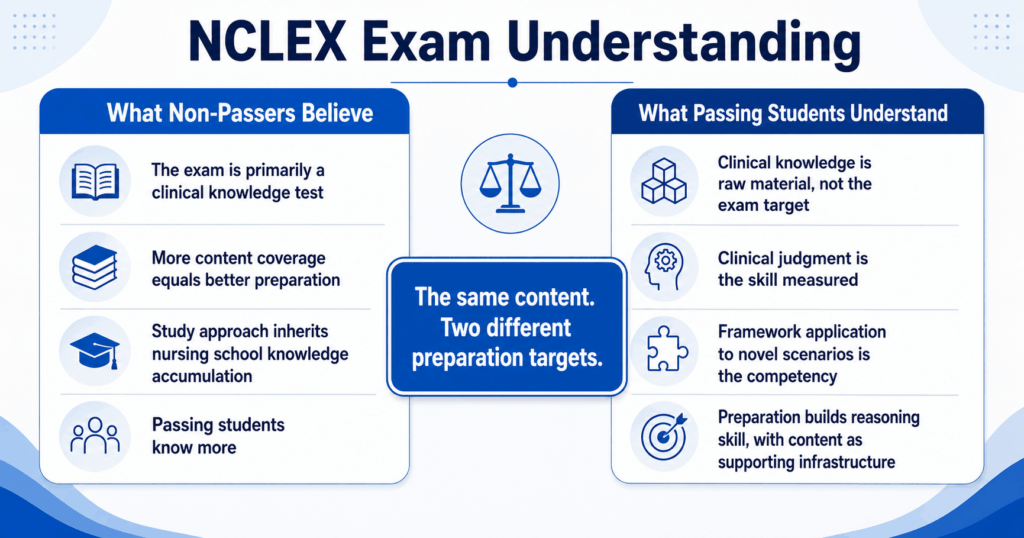
What Non-Passers Believe
The most consequential misunderstanding that separates non-passing from passing NCLEX exam candidates is the belief that the examination is primarily a clinical knowledge test — that the candidates who know the most clinical content are the most likely to pass, and that the preparation investment most aligned with passing is comprehensive clinical content coverage. This belief is understandable: nursing school is organized almost entirely around clinical knowledge acquisition, assessed through examinations that directly test clinical knowledge recall, and the transition from nursing school to NCLEX preparation inherits the assumption that the same knowledge-accumulation approach that worked for nursing school will work for NCLEX preparation.
What Passing Students Understand
Passing NCLEX exam candidates understand that clinical knowledge is the necessary raw material of clinical judgment but is not the same thing as clinical judgment — and that the examination tests the latter rather than the former. Clinical judgment is the ability to apply clinical reasoning frameworks to specific patient clinical scenarios to identify the correct nursing priority action for that specific patient at that specific clinical moment. A candidate with extensive clinical knowledge who applies it without the priority framework, the nursing process sequence, or the patient-specificity that the examination requires is demonstrating clinical knowledge without clinical judgment — and the NCLEX exam is designed to distinguish between these two. The passing candidate prepares differently from the non-passing candidate not because they know more but because they understand they are building a different skill than knowledge accumulation: the skill of applying clinical reasoning frameworks to novel scenarios they have not specifically encountered before.
How This Understanding Changes Preparation
When this understanding is genuinely held, preparation shifts from content coverage as the primary activity to clinical reasoning framework development as the primary activity, with content coverage as the supporting infrastructure that gives the framework material to work with. The passing candidate’s daily session is organized around developing the clinical judgment skill — the pre-option sequence habit, the priority framework application, the error type classification that identifies framework misapplication rather than knowledge absence — rather than around accumulating more clinical content. Content coverage sessions are targeted to confirmed knowledge gaps rather than allocated to broad comprehensive review. The understanding that the NCLEX exam measures clinical judgment rather than clinical knowledge is the single conceptual shift that produces the largest downstream change in preparation approach.
Understanding 2: The Adaptive Algorithm Is an Ally, Not an Adversary
What Non-Passers Believe
The NCLEX exam’s Computerized Adaptive Testing algorithm is one of the most anxiety-generating features of the examination for candidates who misunderstand its function. The most common misunderstanding: the algorithm is trying to find the level at which the candidate fails — increasing difficulty until errors appear and using the failure threshold to determine the result. Under this belief, a hard question is a threat, a correct answer on a hard question is a temporary reprieve, and the exam getting harder is evidence that the algorithm is closing in on the point where the candidate will fail. This misunderstanding converts the natural difficulty increase that strong performance produces into a mid-exam anxiety signal that degrades the clinical reasoning quality that the exam is measuring.
What Passing Students Understand
Passing NCLEX exam candidates understand the adaptive algorithm as a measurement instrument rather than an adversary — one that is trying to determine as efficiently as possible whether the candidate’s clinical reasoning ability is above or below the passing standard. The algorithm selects progressively harder questions as performance improves not to find the failure threshold but to gather the most statistically informative evidence about where the ability estimate sits relative to the passing standard. When the exam is getting harder, the algorithm is responding to evidence that the ability estimate is above the passing standard and is selecting questions that will refine that estimate with the greatest statistical precision. The hard question is not a threat — it is the algorithm’s response to strong prior performance. The passing candidate experiences this as a measurement system doing its job rather than as a system bearing down on them.
How This Understanding Changes Exam Day
When the adaptive algorithm is understood as an ally rather than an adversary, the mid-exam experience of increasing difficulty is reinterpreted from a performance deterioration signal to a strong performance signal — which eliminates one of the most common sources of mid-exam anxiety that degrades clinical reasoning quality in the latter half of the session. The passing candidate who reaches question 50 and finds it harder than question 10 interprets this as the expected experience of a well-performing adaptive session and applies the same clinical reasoning quality to question 50 as to question 10. The non-passing candidate who reaches question 50 and finds it harder interprets this as evidence of worsening performance and brings the cortisol elevation and attentional narrowing of anxiety to questions 51 through 75 or beyond — which is precisely when the clinical reasoning quality the exam is measuring deteriorates.
Understanding 3: The Correct Answer Is Specific to This Patient, Not to This Condition

What Non-Passers Believe
Candidates who do not pass the NCLEX exam on their first attempt frequently report that the examination felt like it was testing an enormous range of clinical scenarios that their preparation had not specifically covered — that the exam’s clinical presentations were unfamiliar even though the underlying clinical content was familiar. This experience reflects a preparation approach calibrated to clinical condition recognition rather than to patient-specific framework application: the candidate who learned that hypertension requires blood pressure monitoring and antihypertensive administration is prepared for the hypertension condition. The NCLEX exam question tests what the nurse prioritizes for this 58-year-old patient with hypertension who also has signs of acute kidney injury, a scheduled antihypertensive due in 10 minutes, and a family member asking about discharge instructions — where the correct answer depends not on recognizing the hypertension condition but on applying the priority framework to the specific constellation of clinical demands this specific patient presents.
What Passing Students Understand
Passing NCLEX exam candidates understand that every question is testing patient-specific clinical judgment rather than condition-specific clinical knowledge — that the specific patient details in the scenario are not background context but the information that makes one option more correct than others that would be correct for different patients in similar but not identical situations. The 68-year-old patient with COPD who presents with confusion and SpO2 of 88 percent requires a different oxygen administration approach than the 25-year-old patient with asthma who presents with the same SpO2 — because the COPD patient’s chronic CO2 retention status changes the oxygen target and the assessment priority in ways that the asthma patient’s clinical history does not. Passing candidates read every NCLEX exam scenario specifically for the patient details that differentiate the correct option from the almost-correct option rather than for the clinical condition that the scenario presents.
How This Understanding Changes Question Engagement
When patient-specificity is genuinely understood, the question-reading approach changes from scanning for the clinical condition (what is this patient’s diagnosis?) to scanning for the patient-specific urgency signal (what specific clinical details in this scenario make one option correct for this patient?). The passing candidate’s first reading of the scenario identifies the patient demographics, the current clinical findings, the relevant history, and — most importantly — the physiological urgency signal embedded in the specific combination of findings this patient presents. The non-passing candidate’s first reading identifies the clinical condition and then selects the option that is most commonly correct for patients with that condition — which is the almost-correct distractor whenever the question’s patient-specific context makes a different option the correct priority.
Understanding 4: Feeling Underprepared Before the Exam Is Not Diagnostic
What Non-Passers Believe
A significant proportion of candidates who do not pass the NCLEX exam on their first attempt made preparation decisions in the final two to three weeks before the exam based on the feeling of being underprepared — extending preparation past the point where all four readiness benchmarks had been met, changing preparation approaches in response to anxiety rather than data, or making exam date decisions based on subjective confidence rather than objective performance indicators. The feeling of unpreparedness in the days before the NCLEX exam is so universal and so intense that it generates preparation decisions that the objective data available at the same time would not have supported — decisions that are driven by what the feeling implies about readiness rather than what the benchmark data shows about readiness.
What Passing Students Understand
Passing NCLEX exam candidates understand that the feeling of being underprepared before the examination is not a reliable signal about actual preparation adequacy — that it is produced by the exam anxiety threat response rather than by accurate self-assessment of clinical reasoning competency, and that it is experienced by virtually every candidate regardless of preparation quality. The passing candidate who feels underprepared on the morning of the exam has a pre-established relationship with this feeling: they have identified it as exam anxiety rather than accurate inadequacy assessment, they have a written preparation evidence record that confirms their benchmark data rather than their subjective experience, and they have a cognitive script for acknowledging the feeling without letting it govern their behavior. The feeling is real; the conclusion it implies about readiness is not reliable.
How This Understanding Changes the Exam Date Decision
When the unreliability of the readiness feeling is genuinely understood, the exam date decision is made from benchmark data rather than subjective confidence. The passing candidate who has met all four readiness benchmarks for three consecutive weeks schedules and sits the exam even when — especially when — the feeling of unpreparedness is strong, because they understand the feeling to be anxiety rather than evidence. The non-passing candidate who has met the same benchmarks but does not trust them over the subjective feeling extends preparation past the benchmark confirmation point, accumulating cognitive fatigue, diminishing marginal returns from additional preparation, and increasing the anxiety that the continued delay is feeding. The exam date that the objective data supports is the right exam date. The understanding that makes it possible to trust that date over the feeling is the conceptual shift that separates many benchmark-confirmed candidates who proceed promptly from benchmark-confirmed candidates who delay unnecessarily.
Understanding 5: The Exam Rewards Framework Fluency, Not Content Memorization
What Non-Passers Believe
Candidates who do not pass the NCLEX exam frequently report that the exam included content areas they had not specifically reviewed, clinical scenarios they had not specifically practiced, and patient presentations that did not match the presentations their preparation had focused on. This report is accurate — but the implication candidates draw from it (that more comprehensive content memorization would have produced a passing result) reflects a misunderstanding of what the examination rewards. The NCLEX exam does not reward the candidate who has memorized the most specific clinical scenarios and their corresponding correct answers. It rewards the candidate whose clinical reasoning framework is fluent enough to apply correctly to any novel scenario the adaptive algorithm selects.
What Passing Students Understand
Passing NCLEX exam candidates understand that the examination is specifically designed to present scenarios in novel combinations that prevent scenario-specific memorization from substituting for genuine framework fluency. The examination writers deliberately construct scenarios in clinical combinations that most candidates have not specifically practiced — not to be unfair but to ensure that the passing result reflects genuine transferable clinical judgment rather than preparation that happened to cover the same scenarios the examination presented. The passing candidate’s preparation develops framework fluency — the three-tier priority hierarchy internalized deeply enough to apply to any clinical presentation, the nursing process sequence applied with the specific exceptions that distinguish mechanical from clinical application — rather than scenario coverage breadth that cannot be made comprehensive enough to cover every possible NCLEX exam scenario combination.
How This Understanding Changes Content Coverage Strategy
When framework fluency is understood as the examination target rather than content memorization, the preparation strategy for content coverage changes from comprehensive horizontal coverage (studying every clinical condition at the same depth) to framework-anchored vertical coverage (studying clinical conditions as examples of how the frameworks apply rather than as content to memorize). A cardiovascular content session oriented toward framework fluency asks: how does the three-tier priority hierarchy apply to this constellation of cardiovascular findings? How does the nursing process sequence apply when this patient presents with chest pain and hypertension simultaneously? These questions build framework fluency with cardiovascular content as the vehicle. A cardiovascular content session oriented toward content memorization asks: what is the correct management for hypertensive emergency? The first approach produces transferable clinical judgment. The second produces correct answers on familiar hypertensive emergency scenarios and incorrect answers on novel cardiovascular presentations testing the same underlying framework.
Understanding 6: The NGN Formats Test Skills That Require Deliberate Development
What Non-Passers Believe
Candidates who approach the 2026 NCLEX exam without adequate NGN format preparation often report that the NGN questions felt structurally unfamiliar even when the clinical content was familiar — that the format itself was disorienting in a way that the clinical scenarios within it were not. This structural disorientation reflects the belief, common among candidates who have deferred NGN preparation, that the clinical reasoning skills tested by NGN format questions are the same skills tested by traditional multiple choice questions and that clinical reasoning developed through traditional question practice transfers directly to NGN formats. Under this belief, the correct preparation for NGN format questions is additional clinical reasoning practice through any format — which produces NGN format unfamiliarity that emerges on exam day as format confusion even when clinical content knowledge is adequate.
What Passing Students Understand
Passing NCLEX exam candidates understand that the NGN clinical judgment format types test cognitive skills that are distinct from and only partially overlapping with the clinical reasoning skills that traditional multiple choice practice develops — and that these skills require deliberate, format-specific development rather than transfer from traditional question practice. The carry-forward integration skill that unfolding case study sets require — maintaining and building upon an accumulating clinical narrative across six sequential questions — is not developed through standalone question practice regardless of volume or rationale quality. The independent criteria evaluation skill that extended multiple response partial credit scoring rewards — assessing each option against explicit clinical criteria rather than comparatively — is not developed through single-best-answer selection practice. These are genuinely different cognitive skills that require deliberate NGN-specific development as a parallel preparation track alongside traditional clinical reasoning development.
How This Understanding Changes NGN Preparation
When the cognitive distinctiveness of NGN skills is genuinely understood, NGN format practice becomes a primary preparation requirement integrated from the first week of preparation rather than a supplementary activity deferred to the final weeks. The passing candidate who understands that carry-forward integration is a separate learnable skill completes full six-question unfolding case study sets with the deliberate carry-forward protocol from week one — not to accumulate NGN question exposure but to develop the specific cognitive skill that the format tests and that four weeks of traditional question practice will not have developed. The passing candidate who understands that independent criteria evaluation is a separate learnable skill practices the explicit per-option criteria check on extended multiple response questions from the beginning — conditioning the evaluation approach that partial credit scoring rewards rather than discovering on exam day that comparative elimination produces incorrect option sets under partial credit conditions.
Understanding 7: Passing Is a Competency Confirmation, Not a Competition
What Non-Passers Believe
The social media environment surrounding NCLEX exam preparation has intensified a competitive comparison dynamic — candidates comparing question counts, accuracy percentages, preparation timelines, and exam-day experiences in ways that frame passing as a competitive outcome rather than a competency confirmation. Under the competitive framing, passing means performing better than peers, and the anxiety of potentially underperforming relative to peers adds a social stakes dimension to an examination that is designed entirely around individual competency confirmation. This framing produces the preparation decisions most damaging to first-attempt passing: anxiety-driven comparison that impairs preparation quality, exam date decisions based on peer timelines rather than individual benchmark data, and the demoralization that follows when peers pass in shorter preparation timelines — which is experienced as evidence of relative inadequacy rather than as evidence that different candidates have different preparation profiles and different gap distributions.
What Passing Students Understand
Passing NCLEX exam candidates understand that the examination is a competency confirmation rather than a competition — that it is asking whether this specific candidate’s clinical reasoning ability is above the minimum safe practice passing standard on this specific occasion, not whether it is above any other candidate’s ability. The adaptive algorithm that each candidate faces is uniquely calibrated to their own response pattern. The exam length that each candidate receives is a function of their own ability estimate’s proximity to the passing standard. The questions selected are the questions most informative about this candidate’s specific ability position. No other candidate’s experience — their question count, their difficulty level, their exam duration — is meaningful data about any different candidate’s exam. The passing candidate’s preparation and exam-day decisions are referenced against their own benchmark data, not against any peer’s preparation investment or exam experience.
How This Understanding Changes the Preparation Environment
When the NCLEX exam is genuinely understood as a competency confirmation rather than a competition, the preparation environment decisions change. The passing candidate deliberately limits exposure to peer preparation comparison — not out of social isolation but out of understanding that peer question counts, accuracy percentages, and preparation timelines are not relevant reference points for their own preparation decisions. Their weekly micro-audit data is the reference. Their four readiness benchmarks are the progress measure. Their exam date is determined by when their benchmarks are met, not when peers are scheduling. This deliberate information environment management — reading as a preparation quality protection rather than as social withdrawal — is the behavioral consequence of genuinely understanding the NCLEX exam as an individual competency measurement rather than a comparative evaluation.
- The understanding that changes the most preparation decisions: Understanding 1 — that the NCLEX exam measures clinical judgment rather than clinical knowledge — produces more downstream changes in preparation behavior than any of the other six. When this understanding is genuinely held, the daily session’s primary activity shifts from content review to clinical reasoning framework development, rationale review becomes analytical rather than confirmatory, error type classification becomes essential rather than optional, and practice question sessions are valued by clinical reasoning development per question rather than by question count per session. Every other behavior change recommended by every NCLEX preparation guide becomes more intuitive when this foundational understanding is genuinely operational.
- The understanding that most directly affects exam-day performance: Understanding 2 — that the adaptive algorithm is an ally rather than an adversary — most directly affects what happens during the NCLEX exam itself. The candidate who genuinely understands the algorithm reframes every hard question as evidence of strong prior performance rather than as a threat, maintains clinical reasoning quality throughout the session because the anxiety signal that difficulty increase would otherwise generate is neutralized, and approaches the final questions of the session with the same process-focused orientation as the first questions. The candidate who misunderstands the algorithm experiences the difficulty increase as a mounting threat that degrades clinical reasoning quality precisely when the ability estimate is being most precisely measured.
- How to verify that a conceptual understanding is genuinely operational rather than intellectually acknowledged: Ask whether the understanding changes your behavior on a difficult practice question right now. If you understand that the NCLEX exam is a clinical judgment test, does encountering a question whose clinical content is familiar but whose priority application you find difficult produce clinical reasoning framework analysis or content review? If you understand that patient-specific details determine the correct answer, do you read the scenario specifically for the physiological urgency signal before reading options, or do you identify the condition and engage options from content knowledge? The genuinely operational understanding produces behavioral change at the moment of difficulty. The intellectually acknowledged understanding does not.
Conclusion
The seven conceptual understandings that separate passing NCLEX exam candidates from non-passing candidates are not behavioral prescriptions. They are beliefs about what the examination is — beliefs that, when genuinely held rather than intellectually acknowledged, naturally produce the preparation behaviors and exam-day orientations that first-attempt passing requires. The NCLEX exam measures clinical judgment, not clinical knowledge. The adaptive algorithm is a measurement ally, not an adversary. The correct answer is specific to this patient, not this condition. The feeling of unpreparedness before the exam is anxiety, not evidence. The exam rewards framework fluency, not content memorization. NGN skills require deliberate development, not transfer from traditional practice. Passing is a competency confirmation, not a competition.
Each of these understandings changes something: how preparation time is allocated, how rationale review is conducted, how exam-day difficulty is interpreted, how the exam date decision is made, how content coverage is approached, how NGN preparation is integrated, and how the comparison information that social media generates is managed. The candidate who genuinely holds all seven is preparing for the NCLEX exam that actually exists in 2026. The candidate who holds some intellectually and others not at all is working hard for an examination that exists partly in accurate understanding and partly in the misunderstandings that the preparation culture has inherited and amplified. The path to passing is the path to accurate understanding — and that path begins with these seven beliefs.
