

Among the NCLEX prep courses that nursing candidates most frequently compare before committing to a preparation platform, UWorld, Archer Review, and NCLEX High Yield occupy three distinct positions in the market — different price points, different pedagogical approaches, different strengths for different candidate profiles. The comparison search that brings most candidates to this guide reflects a specific decision pressure: all three have substantial social media presence, all three have vocal communities of candidates who attribute their passing to that specific platform, and the competing testimonials produce exactly the kind of decision paralysis that makes choosing a platform harder than using one.
This guide resolves that comparison directly. Not by declaring a single winner — because the right platform genuinely depends on the candidate’s preparation profile — but by evaluating all three against the five criteria most relevant to the 2026 NCLEX examination: current test plan alignment and NGN format coverage, question bank difficulty calibration, NGN-specific preparation quality, clinical reasoning orientation, and value relative to cost. The candidate who reads this guide and honestly assesses their own preparation profile against each platform’s strengths will have a clear, defensible selection rather than a guess based on which community is louder on TikTok.
A transparency note that applies to all three platforms: this guide evaluates documented preparation components against the 2026 examination’s specific requirements. Pass rate claims and guarantee marketing from all three platforms are not incorporated as evaluation criteria because they are marketing instruments rather than objective preparation quality measures. What is evaluated is what each platform specifically does to prepare candidates for what the 2026 examination specifically tests.
The Evaluation Framework: Five Criteria for 2026
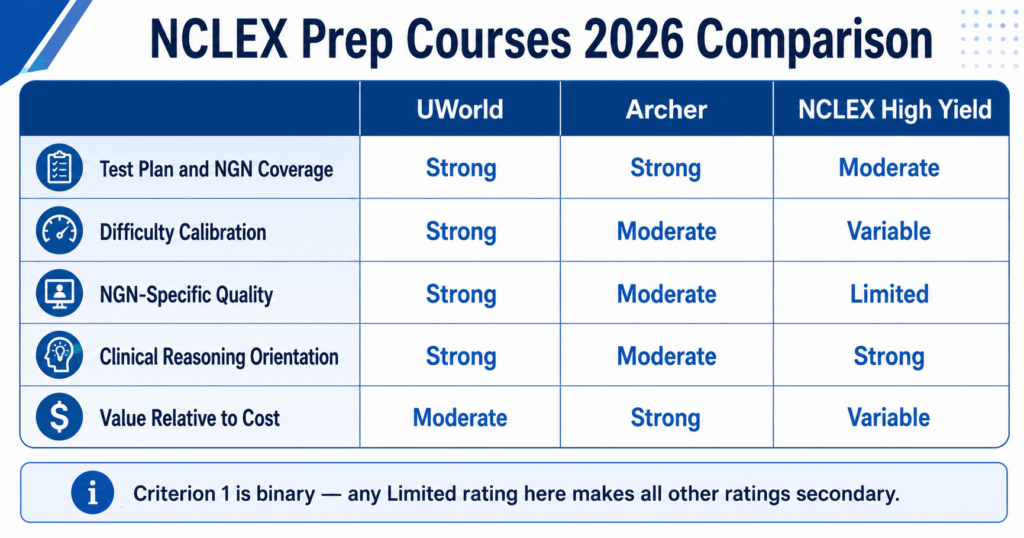
The five criteria that determine which of these NCLEX prep courses best serves a given candidate’s 2026 preparation needs are identical to those applied in the broader best-courses guide: current test plan alignment and NGN format coverage, question bank difficulty calibration, NGN-specific preparation quality, clinical reasoning orientation, and value relative to cost. Each platform is evaluated against all five so that the comparison is apples-to-apples rather than each platform’s marketing pitch against the others’ weaknesses. The most important of these criteria for 2026 is the first: whether the platform covers all five NGN format types with explicit CJMM cognitive skill instruction. This is a binary pass-or-fail criterion because the NGN format items that constitute 30 to 35 percent of the 2026 examination cannot be adequately prepared for by a platform that covers them partially, covers them without CJMM framework instruction, or does not cover them at all. All subsequent criteria are secondary to this one — a platform that fails Criterion 1 is providing incomplete preparation for the current examination regardless of how strongly it performs on the other four.
UWorld: The Clinical Reasoning Depth Standard

Criterion 1: Test Plan Alignment and NGN Coverage
UWorld has maintained consistent updates to its question bank and content in alignment with NCLEX test plan changes since the April 2023 NGN launch, and its current platform reflects April 2026 test plan alignment with all five NGN format types included. UWorld’s NGN content includes unfolding case study sets, bow tie questions, extended multiple response, matrix questions, and trend questions — the complete current NGN format inventory. CJMM cognitive skill annotation is integrated into UWorld’s NGN question rationales, identifying which of the six cognitive skills each question tests and why the correct option expresses that skill rather than another. This makes UWorld one of the stronger performers on Criterion 1 among the three NCLEX prep courses in this comparison.
Criterion 2: Difficulty Calibration
UWorld’s question bank difficulty calibration is among the most consistently cited strengths of the platform among candidates who have sat the 2026 examination. Practice accuracy on UWorld’s mixed-difficulty question bank falls in the 55 to 65 percent range for candidates who are genuinely approaching NCLEX readiness — consistent with the actual examination’s difficulty standard rather than inflated by below-NCLEX difficulty content. This calibration accuracy is the feature that makes UWorld’s practice accuracy data the most reliable readiness signal available from any of the three NCLEX prep courses in this comparison. The NCSBN official sample questions at ncsbn.org remain the authoritative calibration reference, but UWorld’s accuracy data is among the closest third-party approximation of what actual examination performance will look like.
Criterion 3: NGN-Specific Preparation Quality
UWorld’s NGN-specific preparation quality is its strongest differentiator from the other two NCLEX prep courses in this comparison. Beyond including all five NGN format types, UWorld’s rationale explanations for NGN questions systematically explain the CJMM cognitive skill the question tested, why the correct option correctly expresses that skill, and why each incorrect option fails either the cognitive skill application or the clinical criteria evaluation. This rationale depth makes UWorld’s NGN preparation particularly effective for candidates who apply the full four-question rationale protocol — because the program’s own rationale content provides the analytical material the protocol requires rather than requiring the candidate to derive it independently. The unfolding case study sets in UWorld’s current platform include carry-forward narrative integration across the six-question set, making them the most clinically accurate approximation of the actual examination’s case study complexity among the three platforms.
Criterion 4: Clinical Reasoning Orientation
UWorld’s pedagogical approach is explicitly oriented toward clinical reasoning framework application rather than content recognition — its questions are consistently designed to test whether the candidate can apply the correct clinical reasoning process to a specific patient context rather than whether they recognize the correct management for a familiar clinical condition. The rationale explanations reinforce this orientation by consistently explaining the priority framework application that produces the correct answer and the reasoning error that each distractor is designed to identify. This clinical reasoning orientation makes UWorld’s practice questions more directly aligned with what the 2026 NCLEX examination tests than a content-recognition-oriented question bank would be.
Criterion 5: Value Relative to Cost
UWorld’s primary limitation among these three NCLEX prep courses is its pricing structure. The annual subscription is among the higher-cost options in the market, though the monthly subscription option — activated during a concentrated three-to-five-week intensive preparation period — brings the platform into a more accessible cost range. Candidates who plan a six-to-eight-week intensive preparation period may find that two monthly subscriptions provide adequate coverage at significantly lower cost than the annual subscription. For candidates whose primary gap is clinical reasoning framework application and who will apply full four-question protocol discipline, the additional cost relative to lower-priced alternatives is justified by the rationale depth that specifically supports this protocol. For candidates with significant content knowledge gaps who need more structured content review than UWorld provides, the cost premium may not be justified by the incremental preparation quality improvement over alternatives that better address their specific gap profile.
Archer Review: The Adaptive Readiness Assessment Specialist
Criterion 1: Test Plan Alignment and NGN Coverage
Archer Review has updated its platform for the 2026 NCLEX test plan and includes NGN format content across all five item types. Archer’s distinctive feature in its NGN coverage is its readiness assessment orientation — the platform’s Archer Review Exam (ARE) simulation provides a predictive readiness score alongside traditional accuracy metrics, which gives candidates an additional data point for the proceed-or-extend decision beyond the four-benchmark framework. Archer’s CJMM framework instruction is present in its NGN content but is integrated somewhat less systematically into its rationale explanations than UWorld’s — the CJMM skill identification is available but requires more candidate initiative to extract from Archer’s rationale format than from UWorld’s more explicit skill annotation.
Criterion 2: Difficulty Calibration
Archer’s question bank difficulty calibration has been a source of mixed candidate feedback — some candidates report Archer’s questions as well-calibrated to NCLEX difficulty, while others report some content areas feeling easier than the actual examination. The calibration variability may reflect the platform’s ongoing question bank development and the difficulty distribution across content areas rather than a systematic below-NCLEX calibration. The NCSBN official sample questions remain the most reliable calibration check for Archer users: comparing Archer accuracy to official sample accuracy in the same content areas identifies whether any calibration discrepancy is affecting the readiness signal. Archer’s ARE simulation, which uses a proprietary readiness scoring algorithm, has been reported by many candidates as a reasonably accurate predictor of examination readiness when the simulation is conducted under exam-condition environmental requirements.
Criterion 3: NGN-Specific Preparation Quality
Archer’s NGN-specific preparation quality is adequate but less comprehensive than UWorld’s in two specific dimensions. First, the rationale depth for NGN questions — while sufficient to explain the correct answer and identify incorrect options — is less consistently systematic in naming the CJMM cognitive skill tested and explaining why each option fails the specific patient context rather than the clinical question in general. This makes the full four-question rationale protocol somewhat more demanding to execute from Archer rationales, as the candidate must identify the CJMM skill and the patient-specific failure reasons independently rather than finding them in the rationale explanation. Second, Archer’s unfolding case study sets, while present and updated for the current test plan, have received somewhat less candidate report of feeling as clinically detailed as the actual examination’s case studies than UWorld’s have. This does not make Archer’s NGN preparation inadequate — it makes it less directly scaffolded for the specific cognitive skills the format tests than UWorld’s more explicitly CJMM-annotated approach.
Criterion 4: Clinical Reasoning Orientation
Archer’s clinical reasoning orientation is solid — its questions are designed to test clinical judgment application rather than content recognition in the majority of its item bank. Archer’s platform includes clinical reasoning framework instruction and the three-tier priority hierarchy is referenced in its rationale explanations. The clinical reasoning orientation is somewhat less consistently explicit than UWorld’s across the full question bank, with some questions in Archer’s bank more directly testing content familiarity than clinical reasoning framework application. For candidates who are applying the full four-question rationale protocol, the variability in Archer’s clinical reasoning orientation means that some questions will provide less analytical protocol material than others — which is a minor disadvantage relative to UWorld’s more consistent framework-application orientation but does not fundamentally compromise the platform’s clinical reasoning development value.
Criterion 5: Value Relative to Cost
Archer Review’s most significant advantage among these three NCLEX prep courses is its price point — Archer is priced substantially below UWorld while providing comparable NGN format coverage, adequate difficulty calibration, and the distinctive ARE readiness assessment that provides a predictive score beyond the traditional accuracy metrics. For candidates who are budget-conscious and who find that the specific preparation quality differential between Archer and UWorld does not justify UWorld’s higher cost for their specific gap profile, Archer provides strong value as the primary question bank. The ARE simulation’s predictive readiness scoring is a specific feature that neither UWorld nor NCLEX High Yield provides in the same form — which gives Archer a distinctive value proposition for candidates who find the four-benchmark readiness framework alone insufficient and want an additional data point for the exam date decision.
NCLEX High Yield: The Targeted Clinical Efficiency Specialist
Criterion 1: Test Plan Alignment and NGN Coverage
NCLEX High Yield takes a different approach to test plan coverage than the other two NCLEX prep courses in this comparison: rather than comprehensive question bank coverage across all content areas, NCLEX High Yield focuses specifically on the highest-yield clinical content — the content areas, clinical principles, and clinical reasoning applications that appear most frequently on the NCLEX examination and that produce the greatest per-question clinical reasoning development return. Its NGN coverage includes all five format types, and its 2026 test plan updates reflect the current CJMM framework. The high-yield content selection approach means that NCLEX High Yield’s question bank is intentionally smaller than UWorld’s or Archer’s — which is a design choice rather than a coverage gap for candidates whose preparation goals align with the high-yield approach.
Criterion 2: Difficulty Calibration
NCLEX High Yield’s difficulty calibration is designed around the highest-yield content areas — which by definition include some of the examination’s most commonly appearing and most consistently challenging clinical scenarios. The difficulty calibration within these high-yield areas has been reported by candidates as appropriately challenging and representative of the examination’s difficulty standard. However, because NCLEX High Yield’s question bank is intentionally narrower in content scope than UWorld’s or Archer’s, the practice accuracy data it produces is more directly reflective of performance in high-yield content areas than of overall examination readiness across the full test plan scope. Candidates whose preparation has addressed all content areas comprehensively may find NCLEX High Yield’s accuracy data a more precise indicator in high-yield areas specifically, while the four-benchmark overall accuracy assessment requires supplementary question sources for content areas outside the high-yield focus.
Criterion 3: NGN-Specific Preparation Quality
NCLEX High Yield’s NGN-specific preparation applies its high-yield philosophy to the NGN format — focusing on the NGN clinical presentations and cognitive skill applications most likely to appear on the examination rather than covering the full range of possible NGN scenario types comprehensively. For candidates who have adequate clinical content foundation and whose NGN preparation need is focused on the highest-frequency NGN skill applications rather than comprehensive NGN format variety, this focused approach can produce efficient NGN preparation within a shorter time investment than comprehensive NGN coverage requires. The limitation is the same as the general high-yield limitation: candidates whose NGN weaknesses fall in lower-frequency cognitive skill applications may not receive adequate practice in those specific areas from NCLEX High Yield’s focused question bank.
Criterion 4: Clinical Reasoning Orientation
NCLEX High Yield’s clinical reasoning orientation is strongly aligned with examination application — its content selection philosophy specifically targets the clinical reasoning applications that produce the most examination-relevant preparation per study hour. Its rationale explanations are oriented toward clinical reasoning framework application rather than clinical content comprehensiveness, which makes the clinical reasoning orientation a genuine strength. The high-yield selection approach means that the clinical reasoning framework is applied to the highest-frequency scenario types rather than across the full diversity of clinical presentations — which is the appropriate tradeoff for candidates who need efficiency in a limited preparation window rather than comprehensive scenario coverage across a longer preparation period.
Criterion 5: Value Relative to Cost
NCLEX High Yield offers competitive pricing relative to the other NCLEX prep courses in this comparison, with the value proposition specifically suited to candidates who need efficient, focused preparation in a compressed time window rather than comprehensive coverage across an extended preparation period. For candidates with three to four weeks remaining before the exam who have completed comprehensive content review through nursing school or other preparation and who need targeted clinical reasoning reinforcement in high-yield areas, NCLEX High Yield’s focused approach may produce the highest per-hour preparation value of the three platforms. For candidates beginning a six-to-eight-week preparation period who need comprehensive content and reasoning development across the full test plan scope, the focused approach may produce insufficient content coverage to close all category gaps the diagnostic assessment identifies.
Head-to-Head: Which Platform Wins on Each Criterion
NGN Coverage and Test Plan Currency: UWorld
On the criterion most consequential for the 2026 examination, UWorld leads — not because Archer or NCLEX High Yield lack NGN coverage but because UWorld’s CJMM cognitive skill annotation is most consistently integrated into its rationale explanations across NGN question types. This annotation reduces the candidate effort required to extract the preparation intelligence the full four-question rationale protocol needs from each NGN question, which produces more efficient NGN-specific clinical reasoning development per practice hour than either of the other NCLEX prep courses provides for candidates applying the same protocol discipline. Archer and NCLEX High Yield are not inadequate on this criterion — UWorld is specifically stronger.
Difficulty Calibration: UWorld and Archer Tied
Both UWorld and Archer provide difficulty calibration that approximates the actual NCLEX examination’s standard more closely than most of the broader NCLEX prep courses market, though both benefit from the NCSBN official sample question comparison check to verify individual candidate experience. NCLEX High Yield’s difficulty calibration within its high-yield content scope is also strong but applies to a narrower content range than the other two platforms. For candidates whose primary concern is whether their practice accuracy data accurately reflects their examination readiness, UWorld and Archer are comparably reliable on this criterion with the NCSBN sample calibration check applied to either.
Value Relative to Cost: Archer for Budget, High Yield for Compressed Timeline
For budget-conscious candidates who need comprehensive coverage at the lowest available cost among the three NCLEX prep courses, Archer provides the strongest value — adequate NGN coverage, solid difficulty calibration, and the distinctive ARE readiness assessment at substantially lower cost than UWorld. For candidates with a compressed preparation window of three to four weeks who need targeted high-yield reinforcement rather than comprehensive coverage, NCLEX High Yield provides the strongest per-hour preparation value. UWorld’s cost is most justified for candidates with six or more weeks of intensive preparation ahead who will apply full four-question protocol discipline consistently — because the rationale depth that justifies UWorld’s cost premium produces the greatest clinical reasoning development return over extended concentrated use.
Clinical Reasoning Orientation: UWorld Leads, Archer and High Yield Are Solid
All three NCLEX prep courses are oriented toward clinical reasoning framework application rather than content recognition — which is the appropriate orientation for the 2026 examination that is specifically designed to present novel clinical scenario combinations. UWorld leads on consistency of this orientation across the full question bank, with some variability in Archer and more intentional scope limitation in NCLEX High Yield. For candidates applying the full four-question rationale protocol to every question, UWorld’s consistency of clinical reasoning orientation produces more consistently protocol-compatible rationale material than the other two platforms — though both provide adequate material for candidates applying the same protocol with somewhat more independent analytical contribution.
- The selection decision in three candidate profiles: Profile A — adequate content foundation, six-week intensive preparation, full protocol discipline planned: UWorld’s rationale depth and consistent clinical reasoning orientation justify the cost premium. Profile B — budget-constrained, four-to-six-week preparation, full protocol discipline planned: Archer provides comparable NGN coverage and adequate difficulty calibration at substantially lower cost, with ARE readiness scoring as a distinctive additional data point. Profile C — compressed three-to-four-week window, comprehensive content coverage already completed, need targeted reinforcement: NCLEX High Yield’s focused high-yield approach provides the highest per-hour preparation value for this specific timeline and gap profile.
- The one platform feature that most candidates do not evaluate before purchasing: Question bank size relative to preparation timeline. A question bank of 2,000 questions used across a six-week preparation period at 50 questions per day provides approximately 2,100 questions of practice — more than sufficient. A question bank of 1,200 questions used across the same period runs out before the preparation period ends, requiring either question repetition (which is acceptable with a spaced interval but reduces novelty) or supplementary sources. Check each platform’s current question bank size against your planned daily question volume and preparation timeline before committing to a subscription.
Whether to use two NCLEX prep courses simultaneously: The single-platform principle applies to all three of these NCLEX prep courses: one platform used with full four-question protocol discipline produces more clinical reasoning development than two platforms used with divided attention and shallower engagement. If the diagnostic assessment identifies that the chosen primary platform has a specific gap — insufficient NGN case study depth, limited content in a specific clinical area, question bank exhaustion before the preparation period ends — targeted supplementation from a secondary source for that specific gap is appropriate. General parallel use of two full platforms produces preparation fragmentation without proportional clinical reasoning development benefit.
Conclusion: Match Platform to Profile, Then Commit
The UWorld versus Archer versus NCLEX High Yield comparison does not produce a single winner that every candidate should choose — it produces a clear framework for matching platform strengths to candidate preparation profiles. UWorld leads on rationale depth, CJMM annotation consistency, and clinical reasoning orientation — making it the strongest choice for candidates with adequate content foundation who need maximum clinical reasoning development through high-quality rationale practice across a six-to-eight-week intensive preparation period. Archer leads on value relative to cost and distinctive ARE readiness assessment — making it the strongest choice for budget-conscious candidates who need comprehensive NGN coverage and a predictive readiness score at substantially lower cost than UWorld. NCLEX High Yield leads on preparation efficiency per hour in a compressed timeline — making it the strongest choice for candidates with three to four weeks before a confirmed exam date who need targeted high-yield reinforcement rather than comprehensive coverage.
The comparison ends when the selection is made. The single platform principle applies regardless of which of these three NCLEX prep courses is selected: full four-question rationale protocol on every question, error type classification for every incorrect answer, CJMM action verb identification for every NGN question, weekly micro-audit with four-benchmark tracking, and exam-condition simulation weekly. These preparation behaviors convert any of the three platforms’ resources into the clinical reasoning competency the 2026 examination measures. The platform provides the question vehicle. The protocol discipline provides the clinical reasoning development. Both matter. The platform decision ends at selection. The protocol discipline begins at the first question.
