

Selecting among NCLEX prep courses in 2026 requires a more specific evaluation framework than in any previous year — because the April 2023 NGN launch and the April 2026 test plan update have created a meaningful quality gap between programs that have adapted their content and format coverage to the current examination and programs that have not. The features that differentiated the best NCLEX prep courses before 2023 — question bank size, content video library depth, rationale quality, and pass rate guarantees — remain relevant but are now secondary to a more fundamental question: does this program specifically prepare candidates for the NGN clinical judgment format types and the CJMM cognitive skill framework that the 2026 examination explicitly tests?
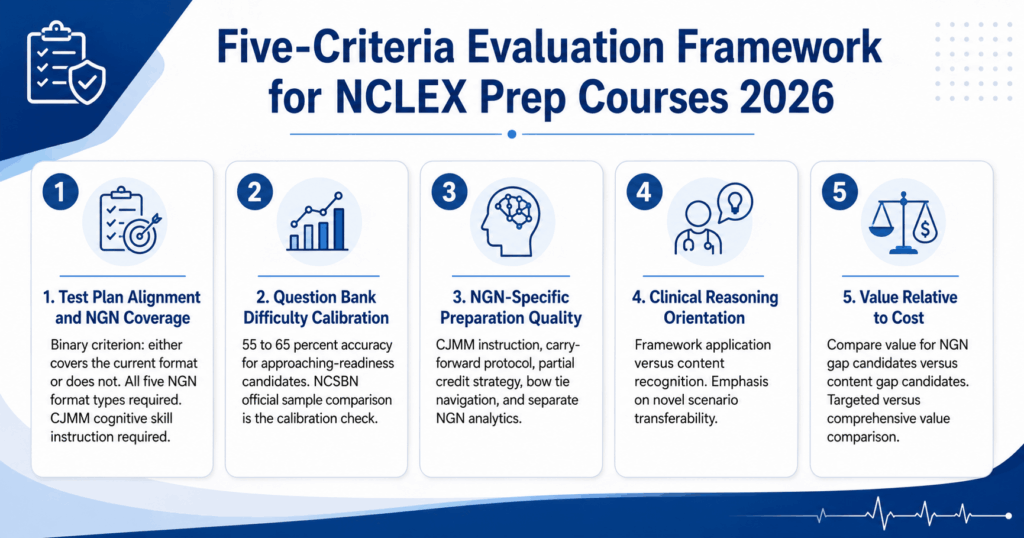
This guide evaluates the leading NCLEX prep courses against a five-criteria framework calibrated to the 2026 examination’s specific demands — not the examination that existed before the NGN transition. The five criteria are: current test plan alignment and NGN format coverage, question bank difficulty calibration to actual NCLEX difficulty, NGN-specific preparation quality, content review approach and clinical reasoning orientation, and value proposition relative to cost. Each program is evaluated on all five criteria so that candidates can identify which program best matches their specific preparation profile rather than which program has the most impressive marketing.
A transparency note before the evaluations: this guide assesses programs on the preparation quality they provide, not on their pass rate marketing claims. Pass rate guarantees in NCLEX prep courses are marketing instruments rather than preparation quality measures — they are typically conditioned on completing a specific study plan that would produce passing results with almost any quality preparation approach, and they are not audited by independent third parties. What this guide evaluates is whether each program’s specific preparation components align with what the 2026 examination actually measures.
The Five Criteria for Evaluating NCLEX Prep Courses in 2026
Criterion 1: Current Test Plan Alignment and NGN Coverage
The most important criterion for any 2026 NCLEX prep course evaluation is whether the program specifies alignment with the April 2026 or later NCLEX test plan and whether it covers all five NGN format types — unfolding case study sets, bow tie questions, extended multiple response, matrix questions, and trend questions — with explicit CJMM cognitive skill instruction. Programs that do not specify their test plan version, programs that were developed for the pre-2023 examination without NGN updates, and programs that cover only some NGN format types are providing incomplete preparation for the current examination regardless of how comprehensive their traditional content is. This criterion is binary: a program either covers the current examination format or it does not, and no amount of clinical content depth compensates for format coverage gaps in the 30 to 35 percent of the 2026 examination that NGN items constitute.
Criterion 2: Question Bank Difficulty Calibration
The second criterion is whether the program’s question bank produces practice accuracy in the 55 to 65 percent range for candidates who are genuinely approaching NCLEX readiness — the range that corresponds to actual examination difficulty. NCLEX prep courses whose question banks produce 70 to 80 percent accuracy for well-prepared candidates are calibrated below the actual examination’s difficulty, which generates false confidence and fails to develop the clinical reasoning competency needed for the adaptive algorithm’s difficulty level. The calibration check is straightforward: complete 25 to 30 NCSBN official sample questions at ncsbn.org and compare the accuracy to the program’s question bank accuracy. A well-calibrated question bank should produce similar accuracy to the official samples. A bank producing significantly higher accuracy is below the examination’s difficulty standard regardless of how well its rationale explanations are written.
Criterion 3: NGN-Specific Preparation Quality
The third criterion is the quality of NGN-specific preparation the program provides beyond simply including NGN format questions. High-quality NGN preparation in NCLEX prep courses includes explicit CJMM cognitive skill instruction (not just question exposure), the carry-forward protocol taught for unfolding case study navigation, partial credit response strategy taught for extended multiple response questions, bow tie center-first strategy taught for bow tie question navigation, and separate NGN accuracy tracking in the program’s analytics. Programs that include NGN questions without explicit CJMM framework instruction are providing format exposure without the strategic skill development that NGN format questions specifically require.
Criterion 4: Clinical Reasoning Orientation
The fourth criterion distinguishes NCLEX prep courses that teach clinical reasoning framework application from those that primarily teach clinical content recognition. Programs oriented toward clinical reasoning framework application explicitly teach the three-tier priority hierarchy applied to specific patient scenarios, the nursing process sequencing principle with its clinical exceptions, the therapeutic communication technique criteria, and how these frameworks are applied to produce correct answers across novel clinical scenarios the candidate has not specifically practiced. Programs oriented toward clinical content recognition teach what the correct management is for each clinical condition — which produces correct answers on familiar scenarios and incorrect answers when the same framework appears in an unfamiliar scenario combination. The 2026 examination is specifically designed to present novel scenario combinations that defeat content recognition, which makes clinical reasoning orientation the more relevant preparation approach.
Criterion 5: Value Relative to Cost
The fifth criterion is whether the program’s preparation quality justifies its cost relative to alternatives — not whether it is the cheapest option but whether the specific preparation advantages it provides over lower-cost alternatives are worth the price difference for a given candidate’s preparation profile. A program that costs $400 and provides significantly better NGN-specific preparation than a $50 alternative may be excellent value for a candidate whose primary preparation gap is NGN format fluency. The same program may be poor value for a candidate whose NGN accuracy is already adequate and whose primary gap is a specific content category that targeted content review rather than a comprehensive program would address more efficiently.
UWorld NCLEX: Best Overall for Clinical Reasoning Depth

What UWorld Does Well
UWorld is the most consistently cited NCLEX prep course for question bank quality among candidates who have sat the 2026 examination, and the primary reason is rationale depth. UWorld’s question rationale explanations are among the most thorough available — explaining not just why the correct answer is correct but why each incorrect option fails for the specific patient in the scenario, which is the four-question rationale protocol component that most other programs’ rationales do not systematically provide. This rationale depth makes UWorld’s question bank particularly effective when used with full four-question protocol discipline, because the program’s own rationale content provides the option-by-option analysis that the protocol requires rather than requiring the candidate to derive it independently. UWorld has also updated its question bank for the April 2026 test plan and includes all five NGN format types with CJMM framework annotation — making it one of the stronger performers on Criterion 1 and Criterion 3 among the major NCLEX prep courses.
UWorld’s Limitations
UWorld’s primary limitation for budget-conscious candidates is its pricing structure — the annual subscription represents one of the higher-cost entries in the NCLEX prep courses market, though the monthly subscription option brings it into the accessible range for intensive preparation periods as described in the budget guide. Its content review library is less developed than dedicated content review platforms, making it more effective as a question bank resource supplemented by free content review than as a standalone comprehensive NCLEX prep course. Candidates who have significant content knowledge gaps requiring structured video instruction may find UWorld less complete as their only resource than candidates whose primary gap is clinical reasoning application.
Who UWorld Is Best For
UWorld is best suited for NCLEX prep course candidates who have adequate clinical content foundation from nursing school and whose primary preparation need is clinical reasoning framework application development through high-quality question practice with thorough rationale review. It is particularly well-suited for candidates who will use the full four-question rationale protocol discipline — because the rationale quality specifically supports this approach — and for candidates with confirmed exam dates who can use the monthly subscription efficiently during a concentrated preparation period.
Kaplan NCLEX: Best for Structured Learners Who Need Both Content and Strategy
What Kaplan Does Well
Kaplan’s NCLEX prep course has historically differentiated itself through its Decision Tree methodology — a structured clinical reasoning framework that teaches candidates a systematic process for eliminating incorrect options and identifying the correct answer. For candidates who benefit from an explicit, teachable decision process rather than a framework they must derive from practice experience, the Decision Tree provides the structured clinical reasoning scaffold that makes question engagement more systematic. Kaplan has updated its content for the 2026 test plan and provides NGN format coverage across all five item types with CJMM framework instruction — making it competitive with UWorld on Criterion 1 and Criterion 3. Kaplan’s content review library is more developed than UWorld’s, making it a more complete standalone NCLEX prep course for candidates who need both content review and question practice from a single program.
Kaplan’s Limitations
The Decision Tree methodology, while genuinely useful for candidates who benefit from explicit decision frameworks, can produce over-reliance on the decision process as a question-answering algorithm rather than as a scaffold for genuine clinical reasoning development. Candidates who apply the Decision Tree mechanically — treating it as a sequence to execute rather than as a clinical reasoning orientation — sometimes find that their decision tree application produces correct answers on familiar scenario types and fails on novel presentations where the decision tree’s specific steps do not map cleanly to the question’s clinical structure. The most effective use of Kaplan’s methodology is as a training framework for clinical reasoning orientation rather than as a permanent question-answering algorithm, which requires the candidate to progressively internalize the reasoning principles the framework teaches rather than continuing to apply the framework as a procedural checklist.
Who Kaplan Is Best For
Kaplan is best suited for NCLEX prep course candidates who benefit from explicitly taught, structured learning frameworks and who need both content review and clinical reasoning instruction from a single integrated program. It is particularly well-suited for candidates who found nursing school’s implicit clinical reasoning instruction insufficient and who benefit from an explicit decision process that makes the priority hierarchy application procedurally clear before it is internalized as automatic clinical reasoning.
ATI NCLEX: Best for Candidates Whose Nursing Schools Used ATI
What ATI Does Well
ATI’s NCLEX prep course advantage for many nursing graduates is continuity: candidates whose nursing schools used ATI throughout their program have existing familiarity with ATI’s content organization, question format, and rationale style that reduces the onboarding friction cost that switching to a new NCLEX prep course platform involves. ATI has updated its NCLEX preparation content for the 2026 test plan with NGN format integration and CJMM framework instruction — making it current on the format criteria that matter most for the 2026 examination. ATI also provides nursing school-to-NCLEX performance correlation data for candidates whose schools used ATI throughout, which can provide a useful baseline for identifying content categories where preparation investment should be prioritized based on nursing school performance history.
ATI’s Limitations
ATI’s question bank difficulty calibration has been reported by some candidates as slightly below the actual NCLEX examination’s difficulty level — producing practice accuracy in the higher end of the readiness range rather than the 55 to 65 percent range that well-calibrated NCLEX prep courses produce. Candidates using ATI as their primary question bank should complete the NCSBN official sample questions as a calibration check and compare their ATI accuracy to their official sample accuracy to assess whether a difficulty gap exists. ATI’s rationale depth is generally adequate but less comprehensive than UWorld’s option-by-option analysis in many of its questions — which makes the full four-question protocol somewhat more demanding to execute from ATI rationales alone.
Who ATI Is Best For
ATI is best suited for NCLEX prep course candidates who completed nursing school with an ATI-integrated curriculum and who have existing ATI subscriptions or institutional access through their nursing program. The continuity advantage is genuine for this population — and the nursing school performance correlation data provides a starting diagnostic that other programs cannot replicate for ATI-tracked candidates. For candidates without existing ATI exposure, the continuity advantage does not apply and the decision between ATI and alternatives should be based on the other four criteria.
Hurst Review: Best for Candidates With Significant Content Gaps
What Hurst Does Well
Hurst Review distinguishes itself among NCLEX prep courses by emphasizing clinical content review depth over question bank volume — a preparation orientation that is specifically valuable for candidates whose primary gap is clinical content knowledge rather than clinical reasoning framework application. Hurst’s systematic content review coverage, organized by body system and clinical category, provides the structured clinical content foundation that candidates who did not achieve strong content mastery in nursing school may need before intensive question practice will produce meaningful accuracy improvement. Hurst has integrated NGN format instruction into its current review content, addressing the 2026 test plan’s clinical judgment format requirements alongside its traditional content review strength.
Hurst’s Limitations
Hurst’s question bank is smaller than UWorld’s or Kaplan’s, which limits the volume of diverse practice scenarios available for clinical reasoning framework application development. For candidates whose primary gap is clinical reasoning application rather than content knowledge, the content-review-oriented approach of NCLEX prep courses like Hurst may provide more structured content instruction than they need while providing less clinical reasoning development opportunity than a question-bank-primary approach would. Hurst is best used as a content foundation resource preceding intensive question bank practice rather than as the sole NCLEX prep course resource.
Who Hurst Is Best For
Hurst is best suited for NCLEX prep course candidates who genuinely need comprehensive content review before question bank practice will be productive — candidates who struggled with clinical content during nursing school, who have been out of nursing school for an extended period before preparing for the NCLEX, or who identify through diagnostic assessment that multiple content categories are significantly below the 50 percent accuracy threshold that warrants content foundation work before question practice emphasis. For candidates with adequate content foundation whose primary gap is clinical reasoning framework application, the content-heavy Hurst approach is less efficient than a question-bank-primary approach that develops clinical reasoning through practice with framework-oriented rationale review.
Simple Nursing and Level Up RN: Best Free and Low-Cost Content Supplements
What These Resources Provide
Simple Nursing and Level Up RN represent a category of NCLEX prep courses that operates primarily through content explanation videos — available on YouTube at no cost — rather than through structured question bank systems. Both channels have produced extensive clinical content review libraries that cover NCLEX-relevant nursing content with attention to examination application rather than purely academic clinical comprehensiveness. Simple Nursing is particularly recognized for simplifying complex pharmacology and pathophysiology content into memorable frameworks. Level Up RN has produced organized NCLEX-focused content review covering major clinical categories with examination-oriented rather than textbook-oriented presentation. Both channels have addressed NGN format content in their more recent video libraries, making them reasonably current for the 2026 examination’s content scope when that content is used alongside NCSBN official format instruction.
Their Limitations as Primary NCLEX Prep Courses
Simple Nursing and Level Up RN are content review supplements rather than complete NCLEX prep courses — they provide clinical knowledge foundation without the question bank practice, difficulty-calibrated assessment, analytics-driven gap identification, or systematic NGN format practice that a complete preparation system requires. Candidates who use these resources as their primary NCLEX preparation are receiving content review without the clinical reasoning framework application development that the examination tests, and without the practice question data that identifies which content areas and error types require additional intervention. These resources are most effective when integrated into a complete preparation system as the content review component — supplementing question bank practice rather than substituting for it.
How to Integrate Them Into a Complete System
The optimal integration of free content resources like Simple Nursing and Level Up RN into a complete NCLEX prep course approach is as the targeted content review component activated when the weekly micro-audit’s error type classification identifies genuine knowledge gaps in specific content categories. Rather than watching content videos systematically as a preparation warm-up, the most efficient use is targeted: a week in which the error type log shows 35 percent knowledge gaps in cardiovascular content warrants a targeted cardiovascular content review session using the most accessible high-quality free resource. This targeted activation produces more efficient preparation value per viewing hour than systematic content video coverage applied without the diagnostic data that identifies which content areas actually need the attention.
How to Choose the Right NCLEX Prep Course for Your Profile
The Diagnostic-First Selection Principle
The most common NCLEX prep course selection mistake is choosing a program based on peer recommendations or marketing before completing a diagnostic assessment that identifies which preparation gaps the program must address. Peer recommendations reflect the peer’s preparation profile — their content gaps, their clinical reasoning development needs, their learning style preferences — which may differ substantially from the selecting candidate’s profile. A peer who benefited enormously from Kaplan’s Decision Tree structure may have benefited because they had strong content knowledge and needed explicit reasoning framework instruction. A candidate who selects Kaplan based on this recommendation but who actually has significant content gaps will find that the Decision Tree is applied to clinical content they have not fully mastered — which produces different results than the peer experienced. Complete a 50-question diagnostic session on any available question bank before selecting a prep course, identify which content categories fall below 50 percent accuracy, classify error types across the session’s incorrect answers, and select the program whose specific strengths most directly address the identified gaps.
The Single Program Principle
The most common NCLEX prep course selection mistake after the diagnostic-first principle is violated is selecting more than one program simultaneously. Splitting preparation investment across two or more programs produces fragmented preparation that loses the rationale style familiarity, difficulty calibration consistency, and analytics continuity that develop through consistent use of a single platform. The preparation efficiency benefit of deep familiarity with one program’s rationale approach and analytics system exceeds the marginal benefit of access to a second program’s question variety — which is why one quality program used with full protocol discipline consistently outperforms two programs used with divided attention. Select one primary program based on the diagnostic assessment and commit to it for the preparation period.
Verifying Currency Before Committing
Before committing to any NCLEX prep course at any price point, verify two specific currency indicators. First, confirm the program specifies alignment with the April 2026 or later NCLEX Detailed Test Plan — this should be explicitly stated on the program’s current homepage or documentation, not inferred from general claims of current content. Second, confirm the program includes all five NGN format types with CJMM cognitive skill instruction — not just mentions of NGN content but specific instruction in CJMM skill identification, carry-forward protocol, partial credit response strategy, and bow tie center-first navigation. Programs that cannot confirm both currency indicators are providing preparation for an examination that has moved on from the version they cover, regardless of their overall reputation or their historical pass rates.
- The single most important question to ask any NCLEX prep course before purchasing: Does your program include explicit instruction in all five NGN format types — unfolding case study, bow tie, extended multiple response, matrix, and trend questions — with specific CJMM cognitive skill instruction for each? A program that answers yes with documentation is providing current examination coverage. A program that answers yes with vague assurance, or that mentions NGN without specifying CJMM instruction, warrants further investigation before purchase. A program that does not address this question clearly is covering an examination that the April 2023 NGN launch fundamentally changed.
- How to test any NCLEX prep course’s difficulty calibration before committing to a full subscription: Most major NCLEX prep courses offer free trial access or sample questions. Complete 25 to 30 of any program’s sample questions and compare your accuracy to your accuracy on the free NCSBN official sample questions. If the program’s questions produce accuracy more than 10 percentage points higher than the NCSBN samples, the program’s difficulty calibration is below the examination standard and the readiness signal it produces during preparation will be inflated. If accuracy is within 10 percentage points in either direction, the calibration is reasonably aligned with the examination’s difficulty standard.
- What a pass guarantee actually means — and what it doesn’t: Every major NCLEX prep course offers a pass guarantee or pass rate marketing claim. Before these claims influence a purchase decision, understand what they cover: almost universally, pass guarantees are conditioned on completing a specific number of questions, content review modules, and practice assessments within a defined time period — a completion rate that would produce passing results with almost any quality preparation approach. The guarantee is not a warranty that the program’s specific preparation quality will produce passing results regardless of how it is used. Evaluate programs on their specific preparation components, not on their guarantee marketing.
Conclusion
The best NCLEX prep courses in 2026 are those that meet the five evaluation criteria calibrated to the current examination: current April 2026 test plan alignment with all five NGN format types covered, question bank difficulty calibrated to actual NCLEX difficulty rather than below-standard practice, NGN-specific preparation quality that includes CJMM framework instruction rather than just NGN question exposure, clinical reasoning orientation that teaches framework application rather than content recognition, and value that justifies the cost relative to lower-cost alternatives given the specific candidate’s preparation gaps. Against these criteria, UWorld leads for candidates whose primary need is clinical reasoning development through thorough rationale quality, Kaplan leads for candidates who benefit from structured decision methodology, ATI leads for candidates with nursing school ATI continuity, Hurst leads for candidates with significant content knowledge gaps, and the free resource system described in the budget guide is competitive with all of them for candidates who apply full protocol discipline to free resources.
The selection principle that matters more than any program ranking is matching the program to the diagnostic assessment rather than to peer recommendations or marketing claims. Identify which content categories fall below 50 percent accuracy, classify the error types that produce the most incorrect answers, determine whether the primary gap is content knowledge or clinical reasoning framework application, verify the program’s NGN coverage and test plan currency, and select the single program whose strengths most directly address the identified preparation profile. Then use it with the full four-question rationale protocol, error type classification, weekly micro-audit, and exam-condition simulation discipline that converts any quality program’s resources into the clinical reasoning competency the 2026 examination measures.
