

The NCLEX preparation challenge facing a repeat test taker is fundamentally different from the challenge facing a first-attempt candidate — and the review approach that addresses it most effectively is correspondingly different in structure, in resource selection, and in preparation priorities. A first-attempt candidate is building a clinical reasoning competency from a nursing school foundation without specific data about where that foundation is insufficient. A repeat test taker has the most specific preparation intelligence available: a Candidate Performance Report that identifies which content categories fell below the passing standard on an actual NCLEX examination at actual adaptive difficulty, plus the preparation experience of the first attempt that reveals which preparation behaviors produced inadequate clinical reasoning development despite the preparation investment they represented.
The most common and most consequential mistake repeat test takers make in NCLEX preparation for the second attempt is applying more of the same approach with more intensity — completing the same question bank with more questions, reviewing the same content areas with more time, preparing for longer periods with more urgency — while the structural preparation behavior that produced insufficient clinical reasoning development in the first attempt remains unchanged. This approach correctly identifies that more preparation is needed while incorrectly identifying what kind of preparation is needed. The second NCLEX preparation that produces a different result is not the first preparation scaled up. It is a different preparation approach designed around the specific gaps the CPR identified, the specific error types that produced those gaps, and the 2026 examination’s specific format demands that the first preparation may or may not have adequately addressed.
This guide builds the complete best NCLEX preparation review system specifically for repeat test takers — how to read the CPR as the preparation prescription it actually is, how to identify whether the first preparation’s structural approach requires changing or whether targeted gap work is sufficient, how to select review resources specifically matched to the second attempt’s identified gaps, and how to build the week-by-week preparation architecture that converts the CPR’s specific intelligence into a second attempt that addresses the actual causes of the first result.
Step 1: Reading the CPR as a Preparation Prescription
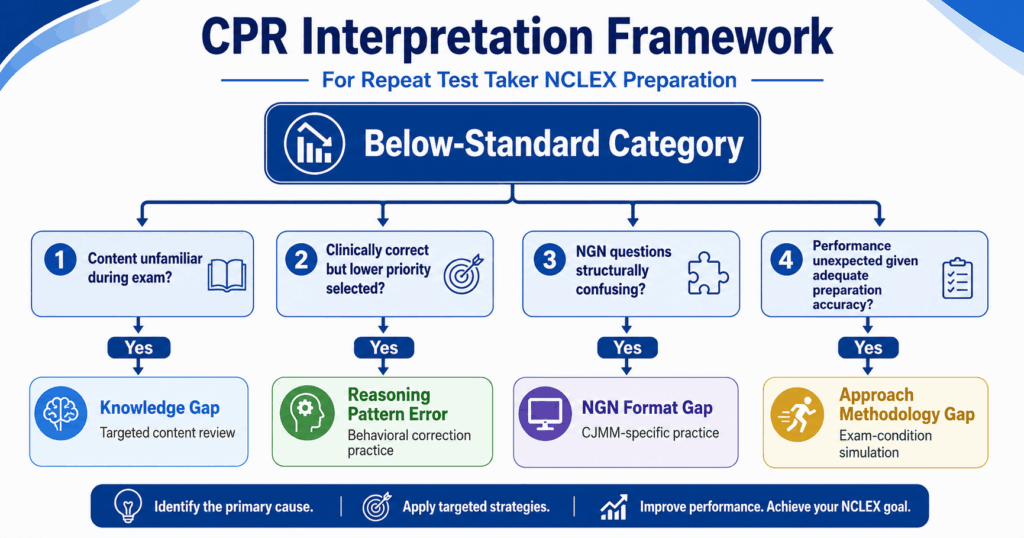
What the CPR Actually Tells You
The Candidate Performance Report issued after a not-passing NCLEX result is the most specific preparation intelligence a repeat test taker possesses — more specific than any diagnostic assessment tool because it reflects actual examination performance at actual adaptive difficulty under actual examination conditions. The CPR’s content category ratings (above passing standard, near passing standard, below passing standard) across the four test plan domains identify which specific content areas produced below-standard ability evidence in the adaptive session. Before selecting any review resource for the second NCLEX preparation, the CPR analysis must be completed — and the analysis must go deeper than reading which categories are below standard. For each below-standard category, three questions must be answered: Was the below-standard performance produced by a knowledge gap, by a reasoning pattern error applied across that content area, by NGN format underperformance in that category’s question set, or by an approach methodology failure (adequate preparation performance but below-standard examination performance from anxiety, pacing, or environmental demands)? Each cause requires a different preparation response, and selecting a review resource before identifying the cause is selecting a solution before diagnosing the problem.
The Four CPR Interpretation Questions
For every below-standard content category in the CPR, a repeat test taker should answer four specific diagnostic questions before determining the preparation response. First: Did this category feel content-unfamiliar during the examination — did questions in this area reveal clinical information that felt genuinely unknown? If yes, a knowledge gap contributed to the below-standard performance and targeted content review in this category is appropriate. Second: Did this category produce the pattern of selecting clinically correct but lower-priority options — choosing communication before unaddressed physiological needs, intervention before assessment, or the almost-correct priority? If yes, a reasoning pattern error contributed and behavioral correction practice is the appropriate response rather than additional content review in this category. Third: Did NGN format questions in this category feel structurally confusing or mechanically unfamiliar beyond the clinical content? If yes, an NGN format gap contributed and CJMM-specific practice targeting this content area’s NGN item types is appropriate. Fourth: Was the below-standard performance unexpected given adequate practice accuracy in this category during preparation? If yes, an approach methodology gap — anxiety, pacing, or testing center environmental demands — contributed and exam-condition simulation and performance anchor conditioning are the appropriate responses.
Building the Second Preparation Prescription From CPR Analysis
The CPR analysis produces a preparation prescription with four possible components that may apply in varying proportions to different below-standard categories: targeted content review for categories with genuine knowledge gaps, behavioral correction practice for categories with systematic reasoning pattern errors, NGN-specific format practice for categories with NGN performance contributions, and exam-condition simulation conditioning for categories showing approach methodology gaps. The most important feature of this prescription is its specificity — it identifies different preparation responses for different categories based on the cause of each category’s below-standard performance rather than applying the same response (more content review in below-standard areas) to every identified gap. The second NCLEX preparation that produces a different result is the one built from this specific prescription rather than from the general assumption that below-standard performance means insufficient content study.
Step 2: Identifying Whether Structural Change or Targeted Work Is Needed

When Targeted Gap Work Is Sufficient
For some repeat test takers, the first NCLEX preparation approach was structurally adequate — the four-question rationale protocol was being applied, error type classification was being used, NGN format practice was integrated, and the weekly benchmark tracking was providing accurate readiness signals — but the second attempt requires only targeted work on the specific content categories and error types the CPR identified rather than a structural overhaul of the preparation approach. The signal that targeted gap work is sufficient rather than structural change: the CPR shows one to two below-standard categories while the majority of categories are at or above the passing standard, the first preparation included full rationale protocol discipline and the below-standard categories were identified as at or near the passing standard in practice analytics, and the error type analysis of the first preparation’s sessions shows that incorrect answers in the below-standard categories were distributed across all four error types rather than clustering in a single error type that would indicate a systematic approach problem.
When Structural Change Is Required
For other repeat test takers, the first NCLEX preparation approach was structurally inadequate — the preparation behaviors that produce clinical reasoning development were not consistently applied, and the below-standard CPR results reflect the preparation approach’s limitations rather than isolated content gaps. The signal that structural change is required: the CPR shows three or more below-standard categories with several at or above the passing standard suggesting an uneven preparation approach rather than uniform near-passing performance, the first preparation relied primarily on answer-checking rationale review rather than the four-question protocol, error type classification was not maintained and every incorrect answer received content review as the default response, NGN format practice was deferred to the final preparation weeks or treated as occasional supplementary practice rather than daily integrated content, or the first preparation was completed without timed conditions producing a practice-to-exam performance gap. When these structural inadequacies are present, repeating the first preparation approach with more questions, more time, or more content review will produce a similar outcome — because the clinical reasoning development that the examination measures is still not being built at the quality level the approach produces.
The Structural Change Inventory for Repeat Test Takers
A repeat test taker determining whether structural change is needed can complete a five-question structural change inventory from the first preparation. One: was the four-question rationale protocol (correct option’s clinical principle applied to this patient, each incorrect option’s failure for this patient, reasoning error type for each distractor, clinical principle transfer for novel scenarios) applied to every practice question? Two: was error type classification maintained for every incorrect answer, identifying knowledge gaps versus reasoning pattern errors versus patient context errors versus NGN cognitive skill errors? Three: were NGN format questions integrated at 30 to 35 percent of every daily session with at least one full six-question unfolding case study set completed daily? Four: was every practice session conducted under 90-second timed conditions with milestone clock checks? Five: was the weekly micro-audit conducted every Sunday with four-benchmark tracking producing the following week’s preparation prescription? A no answer to two or more of these questions identifies structural preparation approach inadequacies that targeted gap work alone will not address in the second preparation.
Step 3: Resource Selection Matched to the Second Attempt’s Specific Needs
When to Switch Question Banks and When to Stay
One of the most common and least analytically grounded decisions repeat test takers make in NCLEX preparation for the second attempt is switching question banks based on the instinct that a different resource will produce a different result. This instinct is sometimes correct and sometimes counterproductive — and the distinction depends on whether the first question bank was the limitation or whether the engagement quality applied to it was the limitation. If the first question bank was below-difficulty calibrated (producing accuracy above 70 percent for a candidate who subsequently did not pass), switching to a better-calibrated bank is warranted and likely to produce better preparation intelligence. If the first question bank was adequately calibrated but was used with answer-checking review rather than full four-question protocol engagement, switching banks without changing the engagement approach will produce the same preparation quality from a different source — because the preparation value extracted from a question bank is determined by how the candidate engages with it, not by which bank it is. The decision to switch question banks should be based on the bank’s difficulty calibration adequacy and NGN format coverage completeness, not on the instinct that novelty will produce improvement.
NGN-Specific Resource Additions for Repeat Test Takers
Repeat test takers who sat the examination before April 2023 or whose first preparation did not adequately address NGN format have a specific resource addition need that goes beyond their primary question bank: dedicated NGN format instruction from a resource that teaches CJMM cognitive skill identification, carry-forward narrative integration protocol, partial credit response strategy, and bow tie center-first navigation explicitly rather than simply exposing candidates to NGN format questions. The NCSBN official NGN tutorial at ncsbn.org is the free foundation for this instruction — written by the examination’s administrator and providing the most accurate available description of what each NGN format type tests and how. Commercial programs with strong NGN instruction (UWorld’s CJMM-annotated rationales, Kaplan’s NGN decision framework, ATI’s updated NGN modules) can supplement this foundation for candidates whose NGN gap assessment shows NGN accuracy more than 10 percentage points below traditional accuracy. The specific NGN resource addition should match the specific NGN error type identified through the NGN gap assessment: candidates whose errors cluster in carry-forward integration need unfolding case study set practice with explicit protocol instruction, candidates whose errors cluster in over-inclusion need independent criteria evaluation drill, candidates whose errors cluster in wrong cognitive skill application need CJMM action verb identification practice.
Content Review Resources Specific to CPR-Identified Gaps
Content review resources for the second NCLEX preparation should be selected specifically for the CPR-identified below-standard categories rather than as comprehensive review programs that re-cover all clinical content. A repeat test taker whose CPR shows cardiovascular and pharmacology below standard with all other categories at or above standard does not need a comprehensive content review program — they need targeted cardiovascular and pharmacology review resources that address the specific knowledge gaps identified by the CPR’s content signal and confirmed by error type analysis as genuine knowledge gaps rather than reasoning pattern errors. For targeted content review, the most efficient resources are organized by clinical category with examination-relevant framing: Hurst Review for comprehensive content-heavy preparation, Level Up RN or Simple Nursing YouTube channels for targeted content video review in specific categories, and clinical pharmacology mnemonics resources for pharmacology-specific gaps. Selecting a comprehensive review program for two below-standard categories wastes preparation time on content the CPR confirmed is already at or above the passing standard.
Step 4: The Second Attempt Preparation Architecture
Week One: Diagnostic and System Build
The first week of second-attempt NCLEX preparation is not question practice — it is diagnostic and system build. Day one through three: complete the full CPR analysis using the four diagnostic questions for each below-standard category, complete the structural change inventory to identify whether approach rebuilding is needed, complete the NGN baseline assessment (NCSBN official samples plus 50 mixed NGN questions with accuracy tracked separately), and complete a 50-question general diagnostic on the primary question bank with error type classification to establish the current preparation baseline. Days four through seven: select review resources matched to the diagnostic outputs, build the Anki deck structure (creating card templates from the first preparation’s most instructive rationale reviews if available, or starting fresh from the diagnostic week’s sessions), establish the weekly schedule including simulation day and micro-audit day, and complete the first full-length simulation under exam-condition requirements to establish the current overall readiness baseline. A repeat test taker who completes this diagnostic and system build week arrives at intensive preparation with more specific preparation intelligence than any first-attempt candidate possesses at the beginning of their preparation.
Weeks Two Through Five: Gap-Targeted Intensive Preparation
The intensive preparation period for a second-attempt NCLEX preparation uses the CPR prescription and diagnostic outputs to allocate daily question practice, content review, and behavioral correction with a specificity that first-attempt preparation cannot match. Daily question sessions allocate 70 percent of questions to the CPR-identified below-standard content categories and 30 percent to at-or-above-standard categories to maintain competency while focusing development effort on identified gaps. NGN content is integrated at 30 to 35 percent of every session with full six-question case study set completion daily — regardless of whether the CPR showed NGN-specific gaps, because the 2026 examination’s NGN proportion makes this the minimum required integration for any adequate preparation. Error type classification is applied to every incorrect answer, and the error type log’s weekly most-frequent error type receives targeted behavioral correction practice in the following week. The structural change inventory’s identified inadequacies receive specific weekly attention: if the first preparation used answer-checking review, the second preparation enforces the full four-question protocol through daily written four-output documentation for the first two weeks until the habit is established.
The Second-Attempt Specific Weekly Micro-Audit Addition
The weekly micro-audit for a second-attempt NCLEX preparation adds one specific data point that first-attempt preparation micro-audits do not require: a CPR category confirmation check. Every Sunday’s micro-audit includes a review of accuracy in the specific content categories the CPR identified as below standard on the first attempt. These categories must reach above 50 percent accuracy in the most recent simulation’s content breakdown and maintain that benchmark for three consecutive weeks before the second-attempt proceed decision is made — regardless of whether the four overall readiness benchmarks are otherwise met. A repeat test taker who meets all four overall readiness benchmarks but whose pharmacology accuracy (a CPR-identified below-standard category) remains at 46 percent in week five has not confirmed that the specific gap the first examination identified has been closed — and proceeding to the examination without this confirmation risks a second not-passing result for the same reason as the first.
The Psychological Dimension: Preparing Differently When the Stakes Feel Higher
The Second-Attempt Performance Anxiety Mechanism
Repeat test takers face a performance anxiety mechanism that first-attempt candidates do not — the anxiety of a previous not-passing result that the nervous system encodes as evidence of danger in the testing center environment. The testing center’s physical conditions, the check-in process, and the appearance of the first examination question are all contextual cues associated with the previous not-passing experience, and the nervous system produces the cortisol elevation and attentional narrowing that accompanied the previous attempt when these cues reappear. This mechanism is not a prediction of the second attempt’s outcome — it is a conditioned physiological response to previously associated contextual cues. The second NCLEX preparation that addresses this mechanism includes specific conditioning work that was not necessary in the first preparation: deliberate environmental simulation under testing-center conditions in every weekly simulation (not occasional exam-condition practice but consistently replicated testing center environmental demands), and pre-prepared cognitive scripts specifically addressing the second-attempt anxiety signals that the first-attempt experience produced.
The CPR Reframe as Confidence Infrastructure
The most effective psychological tool available to a repeat test taker in NCLEX preparation is the CPR itself — specifically the content categories that are at or above the passing standard on the first attempt. A CPR that shows seven categories at or above the passing standard and two below the passing standard is objective evidence that the previous preparation built genuine clinical reasoning competency in seven of nine content areas that the examination confirmed. This is a fundamentally different starting position from a first-attempt candidate who has no examination-confirmed competency data — the repeat test taker knows specifically what they can do, what the examination confirmed they can do, and what specifically remains to be built. The psychological reframe that uses this evidence is not wishful optimism: it is accurate evidence interpretation that converts the CPR from a failure verdict into a precise map of confirmed competency and specific remaining gaps. Building a written confidence inventory from the CPR’s at-or-above-standard categories — a document that lists what the first examination confirmed the candidate can do at passing-standard clinical reasoning quality — is the preparation investment in psychological infrastructure that the second attempt’s anxiety management requires.
The Three-Day Emotional Processing Protocol Before Rebuilding
The most common and most costly mistake repeat test takers make in the days following a not-passing result is beginning second-attempt NCLEX preparation immediately — driven by urgency, anxiety, and the instinct that the sooner preparation begins the sooner the second attempt can be scheduled. The immediate preparation response is counterproductive because the nervous system’s processing of a significant setback requires time that preparation cannot substitute for, and NCLEX preparation begun in the acute emotional aftermath of a not-passing result is lower-quality preparation than the same preparation begun after adequate emotional processing has occurred. Three days of deliberate non-preparation activity — engaging in activities that are genuinely restorative rather than merely distracting, allowing the emotional response to the result its appropriate space rather than immediately redirecting it into preparation urgency — produces a psychological state from which second-attempt preparation is more productive than preparation begun in the hours following the result. This is not delay for its own sake: it is the physiological investment in the nervous system’s regulatory capacity that makes the subsequent preparation period more effective.
- The single most important resource addition for most repeat test takers: The NCSBN official NGN tutorial and sample questions at ncsbn.org — completed before any other second-attempt preparation activity begins. Every repeat test taker benefits from this resource regardless of whether the CPR identified NGN-specific gaps, because the April 2026 test plan’s increased NGN proportion means any second-attempt NCLEX preparation that does not adequately address NGN format is missing a larger portion of the examination than first-attempt preparation from before April 2026 needed to address. The official tutorial is free and takes two to three hours to complete — and provides the most accurate available calibration of what the current examination’s NGN format actually tests.
- How to structure the 45-day minimum waiting period most productively: The 45-day minimum waiting period between NCLEX attempts is not the maximum preparation time available — it is the minimum period before a second attempt can be scheduled. The optimal use of this period divides into three phases: days one through three are emotional processing (no preparation), days four through ten are the diagnostic and system build week described in Step 4, and days eleven through forty-five are the gap-targeted intensive preparation period. A second-attempt candidate who completes 35 days of gap-targeted intensive preparation following a diagnostic week has more specific and more efficiently directed preparation than a candidate who uses the full 45 days of undifferentiated preparation without the CPR-driven allocation that makes each study session address the actual causes of the first not-passing result.
- What a well-chosen second-attempt question bank provides that the first attempt’s bank may not have: For repeat test takers switching question banks, the primary value the new bank should provide is better calibration of the specific gap types identified in the CPR analysis. A repeat test taker whose CPR shows pharmacology below standard and whose first bank’s pharmacology rationales were brief should choose a second bank specifically for pharmacology rationale depth — explaining the mechanism, the nursing priority, and the patient-specific application that makes one option correct for this patient rather than providing a general pharmacology explanation. A repeat test taker whose first bank had limited NGN content should choose a second bank specifically for NGN format quality and CJMM annotation. The switch decision should be gap-type specific rather than a general judgment that a different bank will produce a different result.
Conclusion
The best NCLEX preparation review for a repeat test taker is not a review program — it is a rebuilt preparation system that begins with the CPR as a preparation prescription, continues with an honest structural assessment of what the first preparation approach actually produced and what it failed to build, proceeds to resource selection specifically matched to the identified gap types, and executes through a preparation architecture that allocates intensive effort to confirmed gaps while maintaining competency in confirmed strengths. This system produces a different second attempt because it addresses the actual causes of the first not-passing result rather than repeating the same preparation approach at higher intensity.
The repeat test taker who completes the CPR analysis with the four diagnostic questions, identifies the structural changes the first preparation requires, selects resources matched to the specific gap types identified, builds and executes the week-by-week second-attempt architecture, confirms all four readiness benchmarks plus CPR category confirmation for three consecutive weeks, and manages the psychological dimension with the CPR reframe and emotional processing protocol is approaching the second attempt with more specific preparation intelligence than any first-attempt candidate possesses. That intelligence — the CPR’s specific performance data combined with the preparation experience the first attempt provided — is the genuine asset that a repeat test taker brings to a second-attempt NCLEX preparation. Use it specifically, use it systematically, and it produces the different result that using it is designed to achieve.
