

The NCLEX prep course market in 2026 spans an enormous price range — from zero dollars using official free resources to over $3,000 for premium tutoring packages — and the relationship between cost and preparation quality is far less linear than the pricing structure implies. Candidates making NCLEX prep course purchasing decisions without a clear picture of what each price tier actually provides are frequently either overspending on features that do not meaningfully improve their clinical reasoning development or underspending on currency and quality dimensions that the 2026 examination’s specific format demands require.
This guide provides the cost transparency that NCLEX prep course marketing rarely does: what the actual price ranges are for every tier of preparation resource in 2026, what specific preparation components each tier provides and what it does not, how to evaluate whether a price premium is justified by the specific preparation advantages it delivers, and where the cost-to-value curve bends — the point at which additional investment stops producing measurably better preparation quality and starts paying for features that do not determine clinical reasoning development outcomes. Understanding these cost-to-value relationships before making any NCLEX prep course investment is the purchasing intelligence that most marketing materials are designed to prevent candidates from having. A note on the costs listed throughout this guide: NCLEX prep course pricing changes frequently, and specific prices may have shifted since this guide was written. The ranges provided reflect the general pricing tiers available in 2026, and candidates should verify current pricing directly with each provider before purchasing. The value analysis remains accurate even when specific prices shift — the cost-to-value relationships between tiers are more stable than the specific dollar amounts within them.
The Full Cost Spectrum: What Every Tier Provides
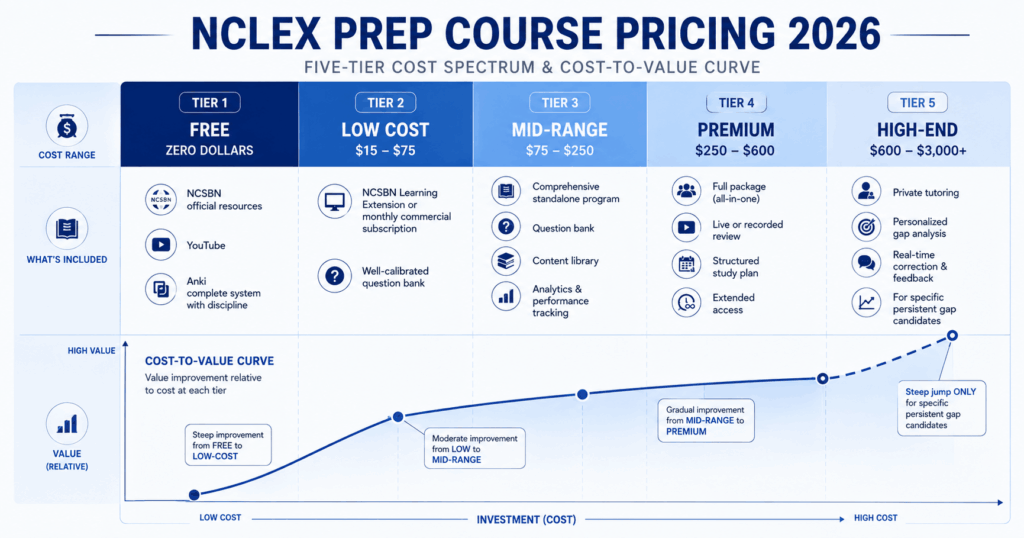
Tier 1: Free — $0
The zero-cost NCLEX prep course tier is more substantial than most candidates realize — and represents a complete preparation system when applied with full protocol discipline. The NCSBN official resources at ncsbn.org provide the current Detailed Test Plan, the official NGN tutorial covering all five format types with CJMM framework instruction, and official sample questions representing the highest-accuracy calibration of the current examination available from any source at any price. These three components alone provide the examination specification, format instruction, and calibration reference that any NCLEX prep course must provide — at no cost. Supplementing with curated free YouTube clinical content review (Simple Nursing, Level Up RN) and Anki for free spaced repetition consolidation completes all three preparation system components — practice questions, content review, and memory consolidation — without any purchase. The honest assessment of the free tier: it provides everything a clinically competent nursing graduate needs for adequate NCLEX preparation when applied with full four-question rationale protocol discipline, error type classification, weekly micro-audit, and exam-condition simulation. Its limitation is that free question bank options are smaller and less consistently difficulty-calibrated than paid options, which requires more careful calibration checking against the NCSBN official samples.
Tier 2: Low Cost — $15 to $75
The low-cost NCLEX prep course tier is where the most significant cost-to-value improvement over the free tier occurs. The primary addition this tier provides is a well-calibrated question bank from a reputable source — either the NCSBN Learning Extension (the examination administrator’s own question bank, providing the most authoritative difficulty calibration available) or a single used copy of a current NCLEX review book for structured clinical content reference. The NCSBN Learning Extension’s 3-week or 5-week subscription options fall within this tier and provide official-quality question practice at a fraction of the cost of major commercial platforms. A single monthly subscription to a major commercial question bank (UWorld, Kaplan, ATI) also falls within this tier when activated for a concentrated 30-day intensive preparation period — bringing premium question quality into the low-cost range by eliminating the annual subscription overhead that inflates the headline price. The honest assessment of the low-cost tier: for most nursing graduates with adequate clinical foundation from nursing school, this tier provides preparation quality that is clinically indistinguishable from higher tiers when the preparation engagement discipline is applied consistently.
Tier 3: Mid-Range — $75 to $250
The mid-range NCLEX prep course tier is where comprehensive standalone programs become available — question bank access combined with structured content review libraries, analytics dashboards, progress tracking, and in some cases adaptive study recommendations. The major commercial platforms’ standard subscription packages (UWorld 3-month, Kaplan NCLEX-RN Complete, ATI NCLEX Focused Review) fall within this tier. What the mid-range tier adds over the low-cost tier: a larger question bank with broader clinical scenario variety, a structured content review video library that reduces the curation effort required for free YouTube content review, platform analytics that surface content category performance data without requiring manual tracking, and in some programs adaptive practice recommendations that identify performance trends without requiring the candidate to conduct the weekly micro-audit manually. The honest assessment of the mid-range tier: it provides genuine preparation convenience through platform-integrated analytics and content libraries — the preparation intelligence that the low-cost tier requires more active self-management to achieve. Whether this convenience premium is worth the additional $75 to $200 depends on whether the candidate will actively use the analytics and content library features rather than defaulting to random question practice without the structured analytics engagement.
Tier 4: Premium — $250 to $600
The premium NCLEX prep course tier includes comprehensive program packages with extended question bank access, full content review libraries, live or recorded review sessions, predictive assessments, readiness indicators, and in some cases limited tutor access or instructor Q&A components. Hurst Review Live, Kaplan’s comprehensive package, and ATI’s complete NCLEX preparation bundle fall within this tier. What the premium tier adds over the mid-range tier: live or recorded structured review instruction that some candidates find more engaging than self-directed video content, program-guided study plans that structure the preparation period without requiring the candidate to design the week-by-week architecture, and extended access periods that reduce time pressure on preparation pacing. The honest assessment of the premium tier: the preparation quality ceiling is not meaningfully higher than the mid-range or even low-cost tier for candidates who apply engagement discipline consistently — the premium is primarily for structured instruction, schedule guidance, and live review components that reduce the self-direction required but do not intrinsically develop more clinical reasoning competency than a self-directed approach applied with the same discipline.
Tier 5: High-End — $600 to $3,000 Plus
The high-end NCLEX prep course tier is dominated by private tutoring packages — individual or small-group tutoring sessions with NCLEX specialists, intensive immersive review programs, and personalized gap analysis with targeted remediation sessions. Private tutoring rates from independent specialists range from $75 to $200 per hour; structured tutoring packages from established NCLEX tutoring services range from $600 for a limited session package to $3,000 or more for comprehensive personalized programs. What the high-end tier adds over the premium tier: genuine clinical reasoning personalization — a tutor who can identify the specific reasoning pattern errors the individual candidate makes, provide real-time correction as those errors occur, and design targeted practice specifically for the candidate’s identified gap profile. This personalization is genuinely different in kind from what any digital platform provides at lower cost, because it applies a skilled clinical reasoning educator’s diagnostic intelligence to the individual candidate’s specific error patterns rather than providing the same structured content to all candidates. The honest assessment of the high-end tier: it is the only tier where the added cost produces a qualitatively different preparation experience rather than more of the same resources. Its value is highest for candidates with persistent, specific gaps that self-directed preparation has not closed after eight or more weeks — not as a first-resort preparation investment.
What You Are Actually Paying for at Each Price Point

The Question Bank Premium
The largest cost driver across NCLEX prep course tiers is question bank quality — specifically difficulty calibration accuracy, rationale depth, and NGN format coverage. The cost premium for a well-calibrated commercial question bank over free question sources is approximately $30 to $100 for a preparation period’s access, and this premium is the most consistently justified cost investment available in the NCLEX prep course market because question bank difficulty calibration directly determines whether the practice accuracy signal the candidate receives during preparation accurately reflects their readiness for the actual examination’s difficulty. A question bank that produces 70 percent accuracy for a candidate approaching readiness is providing a false confidence signal that will likely lead to underpreparation. A question bank calibrated to the actual examination’s difficulty producing 57 percent accuracy for the same candidate is providing the accurate readiness signal that enables data-based preparation decisions. The $30 to $100 cost difference between these two question bank options is the most precisely justified cost investment in any NCLEX prep course budget.
The Content Review Premium
The cost premium for a structured commercial content review library over free YouTube content review is approximately $50 to $150 above a question-bank-only subscription — the incremental cost of adding organized video content from the same platform rather than curating free YouTube content independently. This premium is justified for candidates who find the curation effort for free content review burdensome enough that it reduces the consistency of content review engagement, and for candidates who benefit from the organizational structure of a platform-integrated content library over independent YouTube channel management. It is not justified for candidates who are comfortable curating free content and who would use the commercial content library at the same engagement quality as free alternatives — because the clinical content itself in NCLEX review is not proprietary in a way that commercial providers can meaningfully differentiate from carefully selected free sources.
The Analytics and Tracking Premium
The cost premium for platform-integrated analytics — content category accuracy breakdown, error pattern identification, readiness indicators, adaptive practice recommendations — over the self-managed tracking that the weekly micro-audit provides is built into mid-range and premium NCLEX prep course subscriptions rather than separately priced. Its value depends entirely on whether the candidate actively uses the analytics rather than defaulting to random undifferentiated practice regardless of what the analytics show. A platform with sophisticated analytics used by a candidate who ignores the category breakdown and practices questions randomly provides no preparation advantage over a free question bank used by a candidate who manually tracks the four readiness benchmarks in a spreadsheet. The analytics premium is valuable to candidates who will actively engage with performance data and adjust their preparation allocation accordingly — and is wasted spending for candidates whose preparation approach would not change based on what the analytics reveal.
The Instruction and Live Review Premium
The cost premium for live or recorded structured instruction — review sessions, instructor explanation videos, live Q&A, structured course delivery — over self-directed study from rationale reviews and free content sources ranges from $100 to $300 above a question-bank-only subscription. This premium is justified for candidates who learn more effectively from structured instruction than from self-directed rationale analysis — who find that an instructor explaining the clinical reasoning behind a priority decision produces more durable understanding than deriving the same reasoning from a rationale explanation independently. It is less clearly justified for candidates who can extract the same clinical reasoning principles from high-quality rationale reviews independently, because the instruction premium pays for delivery format rather than for clinical reasoning content that is not available through rationale review of a well-chosen question bank.
Where the Cost-to-Value Curve Bends
The Steepest Value Gain: Free to Low-Cost
The steepest improvement in NCLEX prep course value per dollar spent occurs in the transition from zero-cost free resources to the low-cost tier — specifically in the addition of a well-calibrated question bank. Free question sources provide genuine preparation value but with inconsistent difficulty calibration that can produce misleading accuracy signals. The NCSBN Learning Extension or a monthly commercial question bank subscription adds accurate difficulty calibration, larger question banks with broader clinical scenario variety, and more consistent rationale depth — for approximately $30 to $75. The clinical reasoning development per dollar improvement from this investment is the highest available anywhere in the NCLEX prep course cost spectrum. Candidates who have been using free resources and experiencing an accuracy plateau should consider whether the difficulty calibration discrepancy between their free question bank and the actual examination is producing a misleading progress signal before investing in higher-tier resources.
The Moderate Value Gain: Low-Cost to Mid-Range
The transition from low-cost to mid-range NCLEX prep course provides meaningful but more modest incremental value — primarily through preparation convenience (platform-integrated analytics, organized content libraries, structured study plans) rather than through intrinsically better clinical reasoning development content. A candidate who finds the self-management of the weekly micro-audit, content curation, and progress tracking burdensome gains genuine preparation quality improvement from the mid-range tier’s integrated management features — because these features reduce friction that otherwise causes the preparation discipline to lapse. A candidate who naturally maintains systematic preparation discipline with self-managed tools gains less incremental value from the mid-range tier’s integration features. The $75 to $200 premium for mid-range versus low-cost resources is best evaluated by honestly assessing whether the convenience features would produce meaningfully better preparation discipline consistency rather than by comparing the marketing feature lists.
The Minimal Value Gain: Mid-Range to Premium
The transition from mid-range to premium NCLEX prep course ($150 to $400 additional cost) provides the most difficult-to-justify value increment for most candidates — because the preparation quality ceiling available from any digital platform has largely been reached at the mid-range tier, and premium features (live review sessions, extended access periods, predictive readiness assessments) add preparation convenience rather than fundamentally different clinical reasoning development content. Live review sessions add an instructional format preference dimension (some candidates engage better with live instruction than recorded) but do not provide clinical reasoning content unavailable through recorded video or rationale review. Extended access periods add time flexibility but do not improve preparation quality for candidates who complete adequate preparation within a mid-range tier’s access window. The premium tier is most clearly justified for candidates who specifically benefit from live instruction format and whose preparation timeline is genuinely uncertain — not as a default investment because premium must be better than mid-range.
The High Specific Value: Persistent Gap Tutoring
The high-end tutoring tier provides genuine value that no lower tier can replicate — but only for candidates at the right point in preparation and with the right type of gap. Private NCLEX prep course tutoring is most valuable when the error type log has identified a persistent specific gap (a reasoning pattern error that behavioral correction practice has not automated after four weeks of deliberate correction, or an NGN cognitive skill error that format-specific practice has not resolved after six weeks of dedicated NGN preparation), when the candidate has completed at least two weeks of systematic self-directed preparation with full protocol discipline, and when the tutor’s expertise specifically addresses the identified gap type rather than providing general clinical content review. Private tutoring applied before self-directed preparation has identified the specific gaps the tutoring should address produces expensive sessions covering broad clinical content rather than the targeted reasoning correction that justifies the high-end tier’s cost premium.
Cost Reduction Strategies That Do Not Compromise Quality
Institutional Access — The Most Overlooked Cost Reduction
The most frequently overlooked NCLEX prep course cost reduction for nursing graduates is institutional access — free or subsidized access to premium question banks through nursing school subscriptions that may extend to recent graduates. UWorld, Kaplan, and ATI all have institutional licensing arrangements with nursing schools, and graduates within a defined window after graduation (commonly six to twelve months) may retain access through their school’s license without any individual purchase. Before purchasing any NCLEX prep course resource, contact the nursing program’s academic resources office or check the student portal to verify whether any institutional access is available and what the eligibility window is. This single inquiry step has saved many nursing graduates hundreds of dollars by discovering that the premium resource they were preparing to purchase was already available through their school’s license.
Subscription Timing — Activating at the Right Moment
For commercial question bank subscriptions without institutional access, the timing of subscription activation significantly affects the cost per useful preparation day. Activating a monthly subscription before intensive daily preparation is occurring — six weeks before the ATT arrives, or during a period when daily practice will be interrupted by other obligations — wastes subscription days on periods when the resource is not being used at its maximum value. The optimal activation timing for any NCLEX prep course subscription is the day intensive daily preparation begins with a confirmed exam date target in view — not the day the candidate decides to begin preparing. A 30-day subscription activated on the day of ATT receipt and used for 25 of 30 days in intensive daily practice produces significantly more value per dollar than the same subscription activated before the ATT arrives and used for 12 of 30 days while the candidate is still building preparation momentum.
Student Discount and Group Access Programs
Several NCLEX prep course providers offer student verification discount programs that reduce standard pricing for candidates who can verify current nursing student or recent graduate status. UWorld and Kaplan have historically offered student pricing through institutional verification or .edu email address confirmation. Group access programs — where a small cohort of nursing graduates from the same program purchase access together under a group license — can reduce per-candidate costs by 20 to 40 percent compared to individual licensing at some providers. Nursing program study groups preparing simultaneously should inquire with commercial providers about group licensing before purchasing individual subscriptions. Additionally, NCLEX prep course pricing frequently varies seasonally — providers commonly offer promotional pricing around NCLEX testing peak periods (spring and fall graduation seasons) that reduces standard rates by 10 to 25 percent for limited windows.
Making the Investment Decision: A Framework
The Three Questions Before Any Purchase
Three questions applied before any NCLEX prep course purchase produce a rational investment decision rather than an anxiety-driven one. First: what specific preparation gap does this purchase address that free or lower-cost resources do not address adequately? If the answer is difficulty calibration accuracy, the low-cost tier is indicated. If the answer is structured content organization reducing curation burden, the mid-range tier’s content library addition is indicated. If the answer is persistent specific gap after systematic self-directed preparation has failed to close it, tutoring is indicated. If the answer is general reassurance that a higher-cost resource will produce a better outcome, the purchase is driven by anxiety rather than specific preparation need — and anxiety-driven purchases in the NCLEX prep course market reliably produce higher spending without better outcomes. Second: will I actually use the features that differentiate this purchase from a lower-cost alternative? Analytics dashboards not consulted, live review sessions not attended, and content libraries not systematically used represent paid features with free-tier value — the resource’s cost tier is irrelevant if engagement with the differentiating features is equivalent to lower-tier engagement. Third: does this resource meet the two 2026 currency requirements — current April 2026 test plan alignment and all five NGN format types with CJMM instruction? A resource that does not meet both requirements is not adequate preparation regardless of its price.
The Total Cost Calculation for Informed Decisions
The complete cost of any NCLEX prep course investment includes the direct resource cost plus the indirect costs that the investment decision produces. A $400 premium NCLEX prep course that produces a first-attempt passing result has a total cost of $400 plus preparation time. A $50 low-cost approach that produces a not-passing result has a total cost of $50 plus the retesting fee of $200 plus the cost of second-attempt preparation resources plus the income loss from an additional 45-day delay in nursing licensure. The comparison that matters for NCLEX prep course investment decisions is not the resource cost alone but the expected total cost including the probability of a first-attempt passing result from each investment option. For most candidates, the evidence suggests that the most reliable path to first-attempt passing is not the most expensive resource but the combination of adequate resource quality (the low-cost tier’s well-calibrated question bank) and maximum preparation engagement discipline (the four-question protocol, error type classification, weekly micro-audit, and exam-condition simulation). The highest-ROI NCLEX preparation investment is not more expensive resources — it is more disciplined engagement with adequate resources.
- How to verify an NCLEX prep course’s value before purchasing: Request or access the free trial content available from most major NCLEX prep course providers and complete two specific tests. First, complete 25 to 30 questions from the trial and compare your accuracy to your accuracy on the NCSBN official sample questions — a gap of more than 10 percentage points suggests the trial content’s difficulty calibration differs significantly from the actual examination. Second, read three complete rationale explanations for incorrect answers and assess whether they provide the four analytical outputs the full rationale protocol requires — why the correct option applies to the specific patient, why each incorrect option fails for this patient, what reasoning error each distractor targets, and what clinical principle transfers to novel scenarios. If the free trial rationale depth supports the full protocol, the paid subscription’s question bank will provide the engagement quality the preparation requires.
- The cost that matters most but is rarely calculated: The income opportunity cost of preparation time is the largest single cost in any NCLEX preparation — not the resource purchase. A nursing graduate delaying licensure by eight additional preparation weeks beyond what a more focused first-attempt preparation would have required is losing approximately eight weeks of registered nurse income. At an average starting RN hourly rate, this represents a much larger financial impact than the difference between any two NCLEX prep course pricing tiers. The preparation resource investment decision that minimizes total cost is the one that produces the shortest preparation period to first-attempt passing readiness — not the one that minimizes the resource purchase price.
- When to spend more and when to spend less: Spend more on the NCLEX prep course question bank quality and difficulty calibration — this is the most directly connected cost to preparation outcome quality and the most reliably justified premium above the free tier. Spend less on content review libraries if you are comfortable curating free YouTube clinical content — the content itself is not proprietary, and free sources cover the same clinical material. Spend less on live review features if you can extract equivalent clinical reasoning understanding from high-quality written rationale review independently. Spend more on targeted private tutoring if and only if eight or more weeks of systematic self-directed preparation have identified a persistent specific gap that self-correction has not closed — not as a first-resort preparation investment.
Conclusion
The cost of an NCLEX prep course in 2026 ranges from zero to several thousand dollars, and the optimal investment for any individual candidate is the level that provides the specific preparation advantages their gap profile requires without paying for features their preparation approach will not use. The steepest cost-to-value improvement occurs in the transition from free resources to a well-calibrated low-cost question bank — the $30 to $75 investment that most directly addresses the preparation quality dimension most connected to examination outcome. The most difficult-to-justify investment is the mid-to-premium tier premium for candidates who will apply equivalent engagement discipline at the lower tier. The most clearly justified high-end investment is targeted private tutoring for candidates with persistent specific gaps after systematic self-directed preparation has failed to close them.
Before purchasing any NCLEX prep course, apply the three pre-purchase questions: what specific gap does this address, will I use the differentiating features, and does it meet the 2026 currency requirements. Verify difficulty calibration against the NCSBN official samples before trusting any resource’s readiness signal. Check institutional access through your nursing school before purchasing any resource individually. And remember that the highest-ROI preparation investment across every cost tier is the same: the full four-question rationale protocol, error type classification, weekly micro-audit, and exam-condition simulation discipline that converts any adequately calibrated resource into the clinical reasoning competency the examination measures — at zero additional cost regardless of which tier the question bank came from.
