

The comparison between NCLEX High Yield and Kaplan represents one of the most specific and consequential resource decisions a nursing candidate can make — two prep courses with genuinely different philosophical approaches to NCLEX preparation, different strengths in the 2026 examination landscape, and different candidate profiles for whom each represents the better investment. Unlike the choice between premium and budget options, or between well-known and lesser-known resources, the High Yield versus Kaplan comparison is between two legitimate, well-regarded preparation approaches that differ fundamentally in how they develop clinical reasoning competency rather than in quality tier.
NCLEX High Yield has built a strong following through its content distillation approach — identifying the clinical topics, pharmacology principles, and priority nursing actions that appear most frequently on NCLEX questions and organizing preparation around high-density exposure to this targeted content. Kaplan has built its NCLEX prep courses reputation through its Decision Tree methodology — a structured clinical reasoning framework that teaches candidates a systematic process for approaching every question type rather than optimizing for content coverage density. These are different preparation philosophies with different preparation outcomes, and the candidate who understands which philosophy matches their specific preparation gap will make a better resource selection than the candidate who chooses based on peer popularity or marketing claims. This guide provides a head-to-head comparison on six specific dimensions: content coverage approach, clinical reasoning methodology, NGN format coverage for the 2026 examination, question bank quality, cost and value, and candidate profile fit. The comparison is calibrated specifically to the 2026 examination’s requirements — the April 2026 test plan’s increased NGN proportion and the CJMM framework that governs clinical judgment measurement — so that the recommendation reflects what the current examination actually measures rather than what previous NCLEX generations tested.
Understanding the Two Preparation Philosophies
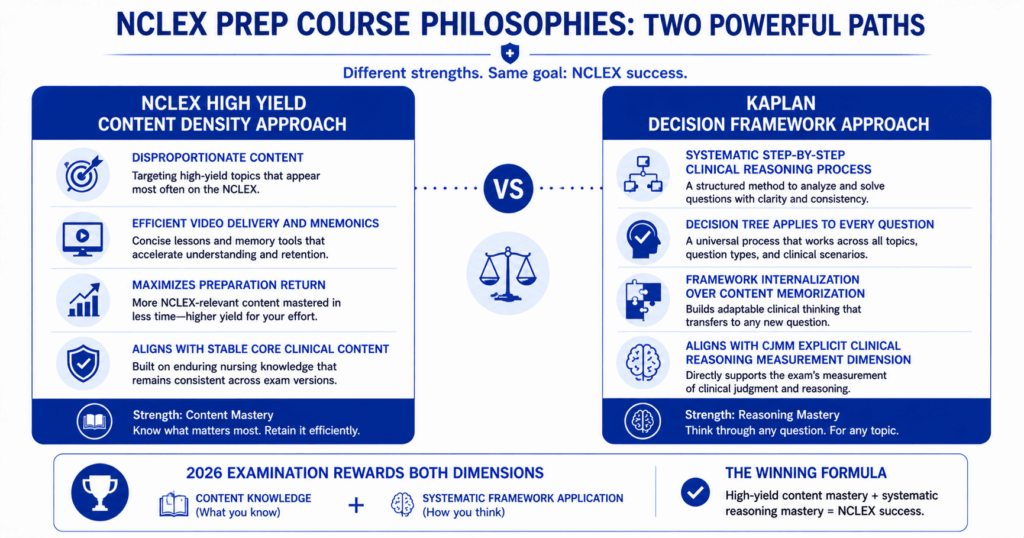
NCLEX High Yield: The Content Density Approach
NCLEX High Yield’s preparation philosophy is built around a specific insight: the NCLEX examination draws disproportionately from a subset of clinical content — high-yield topics that appear frequently across examination sessions rather than distributing questions evenly across all possible clinical content. By identifying these high-yield topics and building preparation around intensive, efficient coverage of them, High Yield argues that candidates can develop the content knowledge most likely to appear on their examination without the time investment of comprehensive coverage of every possible clinical area. The High Yield approach emphasizes efficient content delivery — video content that distills core clinical principles quickly, mnemonics that make pharmacology and priority content memorable, and practice exposure to the content areas that examination statistics suggest matter most.
Kaplan: The Decision Framework Approach
Kaplan’s preparation philosophy takes a different starting premise: that NCLEX examination performance is determined more by how candidates approach questions than by which specific content they have memorized. Kaplan’s Decision Tree methodology teaches a systematic, step-by-step process for evaluating every question regardless of content area — a clinical reasoning framework that, when internalized, applies to every novel scenario the examination presents. The Decision Tree guides candidates through identifying the question’s core clinical issue, applying the appropriate priority framework, and systematically eliminating options that violate the framework’s principles. Kaplan’s argument is that a candidate who has genuinely internalized the Decision Tree will outperform a candidate with equivalent content knowledge who does not have a systematic approach for applying that knowledge under examination conditions.
How the Two Philosophies Interact With 2026 Examination Demands
The 2026 NCLEX examination’s shift toward explicit clinical judgment measurement through the CJMM framework and NGN format questions creates an interesting interaction with these two preparation philosophies. The High Yield content density approach aligns well with the examination’s stable core of high-yield clinical content that has been consistently tested across multiple test plan versions — the cardiovascular, respiratory, and pharmacology content that NCLEX prep courses have always emphasized. The Kaplan framework approach aligns well with the 2026 examination’s explicit clinical reasoning measurement through the CJMM’s six cognitive skills, which reward candidates who have a systematic clinical reasoning process over those who are relying on content recognition in familiar scenarios. In the 2026 examination context, a preparation approach that combines High Yield’s content efficiency with Kaplan’s framework instruction would address both examination dimensions — which is relevant when considering whether using both resources simultaneously or sequentially is appropriate for a specific candidate profile.
Dimension 1: Content Coverage
NCLEX High Yield on Content Coverage
NCLEX High Yield’s content coverage approach is its primary strength and its most distinctive feature among NCLEX prep courses. The program’s video library covers the highest-yield clinical content areas — cardiovascular, respiratory, neurological, gastrointestinal, pharmacology, mental health, and maternal-newborn nursing — with a density and efficiency that allows candidates to absorb large amounts of clinically relevant information in relatively short viewing sessions. The mnemonics and memory frameworks that High Yield provides for pharmacology content (drug classes, mechanisms, nursing considerations, and priority monitoring parameters) are among the most frequently praised features by candidates who have used the program. For candidates who identify through diagnostic assessment that genuine clinical content knowledge gaps are the primary cause of their preparation challenges, High Yield’s content delivery efficiency is a genuine preparation advantage.
Kaplan on Content Coverage
Kaplan’s content coverage in its NCLEX prep courses is comprehensive — a full clinical nursing review library covering all four NCLEX test plan content domains with video instruction, practice questions, and reference materials organized by content area. What distinguishes Kaplan’s content coverage from High Yield’s is not breadth or density but integration: Kaplan’s content is consistently presented in the context of how the NCLEX tests it, with clinical reasoning application alongside clinical content rather than clinical content presented as a standalone knowledge base that the candidate must separately learn to apply. A Kaplan cardiovascular module explains cardiovascular priority decisions and the clinical reasoning behind them rather than only the pathophysiology and nursing management facts. This integration makes Kaplan’s content coverage more directly examination-applicable but potentially less efficient for pure content absorption than High Yield’s distillation approach.
2026 Verdict on Content Coverage
For content coverage specifically, NCLEX High Yield has the edge for candidates whose primary gap is clinical content knowledge — particularly pharmacology and the specific high-yield clinical areas where examination statistics suggest concentrated question density. Kaplan has the edge for candidates whose content knowledge is adequate but who need clinical content delivered in the context of examination application. Candidates with significant content gaps should consider High Yield for content foundation before or alongside Kaplan’s framework instruction; candidates with adequate content foundation should consider Kaplan’s integrated approach as more efficiently applicable.
Dimension 2: Clinical Reasoning Methodology

NCLEX High Yield on Clinical Reasoning
NCLEX High Yield’s clinical reasoning instruction is integrated into its content delivery rather than presented as a standalone methodology. The program teaches priority principles and examination application alongside clinical content — explaining why a cardiovascular finding takes priority over a gastrointestinal finding in a given scenario, or why assessment precedes intervention in a specific clinical context. This integrated approach teaches clinical reasoning application contextually — through the same clinical content examples that the video content covers — rather than through an explicit, generalizable framework that candidates can apply independently to any novel scenario. The integrated approach is effective for candidates who learn clinical reasoning best through content-specific examples and who will encounter similar content on their examination; it is less effective for candidates who need a transferable reasoning framework for novel scenario presentations.
Kaplan’s Decision Tree Methodology
Kaplan’s Decision Tree is the most distinctive and most debated feature of its NCLEX prep courses. The methodology provides an explicit, step-by-step clinical reasoning process: identify whether the question asks about safe care or clinical care, determine what the question is really asking, apply the appropriate clinical reasoning framework (ABCs, Maslow, nursing process), and systematically evaluate options against the framework’s principles. For candidates who benefit from explicit procedural instruction in clinical reasoning — who find that implicit framework development through practice question exposure alone produces inconsistent results — the Decision Tree provides the structured cognitive scaffold that converts clinical content knowledge into consistent priority framework application. The limitation acknowledged even by Kaplan advocates is the mechanical application risk: candidates who apply the Decision Tree as a procedure rather than internalizing it as clinical reasoning orientation may find that it produces correct answers on familiar scenario types and breaks down on novel presentations where the procedure’s steps do not map cleanly.
2026 Verdict on Clinical Reasoning Methodology
Kaplan has the clear edge on clinical reasoning methodology for the 2026 examination, where the CJMM’s explicit six-skill framework rewards systematic clinical reasoning orientation. The Decision Tree’s structured approach aligns conceptually with the CJMM’s decomposition of clinical judgment into named, practicable cognitive skills — both reward candidates who have an explicit process for approaching clinical reasoning questions over candidates who rely on content recognition. NCLEX High Yield’s integrated reasoning instruction is adequate for traditional multiple choice questions where content-anchored priority application is sufficient but provides less direct preparation for the NGN format’s explicit cognitive skill measurement than Kaplan’s framework-forward approach.
Dimension 3: NGN Format Coverage for 2026
NCLEX High Yield on NGN Coverage
NCLEX High Yield has addressed the NGN format transition in its content library with dedicated NGN-specific modules covering each of the five format types and CJMM framework instruction. The quality of High Yield’s NGN coverage is adequate for format familiarization — candidates who work through the NGN modules will understand the structural features of each format type and the cognitive skill each tests. Where High Yield’s NGN coverage is less developed relative to Kaplan is in the integration of NGN format practice with the program’s clinical content delivery: High Yield’s NGN content tends to be presented as a separate module layer added to the existing content structure rather than integrated throughout the content curriculum. Verify current NGN module depth at the High Yield website before purchasing, as the program has been updating its NGN content continuously since the April 2023 launch and the current version may be more thoroughly integrated than earlier iterations.
Kaplan on NGN Coverage
Kaplan’s NGN coverage for the 2026 NCLEX prep courses context is among the strongest available from the major commercial platforms — and the integration is its specific advantage. Because Kaplan’s preparation philosophy already centers on explicit clinical reasoning framework instruction through the Decision Tree, the extension to NGN format’s CJMM cognitive skill framework is a natural addition rather than a separate module layer. Kaplan’s NGN instruction explicitly maps the Decision Tree’s clinical reasoning steps to the CJMM’s six cognitive skills, helping candidates understand how the framework they have already been building applies directly to NGN format questions. The carry-forward protocol for unfolding case study sets, the partial credit response strategy for extended multiple response, and the bow tie center-first navigation are each addressed within Kaplan’s framework-oriented instruction with connection to the Decision Tree’s clinical reasoning principles. This integration means that candidates who have genuinely internalized the Kaplan framework arrive at NGN format questions with a preparation foundation that maps directly to what those questions test.
2026 Verdict on NGN Coverage
Kaplan has the edge on NGN coverage specifically for the 2026 examination — not because High Yield lacks NGN content but because Kaplan’s framework integration produces more directly transferable NGN preparation than High Yield’s modular NGN layer. For candidates whose primary 2026 preparation concern is NGN format fluency and CJMM cognitive skill development, Kaplan’s integrated approach is the stronger of the two NCLEX prep courses. For candidates whose primary gap is traditional format content knowledge with NGN as a secondary concern, High Yield’s content efficiency with NGN modules as a supplement may be equally effective in less preparation time.
Dimension 4: Question Bank Quality
NCLEX High Yield on Question Bank
NCLEX High Yield’s question bank provides practice questions organized by the high-yield content areas that the program’s content curriculum covers — allowing candidates to practice the content immediately after engaging with the video instruction on that content. The question bank’s rationale explanations are adequate but generally less detailed in distractor analysis than the major commercial platforms’ rationales — they tend to explain the correct answer more comprehensively than they explain why each incorrect option fails for the specific patient. This rationale limitation means that executing the full four-question rationale protocol from High Yield questions requires more independent derivation of the distractor analysis component than from Kaplan or UWorld rationales. The question bank’s difficulty calibration should be checked against the NCSBN official sample questions before treating its accuracy signal as reliable readiness measurement.
Kaplan on Question Bank
Kaplan’s question bank is among the largest available in the major NCLEX prep courses market, with thousands of questions across all content domains and NGN format types. The rationale explanations are thorough and framework-integrated — explaining the correct answer in the context of the Decision Tree’s clinical reasoning principles and providing distractor analysis that helps candidates understand why each incorrect option violates the framework rather than only confirming which option was correct. This rationale structure makes the four-question protocol more straightforwardly executable from Kaplan rationales than from High Yield rationales, because the distractor analysis component is more consistently provided. Kaplan’s difficulty calibration is generally well-aligned with the actual examination’s adaptive difficulty, producing accuracy in the 55 to 65 percent range for approaching-readiness candidates, though a calibration check against the NCSBN official samples is advisable.
2026 Verdict on Question Bank
Kaplan has the edge on question bank quality for the 2026 examination context — larger question volume, more framework-integrated rationale explanations that support the four-question protocol more directly, and a question bank that produces NGN format practice integrated throughout rather than as a separate module. NCLEX High Yield’s question bank is adequate for candidates whose primary preparation activity is content-focused question practice in high-yield areas; it is less optimal for candidates whose primary preparation activity is clinical reasoning framework development through question bank engagement.
Dimension 5: Cost and Value
NCLEX High Yield Pricing
NCLEX High Yield offers its content through a subscription model with pricing that is generally lower than Kaplan’s full NCLEX prep courses package — making it the more accessible option for budget-conscious candidates who are specifically seeking content delivery efficiency rather than a comprehensive framework instruction program. High Yield’s pricing structure has varied across different access tiers, and candidates should verify current pricing at the High Yield website before making a purchase decision, as NCLEX prep courses pricing changes frequently. The value proposition of High Yield’s lower cost is most clearly realized for candidates who need content delivery efficiency as a specific, identified preparation gap — where the High Yield investment addresses the exact preparation need rather than providing comprehensive preparation features that the candidate does not specifically require.
Kaplan NCLEX-RN Pricing
Kaplan’s NCLEX prep courses are generally priced in the mid-to-premium range of the major NCLEX preparation market — higher than High Yield’s subscription cost and broadly comparable to UWorld’s annual subscription. The comprehensive package that includes question bank access, content review library, Decision Tree instruction, live review sessions, and extended access period represents Kaplan’s full preparation system value proposition. Candidates who use only Kaplan’s question bank without the Decision Tree instruction and live review components are not accessing the features that differentiate Kaplan’s preparation value from a question-bank-only alternative at similar cost. Verify current pricing at Kaplan’s NCLEX preparation page, and consider whether the specific preparation features that justify the premium — Decision Tree instruction, live review sessions, content library — match the specific preparation gaps the diagnostic assessment has identified.
Value Assessment: The Right Question Is Not Which Is Cheaper
The cost comparison between NCLEX High Yield and Kaplan as NCLEX prep courses is less informative than the value-per-preparation-gap comparison — whether each program’s specific preparation strengths address the candidate’s specific preparation gaps more efficiently than the other. High Yield is the higher-value option for candidates whose primary gap is clinical content knowledge efficiency — the cost per content delivery hour is lower, and content delivery is what the program specifically excels at. Kaplan is the higher-value option for candidates whose primary gap is clinical reasoning framework application — the Decision Tree instruction and framework-integrated question bank provide the preparation features that address this gap, and the additional cost over High Yield is justified when this gap is the actual preparation priority. Candidates who need both content efficiency and framework instruction — the largest candidate population — should consider whether using High Yield for content and Kaplan’s question bank for framework application practice is more cost-efficient than purchasing Kaplan’s comprehensive package alone.
Dimension 6: Candidate Profile Fit
The Profile Where NCLEX High Yield Wins
NCLEX High Yield is the stronger of the two NCLEX prep courses for candidates with three specific profile characteristics. First, candidates with identified clinical content knowledge gaps — particularly in pharmacology, where High Yield’s mnemonic-based content delivery is a specific and frequently praised strength — who need efficient, memorable content delivery rather than framework instruction for content they already have. Second, candidates with limited preparation time who need the highest density of high-probability examination content in the shortest possible preparation investment — the High Yield efficiency argument is most compelling when time is the binding constraint rather than framework development. Third, candidates who already have a clinical reasoning framework from another source (Kaplan from a previous preparation period, nursing school instruction that explicitly taught priority frameworks, or a preparation approach that has already developed solid CJMM orientation) and need High Yield specifically for content reinforcement rather than framework development. For these three profiles, High Yield’s content efficiency advantage over Kaplan’s comprehensive framework approach justifies selecting it as the primary or supplementary resource.
The Profile Where Kaplan Wins
Kaplan is the stronger NCLEX prep courses option for candidates with three contrasting profile characteristics. First, candidates whose primary preparation challenge is clinical reasoning application rather than content knowledge — who find that they know the clinical content but consistently select the almost-correct option or apply the wrong priority framework to specific patient scenarios — because the Decision Tree directly addresses this gap in a way that High Yield’s content-anchored reasoning instruction does not. Second, candidates who benefit from explicit, structured learning frameworks and who learn clinical reasoning most effectively through procedural instruction rather than through implicit development from practice question exposure — the Decision Tree’s step-by-step explicitness provides the cognitive scaffold that this learning profile requires. Third, candidates with significant NGN preparation needs for the 2026 examination who benefit from the Decision Tree’s direct conceptual connection to the CJMM framework — because this connection makes the NGN-specific preparation that the 2026 examination requires more immediately accessible than learning the CJMM from a High Yield module that is more separate from the primary preparation framework.
The Profile Where Both Together Make Sense
A specific candidate profile justifies using both NCLEX High Yield and Kaplan as complementary rather than competing NCLEX prep courses: candidates who have significant content gaps in the high-yield areas where High Yield specifically excels (pharmacology, priority nursing actions in specific clinical categories) AND a primary reasoning framework gap that Kaplan’s Decision Tree addresses. For this profile, the most efficient combination is using High Yield’s content modules and mnemonics for the content gap areas while using Kaplan’s question bank and Decision Tree instruction for framework application development — not running both programs’ full curricula simultaneously, which would produce preparation fragmentation, but strategically deploying each program’s specific strength to the specific gap it addresses best. The cost of both programs together should be evaluated against whether a single comprehensive program (Kaplan’s full package, which includes content review) would address both gaps adequately in a single resource.
The Verdict: Which Should You Choose?
Choose NCLEX High Yield If
Choose NCLEX High Yield as your primary NCLEX prep courses resource if your diagnostic assessment shows multiple below-standard content categories that reflect genuine knowledge gaps rather than reasoning pattern errors, particularly in pharmacology, priority nursing actions, or the specific high-yield clinical areas that High Yield targets. Choose it if your preparation time is limited and you need the most efficient content-per-hour investment available among the major programs. Choose it if you already have a solid clinical reasoning framework from a previous preparation period, nursing school instruction, or the NCSBN official CJMM documentation and primarily need content reinforcement rather than framework development. And choose it if your budget favors the lower-cost option, recognizing that you will need to supplement with NCSBN official NGN tutorial content and deliberate CJMM action verb identification practice to ensure adequate 2026 format preparation.
Choose Kaplan If
Choose Kaplan as your primary NCLEX prep courses resource if your error type analysis shows that reasoning pattern errors (wrong priority framework, almost-correct option selection, psychosocial before physiological) account for 40 percent or more of your incorrect answers — because the Decision Tree directly addresses this error pattern in a way that content-focused alternatives do not. Choose it if you benefit from explicit, structured, procedural cognitive frameworks rather than implicit framework development through practice. Choose it if your 2026 NGN preparation needs are significant and you want the framework integration that maps Decision Tree reasoning directly to CJMM cognitive skills. And choose it if you prefer a single comprehensive program that addresses both content review and reasoning framework development rather than a complementary dual-resource approach.
The One Thing That Matters More Than Which You Choose
Regardless of whether you choose NCLEX High Yield, Kaplan, or any other resource, the preparation behaviors that determine passing outcomes remain the same: the full four-question rationale protocol applied to every practice question, error type classification for every incorrect answer, CJMM action verb identification before every NGN question, and the weekly micro-audit tracking all four readiness benchmarks. These behaviors can be applied to High Yield’s question bank, to Kaplan’s question bank, to the NCSBN official samples, or to any other question source. The resource provides the material. The behaviors determine what clinical reasoning development is extracted from that material. Choose the resource that best matches your specific preparation gap profile — then apply maximum behavior quality to it. That combination produces the first-attempt passing result regardless of which resource was chosen.
- The most efficient way to use both resources without preparation fragmentation: Use NCLEX High Yield for content review activation — watching targeted High Yield videos in specific content categories immediately after the weekly micro-audit identifies those categories as below 50 percent accuracy — and use Kaplan’s question bank as the primary daily practice source, applying the four-question protocol and error type classification to Kaplan’s framework-integrated rationale explanations. This combination deploys each program’s specific strength without running both programs’ full curricula simultaneously, which would fragment preparation attention across two different organizational systems and two different reasoning frameworks.
- How to verify which of the two programs better matches your preparation gap: Complete a 25-question session from each program’s trial access or free sample content under the same timed conditions, applying the full four-question protocol to every incorrect answer and classifying each error type. If the error type log from both sessions shows primarily knowledge gaps (40 percent or more knowledge gap errors), High Yield’s content efficiency is the more directly relevant preparation investment. If the error type log shows primarily reasoning pattern errors (40 percent or more reasoning pattern errors), Kaplan’s Decision Tree instruction is the more directly relevant investment. The error type distribution, not peer popularity or marketing positioning, is the preparation-relevant signal for this choice.
- What to do if you have already used one and it did not produce the results you needed: If you have used NCLEX High Yield and did not achieve adequate benchmark progress, audit your error type log from those sessions — if reasoning pattern errors account for more than 40 percent of incorrect answers, the content efficiency approach you invested in was not addressing the primary gap, and switching to Kaplan’s framework instruction would address the actual cause. If you have used Kaplan and did not achieve adequate benchmark progress, audit whether the Decision Tree was being applied as a mechanical procedure or as a genuinely internalized clinical reasoning orientation — if mechanical, additional practice with deliberate framework internalization focus would address the gap without switching programs; if the content knowledge underlying the Decision Tree’s application is insufficient, adding High Yield for content reinforcement is the appropriate supplement.
Conclusion
NCLEX High Yield and Kaplan are both legitimate, quality NCLEX prep courses with genuinely different preparation philosophies, different strengths in the 2026 examination landscape, and different candidate profiles for whom each represents the better investment. High Yield wins on content delivery efficiency, particularly pharmacology and high-yield content density, and on value for candidates who need content reinforcement rather than framework development. Kaplan wins on clinical reasoning framework instruction, NGN format integration through the Decision Tree-to-CJMM connection, question bank size and rationale depth, and on value for candidates whose primary gap is reasoning application rather than content knowledge.
The choice between them should be driven by the error type distribution in your diagnostic assessment — not by peer recommendations, marketing claims, or the assumption that one is universally better than the other. A candidate whose errors cluster in knowledge gaps chooses differently than a candidate whose errors cluster in reasoning pattern errors, and both choose correctly when the choice is grounded in diagnostic data rather than social comparison. Whichever you choose, apply the full preparation protocol to it: the four-question rationale review, the error type classification, the CJMM action verb identification, and the weekly micro-audit. That protocol, applied to either adequate resource, produces the clinical reasoning competency that the 2026 NCLEX examination measures.
