

The question nursing candidates most commonly ask about NCLEX preparation resources — can I pass without UWorld? — is the right question asked for the wrong reason. It is typically asked because UWorld has become so dominant in NCLEX preparation culture that candidates who cannot afford it, whose nursing schools did not provide it, or who are using a different question bank worry they are at a systematic preparation disadvantage. The honest answer is direct: yes, you can pass the NCLEX without UWorld. Candidates pass the NCLEX every day using Kaplan, ATI, the NCSBN Learning Extension, Hurst Review, and combinations of free resources. What determines first-attempt passing is not which question bank you use — it is how you engage with whatever question bank you have access to.
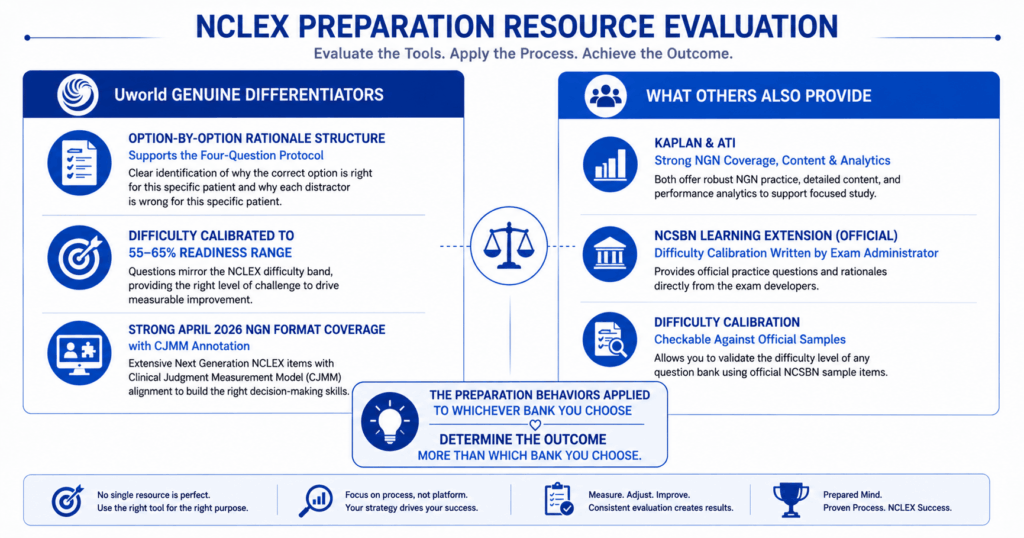
The more important question — and the one this guide builds toward — is not which question bank produces the best NCLEX preparation outcomes, but what preparation behaviors produce those outcomes regardless of which question bank is used. UWorld has earned its market-dominant reputation through genuine strengths: option-by-option rationale depth, excellent difficulty calibration to the actual NCLEX, strong NGN format coverage, and analytics that surface performance trends clearly. These are real advantages. They are also advantages that the preparation approach you apply to a question bank can either maximize or waste entirely — a candidate who uses UWorld with answer-checking review is extracting less clinical reasoning development from it than a candidate who uses a less prestigious question bank with full four-question rationale protocol engagement.
This guide examines what UWorld specifically provides that makes it valuable for NCLEX preparation, what alternatives provide equivalent or near-equivalent preparation value, and — most importantly — what the preparation behaviors are that determine passing outcomes regardless of which resource is used. By the end, the question will have shifted from ‘can I pass without UWorld?’ to ‘what does my preparation approach need to provide regardless of which question bank I use?’
What UWorld Actually Provides — The Honest Assessment
Rationale Depth: UWorld’s Primary Advantage
UWorld’s primary advantage in NCLEX preparation is the depth of its rationale explanations — specifically the consistent option-by-option analysis that explains not just why the correct answer is correct but why each incorrect option fails for the specific patient in the scenario. This rationale structure directly supports the four-question rationale protocol that is the highest-return preparation behavior in any NCLEX preparation approach: for every question, the protocol requires identifying the clinical principle the correct option applies to this specific patient, why each incorrect option fails for this patient specifically, what reasoning error type each distractor targets, and what clinical principle transfer the question teaches for novel scenarios. UWorld’s rationale design provides the content for all four protocol outputs without requiring the candidate to derive the distractor analysis independently — which makes the four-question protocol faster and more consistently thorough to execute from UWorld rationales than from rationale explanations that address only the correct answer.
Difficulty Calibration: UWorld’s Second Advantage
UWorld’s question bank is consistently calibrated closer to the actual NCLEX examination’s adaptive difficulty than most competing platforms — producing practice accuracy in the 55 to 65 percent range for candidates approaching readiness rather than the 70 to 80 percent range that indicates below-NCLEX difficulty. This difficulty calibration provides two specific preparation advantages: an accurate readiness signal (the practice accuracy data reflects performance at a difficulty level comparable to the actual examination rather than at an easier level that inflates the readiness impression) and adequate preparation for the examination’s actual difficulty level (candidates who have been consistently performing in the 55 to 65 percent range on well-calibrated questions arrive at the examination with clinical reasoning calibrated to the difficulty they will encounter). The difficulty calibration advantage is the most directly outcome-connected UWorld feature — inaccurate readiness signals from below-difficulty question banks are a specific and frequent cause of not-passing results among candidates who felt adequately prepared.
NGN Coverage: The 2026-Specific Advantage
UWorld has updated its question bank for the April 2026 test plan with comprehensive coverage of all five NGN format types — unfolding case study sets, bow tie questions, extended multiple response, matrix questions, and trend questions — with CJMM cognitive skill annotation in its rationale explanations. This coverage is strong but not unique to UWorld among the major platforms: Kaplan, ATI, and the NCSBN Learning Extension all provide current NGN format coverage with varying degrees of CJMM framework instruction. The NCSBN Learning Extension provides NGN content written by the examination’s own administrator — which cannot be replicated by any third-party platform regardless of how closely they study the official format specifications. For NGN-specific NCLEX preparation, UWorld provides strong coverage but is not the only or necessarily the best source of current NGN format instruction.
What UWorld Does Not Uniquely Provide
Several NCLEX preparation features that UWorld marketing implies are distinctive are actually available from multiple platforms. Analytics that surface content category accuracy breakdown and performance trends are provided by Kaplan, ATI, and most major question banks. A large question bank volume is matched or exceeded by Kaplan. Clinical content review libraries are available from Hurst and Kaplan at similar or greater depth than UWorld’s supplementary content. The primary UWorld features with meaningful competitive differentiation are the option-by-option rationale structure and the difficulty calibration — and the preparation implications of both are: choose a question bank whose rationale explanations support the four-question protocol, and verify difficulty calibration against the NCSBN official samples. Those criteria do not lead exclusively to UWorld.
What Determines Passing: The Behavior-Over-Resource Principle

The Engagement Quality Gap Is Larger Than the Resource Quality Gap
The most important truth about NCLEX preparation resource selection is that the gap between the worst and best commercial question banks is smaller than the gap between full four-question rationale protocol engagement and answer-checking review applied to the same question bank. A candidate using Kaplan with full four-question rationale protocol, error type classification, CJMM action verb identification for every NGN question, weekly micro-audit, and exam-condition simulation will consistently outperform a candidate using UWorld with answer-checking review — because the preparation behaviors produce clinical reasoning development and the question bank provides the raw material that those behaviors operate on. The resource matters. The behavior matters more. This is not a rationalization for using an inadequate resource — it is an accurate description of the relative weight of resource quality and engagement quality in determining NCLEX preparation outcomes.
The Four Behaviors That Determine Outcomes Regardless of Question Bank
Four specific NCLEX preparation behaviors produce clinical reasoning development regardless of which question bank they are applied to. First, the full four-question rationale protocol: for every practice question, identifying the clinical principle the correct option applies to this specific patient, why each incorrect option fails for this patient, the reasoning error type each distractor targets, and the clinical principle transfer the question teaches. This behavior extracts five times the clinical reasoning development per question as answer-checking regardless of the question source. Second, error type classification for every incorrect answer: distinguishing knowledge gaps from reasoning pattern errors from patient context errors from NGN cognitive skill errors before deciding any preparation response — because each error type requires a different intervention and applying content review to reasoning pattern errors is the wrong intervention regardless of how high-quality the question bank is. Third, CJMM action verb identification before every NGN question: reading the action verb, naming the cognitive skill, using that identification to determine what the correct answer must demonstrate before any option is read — this behavior works with any NGN question from any source. Fourth, weekly micro-audit tracking all four readiness benchmarks: overall accuracy trend, content category minimum, NGN accuracy separately tracked, and simulation result — producing the data-based preparation decisions that make each week’s practice more efficiently directed than undifferentiated question accumulation.
What Question Bank Features Actually Matter for These Behaviors
Given that the four outcome-determining behaviors can be applied to any question bank, the question bank features that actually matter for NCLEX preparation are the ones that enable these behaviors rather than the ones that provide the most impressive feature list. The rationale depth that enables the four-question protocol: does the rationale explain why each incorrect option fails for this specific patient, or does it only explain the correct answer? The difficulty calibration that produces accurate readiness signals: does the question bank produce accuracy in the 55 to 65 percent range for approaching-readiness candidates, verifiable against the NCSBN official samples? The NGN format coverage that enables CJMM action verb identification practice: does the bank include all five NGN format types with CJMM cognitive skill annotation in rationale explanations? These three feature criteria identify the question banks that enable the outcome-determining behaviors — and they describe UWorld well, but they also describe Kaplan, ATI (with a calibration check), and the NCSBN Learning Extension.
The Best UWorld Alternatives in 2026
Kaplan NCLEX-RN: The Strongest Direct Alternative
Kaplan is the strongest direct alternative to UWorld for NCLEX preparation among the major commercial platforms — with a question bank of comparable size, an integrated content review library that UWorld does not provide at the same depth, and strong April 2026 NGN format coverage with CJMM framework instruction through its Decision Tree methodology. Kaplan’s rationale explanations are generally thorough, though the option-by-option distractor analysis is less consistently provided than in UWorld — which means the four-question protocol requires slightly more independent derivation of distractor analysis from Kaplan rationales than from UWorld rationales. Kaplan’s difficulty calibration is comparable to UWorld’s in the preparation materials that target NCLEX-level difficulty, though a calibration check against the NCSBN official samples is advisable before treating the accuracy signal as equivalent. For candidates who benefit from explicit structured decision methodology (the Decision Tree) alongside question bank practice, Kaplan provides a distinctive preparation advantage that UWorld does not specifically offer.
NCSBN Learning Extension: The Official-Source Alternative
The NCSBN Learning Extension is the only question bank in the NCLEX preparation market written by the organization that administers the examination — which gives it a specific and unreplicable advantage: questions written to the same content development standards and difficulty calibration as the actual examination items. For NCLEX preparation focused specifically on the accuracy and difficulty of practice questions, the NCSBN Learning Extension provides the most authoritative available alternative to any third-party bank including UWorld. Its rationale explanations are adequate for the four-question protocol though generally less detailed in distractor analysis than UWorld’s — which requires slightly more independent derivation of the protocol’s second and third outputs. Its NGN format coverage reflects the current 2026 test plan by definition since the NCSBN administers the examination. Pricing is significantly lower than UWorld’s annual subscription, making it the strongest value alternative for budget-conscious NCLEX preparation candidates who prioritize difficulty calibration accuracy above rationale depth.
ATI NCLEX: The Continuity Alternative
ATI is the strongest alternative for nursing graduates whose nursing school programs used ATI throughout their education — the rationale familiarity, question format recognition, and analytics style continuity that ATI nursing school users bring to ATI’s NCLEX preparation product reduce the onboarding friction cost that switching to UWorld or Kaplan involves. ATI has updated its NCLEX preparation content for the April 2026 test plan with NGN format coverage across all five item types. Its difficulty calibration has been reported by some candidates as slightly below NCLEX difficulty at the high end of the accuracy range — a calibration check against the NCSBN official samples before treating ATI accuracy as the primary readiness signal is advisable. For candidates without nursing school ATI continuity, the continuity advantage does not apply and the choice between ATI and other platforms should be based purely on the three feature criteria (rationale depth, difficulty calibration, NGN coverage).
Free Resources: The Zero-Cost Alternative
The NCSBN official sample questions, curated YouTube content review (Level Up RN, Simple Nursing), and a personalized Anki deck built from practice session rationale reviews constitute a complete free NCLEX preparation system that addresses every component the examination requires — when the four outcome-determining behaviors are applied consistently. The primary limitation of the free resource system is question volume and consistency: the NCSBN official sample count is limited, free question banks have less consistent difficulty calibration and rationale depth, and the four-question protocol requires more independent derivation of distractor analysis from free question rationales than from UWorld or Kaplan. For candidates who apply full protocol discipline to the free resources, the preparation quality is competitive with paid alternatives. For candidates who find that free rationale explanations do not consistently support the full four-question protocol outputs, the $30 to $75 investment in the NCSBN Learning Extension or a monthly Kaplan or ATI subscription brings rationale depth and difficulty calibration to the level that the four-question protocol requires without the full UWorld subscription cost.
When UWorld IS Worth the Investment
The Three Candidate Profiles Where UWorld’s Premium Is Justified
Despite the honest assessment that UWorld is not necessary for passing NCLEX preparation, three specific candidate profiles represent situations where UWorld’s specific advantages justify its premium cost. First, candidates whose primary preparation bottleneck is rationale review quality — who find that rationale explanations from alternative platforms require substantial independent derivation of the four-question protocol outputs, making the protocol slower and less consistently thorough to execute. For these candidates, UWorld’s option-by-option rationale structure accelerates the protocol execution and increases the clinical reasoning development extracted from each question session — a genuine value return on the additional cost. Second, candidates who identified through calibration checking that their current question bank is producing accuracy above 70 percent and whose first-attempt exam date is approaching — the difficulty calibration upgrade that UWorld provides converts the preparation investment of the remaining weeks into a more accurate readiness signal. Third, candidates with nursing school or other institutional access to UWorld through their program’s subscription — for whom the UWorld quality is available at no individual cost and represents the highest-value option by default.
When the Premium Is Not Justified
UWorld’s premium is not justified for three equally specific candidate profiles. First, candidates whose primary preparation gap is clinical content knowledge rather than clinical reasoning framework application — for whom a content-review-heavy program (Hurst, Kaplan’s content library) addresses the primary gap more efficiently than UWorld’s question-bank-primary approach. Second, candidates using a currently adequate question bank with full four-question protocol discipline who are meeting all four readiness benchmarks — for whom the rationale and calibration advantages UWorld provides would produce marginal rather than meaningful additional clinical reasoning development. Third, budget-constrained candidates for whom the UWorld cost represents a genuine financial burden — for whom the NCSBN Learning Extension or a monthly Kaplan subscription at significantly lower cost provides adequate rationale depth and calibration accuracy, and for whom the financial stress of the UWorld investment would impair preparation quality more than the rationale depth advantage would improve it.
The One Situation Where Switching to UWorld Mid-Preparation Is Warranted
The most defensible mid-preparation switch to UWorld from an alternative question bank occurs when calibration checking reveals a significant difficulty discrepancy — specifically when practice accuracy on the current question bank is consistently above 70 percent while the NCSBN official sample accuracy is below 65 percent. This discrepancy indicates that the current question bank’s below-NCLEX difficulty is providing an inflated readiness signal that will not accurately represent exam-day performance. Switching to a better-calibrated question bank in this situation directly addresses the specific preparation problem — the inaccurate readiness signal — that is the most consequential calibration failure in NCLEX preparation. A mid-preparation switch for any other reason (peer pressure, anxiety about not having the most popular resource, uncertainty about whether the current bank is good enough) is less clearly justified and risks the rationale familiarity and analytics continuity loss that switching platforms mid-preparation involves.
Building the Best NCLEX Preparation System Without UWorld
The Alternative System That Matches UWorld’s Preparation Quality
A NCLEX preparation system without UWorld that produces equivalent preparation quality requires three components selected against the three criteria that UWorld’s genuine advantages address. For rationale depth: Kaplan’s standard NCLEX-RN subscription provides the next-closest option-by-option rationale analysis, or the NCSBN Learning Extension for candidates prioritizing difficulty calibration authority over rationale depth. For difficulty calibration verification: complete the NCSBN official sample questions at ncsbn.org and compare accuracy to the chosen question bank’s accuracy — verify the gap is within 10 percentage points before treating the bank’s readiness signal as reliable. For NGN format instruction: supplement any question bank with the NCSBN official NGN tutorial at ncsbn.org, which provides the authoritative format instruction that any question bank’s NGN content builds on. These three components address the specific advantages UWorld provides in a system that does not require UWorld specifically.
The Non-Negotiable Protocol Additions for Any Bank
Any NCLEX preparation system — with or without UWorld — requires the same four non-negotiable protocol additions to convert question bank access into clinical reasoning development. Apply the full four-question rationale protocol to every practice question regardless of question source. Classify every incorrect answer by error type (knowledge gap, reasoning pattern error, patient context error, NGN cognitive skill error) before deciding any preparation response. Apply the CJMM action verb identification habit to every NGN question before reading any option. Conduct the weekly Sunday micro-audit tracking all four readiness benchmarks and producing the following week’s preparation prescription. These four behaviors are the preparation system. The question bank is the material the system works with. No question bank — including UWorld — provides these behaviors automatically. They are applied by the candidate to whatever resources are available, and they are what determine the clinical reasoning competency that NCLEX preparation must produce.
The Calibration Check That Replaces UWorld’s Difficulty Guarantee
The primary preparation quality guarantee that UWorld’s market reputation provides — confidence that the question bank’s difficulty is calibrated to the actual examination — is replicable through a specific verification procedure with any question bank. Complete 25 to 30 NCSBN official sample questions at ncsbn.org and record the accuracy. Then complete 25 to 30 questions from the chosen question bank under the same timed conditions and record the accuracy. If the question bank accuracy is within 10 percentage points of the official sample accuracy in either direction, the calibration is reasonably aligned with the actual examination’s difficulty standard. If the question bank accuracy is more than 10 percentage points above official sample accuracy, the bank is below NCLEX difficulty and its readiness signal is inflated. This verification procedure takes approximately 90 minutes and provides the calibration confidence that UWorld’s reputation provides implicitly — at zero additional cost, applicable to any question bank.
- The honest bottom line on UWorld for NCLEX preparation: UWorld is a genuinely excellent NCLEX preparation resource — its rationale depth and difficulty calibration are real advantages that produce measurable preparation value when used with full protocol discipline. It is not a necessary condition for passing, and candidates without access to it are not at a systematic disadvantage when they apply equivalent preparation discipline to any well-calibrated alternative. The preparation decision that matters most is not which question bank to use but whether to apply the four outcome-determining behaviors to whichever question bank is used. Apply those behaviors to any adequate alternative and the preparation quality is competitive with UWorld. Apply answer-checking review to UWorld and the preparation quality is not.
- How to determine if your current question bank is adequate without UWorld: Apply the three adequacy criteria directly to whatever question bank you are currently using. Does the rationale explain why each incorrect option fails for the specific patient in the scenario — or only why the correct answer is right? Complete the NCSBN official samples and compare accuracy to your bank’s accuracy — is the gap within 10 percentage points? Does the bank include all five NGN format types with CJMM cognitive skill annotation? If yes to all three, your current bank is adequate for NCLEX preparation with full protocol discipline. If no to any of the three, the specific inadequacy indicates either a rationale depth limitation (address by applying more independent derivation in the four-question protocol), a calibration issue (address by using NCSBN samples as the readiness gauge rather than bank accuracy), or an NGN coverage gap (address by supplementing with NCSBN official NGN tutorial content).
- When peer pressure to use UWorld is strongest — and when to ignore it: The nursing student social media ecosystem has created a preparation culture where UWorld is treated as an implicit prerequisite — where candidates who are not using it feel a social pressure to acquire it that is disproportionate to the actual preparation advantage it provides over well-chosen alternatives. The most productive response to this social pressure is the three-criteria adequacy check applied to the current question bank. If the bank passes all three criteria, the social pressure is not a preparation intelligence signal — it is comparison anxiety disguised as resource advice. If the bank fails any of the three criteria, the specific failure — not the social pressure — is the reason to consider an alternative.
Conclusion
You can pass the NCLEX without UWorld. Candidates have passed using Kaplan, ATI, the NCSBN Learning Extension, Hurst Review, and combinations of free resources that include the NCSBN’s own official question content. What determines passing is not the question bank name — it is the preparation behaviors applied to whatever question bank is used: the full four-question rationale protocol, error type classification, CJMM action verb identification, and weekly micro-audit that together convert question bank access into clinical reasoning competency. UWorld is excellent because its rationale depth and difficulty calibration enable these behaviors efficiently. The alternatives described in this guide are adequate because they enable the same behaviors with slightly different rationale support requirements and with calibration verifiable against the NCSBN official samples.
The preparation decision that matters is: does my question bank’s rationale explanations support the full four-question protocol, is its difficulty calibration verified against the NCSBN official samples, and does it cover all five NGN format types with CJMM instruction? Apply these three criteria to your current question bank before deciding whether UWorld is necessary. If the bank passes all three, apply the four outcome-determining behaviors to it with full discipline and your NCLEX preparation is adequate. If it fails any of the three, the specific failure — not the brand gap — is what needs to be addressed. The question was never really about UWorld. It was always about whether your preparation approach extracts the clinical reasoning development that the examination measures. That development comes from the behaviors. Any adequate question bank provides the material. Build the behaviors, apply them consistently, and the question bank you use matters far less than the preparation culture around it suggests.
