

A 30-day NCLEX study plan is one of the most searched preparation frameworks in nursing — and one of the most commonly misused. The candidates who succeed with a 30-day approach are not those who cram the maximum possible content into each day, but those who build a structured, phased preparation system that develops clinical reasoning competency at a sustainable daily intensity, integrates the 2026 examination’s NGN format requirements from day one, tracks progress against objective readiness benchmarks throughout, and arrives at exam day with both the clinical judgment the examination measures and the cognitive freshness that exam-day performance requires. A 30-day NCLEX study plan that compresses six weeks of high-quality preparation into four weeks of exhausting preparation produces burnout before the exam date, not readiness.
This NCLEX study plan is designed for candidates who have a confirmed ATT and an exam date approximately 30 days away — candidates with an adequate clinical knowledge foundation from nursing school who need a structured preparation period to develop clinical reasoning framework application competency, integrate NGN format fluency, and confirm readiness through benchmark tracking. It is not designed for candidates who have significant content knowledge gaps requiring comprehensive content coverage before practice can be productive — those candidates need a longer preparation timeline to close content gaps before intensive practice. The 30-day NCLEX study plan assumes a preparation foundation and delivers the structured intensive period that converts that foundation into exam-ready clinical judgment.
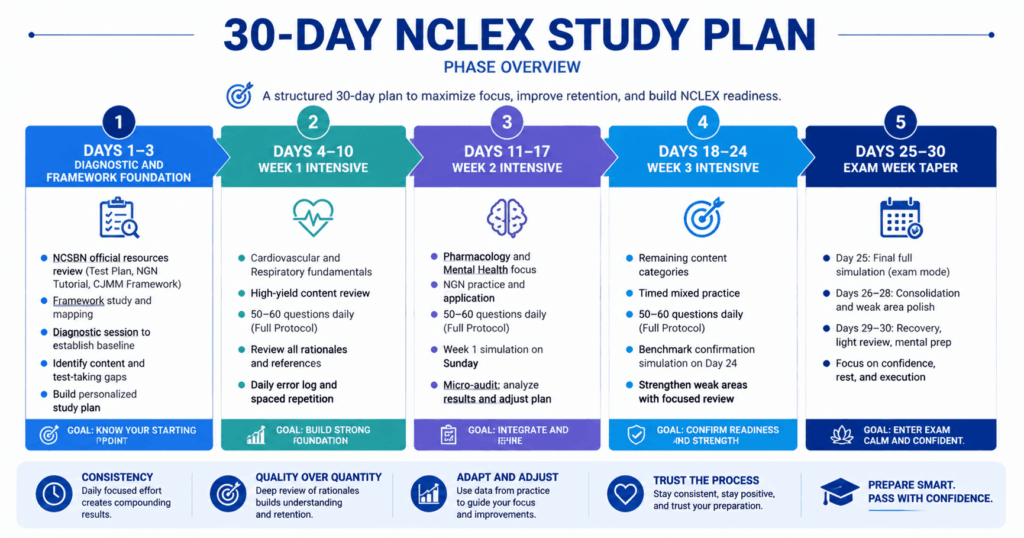
The plan is organized into four phases: Days 1 through 3 (Diagnostic and Framework Foundation), Days 4 through 10 (Week 1 Intensive), Days 11 through 17 (Week 2 Intensive with First Simulation), Days 18 through 24 (Week 3 Intensive with Benchmark Confirmation), and Days 25 through 30 (Exam Week Taper). Each phase has specific daily targets, weekly milestones, and benchmark checkpoints that make the plan self-adjusting — if benchmarks are not met at week transitions, the plan identifies which targeted interventions to add rather than simply continuing unchanged into the next phase.
Before Day 1: What You Need in Place
Your ATT and Exam Date
This NCLEX study plan is built around a confirmed exam date approximately 30 days from now. If your ATT has not yet arrived, use the waiting period to complete the Day 1 through 3 diagnostic and foundation activities — which do not require a specific exam date but establish the preparation baseline that the intensive phases build on. Candidates who begin the 30-day NCLEX study plan without a specific exam date lose the motivational architecture and pacing discipline that a confirmed appointment provides.
Your Question Bank Subscription Active
Activate your primary question bank on Day 1 — not before. Subscriptions activated before intensive daily preparation begins lose access days to periods of low-engagement practice that do not extract the preparation value that justifies the subscription cost. If using a monthly subscription (UWorld, Kaplan, ATI) or the NCSBN Learning Extension, activate it the morning of Day 1 so the full subscription period aligns with the intensive preparation period. If relying on the free NCSBN official samples and supplementary free question banks, confirm your access before Day 1.
Your Tracking System Ready
Before Day 1, set up the two tracking tools this NCLEX study plan requires. A simple weekly accuracy tracker — a spreadsheet or notebook with columns for Overall Accuracy, Content Category Minimum, NGN Accuracy (tracked separately), and Simulation Result — records the four benchmark data points each Sunday. An error type log — four columns labeled Knowledge Gap, Reasoning Pattern Error, Patient Context Error, and NGN Cognitive Skill Error — records every incorrect answer’s classification throughout the preparation period. These two tools take ten minutes to set up and provide the preparation intelligence that converts daily practice into targeted improvement rather than undifferentiated question accumulation.
Phase 1: Days 1–3 — Diagnostic and Framework Foundation
Day 1: NCSBN Foundation and Diagnostic
Day 1 of the NCLEX study plan is the only day that does not include a standard practice question session. Morning (90 minutes): download and read the NCSBN current Detailed Test Plan at ncsbn.org — read the full document, noting the four content domain percentages and the cognitive skill distribution. This is the examination specification that every subsequent preparation decision should reference. Afternoon (90 minutes): complete the NCSBN official NGN tutorial and all available official sample questions at ncsbn.org. Take notes on each of the five NGN format types and the CJMM cognitive skill each tests. Evening (60 minutes): complete a 50-question diagnostic session on your question bank under timed conditions (90 seconds per question). Apply the four-question rationale protocol to every incorrect answer. Record the overall accuracy and content category breakdown in your tracking system. This diagnostic establishes the preparation baseline and identifies which content categories need the most attention in Weeks 1 through 3.
Day 2: CJMM Framework Study and First NGN Practice
Morning (60 minutes): read the NCSBN CJMM framework documentation at ncsbn.org. Write down the six cognitive skills (recognize cues, analyze cues, prioritize hypotheses, generate solutions, take action, evaluate outcomes) and the action verb in each NGN question type that signals which skill is being tested. This is the foundational knowledge that makes NGN questions navigable rather than arbitrary. Afternoon (90 minutes): complete your first full six-question unfolding case study set from your question bank, applying the carry-forward protocol between each question. If your question bank does not offer filtered unfolding case study sets, use the NCSBN official sample set. Apply the CJMM action verb identification habit to each question before reading any option. Evening (60 minutes): complete 25 traditional multiple choice questions from the content category that scored lowest in yesterday’s diagnostic. Apply full four-question protocol to every incorrect answer and classify each error type in your log.
Day 3: Framework Integration and Priority Review
Day 3 integrates the clinical reasoning frameworks with the diagnostic baseline to finalize the preparation priorities for the intensive phase. Morning (90 minutes): review the three-tier priority hierarchy (ABCs, Maslow physiological and safety, psychosocial) and the nursing process sequence (assessment before intervention, with specific clinical exceptions). Practice applying the pre-option sequence — question layer identification, framework activation, physiological urgency signal scan, preliminary prediction — to 10 sample question stems without reading any options. Afternoon (90 minutes): complete 40 mixed questions (30 traditional, 10 NGN) applying the pre-option sequence and CJMM action verb identification to every question. Record overall accuracy, content category accuracy, and NGN accuracy separately. Evening (45 minutes): review the error type log from Days 1 through 3 and identify the most frequent error type — this becomes the behavioral correction target for Week 1.
Phase 2: Days 4–10 — Week 1 Intensive

The Week 1 Daily Session Structure
Every preparation day in the NCLEX study plan’s intensive phase follows the same core session structure, with content category allocation adjusting based on diagnostic results. Morning (20 minutes): Anki spaced repetition — due cards only, no new cards in the morning session. Primary session (90–100 minutes): 50 to 60 questions under 90-second timed conditions — 65 percent from the diagnostic-identified priority content categories, 35 percent from other categories for maintenance — with 30 to 35 percent of total questions as NGN format including at least one full six-question unfolding case study set completed with the carry-forward protocol. After primary session (45–60 minutes): full four-question rationale protocol for every question, error type classification for every incorrect answer, and five to eight new Anki card creations from the session’s identified clinical reasoning principles. Rest days: Saturday and Sunday. Saturday is simulation day (described below). Sunday is rest and micro-audit day.
Days 4–6: Cardiovascular and Respiratory Priority
The first three intensive days of the NCLEX study plan target cardiovascular and respiratory content — the two highest-weight content areas across every NCLEX test plan version and the areas most likely to contain reasoning pattern errors rather than knowledge gaps for candidates with adequate nursing school preparation. Day 4: 50 questions, 70 percent cardiovascular, 30 percent mixed, full protocol. Day 5: 55 questions, 50 percent cardiovascular, 20 percent respiratory, 30 percent mixed with two full NGN case study sets. Day 6: 55 questions, 50 percent respiratory, 20 percent cardiovascular maintenance, 30 percent mixed — assess whether reasoning pattern errors (almost-correct cardiovascular priorities, psychosocial before physiological in respiratory emergencies) are reducing in frequency compared to Days 1 through 3. If reasoning pattern errors remain above 40 percent of incorrect answers, add the three-tier priority explicit check drill to every priority question in subsequent sessions.
Days 7–9: Fundamentals, Safety, and Infection Control
Days 7 through 9 shift the NCLEX study plan’s primary content focus to nursing fundamentals and safe/effective care — content areas that generate high question volume in the safe and effective care environment domain and that frequently produce patient context errors (correct framework applied to misread scenario details). Day 7: 55 questions, 60 percent fundamentals and safety content, 40 percent mixed. Day 8: 60 questions, 50 percent safety and infection control, 50 percent mixed with two full NGN sets. Day 9: 55 questions, equally distributed across the week’s content areas with full NGN integration. By Day 9, the CJMM action verb identification habit should be firing automatically on most NGN questions — if it still requires deliberate effort on the majority of NGN questions, add a 10-minute daily NGN action verb drill (reading 10 NGN question stems, naming the cognitive skill without reading options) to each remaining week.
Day 10: Week 1 Simulation and Sunday Micro-Audit
Day 10 (Saturday) is the Week 1 full simulation — 100 questions under exam-realistic conditions: sit at a desk not a couch, all personal devices removed, room temperature slightly cooler than comfortable, visible timer only, interquestion reset applied after every question throughout the session. Record five simulation metrics: overall accuracy versus the 55 to 60 percent readiness threshold, content category breakdown with any below-50-percent categories identified, NGN accuracy calculated separately, pacing data from the four milestone clock checks, and reasoning quality comparison between questions 1 through 30 and questions 71 through 100. Day 10 (Sunday) is rest and micro-audit: complete the weekly micro-audit from the simulation and week’s session data, update the error type log frequency count, and adjust Week 2 content allocation based on the simulation’s content category breakdown. Any category below 50 percent in the simulation becomes the primary focus of the following week’s question allocation.
Phase 3: Days 11–17 — Week 2 Intensive
Week 2 Content Focus: Pharmacology and Mental Health
Week 2 of the NCLEX study plan shifts content focus to pharmacology and mental health nursing — two content areas that generate high first-attempt not-passing rates for distinct reasons. Pharmacology errors tend to cluster in knowledge gap and NGN cognitive skill error categories: candidates who know pharmacology facts but misidentify whether a pharmacology scenario requires a recognize cues or analyze cues cognitive skill response. Mental health nursing errors tend to cluster in reasoning pattern errors, specifically the psychosocial-before-physiological pattern that therapeutic communication options trigger in scenarios where the patient also has unaddressed physiological needs. These distinct error type patterns require different correction practice — pharmacology sessions should emphasize CJMM action verb identification for every pharmacology NGN question, while mental health sessions should include the explicit three-tier check drill before every mental health question that presents both physiological findings and communication options.
Days 11–13: Pharmacology Deep Dive
Days 11 through 13 allocate 60 to 70 percent of daily question sessions to pharmacology content with the remaining 30 to 40 percent mixed for maintenance and NGN integration. Day 11: 55 questions, pharmacology-heavy, explicit CJMM action verb identification written down for every NGN pharmacology question before options are read. Day 12: 60 questions, pharmacology with two full NGN unfolding case study sets — at least one set should involve a pharmacology-heavy clinical scenario to build the CJMM skill identification habit in pharmacology contexts specifically. Day 13: 55 questions, pharmacology and cardiovascular maintenance, assess whether the error type log shows pharmacology knowledge gaps versus pharmacology NGN skill errors — if knowledge gaps predominate, add a 30-minute targeted pharmacology content review session using Simple Nursing or Level Up RN pharmacology modules before the Day 14 session.
Days 14–16: Mental Health and Therapeutic Communication
Days 14 through 16 shift the NCLEX study plan to mental health nursing with explicit attention to the reasoning pattern error most common in this content area. Day 14: 55 questions, 65 percent mental health content, explicit pre-option sequence application with the physiological urgency scan emphasized before every mental health question. Day 15: 60 questions, mental health and pharmacology maintenance, track how many mental health questions trigger the psychosocial-before-physiological pattern and whether the explicit three-tier check is catching it before the psychosocial option is selected. Day 16: 55 questions, mixed content, compare mental health error type frequency between Day 14 and Day 16 — a reduction in reasoning pattern errors and a maintained or improved therapeutic communication accuracy indicates the Week 2 behavioral correction is working. If no reduction is visible, continue the explicit physiological urgency scan drill into Week 3 rather than treating the pattern as corrected.
Day 17: Week 2 Simulation and Benchmark Assessment
Day 17 (Saturday) is the Week 2 full simulation under the same exam-condition requirements as Week 1. Apply all five simulation metrics. Compare Week 2 simulation results to Week 1 simulation results: is overall accuracy trending above the 55 to 60 percent threshold? Is the week’s lowest content category above 50 percent? Is NGN accuracy above 50 percent and improving? Is pacing within the milestone targets throughout? If all four Week 2 benchmark indicators are positive, the NCLEX study plan is on track for readiness confirmation in Week 3. If any indicator is below threshold, the Week 3 content allocation adjusts to prioritize the specific gap — the category below 50 percent receives 70 percent of Week 3 question allocation, and the error type producing the highest frequency of incorrect answers receives deliberate daily behavioral correction practice. Day 17 (Sunday) is rest and complete micro-audit.
Phase 4: Days 18–24 — Week 3 Intensive and Readiness Confirmation
Week 3 Content: Remaining Gaps and Readiness Confirmation
Week 3 of the NCLEX study plan serves a dual function: completing coverage of any remaining below-standard content categories identified through the first two simulations and confirming all four readiness benchmarks before the exam week taper begins. The week 3 content allocation is determined entirely by the Week 2 simulation’s content breakdown — whichever category remains below 50 percent receives 70 percent of daily question allocation, and if all categories are above 50 percent the allocation distributes across the areas with the lowest accuracy numbers for continued improvement. The Week 3 sessions maintain the same daily session structure as Weeks 1 and 2 with one addition: a daily 10-minute reflection on the pre-option sequence habit quality — not accuracy, but whether the question layer identification and preliminary prediction are consistently occurring before options are read. This reflection catches habit degradation before the exam date reveals it.
Days 18–20: Gap Closure and Habit Confirmation
Days 18 through 20 focus on closing the specific gaps identified by the Week 2 simulation and confirming that the preparation habits built in Weeks 1 and 2 are operating at automatic rather than deliberate application. Day 18: 55 questions, primary allocation to Week 2 simulation’s lowest-accuracy category, habit reflection completed at end of session. Day 19: 60 questions, gap-targeted allocation with full NGN integration, assess whether the CJMM action verb identification is firing before options are read without conscious effort — if it still requires deliberate initiation, the exam is still 11 days away and continued deliberate practice will produce automatic application by Day 25. Day 20: 55 questions, mixed content including all previously covered categories at maintenance level, with at least two full NGN unfolding case study sets. The cumulative error type log after Day 20 should show knowledge gap errors decreasing, reasoning pattern errors decreasing, and NGN cognitive skill errors decreasing — if any category is not decreasing, that error type’s targeted correction needs to be intensified in Days 21 through 24.
Days 21–23: Integration and Full-Protocol Mastery
Days 21 through 23 shift the NCLEX study plan from targeted gap work to integration — confirming that the clinical reasoning framework application, NGN format fluency, and error type correction habits developed across three weeks operate coherently as a complete clinical reasoning system rather than as separate techniques applied piecemeal. Day 21: 60 questions fully mixed across all content areas with the highest realistic NGN proportion — 35 percent NGN — and the pre-option sequence applied to every question. Day 22: 55 questions mixed, focus on the error type log’s current most frequent error type and apply deliberate correction practice specifically to questions that trigger that error type’s context. Day 23: 60 questions mixed, final targeted session before the Week 3 simulation — assess overall accuracy trend, NGN accuracy, and content category minimum to confirm the four readiness benchmarks are approaching met status.
Day 24: Week 3 Simulation — The Readiness Confirmation
Day 24 (Saturday) is the most important simulation in the NCLEX study plan — the readiness confirmation simulation that determines whether the exam date proceeds as scheduled or whether targeted extension is needed. Apply all five simulation metrics with the additional readiness confirmation standard: overall accuracy above 58 percent (slightly higher than the 55 to 60 percent threshold to provide margin for exam-day performance variation), no content category below 52 percent, NGN accuracy above 52 percent, pacing within targets throughout, and no significant reasoning quality decline in the final third of the session. If all five metrics meet these confirmation standards and all four weekly benchmarks have been met across all three weeks, the proceed decision is confirmed — the exam date is the right exam date and the preparation is complete. If any metric falls below confirmation standards with six days remaining, the taper phase adds targeted review for the specific gap rather than eliminating taper recovery. Day 24 (Sunday) is complete rest and micro-audit.
Phase 5: Days 25–30 — Exam Week Taper
Day 25: Final Targeted Review
Day 25 is the last day of substantive NCLEX study plan practice. Morning (20 minutes): Anki due card review only. Primary session (60 minutes — shorter than previous weeks): 35 to 40 questions targeted to any content categories that did not fully reach the confirmation thresholds in the Day 24 simulation. Rationale review (30 minutes): full four-question protocol for all incorrect answers, error type classification, no new Anki card creation. No afternoon session. This shorter, targeted Day 25 session closes any remaining specific gaps without the cognitive demands of a full-length session that would interfere with the recovery the final days require.
Days 26–28: Consolidation and Recovery
Days 26 through 28 eliminate question practice from the NCLEX study plan entirely. Each day includes only 15 minutes of Anki due card review (no new cards, existing deck only) and 20 minutes of clinical framework review — reading through the three-tier priority hierarchy, the nursing process sequence with exceptions, the CJMM six cognitive skill action verb pairs, and the pre-option sequence steps as a consolidation and confidence-activation activity rather than new learning. The primary activity of Days 26 through 28 is physiological recovery: seven to eight hours of sleep each night, 30 minutes of moderate aerobic physical activity each day, normal meals at regular times, and genuine non-nursing social engagement that allows the nervous system to return to baseline from the three-week intensive preparation period. Exam day performance is substantially determined by the cognitive freshness available on exam morning — these three recovery days protect that cognitive freshness.
Day 29: Logistics Confirmation and Confidence Activation
Day 29 has no question practice and no content review. Its activities are logistical and psychological. Logistical: confirm the testing center location and address, confirm the arrival time (at least 30 minutes before the scheduled appointment), confirm the identification documents required and ensure they are accessible, confirm what items are permitted and not permitted in the testing center, and plan the exam morning transport including any contingency for traffic or transit delays. Psychological: write a confidence activation paragraph — a brief written statement of what the preparation has built and what the four weeks of systematic work have confirmed. This paragraph is not motivational performance — it is an evidence-based summary: the three weeks of above-threshold practice, the readiness confirmation simulation, the error type log showing decreasing error frequencies, and the benchmark data confirming clinical reasoning competency. Read this paragraph on exam morning before leaving for the testing center.
Day 30: Exam Day
Exam morning protocol for this NCLEX study plan: wake naturally if the appointment allows it, or with sufficient time for the morning routine without rushing. Protein-forward breakfast. Ten minutes of light physical movement (a brief walk, stretching) to activate the nervous system without generating cortisol elevation. Read the confidence activation paragraph written on Day 29. Apply the process-focus mantra during the commute: this question, this reasoning, now. Arrive at the testing center 30 minutes before the scheduled appointment. During the check-in process, take slow deliberate breaths — the check-in is a familiar process from the preparation you completed, not a novel stressor. Before clicking to begin the first question, apply the pre-first-question grounding sequence: eyes closed, one slow exhale, hands flat on the desk, three seconds of deliberate present-moment orientation. Then begin — and apply the same clinical reasoning quality to question one that you applied to every question across 30 days of preparation.
- What to do if the Day 24 readiness confirmation simulation does not meet all thresholds: Do not panic and do not automatically reschedule. First, identify which specific metric fell below the confirmation threshold — overall accuracy, a specific content category, NGN accuracy, pacing, or reasoning quality in the final third. If the gap is specific and small (one content category at 48 percent instead of 52 percent, or NGN accuracy at 47 percent instead of 52 percent), the taper phase adds one targeted 45-minute session per day for Days 25 and 26 addressing the specific gap while maintaining the recovery structure for Days 27 through 30. If multiple metrics fell below threshold by significant margins, a one-week extension with a new targeted week of gap work before a new confirmation simulation is the more appropriate response. The confirmation simulation provides the data for a rational decision — not a panic response.
- How to adjust the 30-day NCLEX study plan if you are working during preparation: If you are working one or two days per week during the 30-day preparation period, designate those days as reduced-session days rather than rest days: 15 minutes of Anki due card review and 20 minutes of targeted question practice on a smartphone during available breaks, with no full 90-minute session on work days. Shift the Saturday simulation to the first full day off after the work week. The plan’s week structure stretches slightly but the phase sequence and benchmark checkpoints remain. Avoid eliminating rest days to compensate for work days — cognitive recovery on designated rest days is more preparation-valuable than additional question sessions on days when post-work cognitive capacity is insufficient for full protocol quality engagement.
- The single most important habit to build in the first three days of this NCLEX study plan: The pre-option sequence — the 10-second habit of identifying the question layer, activating the relevant clinical reasoning framework, scanning for the physiological urgency signal, and forming a preliminary prediction before reading any answer option. Building this habit from Day 1 ensures it fires automatically by Day 24 without consuming working memory resources. Candidates who wait until Week 2 or 3 to begin the pre-option sequence find that the exam arrives before the habit has reached automatic application — which means it requires deliberate effort on exam day exactly when working memory resources are most needed for clinical reasoning itself.
Conclusion
The 30-day NCLEX study plan works when it is executed as a phased, benchmark-driven preparation system rather than as a content coverage sprint. The diagnostic and foundation phase establishes the preparation baseline and installs the strategic habits that make every subsequent practice session more efficient. The three intensive weeks develop clinical reasoning framework application through targeted content allocation, full protocol engagement, and weekly simulation that confirms progress against objective benchmarks. The exam week taper converts the cognitive investment of 25 preparation days into the rested, recovered clinical reasoning capacity that exam day requires. Every phase depends on the discipline that makes the previous phase productive: the four-question rationale protocol, error type classification, CJMM action verb identification, weekly micro-audit, and pre-option sequence habits that extract maximum clinical reasoning development from each day’s practice.
The candidate who follows this NCLEX study plan with consistent daily discipline — not maximum possible hours but maximum possible quality per session — arrives at Day 30 with 25 days of systematic clinical reasoning development, three confirmed above-threshold simulations, a decreasing error type frequency log showing progressive habit automation, and a preparation evidence record that provides the data-based confidence that exam morning requires. That is the 30-day NCLEX study plan outcome the preparation system is designed to produce.
