

Ranking NCLEX review programs by student success requires a more honest framework than most ranked lists provide — because the most commonly cited ranking criteria (pass rate guarantees, marketing claims, and social media popularity) are among the least reliable indicators of genuine preparation quality. Pass rate guarantees are marketing instruments conditioned on completion requirements that would produce adequate results with almost any preparation approach. Social media popularity reflects shareability, not preparation efficacy. And program self-reported pass rates are not independently audited and cannot be verified against the candidate populations using them.
This ranking evaluates NCLEX review programs against four criteria that more directly predict first-attempt passing outcomes: current test plan alignment with all five NGN format types and CJMM framework instruction, question bank difficulty calibration to actual NCLEX difficulty, clinical reasoning orientation that teaches framework application rather than content recognition, and candidate success profile match — which candidate preparation profiles each program most consistently produces first-attempt passing results for. Programs are ranked within these criteria, not by unverifiable pass rate claims.
An important transparency note before the rankings: NCLEX review program pricing and features change frequently, and specific current details should be verified directly with each program before purchasing. The preparation quality assessments reflect available evidence and documented program features as of mid-2026 and are intended as a starting framework for candidate evaluation rather than as definitive final judgments. The best NCLEX review program for any individual candidate is the one best matched to their specific preparation gap profile — not necessarily the one ranked highest on a general list.
The Four Criteria This Ranking Uses
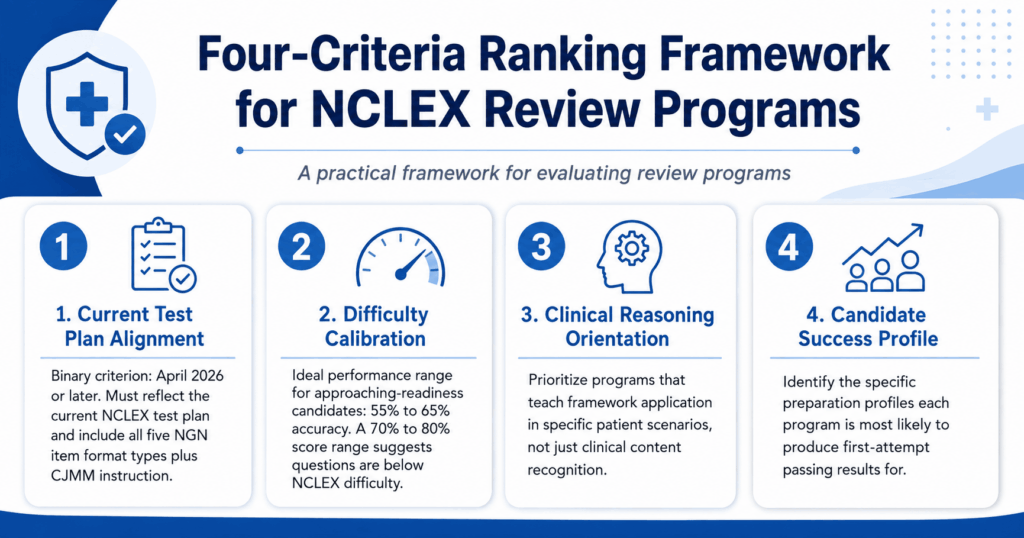
Every NCLEX review program in this ranking is evaluated against four criteria calibrated to the 2026 examination’s specific demands rather than to historical NCLEX pass rates or marketing positioning.
Criterion 1 — Current Test Plan Alignment: Does the program explicitly specify alignment with the April 2026 or later NCLEX test plan and cover all five NGN format types (unfolding case study, bow tie, extended multiple response, matrix, trend questions) with explicit CJMM cognitive skill instruction? This is a binary criterion — a program either covers the current examination format or it does not.
Criterion 2 — Difficulty Calibration: Does the program’s question bank produce practice accuracy in the 55 to 65 percent range for candidates approaching NCLEX readiness, consistent with the actual examination’s adaptive difficulty? Programs producing 70 to 80 percent accuracy for well-prepared candidates are below NCLEX difficulty and provide inflated readiness signals.
Criterion 3 — Clinical Reasoning Orientation: Does the program teach clinical reasoning framework application — how clinical content is applied through priority frameworks to specific patient scenarios — rather than primarily clinical content recognition?
Criterion 4 — Candidate Success Profile: Which specific candidate preparation profiles does the program most consistently produce first-attempt passing results for? Every program has a candidate profile it serves best and profiles where alternative programs outperform it.
The Rankings
1. UWorld NCLEX — Best Overall for Clinical Reasoning Depth
UWorld ranks first among NCLEX review programs for overall preparation quality because it leads on the two criteria most directly connected to clinical reasoning development outcomes: difficulty calibration and rationale depth. UWorld’s question bank is consistently calibrated at actual NCLEX adaptive difficulty, producing the 55 to 65 percent accuracy range for approaching-readiness candidates that provides an accurate readiness signal. Its option-by-option rationale structure explains why each incorrect option fails for the specific patient in the scenario — directly supporting the four-question rationale protocol that is the highest-return preparation behavior available. UWorld has updated its question bank for the April 2026 test plan with comprehensive NGN format coverage and CJMM cognitive skill annotation. Its limitation is that it is a question-bank-primary program with a less developed content review library than Kaplan or Hurst, making it more effective as a clinical reasoning development resource for candidates with adequate content foundation than as a standalone comprehensive NCLEX review for candidates with significant content gaps. Best for: candidates with adequate nursing school content foundation whose primary gap is clinical reasoning framework application development. Verify current pricing at uworld.com.
2. NCSBN Learning Extension — Best for Difficulty Calibration Accuracy
The NCSBN Learning Extension ranks second overall and first on Criterion 2 by definition — it is the only NCLEX review program whose question bank is written by the organization that administers the examination, providing difficulty calibration accuracy that no third-party program can replicate. Questions written by NCSBN content experts using the same test development standards as actual examination items cannot be surpassed in calibration authenticity by any commercial alternative regardless of how carefully commercial programs study the official format specifications. The Learning Extension covers all five NGN format types with CJMM framework instruction current to the 2026 test plan by definition. Its rationale explanations are adequate but generally less detailed in option-by-option distractor analysis than UWorld — meaning the four-question protocol requires more independent derivation of the distractor analysis component. Its content review library is less comprehensive than Kaplan’s. Pricing is significantly below the major commercial platforms, making it the strongest value option for candidates who prioritize difficulty calibration accuracy. Best for: all candidates as a calibration reference and supplementary question bank; primary resource for budget-conscious candidates who prioritize calibration authenticity over rationale depth. Visit learningext.com for current pricing.
3. Kaplan NCLEX-RN — Best for Clinical Reasoning Framework Development
Kaplan ranks third overall and leads on Criterion 3 among the major commercial NCLEX review platforms. The Decision Tree methodology — Kaplan’s systematic clinical reasoning framework for approaching every question type — is the most explicit and most complete clinical reasoning framework instruction available from any major NCLEX review program, and its conceptual alignment with the CJMM’s six cognitive skills gives it a specific 2026 examination advantage. For candidates whose error type analysis shows that reasoning pattern errors (wrong priority framework, almost-correct option selection) account for 40 percent or more of incorrect answers, Kaplan’s Decision Tree instruction directly addresses the primary gap in a way that no other major NCLEX review program does with the same systematic explicitness. Kaplan’s question bank is the largest among the major platforms, its rationale explanations are framework-integrated, and its NGN coverage maps Decision Tree principles directly to CJMM cognitive skills. Its content review library is more developed than UWorld’s, making it a more complete standalone program. Best for: candidates whose primary challenge is clinical reasoning application rather than content knowledge, and candidates who benefit from explicit structured cognitive frameworks. Visit kaplan.com/nclex for current pricing.
4. ATI NCLEX Focused Review — Best for ATI-Integrated Nursing School Graduates

ATI ranks fourth overall with a specific first-place ranking for Criterion 4 candidate profile match for one population: nursing graduates whose nursing school programs used ATI throughout their education. The rationale familiarity, question format recognition, analytics style continuity, and nursing school-to-NCLEX performance correlation data that ATI provides for its nursing school users represent genuine preparation efficiency advantages that are not replicable by programs the candidate has not previously used. ATI has updated its NCLEX review content for the April 2026 test plan with NGN format coverage, and its question bank is well-calibrated for most content areas though a calibration check against the NCSBN official samples is advisable at the higher accuracy ranges. For candidates without ATI nursing school continuity, the continuity advantage does not apply and the choice between ATI and programs ranked above it should be based purely on the other three criteria. Best for: nursing school ATI curriculum users within the post-graduation access eligibility window; secondary choice for candidates without ATI continuity who need integrated content and question bank. Visit atitesting.com for current pricing.
5. Hurst Review — Best for Significant Content Knowledge Gaps
Hurst Review ranks fifth overall and leads on content review depth among all ranked NCLEX review programs — a specific ranking first position that makes it the strongest choice for the candidate profile where content knowledge gaps are the primary preparation challenge. Hurst’s systematic body-system-organized content review, delivered through live and recorded review sessions with a clinical reasoning application layer, addresses the clinical content foundation gaps that question-bank-primary programs like UWorld and the NCSBN Learning Extension are less designed to fill. Hurst has integrated NGN format instruction into its 2026 content with CJMM framework modules. Its question bank is smaller than the major commercial platforms, which limits its value as the primary question practice resource — Hurst is most effectively used as the content foundation resource preceding intensive question bank practice from a higher-ranked question-bank-primary program rather than as the sole NCLEX review resource. Best for: candidates with multiple below-standard content categories on diagnostic assessment, candidates who have been out of nursing school for an extended period before preparing, and repeat test takers with CPR-identified content knowledge gaps. Visit hurstreviewnursing.com for current pricing.
6. Archer Review — Best Focused Value for Framework-Oriented Learners
Archer Review ranks sixth and has built a specific following among nursing candidates who want clinical reasoning framework orientation at a price point below the major commercial platforms. Archer’s content delivery emphasizes examination-application framing alongside clinical content — explaining the clinical reasoning behind priority decisions rather than only the clinical facts — and its question bank is organized around the examination-relevant clinical reasoning skills that the NCLEX tests. Archer has addressed the 2026 test plan’s NGN requirements with updated format content, though candidates should verify the currency and depth of its CJMM instruction against the NCSBN official tutorial before treating it as the primary NGN format resource. Archer’s pricing is generally more accessible than UWorld or Kaplan’s comprehensive packages, making it a competitive value proposition for candidates whose budget does not extend to the top-ranked programs. Best for: candidates seeking a framework-oriented NCLEX review at a cost point below UWorld and Kaplan, and candidates whose nursing school provided ATI or other content foundation that Archer’s question bank can build on without requiring a comprehensive content review library. Verify current pricing and NGN coverage at archerreview.com.
7. NCLEX High Yield — Best for Pharmacology and Content Efficiency
NCLEX High Yield ranks seventh overall and leads for one specific content area: pharmacology preparation efficiency. High Yield’s mnemonic-based pharmacology content delivery and its systematic targeting of the highest-probability examination content areas make it the most efficient content delivery resource available among major NCLEX review programs, with a preparation efficiency advantage that is most clearly realized when pharmacology and the specific high-yield clinical areas are the identified preparation gaps. High Yield’s clinical reasoning instruction is integrated with its content rather than presented as a standalone framework, which limits its effectiveness as a reasoning framework development resource relative to Kaplan. Its NGN coverage is adequate for format familiarization through dedicated modules, though less integrated than Kaplan’s framework-based approach. Best for: candidates with identified pharmacology gaps and time constraints who need maximum content density, candidates who already have a clinical reasoning framework and need content reinforcement, and as a supplementary content resource alongside a higher-ranked question-bank-primary program. Verify current pricing and NGN module currency at nclexhighyield.com.
8. Simple Nursing — Best Free Content Review Supplement
Simple Nursing ranks eighth and occupies a unique position in this list as the highest-ranked primarily free NCLEX review resource — a YouTube-based content review channel that provides clinical reasoning application alongside clinical content explanation at zero cost. Simple Nursing’s pharmacology content, pathophysiology explanations, and priority nursing action videos are among the most consistently recommended free preparation resources in the nursing student community for legitimate preparation quality reasons rather than only for accessibility. Its content is best used as a targeted supplement rather than a primary preparation resource — activated by the weekly micro-audit when specific content categories fall below 50 percent accuracy rather than watched sequentially as a primary curriculum. Simple Nursing has produced NGN-specific content though candidates should verify the currency and CJMM depth of its NGN videos against the NCSBN official tutorial before relying on it for 2026 format preparation. Best for: all candidates as a free supplementary content review resource; primary content resource for candidates using the free preparation system. Access at simplenursing.com and YouTube.
9. Level Up RN — Best Free Framework-Application Content Review
Level Up RN ranks ninth and joins Simple Nursing as the highest-ranked free NCLEX review resources — with a differentiated position from Simple Nursing in that Level Up RN specifically emphasizes clinical reasoning framework application alongside clinical content rather than content clarity as its primary delivery strength. Level Up RN’s question walkthrough content explains the clinical reasoning behind priority decisions in ways that build examination-applicable framework orientation rather than only content knowledge. Level Up RN has addressed NGN format content in its more recent library with CJMM framework instruction that is among the better free sources for 2026 format preparation when verified against the NCSBN official documentation. Like Simple Nursing, Level Up RN is most effective when used as a targeted content review supplement activated by diagnostic data rather than as a systematic sequential primary curriculum. Best for: all candidates as a free framework-oriented content review supplement; strongest free resource for candidates whose primary gap is clinical reasoning application rather than content knowledge. Access at leveluprn.com and YouTube.
10. Free NCSBN System (Official Resources + Anki) — Best Complete Free System
The complete free NCSBN preparation system ranks tenth and deserves explicit ranking rather than omission — because the NCSBN official resources (Detailed Test Plan, NGN tutorial, official sample questions, CJMM framework documentation) combined with Anki for free spaced repetition consolidation represent a complete NCLEX review preparation system that costs nothing and addresses every preparation component the 2026 examination requires. The NCSBN official resources are always the most current available for any test plan version by definition, provide the authoritative NGN format instruction and difficulty calibration reference, and require no purchase. Anki provides free memory consolidation infrastructure on desktop and Android. The system’s limitation relative to the ranked programs above it is question volume and rationale consistency — the official sample count is limited, and free question bank supplements have less consistent rationale depth than the major commercial platforms. The free NCSBN system ranks tenth among programs rather than highest because the programs ranked above it provide genuine preparation quality advantages for candidates who can access them; it ranks on this list at all because it is a complete, adequate, and underappreciated preparation system. Best for: all candidates as the foundation layer of any preparation system, and as the primary system for candidates with zero preparation budget applying full protocol discipline.
How to Use This Ranking to Choose Your Program
The Diagnostic-First Selection Principle
The ranking in this guide is a starting framework for evaluation, not a prescription to automatically select the top-ranked program. The correct NCLEX review program for any individual candidate is the one whose specific strengths most directly address that candidate’s specific preparation gaps — and the diagnostic assessment that identifies those gaps is the prerequisite for any rational program selection. Complete a 50-question diagnostic session on any available question bank before consulting this ranking, identify which content categories fall below 50 percent accuracy, classify the error types that produce the most incorrect answers (knowledge gaps versus reasoning pattern errors versus patient context errors versus NGN cognitive skill errors), and use the error type distribution to match your preparation profile to the ranked program whose candidate success profile description most closely corresponds.
Matching Rankings to Preparation Profiles
The ranking’s practical application maps as follows by preparation profile. Candidates with adequate content foundation and clinical reasoning as the primary gap: programs 1 (UWorld) and 3 (Kaplan) are the primary choices. Candidates who prioritize difficulty calibration accuracy above all else: program 2 (NCSBN Learning Extension) at significantly lower cost. Candidates with ATI nursing school continuity: program 4 (ATI) over programs ranked higher for this specific profile. Candidates with significant content knowledge gaps: programs 5 (Hurst) and 7 (High Yield) for content foundation before intensive question practice. Candidates with budget constraints: programs 2 (Learning Extension), 8 (Simple Nursing), 9 (Level Up RN), and 10 (Free NCSBN System) provide complete adequate preparation at minimal or zero cost. Candidates who need both content and framework development: combination of program 7 (High Yield) for content efficiency and program 1 or 3 for question bank engagement.
What No Ranking Can Tell You
This ranking cannot tell you which program will produce a passing result for you specifically, because the preparation outcome is determined more by the engagement behaviors applied to the program than by the program itself. The four behaviors that determine passing outcomes — the full four-question rationale protocol, error type classification for every incorrect answer, CJMM action verb identification before every NGN question, and the weekly micro-audit tracking all four readiness benchmarks — are not provided by any program automatically. They are applied by the candidate to whatever program they use. A candidate who applies these behaviors to program 10 (the free NCSBN system) is producing more clinical reasoning development than a candidate who uses program 1 (UWorld) with answer-checking review. Choose the program best matched to your preparation gap profile. Apply the preparation behaviors to it with full discipline. That combination produces first-attempt passing results more reliably than any program ranking can.
- The single most important verification before purchasing any ranked program: Complete the NCSBN official sample questions at ncsbn.org (free) and record your accuracy. Then complete an equivalent number of questions from the trial access or sample content of the program you are considering purchasing, under the same timed conditions, and compare the accuracy. A gap of more than 10 percentage points between your accuracy on the NCSBN samples and the program’s questions indicates a difficulty calibration discrepancy — the program is either below NCLEX difficulty (your accuracy is significantly higher on its questions than on the official samples) or above NCLEX difficulty (your accuracy is significantly lower). This 90-minute verification step is the most informative pre-purchase check available and costs nothing beyond the time to complete it.
- How to use multiple ranked programs without preparation fragmentation: The most efficient use of multiple programs is role-specific: designate one program as the primary daily question practice resource and use additional programs for targeted supplementary roles only. Use the primary program for the 50 to 60 daily questions, full protocol engagement, error type classification, and weekly micro-audit tracking. Use supplementary programs for targeted content review activated by the micro-audit’s below-50-percent category data — watching a Hurst Review or Simple Nursing module in a specific below-standard content area, for example, rather than running both programs’ full curricula simultaneously. Avoid the preparation fragmentation that comes from alternating between two programs’ question banks without consistent rationale style familiarity.
The ranking criterion that matters most for the 2026 examination specifically: Criterion 1 — current test plan alignment with all five NGN format types and CJMM cognitive skill instruction — is the most important criterion for the 2026 examination because NGN items constitute approximately 30 to 35 percent of the examination session. Any program on this list that does not meet Criterion 1 fully is providing preparation for 65 to 70 percent of the current examination, which produces below-standard ability evidence from the NGN portion of the adaptive session regardless of how strong the traditional format preparation is. Before finalizing any selection from this ranking, verify the specific program’s NGN coverage by completing its trial NGN sample questions alongside the NCSBN official NGN samples and comparing the format authenticity, CJMM skill identification instruction, and cognitive skill depth.
Conclusion
The ten NCLEX review programs ranked in this guide represent the full spectrum of preparation quality, preparation philosophy, candidate profile fit, and cost tier available in the 2026 examination preparation market. UWorld leads on overall clinical reasoning depth. The NCSBN Learning Extension leads on difficulty calibration authenticity. Kaplan leads on clinical reasoning framework instruction. ATI leads for its nursing school continuity population. Hurst leads on content knowledge gap depth. Archer, High Yield, Simple Nursing, and Level Up RN fill specific value, content efficiency, and free resource niches. The complete free NCSBN system deserves explicit recognition as a complete, adequate preparation approach for candidates who apply full protocol discipline to it.
The ranking’s most important implication is also its most frequently overlooked one: no program on this list will produce a first-attempt passing result through access alone. Every program on this list — from the top-ranked UWorld to the free NCSBN system — requires the same four preparation behaviors applied consistently to whatever question bank it provides: the full four-question rationale protocol, error type classification, CJMM action verb identification, and weekly micro-audit. Those behaviors are the preparation system. The ranked programs are the material the system works with. Choose the program best matched to your preparation gap profile. Apply the behaviors to it with maximum discipline. That is the formula that the 2026 NCLEX examination is designed to reward.
