

Of the five Next Generation NCLEX item types, NGN bow-tie questions are the format candidates most consistently describe as the one that makes them freeze — not because the underlying content is unusually difficult, but because the format itself asks for three separate, interlocking judgments inside a single question, each scored independently. A candidate can correctly identify the patient’s condition, choose a strong nursing action, and still lose credit because the parameter selected to evaluate that action does not match the condition-action pair the item is actually testing. Understanding why bow-tie questions feel different is the first step toward answering them consistently rather than guessing your way through them.
This guide breaks NGN bow-tie questions down into their actual structure, walks through a repeatable five-step method for working through any bow-tie item regardless of clinical topic, applies that method to a full worked example, identifies the specific mistakes that cost candidates points on this format, and lays out a practice protocol that turns the method into an automatic habit rather than something you have to consciously reconstruct under exam-day pressure.
Everything here is calibrated to the 2026 NCLEX test plan and the Clinical Judgment Measurement Model (CJMM) that governs how bow-tie questions are scored. The method taught here is not a shortcut around clinical reasoning — it is a structure for applying the clinical reasoning you already have in the order the bow-tie format actually rewards.
What Is a Bow-Tie Question, and Why Does It Feel So Different
The Structure Behind the Name
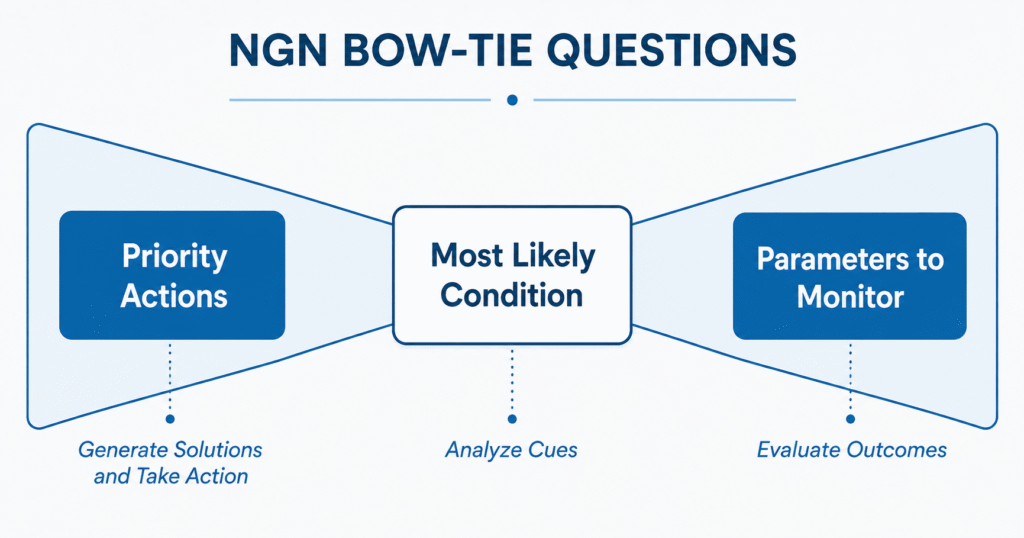
NGN bow-tie questions get their name from the shape of the on-screen diagram: a center box connected by two narrowing lines to a box on the left and a box on the right, visually resembling a bow tie. The center box asks you to identify the client’s most likely condition or the priority problem from a case presentation. The left box asks you to select the nursing actions most appropriate for that condition. The right box asks you to select the parameters you would monitor to evaluate whether those actions are working. All three boxes are drawn from the same case stem, and all three are scored independently — meaning a candidate can get the center right and still lose points on either side.
The Cognitive Skills a Bow-Tie Question Is Built to Measure
The bow-tie format is generally understood to map cleanly onto three of the CJMM’s six cognitive skills in sequence: Analyze Cues drives the center selection, Generate Solutions and Take Action drive the left selection, and Evaluate Outcomes drives the right selection. This sequencing is exactly why NGN bow-tie questions feel harder than a traditional multiple-choice item — a standard question tests one cognitive skill at a time, while a single bow-tie item requires you to move through three skills in order, with each answer depending on the one before it. Missing the center identification does not just cost you the center points; it makes the left and right selections harder to reason through correctly as well, since both are built on top of whatever condition you identified.
The Five-Step Method for Answering Bow-Tie Questions

The method below applies to any NGN bow-tie question regardless of clinical topic, because it addresses the format’s structure rather than any specific content area. Working the steps in this order — and resisting the pull to jump to the answer options before completing the earlier steps — is what separates a systematic bow-tie approach from a guess-and-check approach.
Step 1: Map the Diagram Before You Read a Single Answer Option
Before looking at any of the three answer option lists, look at the diagram itself and note what each box is actually asking for. Bow-tie items occasionally vary the right-side box’s specific framing — sometimes it asks for parameters to monitor, sometimes for expected outcomes, sometimes for potential complications to watch for. Reading the exact wording of each box before you touch the options prevents the common error of answering the question you assumed was being asked rather than the one actually printed on screen.
Step 2: Read the Case Stem for Cue Clusters, Not Isolated Facts
NGN bow-tie questions are built from a case stem containing multiple data points — vital signs, lab values, patient statements, assessment findings — that are meant to be read as clusters pointing toward a single clinical picture, not as a checklist of isolated facts to match against individual answer options. As you read, group the cues mentally: which findings cluster together and point toward the same underlying process? A cue cluster is almost always more diagnostic than any single value in isolation, and treating the stem as a cluster rather than a list is what makes the center-box identification accurate.
Step 3: Commit to the Center Condition Before Looking at Either Side
Select your center-box answer using only the case stem, before reading the left or right answer option lists. This ordering matters specifically because bow-tie left and right options are often written to look plausible in isolation but only make clinical sense once you’ve identified the correct center condition. Reading the side options first — and letting them shape your interpretation of the center — is one of the most common ways candidates talk themselves out of the correct condition identification.
Step 4: Select the Left-Side Actions Using a Priority Framework Anchored to That Condition
With the center condition confirmed, apply a priority framework — ABCs, Maslow’s hierarchy, the nursing process, or the specific safety-versus-therapeutic distinction the scenario calls for — to the left-side action options, asking specifically which actions address the condition you identified in step three. An action that would be appropriate for a different condition but is not specific to the confirmed condition is a distractor, even when it is a generally reasonable nursing action in the abstract.
Step 5: Select the Right-Side Parameters That Actually Evaluate the Actions You Chose
The right box is where NGN bow-tie questions most frequently catch candidates who have done steps one through four correctly. The right-side selections should evaluate whether the specific actions you selected in step four are working — not simply list generic assessment parameters that sound relevant to the condition. If you selected an intervention aimed at improving oxygenation, the corresponding right-side parameter should be one that would directly reflect a change in oxygenation status, not an unrelated vital sign that happens to appear plausible in the option list.
A Worked Example Walkthrough
Consider a case stem describing a client three days post-abdominal surgery who develops a temperature of 101.8°F, a heart rate of 118, shallow respirations at 26 per minute, and a new report of sharp pain on deep inspiration, with the nurse noting diminished breath sounds at the right lung base. Applying the five-step method: step one confirms the diagram is asking for the most likely condition, priority actions, and parameters to monitor. Step two clusters the cues — fever, tachycardia, shallow rapid respirations, pleuritic pain, and diminished basilar breath sounds in a postoperative client — as a set pointing toward a respiratory complication rather than treating the temperature and heart rate as independent, unrelated findings.
Step three commits to the center condition: this cue cluster is most consistent with atelectasis or an evolving postoperative pneumonia, with atelectasis being the more likely early finding given the timing and the shallow breathing pattern that frequently precedes it. Step four selects left-side actions specific to that condition — encouraging incentive spirometry, assisting with early ambulation, and positioning for maximal lung expansion — rather than generic postoperative actions like reviewing the surgical dressing, which does not address the identified respiratory process. Step five selects right-side parameters that would evaluate those specific actions: oxygen saturation trend and breath sound findings on reassessment, rather than a parameter like surgical incision appearance, which would not reflect whether the respiratory interventions selected in step four are working.
The Most Common Bow-Tie Mistakes That Cost Points
Mistake 1: Reading the Answer Options Before Restating the Cue Cluster
Jumping straight to the center-box options before mentally summarizing what the case stem’s cues point toward means the answer options — rather than the clinical picture — end up doing the diagnostic reasoning. This reverses the correct order and makes candidates vulnerable to plausible-sounding distractors that would not have seemed plausible if the cue cluster had been identified first.
Mistake 2: Choosing Left-Side Actions Before Confirming the Center Condition
Because left-side action options are written to sound reasonable in isolation, selecting them before the center condition is locked in frequently produces an internally inconsistent answer set — a correct center identification paired with actions that actually belong to a different, related condition. The action selection should always happen after, and in direct reference to, the confirmed center answer.
Mistake 3: Treating the Right Side as a Generic Assessment List
The right-side box is not asking what you would generally assess in a client with this condition — it is asking what would specifically confirm or refute whether the left-side actions are producing the intended effect. Selecting broadly reasonable assessment parameters instead of action-specific evaluation parameters is the single most frequent source of lost points on an otherwise well-answered bow-tie item.
Mistake 4: Scoring the Item as All-or-Nothing in Your Own Head
Because each of the three boxes is scored independently, a candidate who gets the center wrong but the actions and parameters right for the condition they identified is still earning partial credit — and a candidate who assumes the whole item is a loss after missing the center box sometimes stops applying careful reasoning to the remaining two boxes as a result. Approach every box as independently scorable and worth full effort regardless of how confident you feel about the box before it.
Mistake 5: Never Practicing Bow-Tie Items Under Realistic Interface Conditions
NGN bow-tie questions have a specific on-screen interaction pattern — dragging or selecting options into each of the three boxes — that is unfamiliar the first several times a candidate encounters it. Practicing exclusively with static PDF versions of bow-tie questions, rather than the interactive format the actual examination uses, leaves candidates spending cognitive effort on the interface itself on exam day instead of on the clinical reasoning the format is meant to measure.
How to Practice Bow-Tie Questions So the Method Becomes Automatic
The five-step method only produces consistent results once it becomes an automatic sequence rather than something you consciously reconstruct question by question. Reaching that point requires a specific practice protocol rather than simply accumulating bow-tie question volume.
Apply a Three-Part Rationale Review to Every Bow-Tie Item
For every NGN bow-tie question you complete, whether you answered it correctly or not, write out three short rationale statements: which specific cues in the stem justified the center condition, why each selected left-side action addresses that specific condition rather than a related one, and why each selected right-side parameter would specifically reflect the effect of those actions. This review takes longer per question than simply checking the answer key, and it is what converts question volume into transferable clinical reasoning rather than pattern memorization of specific items.
Track Bow-Tie Accuracy Separately From Overall NGN Accuracy
Because bow-tie questions are scored across three independent parts, tracking only whether you got the item fully correct hides useful information. Track center-box accuracy, left-side accuracy, and right-side accuracy as three separate running percentages during your weekly practice review. A candidate whose center accuracy is strong but whose right-side accuracy is consistently weaker has a specific, addressable gap — evaluation-parameter selection — rather than a generalized bow-tie weakness, and that specificity should directly shape the next week’s practice focus.
Use the NCSBN Official NGN Tutorial as Your Format Reference
Before relying heavily on any third-party question bank’s bow-tie items, complete the official NGN case study tutorial and sample questions at ncsbn.org, since these are produced by the organization that writes the actual examination and provide the most authoritative reference for exactly how the on-screen interaction and scoring for NGN bow-tie questions work. Use this official reference as the calibration point for judging whether a commercial question bank’s bow-tie items are presented in a comparably realistic format.
Consistent application of the five-step method, combined with the three-part rationale review and separate accuracy tracking for each box, is what converts NGN bow-tie questions from the format candidates dread into a format that becomes genuinely predictable — because the method addresses the actual structure the item is built on rather than treating the bow-tie as three unrelated multiple-choice questions stapled together.
Conclusion
NGN bow-tie questions feel harder than traditional NCLEX items because they genuinely test more at once — three sequential cognitive skills, each scored independently, built from the same case stem. That structure is exactly why a systematic method outperforms an intuitive, options-first approach: mapping the diagram, reading the stem for cue clusters, committing to the center condition before either side, anchoring the left-side actions to that specific condition, and selecting right-side parameters that evaluate those specific actions in that order, every time.
The method is learnable and, with consistent rationale review and separate accuracy tracking for each of the three boxes, becomes automatic well before exam day. Practice NGN bow-tie questions deliberately rather than simply accumulating volume, and the format that once felt like the hardest part of the NGN portion becomes one of the more consistently scorable ones — because you are no longer guessing at a diagram, you are working a method you have already proven to yourself works.
