

NCLEX partial credit means a single item can be worth more than one point, and you can earn some of those points without earning all of them. On a five-target bow-tie item, three correct placements earn three points rather than nothing.
That much most students know. What they usually do not know is that the NCLEX uses three different scoring rules, and only some of them subtract points when you select something incorrect. Answering a subtracting item the way you would answer a non-subtracting one is one of the most avoidable ways to lose points on the exam.
There is a reliable way to tell which rule you are looking at, and it comes straight from the pattern in NCSBN’s own published list.
Quick Answer
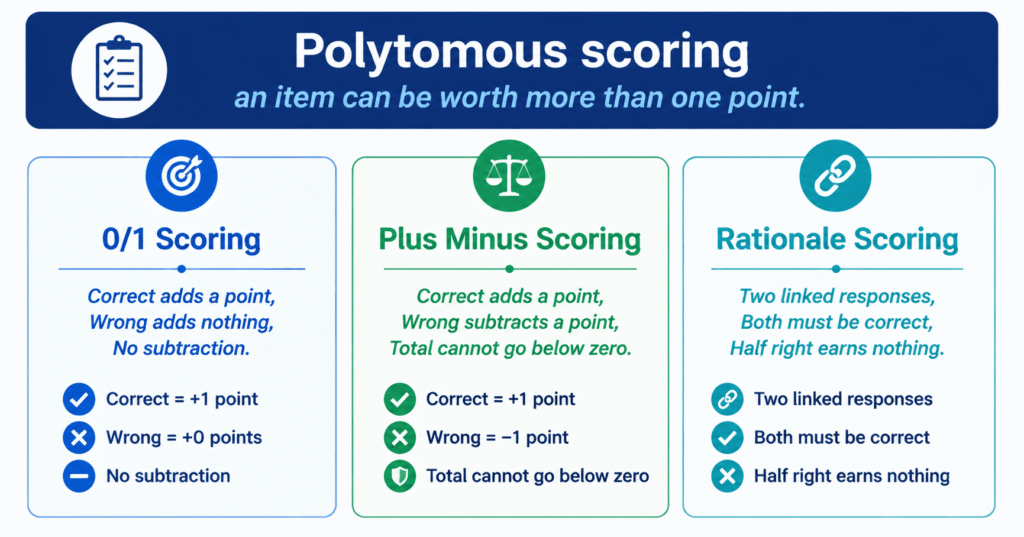
The NCLEX uses three scoring rules. Under 0/1 scoring, each correct response earns a point and incorrect responses earn nothing, with no subtraction. Under plus/minus scoring, correct responses add a point and incorrect responses subtract one, with a negative total rounded up to zero. Under rationale scoring, two linked responses are scored as a pair and both must be correct. Partial credit applies to items with more than one correct response.
What Does Polytomous Scoring Mean?
Understanding NCLEX Partial Credit
Polytomous scoring means an item can produce more than two score outcomes.
The older NCLEX used dichotomous scoring for everything. Each item was either all correct or all incorrect. There was no middle. A select-all-that-apply item where you identified four of five correct options scored the same as one where you identified none.
Polytomous scoring replaced that for items with more than one correct response. Now those items map onto a range of score points. A five-blank cloze item can score anywhere from zero to five.
The reason for the change is straightforward. Nursing judgment is not all-or-nothing in practice, and an exam that treats a nearly correct answer as identical to a completely wrong one throws away information about what a candidate actually knows. Partial credit lets the exam measure partial understanding.
The Three Scoring Rules

1. 0/1 scoring
The total score for a multi-point item is the sum of all correct responses. For single-response items, choosing the key earns a point and choosing a distractor scores zero.
The defining feature is what does not happen: nothing is subtracted. An incorrect response earns zero for that element and leaves your other elements untouched.
2. Plus/minus scoring
Points are earned for correct selections and subtracted for incorrect ones. The item total is the sum of correct options endorsed minus the sum of incorrect options endorsed. All negative totals are rounded up to zero.
NCSBN describes this rule as applying to multi-point items where candidates are free to select as many or as few options as apply. Hold onto that phrasing, because it is the key to the whole article.
3. Rationale scoring
Points are earned only when both responses in the pair are correct. This rule applies to items assessing paired information, where a concept requires justification through a rationale, along the lines of a nurse performing action X because of Y.
Half right scores the same as entirely wrong under this rule. It is the one place on the exam where partial credit genuinely does not apply within the pair.
Which Items Use Which Rule?
NCSBN publishes the mapping. Here it is in full:
| Item type | Scoring rule | Does a wrong selection subtract? |
|---|---|---|
| Matrix Multiple Choice | 0/1 | No |
| Multiple Response Select N | 0/1 | No |
| Drop-Down Cloze | 0/1 | No |
| Drop-Down Table | 0/1 | No |
| Bow-Tie | 0/1 | No |
| Multiple Response Select All That Apply | Plus/minus | Yes |
| Matrix Multiple Response | Plus/minus | Yes |
| Multiple Response Grouping | Plus/minus | Yes |
| Drop-Down Rationale | Rationale | Pair must be fully correct |
| Drag-and-Drop Rationale | Rationale | Pair must be fully correct |
Two details inside that table matter more than they look.
Bow-tie items are worth a maximum of five points, because there are five targets for five correct tokens, and they sit under 0/1 scoring. Nothing is subtracted for a wrong token.
Matrix Multiple Response is floored per column, not per item. Scores are summed across columns, and any negative column score is rounded to zero independently, so a badly answered column cannot drag down the columns beside it. Multiple Response Grouping works the same way but sums across rows.
The Free-Choice Test: How to Tell Which Rule Applies
Look at the two lists again and a pattern appears that NCSBN does not spell out but that its own list makes visible.
Every item type under 0/1 scoring fixes how many responses you may give. Matrix multiple choice allows one selection per row. Select N caps you at N and will not let you exceed it. Drop-down cloze and drop-down table allow one option per blank. Bow-tie has exactly five targets.
Every item type under plus/minus scoring lets you decide how many to select. SATA, matrix multiple response, and grouping all leave the number up to you. NCSBN’s own description of the rule says as much: it applies where candidates are free to select as many or as few options as apply.
That gives you a practical test:
If the item controls how many responses you give, assume nothing is subtracted. If you control how many, assume subtraction applies.
The logic behind it is sound. Subtraction exists to discourage over-selecting. An item that already caps your selections does not need a penalty, because you cannot over-select in the first place.
Two caveats keep this honest. This is a pattern derived from NCSBN’s published list rather than a rule NCSBN states. And rationale items sit outside it, because they are paired rather than free-choice. But as a working heuristic under exam conditions, it is far more useful than trying to memorise ten item types.
Highlight items are worth a note here. They are not named on NCSBN’s scoring page, and they let you select freely, which the free-choice test predicts should mean subtraction applies. Nursing education publishers describe them exactly that way. The heuristic and the available documentation agree.
Traditional SATA Is No Longer All or Nothing
A large amount of NCLEX advice still in circulation says that select-all-that-apply items are all correct or all incorrect. That is out of date.
NCSBN states that traditional NCLEX multiple response select-all-that-apply items are scored using the plus/minus method, which allows partial scoring of multi-point items to evaluate partial understanding, and notes explicitly that these item types previously allowed only scores of all correct or all incorrect.
Two things follow, and they pull in opposite directions:
Good news: a partly correct SATA answer is now worth something. Identifying three of four correct options earns points rather than nothing.
Less good news: a wrong selection now costs you a point you had already earned. Under the old all-or-nothing rule, adding a doubtful option was a gamble on the whole item. Under plus/minus, it is a guaranteed subtraction if you are wrong.
If you learned SATA strategy from older material, the underlying advice to select only what you can defend still holds. The reason has changed.
A 5-Step Method for Deciding Whether to Add a Selection
Step 1: Check whether the item fixes how many responses you may give
Read the instruction line and look at the response interface. One per row? A stated number? A fixed set of targets? Or an open list of checkboxes?
Step 2: If the number is fixed, fill every slot
No points are subtracted on these items, and the exam will not advance until every required response is provided. There is no defensive value in hesitating. Reason it through, commit, and move on.
Step 3: If you control the number, select conservatively
This is where most partial credit is lost. Assume every selection you add can subtract. Adding an option because it might be right is not a free hedge.
Step 4: Justify each selection in one sentence before adding it
For each option you are considering, say why it applies to this client. If you cannot produce a sentence, that selection is a guess wearing a lab coat.
Step 5: Never leave a required response blank
The exam will not let you advance with an incomplete item, and there is no time limit on any individual item. Blank is not an available strategy anywhere on the NCLEX.
Worked Example 1: The Same Question, Two Scoring Rules
The following is an original teaching example written for this article. It is not an actual exam item.
Scenario: A nurse is teaching a client who has a new prescription for levothyroxine.
Options:
- Take the medication in the morning on an empty stomach
- Report palpitations or unexplained weight loss
- Separate the dose from calcium or iron supplements by several hours
- Stop the medication once symptoms improve
- Double the next dose if a dose is missed
- Expect the full therapeutic effect within twenty-four hours
Options 1, 2 and 3 are correct. Options 4, 5 and 6 are not.
Asked as select all that apply
Plus/minus scoring applies. Consider three candidates.
A student who selects 1, 2 and 3 earns three points.
A student who selects 1, 2, 3 and 6, adding the last one because it seemed plausible, earns three minus one, which is two points. The extra selection cost a point they had already banked.
A student who selects all six to be safe earns three minus three, which is zero. The safest-feeling answer produces the worst score.
Asked as select three
Now 0/1 scoring applies, and the interface will not let you pick more than three.
A student who selects 1, 2 and 3 earns three points.
A student who selects 1, 2 and 6 earns two points. The wrong pick earns nothing but subtracts nothing.
The transferable insight
Compare the cost of one wrong selection under each rule.
On the select-three version, a wrong pick costs one point: the point you failed to earn. On the SATA version, a wrong pick costs two points: the one you failed to earn plus the one it subtracts from your total.
A wrong selection is twice as expensive when you control the number. That single sentence is the practical core of NCLEX scoring strategy.
Worked Example 2: How the Zero Floor Actually Works
Original teaching example.
The rounding-to-zero rule is widely mentioned and rarely explained, and where the floor sits depends on the item.
On a SATA item, the floor is the whole item. Suppose an item has three correct options among seven, and a student selects six options: two correct and four incorrect. The arithmetic is two minus four, which is negative two, rounded up to zero. The student scores zero rather than a negative number.
On a matrix multiple response item, the floor sits at each column. Suppose a two-column matrix where a student answers one column well and the other badly.
| Column A | Column B | |
|---|---|---|
| Correct selections | 3 | 1 |
| Incorrect selections | 1 | 4 |
| Raw column score | +2 | −3 |
| After rounding | 2 | 0 |
The item total is two, not negative one and not zero. Column B’s damage is contained within Column B, because each column is scored independently and does not negatively affect the surrounding columns.
Why this matters on exam day. A student who realises halfway through a matrix that they have badly misjudged one category sometimes decides the item is lost and rushes the rest. It is not lost. The column you understand still pays out in full.
What Partial Credit Does Not Mean
It does not make guessing free. On plus/minus items, a guess that misses actively removes points. Partial credit rewards partial knowledge, not padding.
It does not mean every item awards it. Single-response items are still worth one point, right or wrong. Partial credit applies to items with more than one correct response.
It does not mean half right is good enough on rationale items. Within a rationale pair, both halves must be correct.
It does not tell you how you are doing. The exam does not show you your score on any item, and a partial score on one item tells you nothing about whether you are passing. How item scores feed into the pass or fail decision is a separate mechanism, handled by computer adaptive testing.
It does not change the fundamentals of studying. Knowing the rules helps you avoid throwing away points you have earned. It cannot manufacture points you have not.
How to Practise With Scoring in Mind
Two adjustments to how you review practice questions will convert this knowledge into points.
Log your over-selections separately from your content errors. When you get a SATA or matrix item wrong, split the causes. Options you missed are a knowledge gap. Options you added that were wrong are a strategy gap. These look identical in a percentage score and need completely different fixes. Students routinely spend weeks reviewing content when their real problem is that they select seven options when four apply.
Recalculate your own scores by hand. For a week, work out what each multi-point item actually earned under its rule rather than marking it right or wrong. Doing the arithmetic yourself makes the cost of a stray selection concrete in a way that reading about it does not.
If you are working through NGN formats systematically, a review program that teaches clinical reasoning rather than answer-selection tricks addresses the knowledge side of this. Programs like NCLEX High Yield that build instruction around the clinical judgment process help you defend selections rather than hedge them, which is what every one of these rules rewards.
Key Takeaways
- Polytomous scoring means an item can be worth more than one point and can earn a partial score.
- The NCLEX uses three rules: 0/1, plus/minus, and rationale.
- Under 0/1 scoring nothing is subtracted for an incorrect response.
- Under plus/minus scoring incorrect selections subtract, and negative totals are rounded up to zero.
- Under rationale scoring both halves of the pair must be correct.
- Free-choice test: if the item fixes how many responses you give, assume no subtraction. If you choose how many, assume subtraction.
- Traditional SATA items now use plus/minus scoring and are no longer all or nothing.
- On matrix multiple response items the zero floor applies per column, so one bad column does not affect the others.
- A wrong selection costs twice as much on a plus/minus item as on a 0/1 item.
