

Unfolding case studies on the NCLEX are the one part of the exam you can predict exactly. Every candidate receives three of them, six items each, 18 items total. That number does not change with exam length, performance, or luck. Whether your exam stops at 85 items or runs to 150, those 18 unfolding case studies NCLEX are in there.
That predictability is worth using. You cannot know which content areas you will draw or how long your exam will run, but you can know precisely what a case study set looks like before you sit down, and you can practise the exact sequence it follows.
Quick Answer
Understanding Unfolding Case Studies NCLEX
Every NCLEX-RN and NCLEX-PN exam includes 18 clinical judgment case study items, arranged as three sets of six items each on one client. Each set works through the six steps of the NCSBN Clinical Judgment Measurement Model in order, from recognizing cues to evaluating outcomes. The client’s situation develops as you move through the six items, and each item is scored independently.
What Is an Unfolding Case Study?
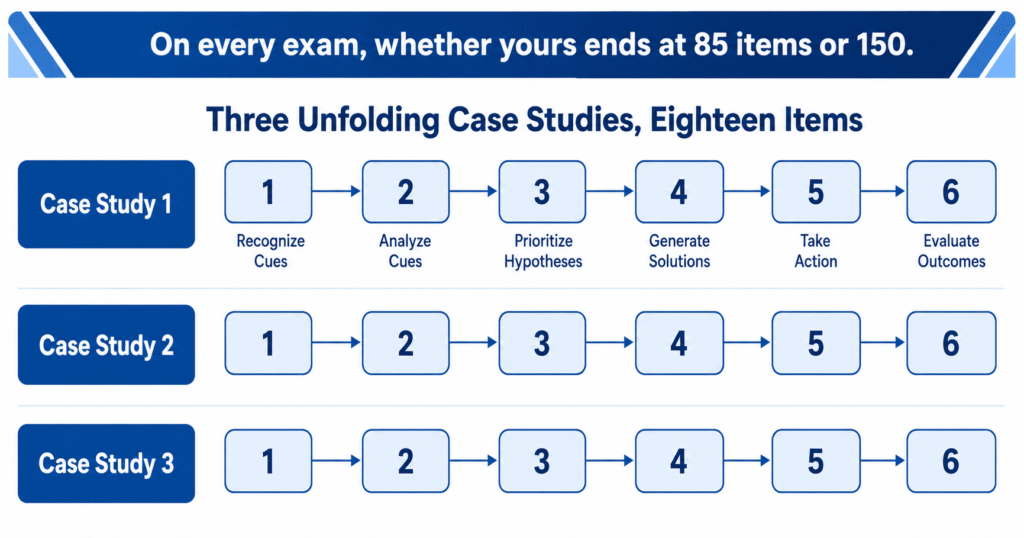
An unfolding case study is a set of six linked items built around a single client. The word unfolding describes what happens across the set: the clinical situation develops, new information appears in the chart, and the client at item six is not in the same state as the client at item one.
The six items follow the six steps of the NCSBN Clinical Judgment Measurement Model in sequential order:
- Recognize cues. Which findings matter?
- Analyze cues. What do those findings mean?
- Prioritize hypotheses. What is most likely, and most urgent?
- Generate solutions. What are the reasonable options?
- Take action. What do you do, and in what order?
- Evaluate outcomes. Is it working?
That order is fixed. If you know which item number you are on, you know which kind of thinking the exam is asking for, which is a genuine advantage and one most candidates never use.
The item formats, by contrast, rotate. You might answer the first item with a highlight item, the second with a matrix, the third with a cloze. The format is just the response mechanism. The step is what is being measured.
Where the 18 Items Fit Into Your Exam
The test plans are specific about this. On a minimum-length NCLEX-RN exam of 85 items, the breakdown is:
| Component | Items |
|---|---|
| Content area items, drawn from the Client Needs percentages | 52 |
| Clinical judgment case study items, three sets of six | 18 |
| Unscored pretest items | 15 |
| Total | 85 |
Two details in that table matter.
Case study items are counted independently of the content area percentages. Because clinical judgment is an integrated process, case studies span any number of content areas, so they sit outside the Client Needs distribution rather than inside it.
The 18 is fixed. The 52 is not. If your exam runs past 85 items, the additional items come from the content areas and the stand-alone pool, not from extra case studies. You will not receive a fourth case study for testing longer.
The same three-set structure applies to the NCLEX-PN, which also allocates 18 items across three sets of six.
Common Questions About When and How They Appear

When in the exam do they show up? NCSBN does not publish the placement of case study sets, and candidate reports vary. Plan for them to appear at any point, including late in a long exam when fatigue is highest. Anyone who tells you they always come first is guessing.
Will you know a case study has started? Yes. The interface changes noticeably. You get a client scenario alongside a chart with record tabs, and the layout is visibly different from a standalone item.
Do you get told which step each item is testing? No. The item does not label itself. But the order is fixed, so counting where you are in the set tells you.
How long should a set take? NCSBN publishes no per-item or per-set time guidance, and there is no time limit on any individual item. What is published is the five-hour appointment limit, which includes all breaks. As rough arithmetic, if 18 of your 85 items are case study items, they represent a little over a fifth of a minimum-length exam, so budgeting roughly a fifth of your working time for them is a reasonable planning assumption rather than a rule.
A 5-Step Method for Working Through a Set
Step 1: Read the opening scenario slowly
You will refer back to this six times. The 30 seconds you spend reading it properly is recovered several times over, and rushing it means rebuilding the client picture at every item.
Step 2: Name which step the item is asking for
Before answering, say it: this is a recognize cues item, or this is a take action item. Counting your position in the set gives you the answer.
This prevents the most expensive case study error, which is answering the wrong step. Giving an intervention when the item asked for an interpretation is a wrong answer even when the intervention is excellent nursing.
Step 3: Reopen the chart tabs on every item
The record updates as the case unfolds. New vital signs, new laboratory results, new nursing notes. Answering item five from your memory of the chart at item one is answering about a client who no longer exists.
Step 4: Answer on the evidence in front of you right now
Not on what you concluded three items ago. If the new data contradicts your earlier hypothesis, follow the new data.
Step 5: Close the item and let it go
Once you confirm an item, you cannot return to it or view your previous responses. More importantly, each item within a case study is independent of the others and scored accordingly. A wrong answer at item two does not affect how items three through six are scored.
Carrying anxiety from one item into the next five is the single most costly habit in this format, and it is entirely avoidable once you know the items do not cascade.
A Complete Worked Case Study
The following is an original teaching example written for this article. It is not an actual exam item.
Opening scenario: A 78-year-old woman was admitted from home two days ago with a urinary tract infection and has been receiving intravenous antibiotics. The nurse is completing morning rounds.
Chart, Vital Signs tab:
| On admission | This morning | |
|---|---|---|
| Temperature | 37.8°C | 35.8°C |
| Heart rate | 88 | 116 |
| Blood pressure | 132/78 | 92/54 |
| Respiratory rate | 18 | 26 |
| Oxygen saturation | 97% on room air | 94% on room air |
Chart, Nurses’ Note: Client drowsy and disoriented to place and time, previously alert and oriented to person, place, time and situation. Skin cool and mottled at the knees. Urine output 15 mL/hr over the last four hours. Reports no pain. Family at bedside reports she “has not been herself since last night.”
Chart, Laboratory Results: White blood cells 18.2 × 10⁹/L. Lactate 3.4 mmol/L. Creatinine 1.6 mg/dL, up from 0.9 on admission.
Item 1 — Recognize Cues (Highlight)
Highlight the findings that require immediate follow-up.
The findings that qualify: the drop in temperature to 35.8°C, the heart rate of 116, the blood pressure of 92/54, the respiratory rate of 26, the new disorientation, the cool mottled skin, the urine output of 15 mL/hr, the elevated lactate, and the rising creatinine.
The trap: hypothermia. Candidates scan for fever because infection means fever, and a temperature of 35.8°C reads as reassuring next to the 37.8°C on admission. In older adults, a falling or subnormal temperature is a recognised sepsis presentation, and here it is one of the most concerning findings on the sheet.
The second trap: “reports no pain” is a real finding and not a concerning one. Highlighting it is an over-selection.
Item 2 — Analyze Cues (Matrix)
For each finding, select whether it supports sepsis, dehydration, or both.
Several findings genuinely support both. Tachycardia, hypotension, and low urine output fit either. The findings that point specifically toward sepsis are the elevated white cell count, the raised lactate, the mottled skin, and the temperature abnormality.
What this item is doing: it is not asking you to decide yet. Analysis means working out what the findings mean, and holding two possibilities at once is the correct behaviour at this step. Candidates who jump to a diagnosis here often mark findings for the answer they have already chosen rather than for what the finding actually supports.
Item 3 — Prioritize Hypotheses (Cloze)
The client is most likely experiencing ___ as evidenced by ___ and is at greatest risk for ___.
Now you commit: sepsis, most likely urosepsis given the admission diagnosis, evidenced by the combination of raised lactate and hypotension with an existing infection, with the greatest risk being septic shock and organ hypoperfusion.
What changed between items 2 and 3: nothing in the chart. What changed is the task. Item 2 asked what the findings mean. Item 3 asks which explanation to act on. This is the pivot point of every case study.
Item 4 — Generate Solutions (Select All That Apply)
Select all interventions that are indicated for this client.
Indicated: obtain blood cultures, administer intravenous fluid resuscitation as prescribed, notify the provider urgently, apply supplemental oxygen, monitor urine output hourly, and recheck lactate.
Not indicated: restricting fluids, administering an antipyretic, and delaying escalation until the next scheduled assessment.
Scoring note: select-all-that-apply items use plus/minus scoring, so adding an intervention you cannot justify subtracts a point. This is the item in the set where over-selection costs the most.
Item 5 — Take Action (Select N)
Select the two actions the nurse should take first.
Notify the provider and begin the prescribed fluid resuscitation.
Why not blood cultures first? Cultures matter and should be obtained, ideally before antibiotics. But this item asks what comes first, and a client with hypotension, a raised lactate and altered mental status needs escalation and perfusion support immediately.
The step distinction: item 4 asked what is appropriate. Item 5 asks what is first. Candidates who answer item 5 with the full list from item 4 have not noticed the step changed.
Item 6 — Evaluate Outcomes (Matrix)
Two hours later. For each finding, select whether it indicates improvement, indicates a complication, or is unrelated.
| Finding | Classification |
|---|---|
| Lactate decreased from 3.4 to 1.8 mmol/L | Improvement |
| Blood pressure 108/66 | Improvement |
| Urine output 45 mL/hr | Improvement |
| New bilateral crackles in the lung bases | Complication |
| Oriented to person and place, still not to time | Improvement |
The teaching point: the crackles. Evaluation is not only about whether the client is getting better. It includes watching for complications caused by your own treatment, and new crackles after aggressive fluid resuscitation are exactly that.
The second point: partial improvement is still improvement. A client oriented to person and place who was disoriented to both two hours ago is moving in the right direction, even though she is not back to baseline. Candidates often classify anything short of normal as a problem.
What the full set demonstrates: one client, six different tasks, four different response formats, and a chart that changed twice. Learning the six steps carries across every case study you will ever see. Learning the four formats carries across only the formats you happened to draw.
Common Mistakes on Unfolding Case Studies
Answering the wrong step. Giving an intervention when the item asked for an interpretation. The most common and most preventable error.
Not reopening the tabs. The chart updates and candidates answer from memory of the opening scenario.
Letting one item contaminate the rest. The items are scored independently. A wrong answer at item two costs you item two.
Committing too early. At the analyze cues step, holding two possibilities is correct. Deciding at item 2 what you should decide at item 3 leads to marking findings to fit a conclusion.
Reusing the item 4 list at item 5. Appropriate and first are different questions.
Over-selecting on the select-all item. Plus/minus scoring means unjustified additions subtract.
Classifying partial improvement as deterioration. At the evaluate step, direction matters more than whether the value has reached normal.
Assuming the trend continues. Item 6 often introduces a complication of the treatment chosen at item 5. Evaluate what is there, not what you expect.
How to Practise Case Studies Effectively
Label every practice item with its step before you answer. Write “recognize cues” or “take action” in the margin. This builds the habit that prevents the most common error, and after a few weeks it becomes automatic.
Review by step, not by item. When you get case study items wrong, sort the errors by which step they occurred at. Errors clustered at recognize and analyze cues usually mean a content gap: you did not know a finding was significant. Errors at take action usually mean a prioritisation problem. Errors at evaluate outcomes usually mean you are not comparing new data against the earlier baseline. Three different failures, three different fixes, and a raw percentage will not distinguish them.
Practise complete sets, not single items. The skill a case study measures is sustaining reasoning about one client across six shifting tasks. Answering isolated questions does not train that. If your practice resource offers full six-item sets, use them, and do them in one sitting.
Do at least some practice late in a session. Case studies can appear at any point in your exam, including when you are three hours in. Practising them only when you are fresh tells you little about how you will handle one at hour four.
If you are preparing systematically, a review program built around the clinical judgment process rather than around question formats matches what these items measure. Programs like NCLEX High Yield that teach the six-step model directly address the reasoning a case study set is testing.
Key Takeaways
- Every NCLEX-RN and NCLEX-PN exam includes 18 case study items in three sets of six, regardless of exam length.
- Each set follows the six clinical judgment steps in fixed order.
- On a minimum-length 85-item exam, the breakdown is 52 content area items, 18 case study items, and 15 unscored pretest items.
- Case study items are counted independently of the Client Needs percentages.
- Item formats rotate within a set. The six steps do not.
- The chart updates as the case unfolds. Reopen the tabs on every item.
- Each item is scored independently. A wrong answer does not cascade.
- You cannot return to a previous item once you advance.
