

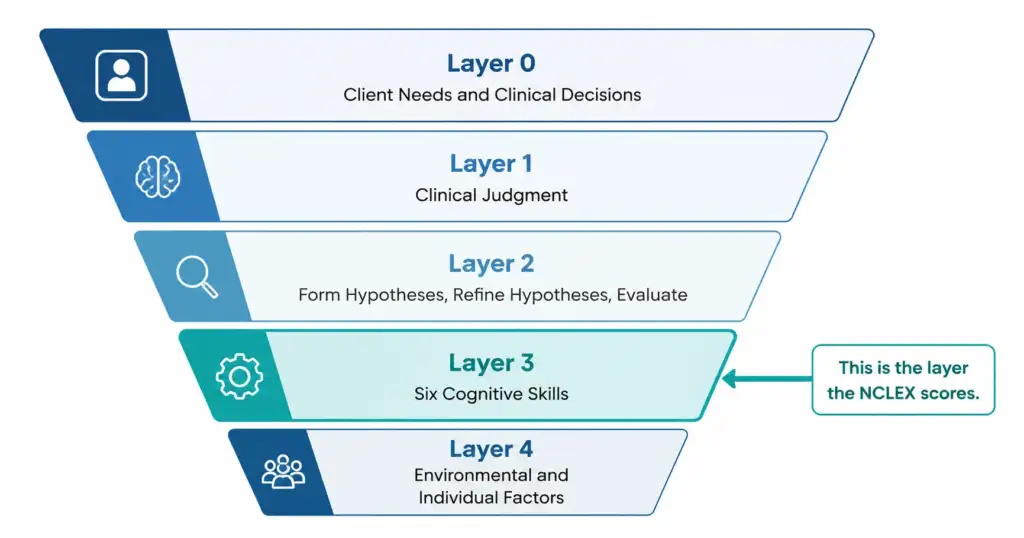
The NCSBN Clinical Judgment Measurement Model is a framework NCSBN built to measure whether a candidate can make sound nursing decisions. It has five layers, and here is the part most study guides bury: the NCLEX scores only one of them.
That single fact saves a lot of wasted effort. Students memorise all five layers, recite them, and still cannot use the model on a question. What you actually need is six terms and a clear sense of what each one asks you to do.
Quick Answer
The NCSBN Clinical Judgment Measurement Model, or NCJMM, is an evidence-based framework NCSBN uses to develop, classify and score NCLEX items measuring clinical judgment. It has five layers, numbered 0 through 4, moving from the broadest context down to the most specific. Layer 3 contains the six cognitive skills the exam measures: recognize cues, analyze cues, prioritize hypotheses, generate solutions, take action, and evaluate outcomes.
What the Model Is Actually For
The NCJMM was not written as a teaching framework. It was built as a measurement framework, which explains why it reads oddly if you approach it as a study method.
NCSBN researchers drew on nursing literature, nurse pedagogy, cognitive psychology, psychological assessment, and decision science. The work involved more than 100 nursing experts and analysis of data from over 200,000 NCLEX candidates. The result is an evidence-based framework for developing, classifying and scoring test items that works within the computerized adaptive testing format the NCLEX already used.
That origin matters for how you use it. The model exists to let NCSBN write items that isolate one specific kind of thinking and score it reliably. When you understand which kind of thinking an item is isolating, the item becomes much easier to answer.
The Five Layers, and Which One Matters
The layers run from broadest to most specific.
| Layer | What it contains | Do you need it for the exam? |
|---|---|---|
| Layer 0 | Client needs and clinical decisions. The context in which judgment happens. | Background only |
| Layer 1 | Clinical judgment itself, as an overall cognitive operation. | Background only |
| Layer 2 | Three broad operations: form hypotheses, refine hypotheses, evaluate. | Useful, not scored |
| Layer 3 | The six cognitive skills. | Yes. This is what is measured. |
| Layer 4 | Environmental and individual factors that shape decisions. | Explains item design |
Layer 0 describes the situation. A client has needs, the nurse makes decisions, and those decisions feed back into the client’s needs. It is the frame around everything else.
Layer 1 is clinical judgment as a single concept. It is the thing being measured, but it is not directly observable, which is precisely the measurement problem the lower layers solve.
Layer 2 breaks judgment into three operations: forming hypotheses about what might be happening, refining those hypotheses, and evaluating what happened. This layer is genuinely useful for understanding the shape of the reasoning, and nursing education literature commonly describes each of its three operations as expanding into two of the Layer 3 skills.
Layer 3 is the operational layer. Six named cognitive skills, each one specific enough to write a test item around and score. Case studies work through all six in order. Stand-alone clinical judgment items target one or more of them.
Layer 4 covers the contextual factors that influence real decisions: environmental factors such as time pressure, available resources, task complexity and the medical record, and individual factors such as the nurse’s knowledge and prior experience.
Layer 4 is worth understanding even though it is not scored, because it explains something students find frustrating. NGN items are loaded with detail: multiple chart tabs, family comments, staffing context, competing demands. That is not padding. Those contextual variables are deliberately built in, because real clinical judgment happens under exactly those conditions. Once you see the extra detail as designed rather than decorative, you stop resenting it and start reading it for what it is.
Does This Replace the Nursing Process?
No, and NCSBN says so directly.
NCSBN states that varied models exist across educational and clinical settings and the NCJMM was not constructed to replace any of them. Their position is that whatever nursing process model is used to teach, good instruction using that model provides a solid foundation for the NGN.
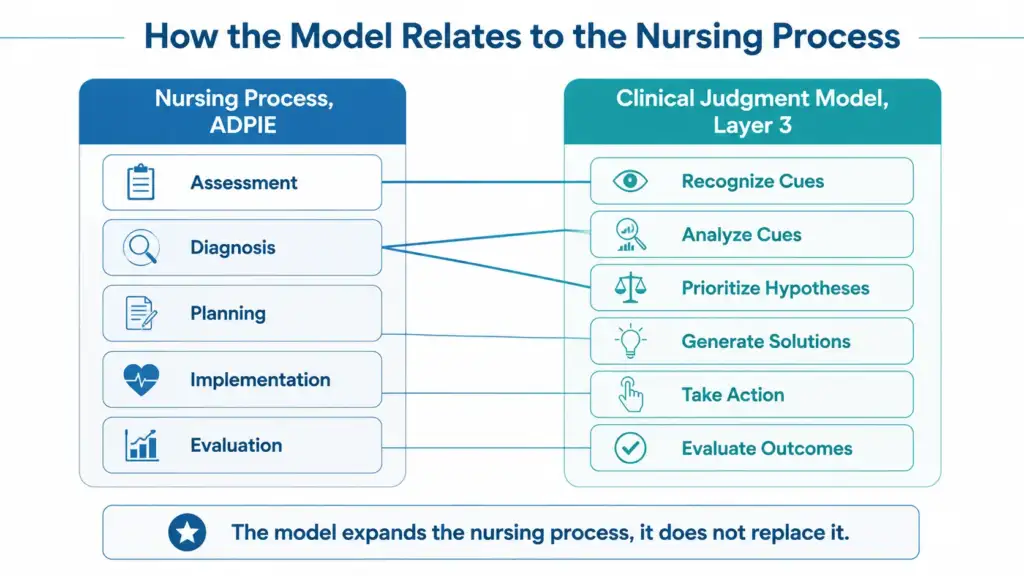
This matters because a fair amount of exam advice implies ADPIE is now obsolete and that students must relearn everything under new labels. That is not what happened. The model expands the nursing process into more measurable components. It does not discard it.
Here is how the two line up:
| Nursing process (ADPIE) | Clinical judgment skills |
|---|---|
| Assessment | Recognize cues |
| Diagnosis | Analyze cues, then prioritize hypotheses |
| Planning | Generate solutions |
| Implementation | Take action |
| Evaluation | Evaluate outcomes |
The mapping is close, and the one meaningful difference tells you what the NGN is really after.
Diagnosis splits into two. In ADPIE, working out what is wrong is a single stage. The clinical judgment model separates interpreting the findings from deciding which interpretation to act on. Those are different cognitive acts, and separating them is exactly where a lot of candidates lose points, because they commit to a condition before they have finished interpreting the data.
If you learned ADPIE, you are not starting over. You are learning that one of its stages contains two distinct steps.
The Six Cognitive Skills
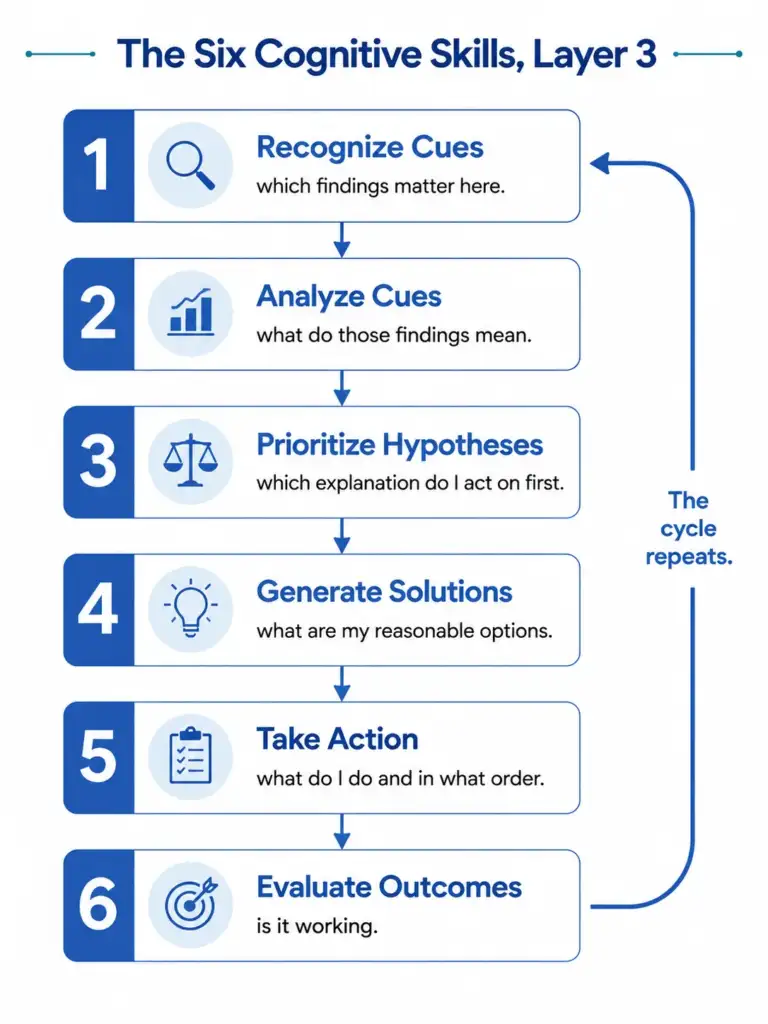
Each skill answers one plain question.
1. Recognize cues — which findings matter here?
Filtering. You have a chart full of information and some of it is relevant, some is normal, and some is real but unrelated to the current problem.
The skill being tested is separating signal from noise, not spotting abnormalities. A value can be abnormal and irrelevant, and a value inside the reference range can be the most important thing on the page if it has moved.
2. Analyze cues — what do those findings mean?
Interpretation. You link the relevant cues together and work out what they could indicate.
At this step, holding more than one possibility is correct behaviour, not indecision. Items at this step frequently offer two conditions that both partly fit, and the honest answer involves both.
3. Prioritize hypotheses — which explanation do I act on first?
Ranking. This is where you commit.
The word that trips people is prioritize, because prioritizing is not the same as picking the most likely. You rank by urgency and risk as well as probability. A less likely explanation that would kill the client faster often outranks a more likely one that would not.
4. Generate solutions — what are my reasonable options?
Listing what is appropriate. Not yet choosing.
The distinction between this step and the next is the most commonly missed one on the exam. This step asks what would be appropriate for this problem.
5. Take action — what do I do, and in what order?
Choosing and sequencing. Now you pick from the options and decide what comes first.
An item asking what is appropriate and an item asking what comes first are different questions with different answers, and answering one with the other is a wrong answer even when the nursing is excellent.
6. Evaluate outcomes — is it working?
Comparing what happened against what you expected.
Two things sit inside this step. Is the client improving, and has your intervention caused a new problem? Evaluation includes watching for complications of your own treatment, which is the part students most often leave out.
The six skills cycle rather than run once. Evaluating outcomes generates new cues, and the process begins again.
A Worked Example: The Model at the Bedside
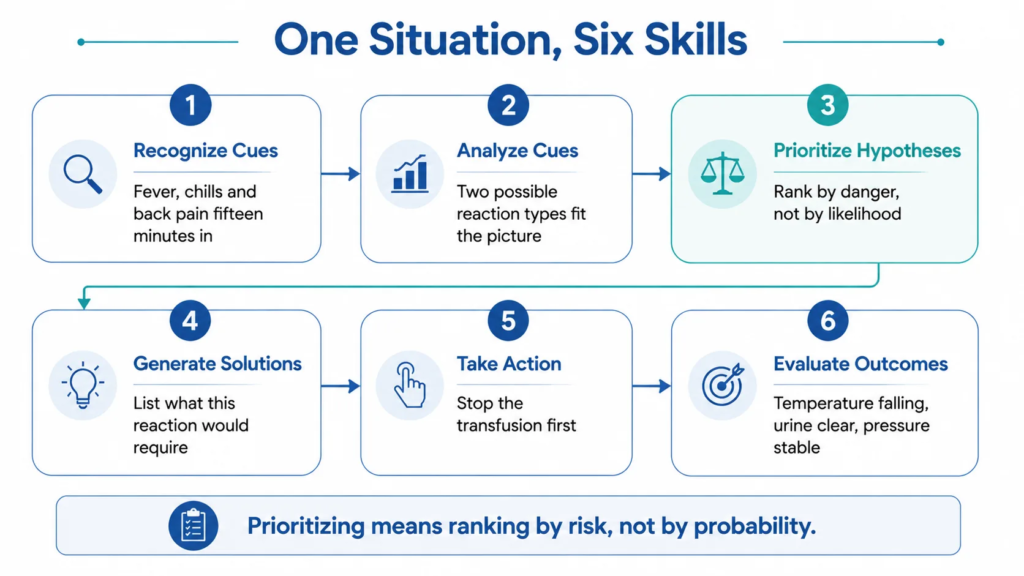
The following is an original teaching example written for this article. It is not an exam item, and it is written as a nurse’s reasoning rather than as exam questions.
Situation: A 62-year-old client is 15 minutes into the second unit of a prescribed red blood cell transfusion for anemia. The client calls out that they feel unwell.
Baseline before the transfusion: temperature 37.0°C, heart rate 82, blood pressure 130/78. Now: temperature 38.3°C, heart rate 104, blood pressure 128/76, respiratory rate 22. The client is flushed, shivering, reports aching in the lower back, and says they feel anxious “like something is wrong.”
Recognize cues
Relevant: the temperature rise of 1.3°C, the chills, the new lower back pain, the tachycardia, the client’s sense of doom, and above all the timing at 15 minutes into the unit.
Not relevant to this decision: the blood pressure, which has not meaningfully moved, and the underlying anemia, which is the reason for the transfusion rather than an explanation for what is happening now.
Timing is a cue in its own right and students routinely overlook it. The same symptoms three days after a transfusion would mean something entirely different.
Analyze cues
Fever with chills during a transfusion fits a febrile non-hemolytic reaction, which is the most common type.
But back pain, anxiety, and a sense of impending doom appearing early in the unit are features associated with an acute hemolytic reaction, which is far less common and far more dangerous.
Both interpretations fit part of the picture. That is the correct state to be in at this step.
Prioritize hypotheses
Here is where the step name earns its keep. If you ranked by probability alone, febrile non-hemolytic reaction wins easily.
You do not rank by probability alone. You rank by what the consequences would be if you were wrong. Treating a hemolytic reaction as though it were a simple febrile reaction risks acute kidney injury, disseminated intravascular coagulation and death. Treating a febrile reaction as though it might be hemolytic costs one interrupted transfusion.
So you act on the dangerous hypothesis while the less dangerous one remains possible. That asymmetry is the whole point of this step, and it is why “prioritize” was chosen instead of “identify.”
Generate solutions
What would this situation require? Stop the transfusion. Keep the intravenous line open with normal saline using new tubing. Stay with the client. Notify the provider and the blood bank. Recheck vital signs. Perform the clerical check of the unit against the client’s identification. Obtain blood and urine samples as prescribed. Prepare to monitor urine output and appearance.
All appropriate. None of them chosen yet.
Take action
Stop the transfusion first. Everything else follows.
This is the sequencing decision, and it is not a close call: the ongoing exposure is the thing causing harm, so removing it precedes investigating it. Candidates who reach for the clerical check first are doing something reasonable in the wrong order.
Evaluate outcomes
Thirty minutes later: temperature 37.6°C and falling, heart rate 88, back pain resolved, blood pressure unchanged, urine clear with no visible discolouration, and no bleeding at the intravenous site.
The picture is improving and the most dangerous hypothesis is becoming less likely. Notice what evaluation involved: comparing against the baseline you recorded before the transfusion, and actively checking for the specific complications the dangerous hypothesis would have produced.
Evaluation is not “does the client seem better.” It is “did the thing I was worried about happen, and did my intervention cause anything new.”
Common Misunderstandings About the Model
Thinking you must memorise all five layers. You need Layer 3. The rest is architecture.
Treating it as a replacement for the nursing process. NCSBN says it is not, and the two map onto each other closely.
Reading “prioritize hypotheses” as “pick the most likely.” It means rank by urgency and risk as well as probability.
Collapsing generate solutions and take action. Appropriate and first are different questions.
Committing to one interpretation at the analyze cues step. Holding two possibilities is correct there.
Thinking evaluation only means improvement. It also means checking for complications your treatment may have caused.
Assuming the model only appears in case studies. Stand-alone items measure these skills too, and the six-step reasoning applies to ordinary multiple-choice items just as well.
How to Actually Use This When You Study
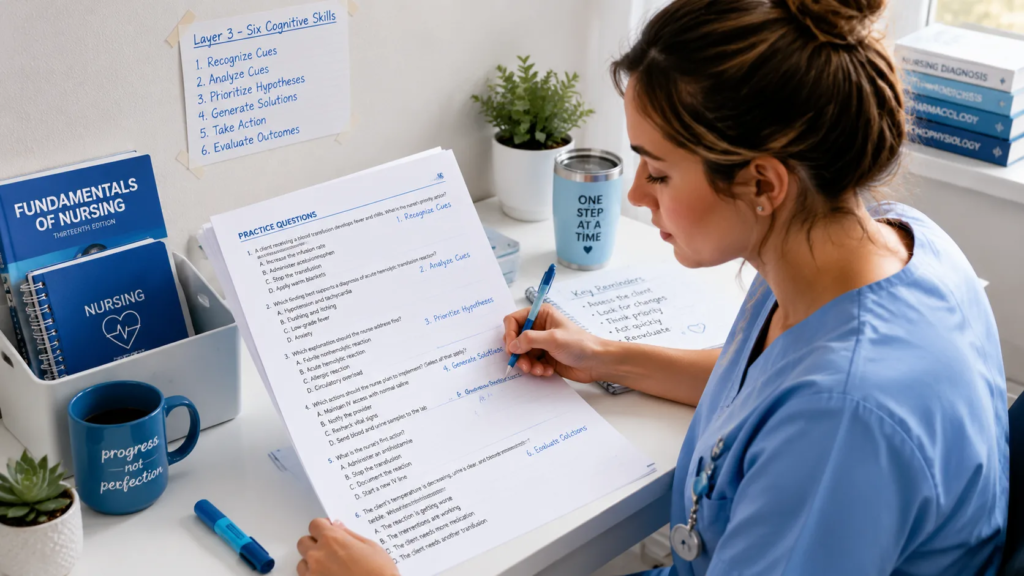
Label your practice questions by skill. Before answering, write which of the six the question is asking for. It takes seconds and it prevents the most common error, which is answering the wrong step.
Sort your errors by skill, not by topic. This is the highest-value habit in this article. Errors concentrated at recognize and analyze cues usually mean a content gap, because you did not know a finding was significant. Errors at prioritize hypotheses usually mean you are ranking by likelihood instead of by risk. Errors at take action usually mean a sequencing problem. Errors at evaluate outcomes usually mean you are not comparing against a baseline.
Four different failures. Four different fixes. A percentage score will not tell them apart, and most students respond to every one of them by reviewing more content, which only helps the first.
Narrate real or simulated situations out loud. Take any clinical scenario and talk through all six steps before checking anything. The model is a sequence of questions, and asking them in order is a habit you can build.
If you are preparing systematically, a review program built around the clinical judgment process rather than around question formats addresses what these items measure. Programs like NCLEX High Yield that teach the six-step model directly work on the reasoning itself rather than on recognising item types.
Key Takeaways
- The NCJMM is a measurement framework NCSBN uses to develop, classify and score NCLEX items.
- It has five layers, numbered 0 through 4, from broadest context to most specific.
- Layer 3 holds the six cognitive skills, and that is the layer the exam measures.
- Layer 4 explains why NGN items contain so much contextual detail. It is designed in, not padding.
- NCSBN states the model was not built to replace the nursing process.
- ADPIE maps closely onto the six skills, with diagnosis splitting into analyze cues and prioritize hypotheses.
- Prioritizing hypotheses means ranking by urgency and risk, not only by likelihood.
- Generate solutions asks what is appropriate. Take action asks what comes first.