

If you are preparing for the NCLEX right now, you have probably already noticed that this exam feels different from anything you studied in nursing school. The questions are longer, more layered, and they are not simply testing whether you can recall a fact. They are testing whether you can think like a nurse — and that is exactly what clinical judgment NCLEX questions are designed to measure.
The Next Generation NCLEX, or NGN, officially launched in April 2023 and completely shifted the focus of the exam. According to the NCSBN, the organization that develops the NCLEX, up to 70% of the scored items on the current exam assess clinical judgment in some form. That is a significant number, and it means that how well you reason through patient scenarios directly determines whether you pass. The good news is that clinical judgment is a skill you can learn and practice. This guide breaks it down step by step so you know exactly what it is, how it is tested, and how to build it before exam day.
What Is Clinical Judgment and Why Does It Matter on the NCLEX?
Clinical judgment is the process a nurse uses to observe a patient, interpret what they are seeing, make decisions, and then evaluate whether those decisions are working. It is not about memorizing protocols. It is about applying knowledge to real, dynamic patient situations.
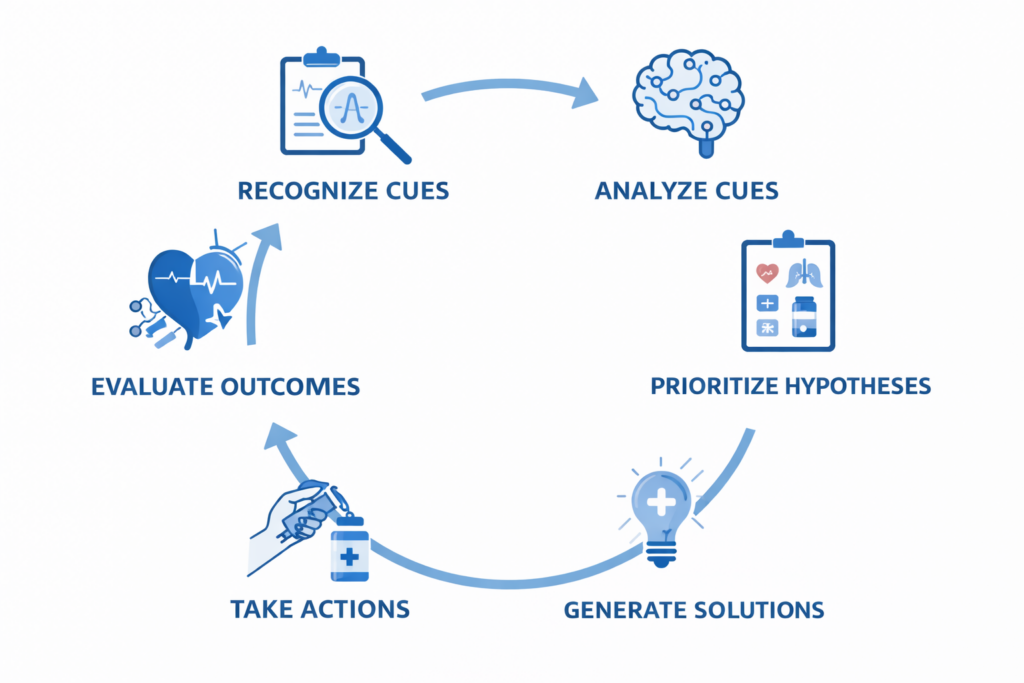
The NCSBN developed a model called the Clinical Judgment Measurement Model, or CJMM, to define and measure this skill on the NGN. This model organizes clinical judgment into six cognitive skills that are embedded directly into exam questions.
The Six Cognitive Skills of the CJMM
- Recognize Cues: Identifying relevant and significant information from a patient scenario, including what stands out and what requires your attention.
- Analyze Cues: Making sense of the information you identified by connecting it to your clinical knowledge and understanding what it might mean.
- Prioritize Hypotheses: Determining which patient problems or conditions are most urgent and should be addressed first.
- Generate Solutions: Developing a plan of care or intervention options based on your prioritized hypotheses.
- Take Actions: Implementing the most appropriate and safe interventions for the patient’s situation.
- Evaluate Outcomes: Assessing whether the interventions worked and determining what needs to happen next.
Understanding these six skills is the foundation of everything else in this guide. Every Next Generation NCLEX question type is built around one or more of these cognitive steps.
How Clinical Judgment NCLEX Questions Are Structured
The NGN introduced several new question types specifically designed to measure clinical judgment. These are different from the traditional multiple-choice questions you may have practiced in nursing school. Knowing what each format looks like will help you approach them without panic on exam day.
Standalone NGN Items
These are single questions that include a detailed patient scenario and ask you to apply one or more cognitive skills. You might be asked to select the most relevant cues from a list, rank hypotheses by priority, or choose the best action for a nurse to take.
Unfolding Case Studies
An unfolding case study presents a patient scenario that evolves across six questions. As new information is added — lab results, changing vital signs, a physician order — you are expected to update your thinking and make new decisions. This format closely mirrors what nursing looks like in a real clinical environment.
Bowtie Questions
The bowtie format asks you to connect patient conditions, nursing actions, and expected outcomes in a structured visual format. You identify the patient’s health problem in the center, then select the actions that address it and the outcomes that indicate whether those actions are working.
Each of these formats is assessing your ability to think through a situation rather than simply recall information. The best way to prepare is to practice using the six cognitive skills deliberately every time you encounter a patient scenario in your studying.

Step-by-Step Strategy to Build Clinical Judgment Skills
Building clinical judgment takes consistent, intentional practice. You cannot develop it by reading alone. You need to actively engage with patient scenarios and push yourself to think through each cognitive step before looking at the answer.
Step 1: Read the Scenario Before Anything Else
Before you look at the question or the answer choices, read the full patient scenario carefully. Ask yourself what information stands out. What vital signs, symptoms, or history details seem significant? This is the recognize cues step, and it sets the foundation for everything that follows.
Step 2: Ask What the Data Means
Once you have identified the relevant cues, pause and ask yourself what they could indicate. If a patient has a heart rate of 118, crackles in the lung bases, and swollen ankles, what conditions could explain that combination? This is the analyze cues step, and it connects your observations to your pathophysiology knowledge.
Step 3: Decide What Is Most Urgent
Not every problem in a scenario is equally important. Once you have formed a few hypotheses, decide which one is the highest priority. Use frameworks like ABC — airway, breathing, circulation — or Maslow’s hierarchy to guide your thinking. Prioritizing correctly is often the difference between a right and wrong answer.
Step 4: Think Before You Choose
Before selecting an answer, ask yourself what a safe, competent nurse would do for this patient right now. Consider which interventions are appropriate, what can be delegated, and what requires immediate action. Then choose the answer that best matches that thinking.
Step 5: Always Evaluate
After selecting an action, ask yourself how you would know if it worked. What would you expect to see improve? What would indicate the patient is getting worse? Thinking through evaluation keeps your clinical reasoning complete and prepares you for follow-up questions in a case study format.
Common Mistakes Students Make with Clinical Judgment on the NCLEX
Even well-prepared students make predictable errors when it comes to clinical judgment NCLEX questions. Being aware of these mistakes before exam day can help you avoid them.
- Jumping straight to the answer choices: Many students read the question and immediately scan the options. This shortcuts the reasoning process. Always form your own thinking about the scenario before evaluating the choices.
- Over-prioritizing rare conditions: Students who have studied pharmacology and pathology intensively sometimes overthink scenarios and gravitate toward unusual diagnoses. In most cases, the correct answer reflects the most common, expected clinical picture.
- Ignoring time cues: Phrases like ‘two hours post-surgery’ or ‘on day three of hospitalization’ are not accidental. They signal where the patient is in their recovery and what complications become more likely at that point.
- Treating all options as equally viable: With select-all-that-apply and extended multiple response questions, some students select every option that sounds reasonable. Think about clinical relevance and priority, not just theoretical correctness.
- Neglecting evaluation questions: Students often find it harder to answer questions about what to do after an intervention. Practice thinking through expected outcomes for every action you would take.
How to Practice Clinical Judgment Every Day
Consistent daily practice is the single most effective way to improve your clinical judgment before the NCLEX. Here is how to make your study sessions count.
When you do practice questions, do not just check whether you got them right or wrong. After each question, spend time reviewing the rationale regardless of your answer. Ask yourself which cognitive step the question was targeting, and then trace through the full reasoning path. Over time, this builds the kind of automatic thinking that carries you through difficult exam scenarios.
NCSBN’s website offers free Next Generation NCLEX resources, including sample questions and tutorials that explain each new question type. These are developed by the same organization that creates the actual exam, so they are the most accurate representation of what you will face. Using them is one of the highest-value things you can do during your preparation.
When you read clinical notes, patient charts, or case studies in your review books, practice narrating the cognitive steps out loud or in writing. Explain what the relevant cues are, what they suggest, and what you would do. This metacognitive practice — thinking about your own thinking — is what separates students who understand clinical judgment from those who are just memorizing steps.
What to Expect on Exam Day
Walking into the NCLEX having practiced clinical judgment will feel completely different from walking in having only memorized content. You will notice that even challenging scenarios feel manageable because you have a structured way to think through them.
On exam day, the NCLEX uses a computer adaptive testing format, which means the difficulty of your questions adjusts based on your performance. The exam will keep presenting scenarios until it has enough information to determine with confidence whether you meet the competency standard for safe nursing practice.
Do not rush. Take time to read each scenario fully before engaging with the question. Use your cognitive skills framework to guide your reasoning. When you feel uncertain, return to the basics: what are the most significant cues, what do they suggest, and what would a safe nurse do right now?
Students who consistently apply clinical judgment on the NCLEX tend to feel more confident throughout the exam because they are not guessing — they are reasoning. That is the goal of everything in this guide.
Conclusion
Mastering clinical judgment NCLEX is not about cramming more facts. It is about changing the way you think. By understanding the NCSBN’s Clinical Judgment Measurement Model, practicing the six cognitive skills deliberately, and reviewing your reasoning on every practice question, you will build the kind of thinking that the NGN is designed to reward.
The nursing profession is grounded in the ability to assess, reason, and act in the best interest of patients. The NCLEX is simply asking you to demonstrate that ability. With consistent, intentional preparation, you are fully capable of doing that.
