

If you have started preparing for the Next Generation NCLEX, you have likely come across a question format that looks nothing like the multiple-choice questions you practiced in nursing school. NCLEX bow tie questions are one of the newer item types introduced with the NGN, and they can feel confusing the first time you see them. The good news is that once you understand the format and the reasoning behind it, they become much more manageable.
The NCSBN officially launched the Next Generation NCLEX in April 2023, and with it came several new question types designed to measure clinical judgment rather than simple recall. Bow tie questions are among the most distinctive of these formats because they require you to think about a patient scenario from multiple directions at once — identifying what is wrong, what you will do about it, and what you expect to happen as a result.
This guide walks you through everything you need to know about NCLEX bow tie questions, including how they are structured, what they are testing, and the step-by-step strategy you need to answer them correctly in 2026.
What Are NCLEX Bow Tie Questions?
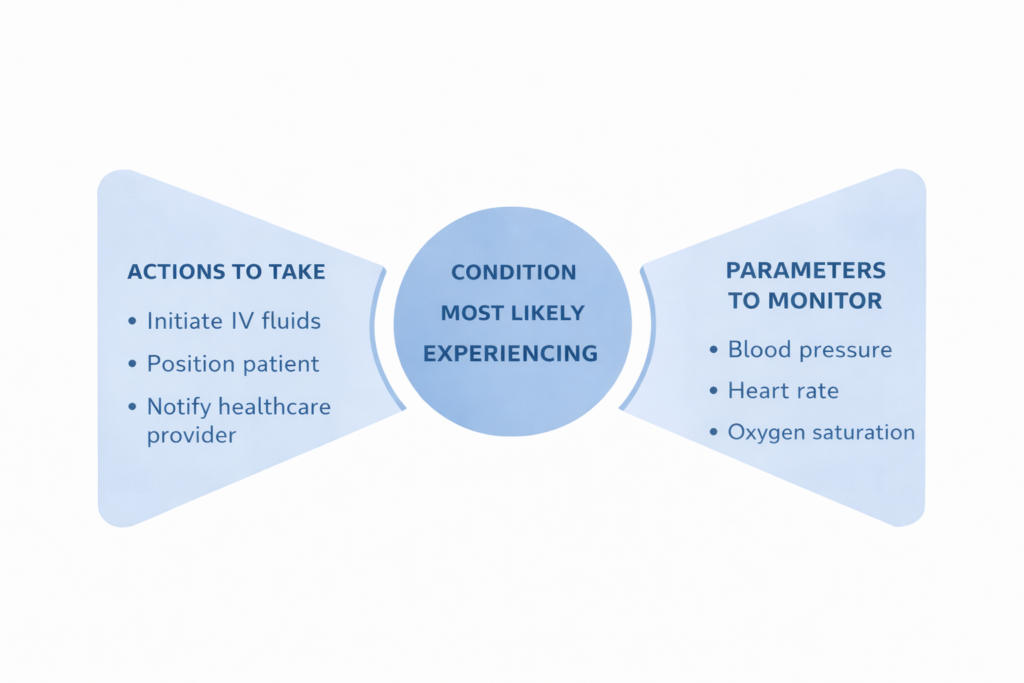
NCLEX bow tie questions are a visual question format introduced as part of the Next Generation NCLEX. The name comes from the shape of the diagram used in the question — two triangles meeting at a center point, which together form the outline of a bow tie.
The center of the bow tie represents the patient’s primary health condition or nursing problem. The left side of the diagram contains a list of potential causes or contributing factors related to that condition. The right side contains a list of potential outcomes or expected improvements that should result from correct nursing care.
You are asked to select items from both sides that correctly connect to the health problem in the center. This means you are not just identifying what is wrong with the patient — you are also connecting that problem to its clinical context on one side and to measurable patient outcomes on the other.
The bow tie format is designed to assess your ability to think through a complete clinical picture. It tests whether you can recognize the factors contributing to a patient’s deterioration and whether you know what evidence-based nursing actions and expected outcomes are appropriate for that condition.
How NCLEX Bow Tie Questions Are Scored
Understanding how NCLEX bow tie questions are scored is just as important as knowing how to answer them. These questions use a partial credit scoring model, which means you do not have to get everything perfectly right to receive points — but incorrect selections will cost you.
According to the NCSBN, the scoring for bow tie questions is based on the number of correct answers you select across both sides of the diagram. Each correct selection earns you a point, and each incorrect selection deducts a point. You cannot score below zero on a single question, so selecting a wrong answer will reduce your score on that item but will not negatively impact other questions.
This scoring model has an important implication for your test strategy: do not guess randomly. Since incorrect answers deduct points, it is better to leave a selection blank if you are truly uncertain than to choose an option you cannot reasonably support with clinical knowledge. However, if you can narrow down the options using your nursing knowledge, selecting your best-supported choice is always worthwhile.
How Many Selections Are Required
For each side of the bow tie, you will typically be required to choose two options from a list of five or six. The center condition is usually pre-filled or requires a single selection. Always read the instructions carefully because the number of required selections may vary between questions.

What Clinical Judgment Skills Do Bow Tie Questions Test?
Every NCLEX bow tie question is grounded in the NCSBN’s Clinical Judgment Measurement Model. This model defines six cognitive skills that nurses use in clinical practice, and the bow tie format specifically targets three of them in a single question.
Prioritize Hypotheses
The center of the bow tie asks you to identify the patient’s primary health problem. This requires you to synthesize the clinical data in the scenario — vital signs, symptoms, history, lab values — and determine which condition or complication best explains what you are seeing. Getting the center correct is the foundation of the entire question.
Generate Solutions
The left side of the bow tie asks you to select the nursing actions that are most appropriate for the identified condition. This tests whether you know the evidence-based interventions for common patient conditions and whether you can distinguish priority actions from supportive or incorrect ones.
Evaluate Outcomes
The right side of the bow tie asks you to identify the parameters you would monitor to determine whether your interventions are working. This is the evaluate outcomes step, and it requires you to know what clinical improvements indicate that nursing care is effective for a specific condition. Because bow tie questions assess three cognitive skills simultaneously, they are considered one of the more demanding formats on the NGN. Preparing for them means strengthening your ability to think across all three of these clinical reasoning steps.
Step-by-Step Strategy to Answer NCLEX Bow Tie Questions
Having a reliable strategy is essential when you encounter NCLEX bow tie questions on exam day. The following approach will help you work through each question methodically and avoid the common errors that cost students points.
Step 1: Read the Full Patient Scenario First
Before you look at the bow tie diagram or the answer options, read the entire patient scenario carefully. Note the patient’s age, medical history, current symptoms, vital signs, and any recent changes in condition. The scenario contains everything you need to answer the question correctly, but only if you read it thoroughly.
Step 2: Identify the Center Condition
Start with the center of the bow tie. Based on the clinical data you just read, determine which condition or nursing problem best fits the patient’s presentation. Think about what the pattern of cues suggests — is this fluid overload, sepsis, hypoglycemia, respiratory failure? Selecting the correct center is critical because it anchors your selections on both sides.
Step 3: Work the Left Side — Nursing Actions
Once you have identified the center condition, move to the left side of the bow tie and ask yourself: what are the priority nursing actions for this specific condition? Think about what a safe, competent nurse would do first. Eliminate options that are contraindicated, irrelevant to this condition, or clearly lower priority than others.
Step 4: Work the Right Side — Parameters to Monitor
Move to the right side and ask yourself: if my nursing actions are working, what should I expect to see improve? Think about which vital signs, lab values, or clinical signs serve as evidence that the condition is resolving. Select parameters that are directly tied to the condition you identified in the center.
Step 5: Review Your Selections Together
Before confirming your answers, take a moment to look at all three sections together. Ask yourself whether your selected actions logically address the center condition, and whether your monitoring parameters would genuinely reflect improvement in that condition. If something feels disconnected, reconsider that selection.
Common Mistakes to Avoid with Bow Tie Questions
Students who are encountering NCLEX bow tie questions for the first time often make the same avoidable errors. Knowing what these are will help you approach the format with greater accuracy.
- Starting with the answer options: Many students look at the lists of actions and parameters before identifying the center condition. This leads to scattered thinking. Always anchor your reasoning in the center problem first.
- Selecting actions that are generally good nursing practice: Bow tie questions are not asking what a nurse might eventually do — they are asking what is most appropriate for this specific condition right now. Avoid selecting actions that are broadly reasonable but not targeted to the identified problem.
- Confusing assessment with action: On the left side of the bow tie, the question asks for nursing actions or interventions. Assessment findings belong on the right side as monitoring parameters. Keep these roles distinct in your mind.
- Overlooking the scoring penalty: Because incorrect selections deduct points, selecting an option you are unsure about is riskier than leaving it unselected. Use your clinical knowledge to guide selections rather than guessing under pressure.
- Rushing through the patient scenario: The clinical details in the scenario are there for a reason. Students who skim the scenario often miss a key piece of information — a recent lab result, a medication, or a timeline cue — that changes the correct answer entirely.
How to Prepare for Bow Tie Questions Before Exam Day
The most effective way to prepare for NCLEX bow tie questions is to practice them regularly and to review your reasoning after every attempt. Simply doing questions is not enough — you need to understand why each option is correct or incorrect.
NCSBN provides free sample NGN questions on their website, including bow tie examples with detailed explanations. These materials are developed by the same organization that creates the NCLEX, so they offer the most accurate representation of what you will see. Spending time with these samples early in your preparation will help you get comfortable with the format before you face it under exam pressure.
As you practice, focus on building your knowledge of the most commonly tested conditions on the NCLEX — heart failure, sepsis, pneumonia, acute kidney injury, diabetic emergencies, and neurological changes. For each of these conditions, practice naming the priority nursing actions and the key parameters you would monitor. This kind of condition-specific preparation maps directly onto the bow tie structure.
Finally, practice reviewing your completed bow tie answers as a set. Ask yourself whether the three sections tell a coherent clinical story. If the center condition is heart failure, the left side should include actions like positioning the patient upright and administering prescribed diuretics, and the right side should include monitoring urine output, breath sounds, and oxygen saturation. When all three sections align clinically, you can feel confident in your selections.
Conclusion
NCLEX bow tie questions may look intimidating at first glance, but they follow a logical structure that maps directly to the way nurses think in clinical practice. By understanding what each section of the diagram is asking, knowing the cognitive skills being tested, and applying a consistent step-by-step strategy, you can approach these questions with confidence rather than confusion.
Start with the center condition, let it guide your actions on the left, and confirm your thinking with the monitoring parameters on the right. Practice this process with real patient scenarios, review your reasoning carefully, and use the free resources available through NCSBN to sharpen your skills. With focused preparation, NCLEX bow tie questions will become one of the formats you feel most ready for on exam day.
