

NCLEX case studies are the most immersive and clinically realistic question format on the Next Generation NCLEX — and for many nursing students, they are also the most challenging. Unlike traditional multiple-choice questions that test a single concept in isolation, NCLEX case studies unfold across multiple questions, simulate a real patient encounter, and require you to think, adapt, and reason your way through a shifting clinical picture.
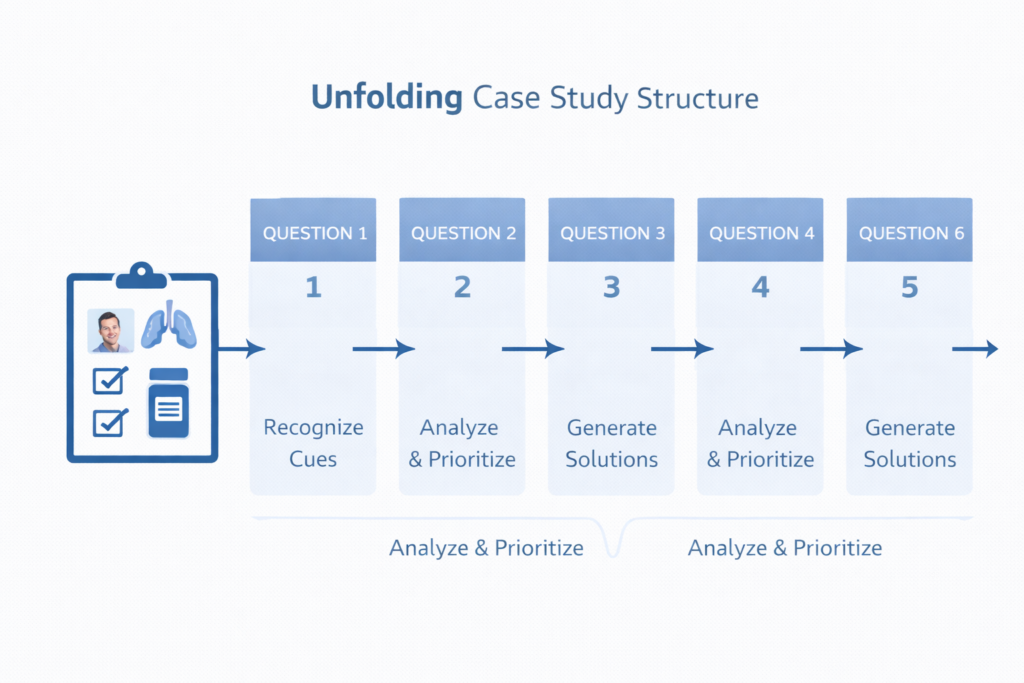
Since the NCSBN launched the Next Generation NCLEX in April 2023, unfolding case studies have become a centerpiece of the exam. According to the NCSBN, every NGN includes at least three scored unfolding case studies, each containing six questions built around a single evolving patient scenario. That means a significant portion of your exam score depends directly on how well you can navigate this format.
This guide breaks down everything you need to know about NCLEX case studies in 2026 — what they look like, how the EHR-style interface works, which clinical judgment skills they test, and the step-by-step strategy to read and answer them with confidence.
What Are NCLEX Case Studies on the NGN?
NCLEX case studies — officially called unfolding case studies — are multi-question scenarios that present a single patient whose condition changes over time. Each case study contains six questions tied to the same patient, and as you move through the questions, new information is added: updated vital signs, lab results, physician orders, nursing notes, or a change in the patient’s status.
This format mirrors what nurses actually experience on the job. In real clinical practice, patient care is not a single decision made in isolation — it is a continuous process of observation, reassessment, and adjustment. NCLEX case studies are designed to test whether you can do exactly that.
Each question within the case study targets a specific clinical judgment cognitive skill from the NCSBN’s Clinical Judgment Measurement Model. One question might ask you to recognize the most significant cues in the patient’s data. The next might ask you to prioritize a hypothesis or select the best nursing action. By the end of the case study, you will have worked through the full clinical reasoning cycle for that patient.
How NCLEX Case Studies Differ from Standalone Questions
Standalone NGN questions present a self-contained scenario and ask a single question. NCLEX case studies, by contrast, build on each other. The answer to one question does not affect what you see in the next, but the patient scenario itself evolves — meaning you must update your clinical thinking as new data becomes available rather than relying on your initial assessment throughout.
Understanding the EHR-Style Interface in NCLEX Case Studies
One of the most distinctive features of NCLEX case studies is the electronic health record interface used to present patient information. Instead of a short paragraph describing a patient, you are shown a tabbed EHR that contains multiple types of clinical data — just like the digital patient charts nurses use in hospitals.
What the EHR Tabs Contain
The EHR interface in NCLEX case studies typically includes several navigable tabs. Understanding what each tab contains will help you locate relevant information quickly during the exam.
- Nurses’ Notes: Chronological documentation of nursing assessments, patient observations, and care provided. This tab often contains the most clinically significant cues and is usually the first place to look.
- Vital Signs: A record of the patient’s vital sign measurements over time, including blood pressure, heart rate, respiratory rate, temperature, and oxygen saturation. Trends in this data are often more meaningful than a single reading.
- Laboratory Results: Lab values with reference ranges. Abnormal values are frequently flagged, but you need to interpret them in the context of the patient’s clinical picture, not in isolation.
- Medical History: The patient’s past medical diagnoses, surgical history, allergies, and relevant background. This provides important context for interpreting current symptoms.
- Physician Orders: Current medication orders, diagnostic tests ordered, and treatment plans. This tab tells you what has already been prescribed and helps you identify what nursing actions are appropriate.
- Flow Sheet: A grid-style record of repeated assessments and interventions over time, useful for identifying patterns or changes in the patient’s status.
You do not need to read every tab from start to finish for every question. Part of the skill in NCLEX case studies is knowing which tabs are most relevant to the specific question being asked and being able to navigate efficiently to the information you need.

Clinical Judgment Skills Tested in NCLEX Case Studies
Each of the six questions in an NCLEX case study targets one of the cognitive skills defined in the NCSBN’s Clinical Judgment Measurement Model. Knowing which skill each question type is assessing helps you focus your reasoning in the right direction.
Recognize Cues
These questions ask you to identify which pieces of information in the EHR are clinically significant. You might be shown a list of data points from the nurses’ notes or vital signs and asked to select the ones that require follow-up or indicate a change in patient status. The key is focusing on what is abnormal, unexpected, or inconsistent with the patient’s baseline.
Analyze Cues
After recognizing what stands out, analyze cue questions ask you to interpret what the data means. Given a set of findings, which conditions are most consistent with what you are seeing? This requires connecting your clinical observations to your pathophysiology and pharmacology knowledge.
Prioritize Hypotheses
These questions ask you to rank or select the most likely or most urgent patient problems. In NCLEX case studies, this often comes after you have been shown new information that changes the clinical picture — for example, a drop in blood pressure alongside new confusion might shift the priority from a previously identified problem.
Generate Solutions and Take Actions
These questions present a nursing problem and ask you to select the most appropriate interventions. In the context of NCLEX case studies, actions must always be matched to the specific phase of the patient’s care and the information currently available in the EHR — not to what you might eventually do later in the shift.
Evaluate Outcomes
The final question in many NCLEX case studies asks you to evaluate whether the nursing interventions were effective. You will be shown updated patient data and asked which findings indicate improvement, which indicate deterioration, or what the nurse should do next based on the current status.
Step-by-Step Strategy to Read and Answer NCLEX Case Studies
Having a repeatable strategy for approaching NCLEX case studies is essential. The EHR interface contains a lot of information, and without a structured approach, it is easy to feel overwhelmed or miss the details that matter most.
Step 1: Read the Opening Scenario Before Touching Any Tab
Every NCLEX case study begins with a brief patient introduction — name, age, reason for admission, and sometimes a short nurses’ note. Read this carefully before navigating to any EHR tab. It tells you the patient’s baseline context and frames everything that follows.
Step 2: Go to Nurses’ Notes and Vital Signs First
In most NCLEX case studies, the nurses’ notes and vital signs tabs contain the most clinically actionable information. Start here to understand what is currently happening with the patient. Note anything that is abnormal, trending in the wrong direction, or inconsistent with what you would expect for this patient.
Step 3: Cross-Reference with Labs and Orders
Once you have a sense of the clinical picture from the nurses’ notes and vitals, check the lab results and physician orders for supporting or conflicting information. A low hemoglobin alongside tachycardia and pallor tells a different story than tachycardia alone. The EHR rewards students who connect data across tabs.
Step 4: Apply the Relevant Cognitive Skill to the Question
Before selecting your answer, identify which cognitive skill the question is targeting. Is it asking you to recognize cues, prioritize a hypothesis, or evaluate an outcome? Aligning your reasoning with the right cognitive skill helps you avoid overthinking and stay focused on what the question is actually asking.
Step 5: Update Your Thinking as New Information Appears
As you move through the six questions in an NCLEX case study, the patient’s condition will evolve. A patient who appeared stable in question one may show signs of deterioration by question four. Do not anchor to your earlier assessment. Treat each new set of EHR data as a fresh clinical picture and reason from what you see now, not what you saw before.
Common Mistakes Students Make on NCLEX Case Studies
Even well-prepared students make predictable errors when working through NCLEX case studies for the first time. Being aware of these patterns before exam day gives you a real advantage.
- Reading every tab before answering: Some students feel they need to read the entire EHR before they can answer confidently. This wastes valuable time. Navigate to the tabs most relevant to the question being asked and read purposefully, not exhaustively.
- Anchoring to the first assessment: In NCLEX case studies, the patient’s status changes. Students who form a strong initial impression and fail to revise it when new data appears will misread the later questions. Stay flexible and update your clinical reasoning as the scenario evolves.
- Treating all data as equally important: The EHR contains a lot of information, and not all of it is relevant to every question. Develop the habit of identifying which data points are clinically significant for the specific question you are answering rather than trying to incorporate everything.
- Ignoring trends in vital signs: A single vital sign reading may be unremarkable. A series of readings showing a downward trend in blood pressure or a rising respiratory rate is a significant clinical signal. Always look at the pattern over time, not just the most recent value.
- Forgetting to re-read the question stem: After navigating through multiple EHR tabs, students sometimes answer a slightly different question than the one that was actually asked. Before selecting your answer, re-read the question stem to make sure your response directly addresses what is being asked.
How to Study for NCLEX Case Studies Effectively
Preparing for NCLEX case studies requires a different approach than studying for traditional multiple-choice questions. You need to build both your clinical knowledge and your ability to navigate and synthesize information from a multi-tab patient record.
The NCSBN offers free Next Generation NCLEX resources on their website, including sample unfolding case studies with full EHR interfaces and detailed answer rationales. These are built by the same team that creates the actual exam and are the most authentic practice materials available. If you have not already worked through the free NCSBN samples, start there.
When practicing NCLEX case studies, resist the urge to flip to the rationale after each individual question. Instead, complete all six questions in the case study as a set before reviewing. This trains you to maintain and update your clinical reasoning across a full patient encounter, which is exactly what the exam requires.
It also helps to study common patient conditions in the format that NCLEX case studies present them. Pick a condition — heart failure, sepsis, stroke, acute respiratory failure — and walk through it as a case study: what would the nurses’ notes say at admission, how would the vitals trend, what labs would be ordered, what nursing actions would be appropriate, and what outcomes would indicate improvement or deterioration. Building this mental model for high-yield conditions will make the EHR data feel familiar rather than overwhelming when you see it on exam day.
Conclusion
NCLEX case studies are one of the most powerful ways the Next Generation NCLEX tests whether you are ready to think and act like a safe, competent nurse. They are not designed to trick you — they are designed to reflect the reality of clinical practice, where patient conditions change and good nurses adapt their reasoning in real time.
By understanding the EHR interface, knowing which cognitive skill each question targets, and applying a consistent step-by-step strategy, you can approach NCLEX case studies with structure and confidence rather than uncertainty. Practice with real NGN-format scenarios, review your reasoning carefully after every case, and use the free NCSBN resources to stay well prepared. The students who do well on NCLEX case studies are not the ones who memorized the most facts — they are the ones who learned to think clearly under pressure.
