

NCLEX exam day mindset is the preparation variable that candidates most consistently underestimate — and most consistently wish they had invested in before sitting the exam. The cognitive science on this is clear: clinical knowledge and clinical reasoning under low-stress conditions do not automatically transfer to clinical reasoning under sustained exam pressure. The same knowledge base that produces correct answers during a relaxed practice session can produce incorrect ones under the physiological and psychological conditions of a high-stakes adaptive examination, not because the knowledge disappeared but because anxiety, rumination, and cognitive fatigue systematically impair the reasoning processes that access and apply it.
The candidates who perform closest to their actual clinical competency on exam day are not the ones who felt least anxious — anxiety before a high-stakes event is normal, nearly universal, and not inherently problematic. They are the ones who developed a specific, practiced NCLEX exam day mindset: a set of cognitive frameworks, physiological regulation techniques, and deliberate attentional habits that keep clinical reasoning accessible and accurate under the specific pressures of a long adaptive examination. These are not personality traits that some candidates naturally have and others do not. They are learnable, practicable skills that are built before exam day rather than improvised during it.
This guide builds the complete NCLEX exam day mindset framework: why anxiety impairs clinical reasoning and how to interrupt that process specifically, the cognitive reframes that convert exam pressure from a threat into a manageable condition, the physiological regulation techniques that restore cognitive clarity within seconds rather than minutes, the attentional discipline strategies that prevent in-exam rumination and second-guessing from compounding into performance collapse, the night-before and morning-of routines that protect cognitive readiness before the first question appears, and the post-exam mental management practices that prevent unnecessary psychological cost from a high-stakes day regardless of outcome.
How Anxiety Impairs Clinical Reasoning — and Why This Matters
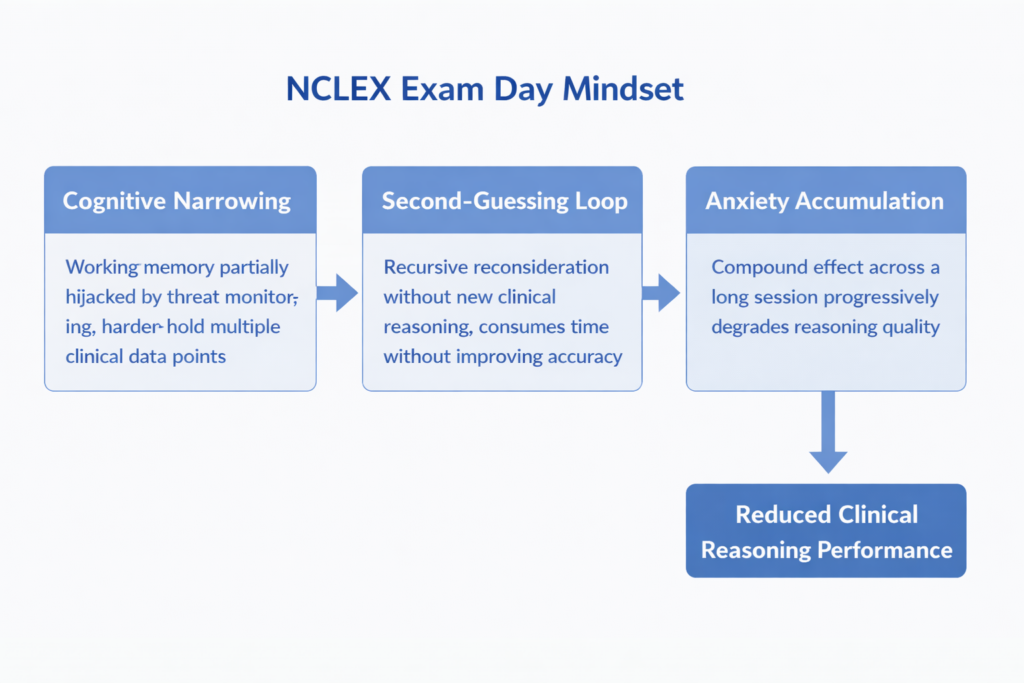
Building an effective NCLEX exam day mindset begins with a precise understanding of how anxiety disrupts clinical reasoning — not a vague awareness that stress is bad, but a specific cognitive model of what changes inside the reasoning process under exam anxiety and why those changes produce incorrect answers even when the underlying knowledge is present.
The Cognitive Narrowing Effect
Anxiety activates the threat-response system, which produces a well-documented attentional narrowing effect: cognitive resources concentrate on the perceived threat rather than distributing across the full task. In the context of NCLEX exam day mindset, this narrowing manifests as the inability to hold multiple clinical data points in working memory simultaneously — which is precisely what complex scenario questions require. A candidate who can process a five-variable clinical scenario calmly during preparation finds the same scenario harder to process under exam anxiety not because the scenario has changed but because working memory capacity has been partially hijacked by threat monitoring. The result is more time spent re-reading the same stem sentence without processing it, more difficulty holding the action verb and the clinical data in mind simultaneously, and more tendency to latch onto the first familiar option rather than reasoning through the full option set.
The Second-Guessing Loop
A second specific mechanism through which anxiety undermines NCLEX exam day mindset performance is the second-guessing loop — the recursive process of reconsidering a committed answer without generating any new clinical reasoning. The candidate selects option B, then notices a feature of option C that seems plausible, then reconsiders B, then reconsiders C, then feels less certain about B than before the reconsideration began — without having applied any new clinical principle or identified any genuine error in the original reasoning. This loop consumes exam time without improving answer quality, often ends in selecting the option that was correct the first time at a higher anxiety cost than simply committing would have produced, and carries accumulated doubt into the next question as cognitive residue. The research on NCLEX performance consistently shows that first responses grounded in clinical reasoning are more often correct than answers changed during second-guessing. NCLEX exam day mindset work specifically targets this loop with interrupt protocols that stop recursive reconsideration before it compounds.
Anxiety Accumulation Across a Long Session
A third mechanism that a prepared NCLEX exam day mindset must address is anxiety accumulation — the way that small anxiety responses to individual difficult questions compound over a long exam session into a chronic elevated stress state that progressively degrades reasoning quality. A candidate who experiences a spike of uncertainty on question 12, another on question 23, another on question 31, and so on across a 100-question session has not experienced 100 independent anxiety events — they have experienced a progressively intensifying anxiety state that by question 80 is consuming significantly more working memory than it was at question 12. Without deliberate reset practices between questions, anxiety from difficult or uncertain items carries forward as background noise that raises the threshold for confident clinical reasoning and lowers the accuracy of the answers that get past it. The NCLEX exam day mindset strategies in this guide are specifically designed to interrupt this accumulation process at regular intervals rather than allowing it to build unaddressed across the full session.
The Cognitive Reframes That Build Exam Day Confidence
Cognitive reframing is the most powerful preparation tool in the NCLEX exam day mindset toolkit — not because it eliminates anxiety but because it changes the meaning assigned to anxiety-producing experiences in ways that prevent those experiences from cascading into performance-degrading responses. These reframes are not affirmations or wishful thinking. They are accurate, evidence-based interpretations of what is actually happening during specific exam experiences that most candidates interpret inaccurately and therefore respond to counterproductively.
Reframe 1: Difficult Questions Are Positive Signals
The most important cognitive reframe in any NCLEX exam day mindset is the correct interpretation of question difficulty. The CAT algorithm continuously adapts question difficulty to the candidate’s estimated competency level — which means that a candidate performing above the passing standard will consistently receive difficult questions throughout the session. Difficult questions are not a sign that the exam has detected a weakness. They are the algorithm’s response to strong performance, presenting harder items to determine the upper boundary of the candidate’s competency. The incorrect interpretation — that difficult questions mean the candidate is failing — triggers anxiety that then actually does impair performance. The accurate interpretation — that difficult questions mean the algorithm is tracking above-standard performance — is not only less anxiety-producing but is simply correct. Building this reframe into the NCLEX exam day mindset before the exam means encountering a difficult question produces an alert but confident cognitive state rather than a threat response.
Reframe 2: Uncertainty Is Not Incompetence
The second core NCLEX exam day mindset reframe addresses the experience of genuine uncertainty on specific questions — the feeling that the correct answer is not immediately apparent after careful reasoning. Most candidates interpret this experience as evidence of inadequate preparation: I should know this, the fact that I am not sure means I did not study enough. This interpretation both misrepresents what is actually happening and triggers unnecessary anxiety. The NCLEX is specifically designed to present questions at the boundary of the candidate’s competency — questions where the reasoning is genuinely challenging even for well-prepared candidates. Uncertainty on a subset of questions is not a failure signal; it is the expected experience of a candidate performing in the zone where the CAT algorithm needs more information to make a confident determination. The NCLEX exam day mindset reframe is: uncertainty on this question means it is testing me at my competency boundary, which is exactly where it should be testing me. The correct response is careful reasoning within the available time, not self-judgment that consumes cognitive resources.
Reframe 3: The Process Controls What the Outcome Cannot
A third NCLEX exam day mindset reframe addresses the fundamental anxiety driver of outcome uncertainty — the fact that the exam result cannot be known or controlled during the exam itself. Attempting to monitor or predict the result in real time — inferring pass or fail from the question count, the difficulty pattern, or the subjective sense of performance — produces the rumination and distraction that are the most direct threats to consistent clinical reasoning. The reframe that resolves this is attention management: the outcome of the exam is determined by the quality of the clinical reasoning applied to each individual question. The quality of that reasoning is the only variable actually controllable in the moment. Directing full attention to the question in front of you — not to the running result tally, not to previous answers, not to what the ending question count might mean — is the most direct mechanism for influencing the outcome. The NCLEX exam day mindset application is a simple mantra, reinforced in preparation and deployed during the exam: this question, this reasoning, now.
Physiological Regulation Techniques for Exam Day

NCLEX exam day mindset is not only a cognitive phenomenon — it is also a physiological one. The stress response produces measurable changes in heart rate, respiration, muscle tension, and cortisol levels that directly affect cognitive function. Physiological regulation techniques address these changes at the biological level, producing cognitive clarity improvements within seconds that cognitive reframing alone cannot achieve as quickly under acute stress.
Controlled Breathing: The 4-7-8 Protocol
The 4-7-8 breathing pattern is the most reliably effective and most practically applicable physiological regulation technique for NCLEX exam day mindset management during the exam. Inhale for four counts, hold for seven counts, exhale for eight counts — the extended exhale activates the parasympathetic nervous system through vagal stimulation, physiologically reducing heart rate, lowering cortisol, and restoring prefrontal cortex function within two to three complete cycles. The total time cost of three 4-7-8 cycles is approximately 60 seconds — a meaningful investment at a milestone checkpoint between question blocks, and a negligible investment as a five-second micro-version between individual questions. The protocol must be practiced before exam day during preparation simulations so that it functions as a conditioned physiological response rather than a new technique requiring attentional effort during the exam. A technique that itself requires cognitive effort to apply is not a useful NCLEX exam day mindset tool under the conditions it is designed to address.
Progressive Muscle Release: The Desk Anchor
Muscle tension is one of the most common and most overlooked physical manifestations of exam anxiety, and it accumulates invisibly across a long exam session in the shoulders, neck, jaw, and hands. Physical tension activates threat-state physiology and reduces the cognitive availability needed for complex clinical reasoning. The desk anchor technique provides a brief, unobtrusive tension release during the exam: place both hands flat on the desk, consciously release grip tension in the fingers and wrists, roll the shoulders back once, and drop them away from the ears. This five-second sequence releases the muscle tension that has accumulated since the last reset without drawing attention from proctors and without disrupting the testing environment. Applied at each milestone checkpoint and whenever awareness of physical tension arises mid-question, the desk anchor keeps the physiological component of NCLEX exam day mindset from building unaddressed into the full-body tension state that significantly impairs cognitive function in the latter third of a long session.
The Pre-Exam Grounding Sequence
The five minutes before the exam begins — sitting at the testing station during the interface tutorial — are the most neurologically important five minutes of the entire NCLEX exam day mindset management process. The physiological state entering question one determines the baseline anxiety level that the entire session builds on. A candidate who enters question one with an elevated heart rate and elevated cortisol from pre-exam anxiety is starting from a compromised baseline that makes every subsequent anxiety increment more impactful. The pre-exam grounding sequence uses the tutorial period deliberately: complete two or three full 4-7-8 breathing cycles, apply the desk anchor to release shoulder and jaw tension, say internally the process-focus mantra, and make deliberate eye contact with the question screen as the tutorial ends rather than looking away. This sequence takes under two minutes and establishes the calm, focused physiological baseline that the NCLEX exam day mindset strategies build on throughout the session.
Attentional Discipline: Staying Present Through the Full Exam
Attention is the limiting resource in NCLEX exam day mindset management. Anxiety, rumination, and performance monitoring all compete for the same attentional bandwidth that clinical reasoning requires. Attentional discipline strategies redirect attention deliberately toward the task that produces correct answers — the current question’s clinical reasoning — and away from the non-task content that anxiety generates.
The Single-Question Focus Rule
The most foundational NCLEX exam day mindset attentional practice is the single-question focus rule: the only question that exists at any moment in the exam is the question currently on screen. Previous questions — their answers, the uncertainty felt about them, whether the selections were correct — do not exist for attentional purposes until after the exam is complete. Future questions — what difficulty level might come next, how many questions remain, what the ending count might mean — do not exist for attentional purposes during the exam. This attentional rule sounds simple and is genuinely difficult to maintain without preparation. The mechanism that makes it practically achievable is the five-second interquestion reset: before reading a new question stem, the reset breath and desk anchor serve as a physical and attentional transition signal that marks the end of the previous question and the beginning of the next one as distinct, separate events. Without this transition signal, the attentional content of the previous question bleeds into the reading of the next stem, contaminating the fresh clinical reasoning the new question requires.
Catching and Releasing Rumination
Rumination — dwelling on a completed question’s answer after moving forward — is the most direct attentional threat to NCLEX exam day mindset during a long exam session. It is not a character flaw or a preparation failure; it is a normal cognitive response to uncertainty under high-stakes conditions. The NCLEX exam day mindset skill is not preventing rumination from arising — it is recognizing it quickly when it does and releasing it with a specific behavioral protocol rather than attempting to suppress it through willpower, which typically intensifies it. When awareness of rumination arises while reading a new question stem, the release protocol is: acknowledge the rumination thought explicitly and briefly (I notice I am still thinking about question 34), then make a deliberate physical gesture (both hands flat on the desk), then re-read the current stem from the beginning as if encountering it for the first time. This acknowledge-gesture-restart sequence interrupts the rumination loop with a concrete behavioral transition rather than an effortful cognitive suppression attempt, and it takes under ten seconds. Practice it during preparation simulations so that it is automatic rather than novel under exam conditions.
Managing the Question Count Awareness
Many candidates experience a specific NCLEX exam day mindset challenge related to awareness of the question count — particularly as the exam approaches or passes the 75-question mark. The anxiety trigger is the uncertainty of not knowing whether the exam will end or continue, and the meaning candidates assign to either outcome. The attentional discipline practice for question count awareness is the same as for all other non-task content: notice the thought (I am wondering if the exam is about to end), name it as a non-task distraction rather than useful information, and return attention to the clinical reasoning the current question requires. The exam will end when the algorithm reaches statistical certainty — which is not influenced by the candidate’s awareness of the question count. The question count is observable information that has no actionable implication during the exam itself. The only actionable variable available at every question is the quality of the clinical reasoning applied to it. Returning attention to that variable at every distraction is the practical application of NCLEX exam day mindset attentional discipline.
The Night Before and Morning Of: Protecting Cognitive Readiness
NCLEX exam day mindset is not built only during the exam — much of it is determined by what happens in the 18 hours before the first question appears on screen. The night-before and morning-of routines that protect cognitive readiness are as much a part of mindset preparation as the in-exam strategies.
The Night Before: Recovery, Not Review
The most consequential night-before NCLEX exam day mindset decision is the one most candidates resist: no content review the evening before the exam. The clinical information available in the 18 hours before the exam cannot meaningfully change what you know — the NCLEX tests clinical reasoning built over weeks of deliberate preparation, and that preparation is complete. What the night before can do is degrade cognitive readiness through anxiety amplification. Reviewing content the night before activates performance-monitoring cognition — the part of the brain that evaluates whether what it is seeing is sufficient — which amplifies anxiety rather than reducing it. The NCLEX exam day mindset approach to the night before is deliberate disengagement from nursing content: eat a real meal with adequate protein and complex carbohydrates, engage in a genuinely enjoyable activity unrelated to nursing, complete the logistics confirmation checklist (ATT, ID, directions, outfit, alarm), and get into bed at a time that allows 7 to 8 hours of sleep. Sleep is the single most important cognitive performance variable within the candidate’s control the night before the exam. Everything else is secondary.
The Morning Routine: Activation Without Overstimulation
The NCLEX exam day mindset morning routine balances two competing needs: cognitive activation — bringing the brain from sleep state to exam-ready alertness — and physiological regulation — preventing the pre-exam anxiety spiral that can begin the moment the alarm goes off. Wake up with enough time for a genuine morning routine without rushing. Eat a real breakfast containing protein and complex carbohydrates — the sustained energy release prevents the mid-exam blood glucose dip that impairs reasoning quality in the final question blocks. Hydrate well before leaving home. Include ten minutes of light physical movement — a brief walk, gentle stretching — which reduces pre-exam cortisol more effectively than stillness and activates the physiological state associated with alert, engaged cognition. Avoid caffeine beyond established personal tolerance — exam day is not the time to experiment with higher doses that could produce anxiety amplification or cardiovascular arousal above the optimal performance zone. Do not review notes or flashcards. Engage the process-focus mantra during the commute: this question, this reasoning, now.
The Arrival Window: Calm Over Rush
Arriving at the testing center 30 minutes before the scheduled appointment is not merely a logistics recommendation — it is a NCLEX exam day mindset strategy. Rushed arrival activates the threat-response system and elevates cortisol in the minutes immediately before check-in, setting a physiologically compromised baseline for the entire exam session. Calm, unhurried arrival allows the check-in process to serve as a decompression window rather than an additional stressor. Use the waiting time between arrival and being called to the testing station for silent 4-7-8 breathing rather than phone use or peer conversation about exam content. Conversation about the exam immediately before it begins activates performance evaluation cognition that elevates anxiety without providing any clinical preparation value. The NCLEX exam day mindset principle for the arrival window is simple: everything that happens between arriving and sitting down is about physiological regulation, not preparation.
Building the NCLEX Exam Day Mindset During Preparation
The most important principle in all of the strategies above is that NCLEX exam day mindset cannot be improvised on the day of the exam — it must be built during preparation through deliberate, consistent practice of the specific cognitive and physiological techniques. A candidate who reads this guide the night before the exam has understood the framework but has not built the conditioned responses that make it functional under pressure.
Integrating Mindset Practice Into Timed Sessions
From week two of preparation onward, every timed practice session is an opportunity to practice NCLEX exam day mindset techniques under conditions that increasingly approximate exam pressure. Apply the five-second interquestion reset between every question during timed sessions — not occasionally, but as a consistent habit that builds automaticity. Apply the 4-7-8 breathing at question 25 and question 50 checkpoints during practice simulations. Apply the rumination release protocol whenever awareness of dwelling on a previous question arises during a session. Practice the desk anchor when noticing physical tension during a long session. These practices feel slightly artificial during preparation sessions when the stakes are lower — they feel necessary and natural during the actual exam when the stakes are high. The goal of practicing them during preparation is to make them automatic before they are needed, so that deploying them on exam day requires no additional cognitive effort.
The Pre-Simulation Mindset Ritual
Before each weekly full simulation during preparation, implement a brief pre-simulation ritual that approximates the NCLEX exam day mindset sequence the exam itself will require: sit at the study station, close all other applications, complete two 4-7-8 breathing cycles, apply the desk anchor, and state the process-focus mantra before beginning the simulation. This ritual has two functions. First, it rehearses the pre-exam grounding sequence so that the actual exam’s tutorial period triggers the same physiological and attentional state that practice has consistently produced. Second, it elevates the psychological stakes of each simulation — treating it as if it matters trains the mindset management systems under conditions closer to actual exam pressure than a casually begun practice session would produce. NCLEX exam day mindset is ultimately a performance under pressure, and performance under pressure requires practice under pressure.
Treating Anxiety as Information, Not Obstruction
The most enduring NCLEX exam day mindset shift that preparation should produce is the relationship with anxiety itself. Candidates who experience pre-exam anxiety as evidence that something is wrong — that they are not ready, that they will fail, that the anxiety itself will prevent performance — are in a self-reinforcing spiral where the anxiety about anxiety becomes a second anxiety source. The accurate reframe is that pre-exam anxiety is information about the exam’s importance, not a performance prediction. Anxiety activates the physiological arousal that produces peak cognitive performance when it is interpreted as preparation rather than threat — the same neurological state that produces panic in a threat interpretation produces heightened focus and rapid cognition in a challenge interpretation. Research on performance under pressure consistently shows that candidates who interpret pre-exam physiological arousal as excitement and preparation rather than fear and threat perform better under those conditions than candidates who attempt to suppress or eliminate the arousal entirely. Build this reframe during preparation by naming pre-session anxiety as readiness activation rather than performance threat — and bring that reframe to exam day as the foundational orientation of the entire NCLEX exam day mindset system.
- Daily mindset practice: After each practice session, spend two minutes reviewing not only which questions were wrong but which questions triggered anxiety, rumination, or second-guessing that disrupted clinical reasoning. These are the specific mindset training targets that deliberate practice during preparation addresses.
- Simulation debrief: After each full simulation, note not only accuracy performance but mindset performance — how well the reset techniques were applied, whether rumination was caught and released quickly, whether anxiety accumulated or was managed across the session. Mindset performance is a preparation variable with the same status as accuracy performance.
- The week-before taper: In the seven days before the exam, taper daily question volume gradually downward rather than maintaining peak volume intensity. High-volume preparation in the final week increases anxiety without increasing readiness — the clinical knowledge is already built. The final week NCLEX exam day mindset priority is cognitive recovery and confidence consolidation, not continued aggressive preparation.
Conclusion
NCLEX exam day mindset is the bridge between the clinical knowledge and reasoning you have built during preparation and the performance you deliver under the specific conditions of a high-stakes adaptive examination. The cognitive reframes — difficult questions as positive signals, uncertainty as competency boundary testing, process focus over outcome monitoring — change how exam experiences are interpreted in ways that prevent anxiety cascades from disrupting clinical reasoning. The physiological regulation techniques — 4-7-8 breathing, the desk anchor, the pre-exam grounding sequence — restore cognitive clarity within seconds when anxiety produces its characteristic working memory impairment. The attentional discipline strategies — single-question focus, rumination release, question count disengagement — keep preparation-built reasoning accessible throughout the full exam session rather than allowing it to be progressively occluded by anxiety accumulation.
None of these strategies are useful on exam day if they are being used for the first time on exam day. Build them into every timed practice session. Apply the pre-simulation ritual before every full simulation. Practice the rumination release protocol when it naturally arises during practice. Develop the anxiety-as-readiness reframe during preparation weeks rather than attempting it cold in the testing center. The NCLEX exam day mindset you arrive with on exam day is the one you built during preparation — not the one you read about the night before. Build it deliberately, practice it consistently, and walk into the testing center knowing that the psychological preparation is as complete as the clinical preparation that preceded it.
