

NCLEX exam day is the moment every week of preparation has been building toward — and how you manage the day itself matters as much as how well you studied. Candidates who arrive at the testing center uncertain about what to bring, unprepared for the check-in process, or carrying unmanaged anxiety into the first question block are at a real disadvantage that has nothing to do with their clinical knowledge or their practice scores.
The good news is that NCLEX exam day is almost entirely predictable. The Pearson VUE testing environment, the check-in procedures, the exam interface, the break policies, and the CAT delivery mechanism all follow standardized protocols you can prepare for in advance. Knowing exactly what will happen when you walk through the testing center door — and having a concrete plan for each stage of the day — converts the unknown into the familiar and frees your full cognitive capacity for the clinical reasoning the exam demands.
This guide covers everything you need to know about NCLEX exam day in 2026: the complete checklist of what to bring, a step-by-step walkthrough of the testing center experience, how the CAT algorithm works and what it means for your experience during the exam, strategies for managing your energy and focus across the full session, and what happens after the exam ends. Read it in the week before your exam, review the checklist the night before, and walk in knowing the day holds no surprises you are not prepared for.
The Complete NCLEX Exam Day Checklist: What to Bring
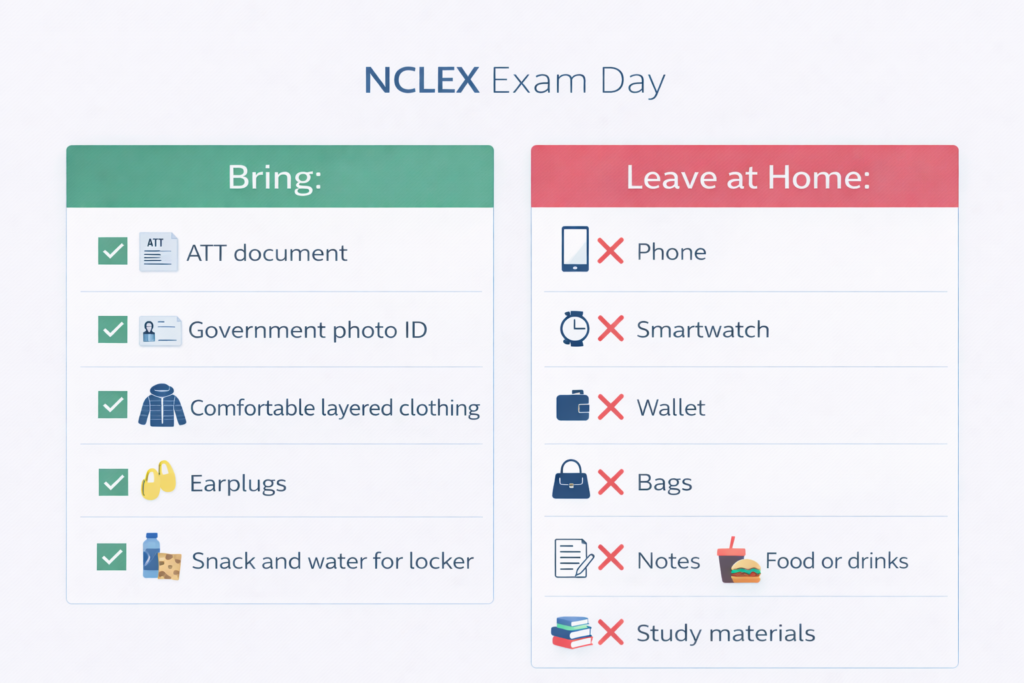
What you bring — and what you leave at home — on NCLEX exam day is governed by strict Pearson VUE testing center policies. Arriving without a required item or bringing a prohibited one can result in delays, denial of entry, or exam invalidation. Confirm each item on this checklist the night before.
Required Items
Your Authorization to Test is the confirmation document issued by Pearson VUE after your registration was processed. Print a physical copy or save a digital version you can access on your phone. Your government-issued photo ID must match the name on your ATT exactly — character for character, including middle names, hyphens, and any suffixes. Accepted forms include a driver’s license, state ID, passport, or military ID. Check both documents side by side the night before NCLEX exam day. A single name discrepancy can trigger a delay or denial at the desk.
What to Leave at Home
Pearson VUE testing centers prohibit all personal items inside the testing room. This includes phones, smartwatches and all other watches, wallets, bags, food, drinks, notes, and study materials of any kind. Lockers are provided for personal belongings at the center. Do not bring prohibited items expecting to leave them in your car — the trip back creates pre-exam stress that is entirely avoidable. Wear comfortable, layered clothing since testing room temperatures vary by location and cannot be predicted in advance.
Optional but Recommended Items
Earplugs or noise-reducing earbuds that comply with testing center policy can meaningfully reduce distraction in a shared testing environment. Many Pearson VUE locations provide foam earplugs at the front desk, but bringing your own ensures you have what you are comfortable with. A light snack and water stored in your locker gives you something to consume during any optional break you take — preventing the energy dip that can impair clinical reasoning in the final question block of a long exam.
The Night-Before Confirmation Checklist
- ATT document: Printed or saved digitally and confirmed accessible.
- Government-issued photo ID: Name verified against ATT character by character.
- Testing center address: Confirmed in a mapping app with estimated travel time including traffic.
- Arrival plan: Departure time set to arrive 30 minutes before the scheduled appointment.
- Clothing: Comfortable and layered; no hooded sweatshirts with large pockets that may require removal.
- Locker items: Snack, water, and any comfort item for a break packed and ready to go.
- Sleep: In bed at a time that allows 7 to 8 full hours — the single most important night-before action.
What to Expect at the Testing Center: Step by Step

The Pearson VUE check-in process follows a standardized protocol that is consistent across all testing center locations. Knowing every step before NCLEX exam day eliminates procedural surprises and keeps your mental energy focused on the exam rather than the logistics surrounding it.
Arrival and Check-In
Arrive at least 30 minutes before your scheduled appointment. Candidates who arrive more than 30 minutes late may be turned away and required to reschedule, forfeiting the exam fee. At the reception desk, present your ATT and government-issued photo ID. Staff will verify your identity, take a digital photograph, and collect a palm vein scan or fingerprint for biometric verification. You will be asked to empty your pockets, remove your watch, and store all personal items in an assigned locker. Some centers ask you to roll up your sleeves or raise your pant cuffs to confirm no materials are concealed — this is standard protocol across all Pearson VUE locations and is not cause for concern.
The Testing Room Environment
You will be escorted to an individual workstation in a room shared with other test-takers completing different exams. Each station includes a computer, keyboard, mouse, a small erasable whiteboard or laminated notepad with a marker for scratch work — personal paper is not permitted — and noise-reducing headphones or foam earplugs available at most locations. The room is monitored by camera and by proctors who walk through periodically. If you need assistance at any point during NCLEX exam day, raise your hand rather than leaving your station.
The Pre-Exam Tutorial
After being seated, you will complete an on-screen tutorial covering the exam interface — how to navigate between questions, how to use the on-screen calculator, how to interact with NGN formats such as text highlighting and matrix grids, and how to flag items for review. The tutorial does not count toward your exam time. Complete it attentively rather than clicking through it quickly. For many candidates it is the first real interaction with the Pearson VUE interface, and familiarity with the highlighting and flagging tools reduces friction during the exam itself. Use this time to settle into the physical environment and take a few slow, deliberate breaths before the first question appears.
Breaks During the Exam
The NCLEX offers optional breaks, typically available after the first two hours of testing and again later in the session. Breaks are not mandatory — if you are in a strong rhythm, you are not required to take one. If you do break, the exam timer continues running, biometric verification is repeated when you return, and you are escorted back to your station. For most candidates, a single short break of five to seven minutes to use the restroom, eat a small snack from your locker, and mentally reset is more beneficial than skipping breaks entirely during a long session. Decide your break strategy before NCLEX exam day rather than in the moment.
How the CAT Algorithm Works on NCLEX Exam Day
Understanding how the Computerized Adaptive Testing algorithm behaves on NCLEX exam day is one of the most direct ways to reduce in-exam anxiety — because most of what candidates find distressing about the CAT experience is a misinterpretation of what is actually happening.
The Exam Adapts to Your Performance in Real Time
The CAT algorithm continuously estimates your competency level based on your cumulative response pattern and adjusts the difficulty of each subsequent question to target that estimated level. Answering a question correctly typically prompts a more difficult next question — the algorithm is identifying the ceiling of your competency. Answering incorrectly may prompt an easier question to re-establish the estimate. This means difficult questions on NCLEX exam day are a signal that you are performing well — not a sign that something is wrong. If the questions feel hard throughout the exam, that is the CAT doing exactly what it is designed to do for a candidate performing at or above the passing standard.
What the Question Count Does and Does Not Tell You
The NCLEX-RN ends between 75 and 150 questions, and the number you receive is determined by when the algorithm achieves statistical confidence that your competency falls either above or below the passing standard — not by how well or poorly you are performing. Candidates who receive 75 questions passed or failed with high certainty after the minimum item count. Candidates who receive 150 questions required the full set for the algorithm to reach a confident determination. More questions does not mean you are failing — it means the algorithm needed additional data to make a certain call, which can occur for both passing and failing candidates. Do not attempt to infer your result from the question count while the exam is in progress.
Experimental Questions
A small number of questions on every NCLEX exam day administration are unscored pretest items being evaluated for future inclusion in the question pool. These questions are indistinguishable from scored items and are distributed throughout the exam. You cannot identify them. Attempting to do so is not a productive use of cognitive resources. Treat every question as fully scored, apply your complete clinical reasoning to each one, and move forward.
Performance Strategies for NCLEX Exam Day: Before the First Question
How you manage the hours before the exam begins has a direct effect on the quality of your clinical reasoning once questions appear on screen. The strategies below protect the cognitive clarity that your preparation has built.
The Morning of the Exam
Wake up with enough time to complete a full morning routine without rushing. A rushed start creates a cortisol spike that narrows prefrontal cortex function — the exact cognitive resource clinical reasoning draws on. Eat a real breakfast with protein and complex carbohydrates for sustained energy. Stay within your established caffeine tolerance — NCLEX exam day is not the time to experiment with a higher dose than normal. Hydrate well before leaving home. Ten minutes of light physical movement, a walk or gentle stretching, reduces physiological anxiety more reliably than sitting with notes. Do not review content the morning of the exam. The information value of last-minute review is negligible; the anxiety amplification it produces is real and direct.
The 30-Minute Arrival Window
Arriving 30 minutes early accomplishes two things: it eliminates the acute stress of potential tardiness, and it gives you time to complete check-in calmly. Use the time between arrival and being called to your station for controlled breathing rather than note review or phone use. The 4-7-8 pattern — inhale for 4 counts, hold for 7, exhale for 8 — physiologically activates the parasympathetic nervous system and reduces acute anxiety within two to three full cycles. Practice this technique during your preparation weeks so it is automatic on NCLEX exam day rather than a new skill applied under pressure.
Using the Tutorial to Settle In
The on-screen tutorial serves a psychological function as well as an instructional one. Use it to acclimate to the physical environment — the chair, screen brightness, keyboard feel, and ambient sound level — before the exam clock starts. Take two or three slow breaths between the end of the tutorial and the first question. The transition from tutorial to question one is the highest-anxiety moment of NCLEX exam day for most candidates. Entering it with a deliberate, settled physiological state rather than a spiked one is worth the ten seconds it takes.
Performance Strategies During the Exam
In-exam performance strategies are the clinical reasoning habits and pacing disciplines that keep your thinking sharp and prevent anxiety from compounding across the full question set on NCLEX exam day.
The Two-Read Rule
Read every question stem twice before engaging the answer options. The first read establishes the clinical scenario and patient context. The second read focuses specifically on what the question is asking — the action verb and the specific nursing decision being tested. Only after two complete reads of the stem should you consider the options. This discipline prevents the most common question-reading error on NCLEX exam day: engaging answer choices before fully processing what is actually being asked, which primes selection toward familiar-sounding distractors rather than the clinically correct answer.
Commit and Move Forward
After applying your full clinical reasoning to a question and selecting your best answer, commit to it and move forward. Do not return to change answers based on second-guessing. Research on NCLEX performance consistently shows that first responses grounded in clinical reasoning are correct more often than answers changed under doubt. If a question genuinely stumps you after full reasoning, make your best clinical judgment and move on — the next question is the one that matters now. Dwelling on uncertainty is the primary time management failure on NCLEX exam day.
The 25-Question Reset
Cognitive fatigue and anxiety compound over long question sets if uninterrupted. Use a milestone reset strategy: at every 25-question interval, take a ten-second pause between questions. Roll your shoulders, take one slow breath, and consciously release any tension from the previous block before continuing. This micro-reset prevents the cognitive narrowing that occurs when anxiety builds unaddressed across an extended session and costs fewer than fifteen seconds per milestone.
When You Genuinely Do Not Know
Every NCLEX exam day candidate encounters questions where the clinical scenario is unfamiliar or the correct answer is not immediately clear. The correct response to uncertainty is not random selection — it is systematic application of clinical reasoning frameworks. Identify the highest-risk finding in the scenario and prioritize patient safety. Apply the ABCs: airway, breathing, circulation. Apply the nursing process: does assessment need to precede intervention here? Apply Maslow: is there a physiological need superseding a psychosocial one? These frameworks will not produce certainty on every uncertain question — but they will produce a clinically defensible answer that the CAT algorithm is designed to credit.
After NCLEX Exam Day: Results, Recovery, and Next Steps
The period immediately after the exam ends — and the days before official results arrive — is its own distinct phase of the NCLEX exam day experience. Managing it intentionally prevents unnecessary distress and positions you correctly regardless of outcome.
The Immediate Post-Exam Experience
Most candidates leave the testing center uncertain about their performance, regardless of how they actually did. The CAT algorithm is designed to maintain question difficulty at the candidate’s competency ceiling throughout the session, which means the exam should feel hard for every candidate who is performing at or above the passing standard. Feeling like you failed after NCLEX exam day is not evidence that you failed. The experience of the exam ending — whether at 75 questions or 150 — does not reliably predict the outcome in either direction. Disengage from performance speculation and focus on rest and recovery.
The Pearson VUE Trick
The Pearson VUE trick — attempting to re-register for a new exam appointment shortly after testing to infer a result from the system response — is widely discussed in nursing communities. It involves checking whether the payment screen appears (sometimes interpreted as a pass) or whether the system allows scheduling to proceed (sometimes interpreted as a fail). This method is unofficial, not endorsed by NCSBN or Pearson VUE, and not always reliable. Use it as informal information only, and do not make significant decisions based on its result.
Official Results Timeline
Official results are typically available within 48 hours through the Pearson VUE Quick Results service for a small fee. Your state board of nursing official result — the one that confirms licensure — is generally available within days to two weeks in most states, though timelines vary by jurisdiction. Until your state board officially reports your license number, you are not yet licensed to practice as a registered nurse and scope of practice restrictions apply.
- Rest the day after the exam: Do not schedule work or significant obligations for the 24 hours following NCLEX exam day. Your nervous system has sustained extended high-demand cognitive stress and requires genuine recovery.
- Avoid post-exam question debriefs with peers: Discussing specific exam questions with nursing communities immediately after the exam amplifies anxiety without changing anything. Defer community discussion until after results are confirmed.
- If you did not pass: Request your Candidate Performance Report from the NCSBN immediately. This document identifies your performance across all content categories relative to the passing standard and is the most valuable free resource for structuring a targeted repeat preparation. Use it to identify what needs to change — not to simply repeat the same preparation at higher volume.
Conclusion
NCLEX exam day holds no surprises for candidates who have prepared for it specifically — and that preparation requires far less time than the clinical content study that preceded it. Confirm your ATT and ID the night before. Arrive 30 minutes early. Understand the check-in process before you walk in. Use the tutorial to settle physically and mentally before question one. Apply the two-read rule, commit-and-move discipline, 25-question reset, and clinical reasoning frameworks throughout the session. Rest after the exam and wait for official results.
The clinical reasoning competency you have built over weeks of deliberate preparation does not disappear under exam pressure — but it does require a clear, calm mind to access reliably. Everything on this NCLEX exam day checklist is designed to protect that clarity, from the morning routine through the moment the session ends. Walk in prepared, perform with the reasoning you have built, and trust the work you have done.
