

Active recall NCLEX preparation is the study approach most consistently associated with faster knowledge consolidation, stronger retention, and higher clinical reasoning accuracy — and it is also the approach that the majority of nursing students underuse in favor of methods that feel more comfortable but produce weaker results. Re-reading notes, highlighting textbook content, and watching review videos are familiar and low-effort. They also do not build the retrievable, applicable knowledge that the NCLEX measures. Active recall does.
The distinction matters enormously for NCLEX preparation because the exam does not test recognition — it tests application. A candidate who can recognize the correct answer when it appears on a flashcard has not necessarily built the clinical reasoning required to select it in a complex, multi-variable patient scenario where four options all sound plausible. Active recall NCLEX techniques close that gap by forcing the brain to reconstruct clinical knowledge from retrieval cues rather than simply identify it from exposure. This process — retrieval practice — is one of the most well-supported findings in cognitive science, and its application to high-stakes professional licensing exams is direct and measurable.
This guide explains what active recall is, why it produces superior results for NCLEX preparation compared to passive study methods, and how to implement five specific active recall NCLEX techniques within a structured preparation system. It also covers how to combine active recall with spaced repetition for maximum long-term retention, common mistakes that undermine the method’s effectiveness, and a practical weekly schedule that integrates active recall into a complete preparation routine. Whether you are beginning your preparation or restructuring a study approach that is not producing the results you need, this guide gives you a concrete, evidence-based system to build on.
What Active Recall Is — and Why Passive Study Fails for NCLEX
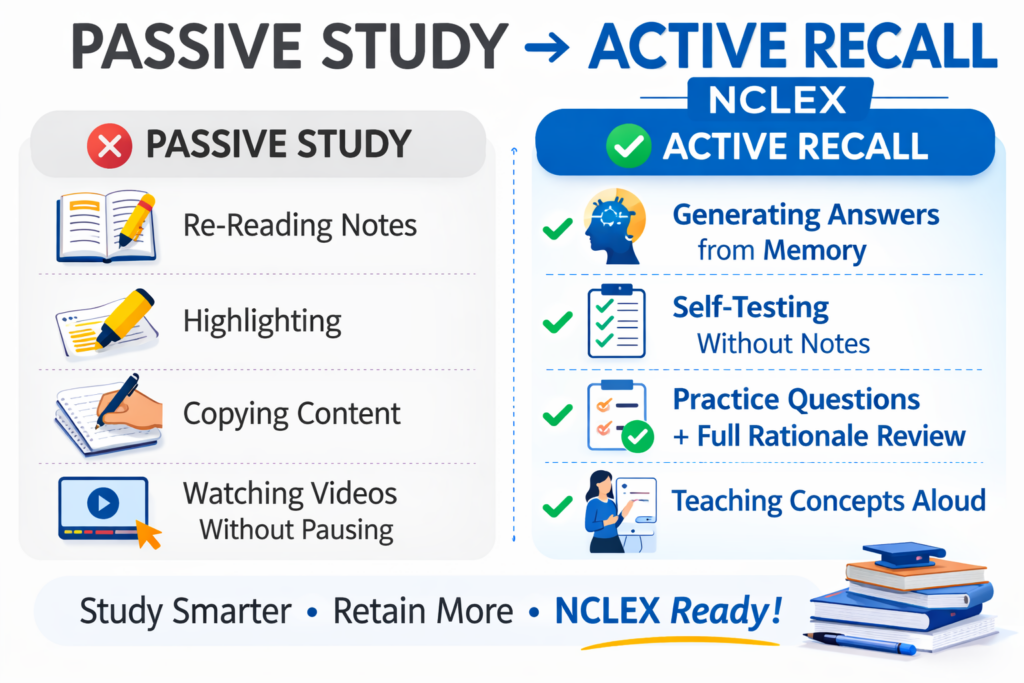
Active recall is the practice of attempting to retrieve information from memory without the information present in front of you. Rather than reading a concept and re-reading it until it feels familiar, active recall requires you to close your notes, pose a question or prompt to yourself, and generate the answer entirely from memory before checking. The effort of retrieval — including the discomfort of not immediately knowing the answer — is what produces durable, applicable learning.
The Problem With Passive Study Methods
Passive study methods — re-reading, highlighting, copying notes, watching videos without pausing to self-test — produce a well-documented cognitive illusion called the fluency effect. When content is familiar from repeated exposure, it feels known. The ease of processing familiar material is misinterpreted by the brain as evidence of understanding. This is why a nursing student can re-read a chapter on cardiac dysrhythmias twice and feel confident, then encounter a clinical scenario question on the NCLEX that requires applying that knowledge and find that the confidence evaporates. Familiarity is not retrievability, and retrievability is what the NCLEX tests.
For active recall NCLEX preparation specifically, the fluency effect is particularly dangerous. The NCLEX does not ask candidates to identify concepts from a list — it presents clinical scenarios and requires candidates to reason from their knowledge base to a clinically defensible action. A knowledge base built primarily through passive exposure is recognizable but not retrievable under the cognitive load of a complex scenario. A knowledge base built through active retrieval practice is accessible precisely when retrieval is most difficult — under pressure, with competing distractors, in an unfamiliar patient presentation.
What the Research Shows
The testing effect — the finding that retrieving information from memory produces stronger long-term retention than re-studying the same material — is one of the most replicated findings in cognitive psychology. Studies consistently show that students who use retrieval practice outperform students who use re-reading on delayed tests of the same material, even when the re-reading group spends more total time studying. For active recall NCLEX preparation, the implication is direct: the time you spend generating answers from memory is more valuable than an equivalent amount of time spent reviewing the same material passively. Less time, stronger results, higher retention — this is the core value proposition of active recall as an NCLEX study method.
Five Active Recall NCLEX Techniques That Actually Work

Not all active recall methods are equally suited to NCLEX preparation. The following five techniques are the most effective applications of active recall for nursing exam content — chosen because they build retrievable clinical knowledge, develop the application and analysis skills the NCLEX tests, and integrate naturally into a structured preparation schedule.
1. Blank Page Recall
Blank page recall is the most direct active recall NCLEX technique. After reading or reviewing a content area — cardiac nursing, respiratory pharmacology, maternal newborn assessment — close all notes and books, take a blank sheet of paper, and write down everything you can remember about that topic without referring to any source. Do not write in outline form from memory of the structure — write in clinical terms, from clinical associations. What are the priority assessment findings? What medications are involved and what do nurses monitor? What are the highest-risk complications and what are the interventions? After exhausting your recall, open your notes and compare what you produced against what you missed. The gaps revealed are your actual knowledge gaps — not gaps in how well you read, but gaps in what your brain can access under retrieval conditions. This is the information that matters for the NCLEX, and it is the information that targeted study should address.
2. Question-and-Answer Flashcards With Clinical Scenario Prompts
Flashcards are the most widely used active recall NCLEX tool, but most candidates use them at the wrong level of complexity. Knowledge-level flashcards — front: ‘What is digoxin used for?’ back: ‘Treats heart failure and atrial fibrillation’ — test recognition of isolated facts. The NCLEX tests application of clinical reasoning in patient scenarios. Application-level flashcard prompts produce far stronger NCLEX preparation: ‘A patient on digoxin reports nausea, blurred yellow-green vision, and has a heart rate of 52. What is the priority nursing action and what assessment data confirms toxicity?’ The cognitive work required to generate a complete clinical response to this prompt mirrors the cognitive work required by actual NCLEX questions. Anki, a free spaced-repetition flashcard platform, is the most effective tool for implementing this technique because it automatically schedules cards based on your recall performance — serving cards you retrieved confidently less frequently and cards you struggled with more frequently.
3. The Feynman Technique for Clinical Concepts
The Feynman Technique is an active recall NCLEX method that tests the depth of conceptual understanding rather than the breadth of factual recall. After studying a clinical concept — left-sided heart failure, diabetic ketoacidosis, autonomic dysreflexia — close your notes and explain the concept as if teaching it to someone with no nursing background. Speak aloud or write the explanation in plain language. The requirement to explain without jargon reveals exactly where your understanding is genuine and where it is surface-level terminology without underlying clinical meaning. A student who can say ‘digoxin toxicity occurs because…’ and explain the mechanism clearly enough for a layperson to follow has built the kind of clinical understanding that supports correct reasoning in unfamiliar NCLEX scenarios. A student who can only recite ‘monitor for toxicity’ has memorized a phrase without building the reasoning that the phrase is meant to represent.
4. Practice Questions as Active Recall — Not as Assessment
Most candidates use NCLEX practice questions primarily as assessment tools — completing sessions to measure their current accuracy and identify weak areas. This is a valuable use. But practice questions are also among the most powerful active recall NCLEX tools available when used differently: as a retrieval practice mechanism rather than a testing mechanism. Before revealing the answer options to a multiple-choice question, read the stem and generate your own answer — what would you do, what would you assess, what is the priority? Then read the options and identify which one most closely aligns with the answer you generated. Then read the full rationale for every option. This approach forces active retrieval before passive confirmation, which produces stronger encoding of the clinical principle than simply reading the question and selecting from the options as presented. It takes slightly longer per question but produces meaningfully stronger retention per question reviewed.
5. Spaced Self-Testing With the Cornell Note System
The Cornell note system, adapted for active recall NCLEX preparation, divides each study page into two columns: a narrow left column for question cues or clinical prompts, and a wide right column for the full answer or content. During initial study, fill in both columns. For active recall review, fold or cover the right column and use only the left-column prompts to generate the full clinical answer from memory before uncovering. This transforms existing notes into a self-testing tool without requiring additional preparation and applies retrieval practice to every review session automatically. The most important element is the spaced review schedule: review a set of Cornell notes the same day they are created, then again 48 hours later, then again after one week, then once more at the two-week mark. This spacing pattern exploits the spacing effect — the finding that information reviewed at increasing time intervals is retained significantly longer than information reviewed in massed repetition sessions.
Combining Active Recall With Spaced Repetition for Maximum NCLEX Retention
Active recall and spaced repetition are complementary mechanisms that address different dimensions of the memory problem in NCLEX preparation. Active recall determines how information is encoded — through retrieval effort rather than passive exposure. Spaced repetition determines when information is reviewed — at the interval that produces maximum long-term retention with minimum review time. Using both together produces a preparation system that is more efficient and more durable than either method used alone.
How Spaced Repetition Works
The forgetting curve — first described by Hermann Ebbinghaus — shows that newly learned information decays rapidly without review, but that each successful retrieval at the right interval slows the decay significantly and extends the period before the next review is needed. Spaced repetition systems exploit this by scheduling each item’s review just before it would be forgotten, based on your previous retrieval performance on that item. For active recall NCLEX preparation, this means that a pharmacology concept you retrieved confidently yesterday is scheduled for review in several days, while a fluid and electrolytes concept you struggled with is scheduled for review tomorrow. The result is that your total review time is concentrated on the material that most needs it rather than distributed uniformly across everything you have studied.
Implementing Spaced Repetition With Anki
Anki is the most widely used free spaced repetition platform and the most practical implementation of the active recall NCLEX spaced repetition combination. When creating Anki cards for NCLEX preparation, use clinical scenario prompts rather than isolated fact prompts — the front of the card should require active clinical reasoning, not simple recognition. Rate your recall honestly after each card: ‘Again’ for complete failure to retrieve, ‘Hard’ for partial retrieval with significant effort, ‘Good’ for correct retrieval with some effort, ‘Easy’ for immediate confident retrieval. The algorithm adjusts future scheduling based on these ratings. Do your Anki reviews every day before your practice question sessions — retrieval practice first thing in a study session produces stronger encoding than review at the end when cognitive fatigue is higher.
A Practical Spaced Review Calendar for NCLEX Content
For candidates who prefer a manual spaced review system without dedicated software, the following schedule produces the core benefit of spaced repetition for active recall NCLEX content. Study a content area using blank page recall and Cornell notes on Day 1. Complete a self-testing review of the same content on Day 2 — cover notes and retrieve. Review again on Day 5, again on Day 12, and a final consolidation review on Day 21. Any content area where retrieval accuracy on Day 5 is weak should be re-studied on Day 6 and reschedule forward from that point. This manual schedule produces four retrieval practice events per content area at increasing intervals — sufficient spacing to achieve durable long-term retention for the high-yield areas the NCLEX consistently tests.
Applying Active Recall to High-Yield NCLEX Content Areas
Active recall NCLEX techniques produce the highest preparation value when applied systematically to the content areas that carry the most weight on the exam. The following examples show how to apply the core techniques to the three highest-yield content categories.
Pharmacology: Class-Based Recall Prompts
Pharmacology is one of the most heavily tested areas on the NCLEX and one of the areas where isolated-fact memorization fails most visibly. Candidates who memorize drug names and side effects in isolation cannot reliably answer the NCLEX’s scenario-based pharmacology questions, which require integrating drug knowledge with patient assessment, priority nursing actions, and patient teaching. Active recall NCLEX techniques for pharmacology work best at the drug class level rather than the individual drug level. Create a recall prompt for each major class — anticoagulants, cardiac glycosides, antipsychotics, insulin types, opioid analgesics — and use blank page recall to generate: the mechanism of action in plain language, the priority nursing assessments before administration, the most dangerous adverse effects and their clinical presentations, the antidote or reversal agent if applicable, and the key patient teaching points. Retrieving this complete clinical profile from memory for each class produces the integrated pharmacological reasoning that NCLEX scenario questions require.
Med-Surg: Condition-to-Intervention Recall Chains
For medical-surgical content, the most effective active recall NCLEX format is the condition-to-intervention recall chain. After studying a condition — left-sided heart failure, acute kidney injury, increased intracranial pressure — use blank page recall to generate the complete clinical chain: the pathophysiology in one or two sentences, the priority assessment findings, the most dangerous complication and its early signs, the first-line nursing intervention for each complication, and the relevant medications with their nursing implications. This chain format mirrors the clinical reasoning structure the NCLEX tests in med-surg scenarios — the ability to move from assessment findings through prioritization to intervention in a logically defensible sequence. Candidates who can generate this chain from a condition prompt have built the clinical reasoning architecture that NCLEX med-surg questions require.
NGN Formats: Active Recall for Clinical Judgment
The Next Generation NCLEX formats — particularly unfolding case studies and bow tie questions — require active recall at a higher level of complexity than traditional multiple-choice preparation. For NGN active recall NCLEX preparation, the most effective technique is scenario-based self-testing: read a brief clinical scenario without any answer options and generate your own complete clinical judgment response. For a bow tie prompt, identify the condition most likely present, the two priority nursing actions, and the two parameters to monitor — all from memory, before seeing options. For an unfolding case study, track how your assessment and intervention priorities shift as new clinical data is introduced across the scenario. This self-generation practice before answer exposure builds the clinical judgment mapping that NGN formats directly assess.
Common Mistakes That Undermine Active Recall NCLEX Preparation
Active recall produces its strongest results when applied correctly and consistently. The following mistakes are the most common ways candidates reduce or eliminate the method’s effectiveness despite intending to use it.
- Peeking before generating: The single most consequential error in active recall NCLEX practice is checking notes or answers before completing a genuine retrieval attempt. The learning benefit of active recall comes entirely from the retrieval effort — not from eventually seeing the correct answer. A student who gives up after ten seconds and looks at the answer has done passive review, not active recall. Sit with the discomfort of not knowing for at least sixty to ninety seconds before checking. The discomfort is the learning mechanism.
- Using recognition-level prompts instead of application-level prompts: Flashcard prompts that test isolated facts — ‘What drug is used for status epilepticus?’ — produce recall of isolated facts. The NCLEX tests clinical application. Prompts should require generation of a clinical reasoning sequence: ‘A patient in the ED is actively seizing and has been for four minutes. What is the priority nursing action, what medication is given first, and what do you monitor after administration?’ The additional complexity of the prompt is what produces NCLEX-level preparation value.
- Treating active recall sessions as assessment rather than learning: Many candidates become discouraged when active recall NCLEX sessions reveal large knowledge gaps — particularly early in preparation when content is newly studied. This discouragement is a misunderstanding of what is happening. Gaps revealed by active recall are the most valuable information your preparation can produce: they show exactly what your brain cannot access under retrieval conditions, which is exactly what the NCLEX will require. Low recall accuracy early in the process is not failure — it is the system working correctly.
- Skipping the generation step for familiar content: Once a content area feels familiar from previous study, it is tempting to skip the retrieval attempt and go directly to reviewing the answer. This is the fluency effect actively undermining your preparation. Familiar content requires active recall practice more than unfamiliar content — because familiarity produces overconfidence in retrievability that the exam will expose. Always generate before reviewing, regardless of how well you feel you know the material.
- Isolating active recall from practice question sessions: Active recall NCLEX techniques produce their highest value when they are integrated with practice question sessions rather than treated as a separate study activity. Blank page recall before a content-area question session primes clinical associations and retrieval pathways. Cornell note self-testing after a question session reinforces the clinical principles the rationales taught. The combination of retrieval practice and practice question review produces stronger consolidation than either activity alone.
A Weekly Active Recall NCLEX Study Schedule
The following weekly framework integrates active recall NCLEX techniques into a complete preparation routine. It is designed for a candidate in the active preparation phase — typically weeks two through five of a six-week preparation timeline — completing approximately four to five hours of daily study.
Daily Structure
Begin each study session with 15 to 20 minutes of Anki or Cornell note spaced retrieval review — reviewing previously studied content before adding new material. This morning retrieval practice activates relevant clinical associations before the day’s new content is introduced. The primary study block — 90 to 120 minutes — covers a specific content area using the blank page recall and Feynman technique sequence: read the content, close all notes, generate everything from memory, identify gaps, re-study gaps specifically, and explain the most complex concepts aloud in plain language. The practice question block — 50 to 75 questions — uses the pre-answer generation method: read the stem, generate your answer, then engage the options. Full rationale review for every question. A brief end-of-session Cornell note creation — 15 minutes — converts the day’s key clinical concepts into a self-testing format for the next scheduled spaced review.
Weekly Content Rotation
Rotate through content areas across the week in a pattern that spaces retrieval review naturally. If Monday covers cardiovascular nursing, cardiovascular active recall NCLEX review returns on Wednesday — not Tuesday — to exploit the spacing effect. Thursday introduces renal nursing with its own blank page and Feynman session. Saturday combines a full mixed-content practice simulation of 100 questions with a Cornell note review of the week’s two or three weakest retrieval areas. Sunday is a lighter review day: Anki or Cornell note retrieval only, no new content, and deliberate rest to allow consolidation. The neurological research on memory consolidation supports rest as an active component of learning — not a gap in preparation.
Adjusting Based on Performance Data
The most important weekly adjustment to an active recall NCLEX schedule is driven by retrieval accuracy data rather than intuition. If blank page recall for a content area produces less than 60 percent of the key clinical information after two spaced reviews, that area needs a full re-study session before the next retrieval attempt — not just another retrieval attempt from the same inadequate knowledge base. If Anki performance on pharmacology cards is consistently at the ‘Hard’ or ‘Again’ level despite three review cycles, the underlying content understanding needs reinforcement from a review book or video resource before retrieval practice can consolidate it. Active recall NCLEX preparation works best when the retrieval data drives content decisions rather than a fixed schedule.
Conclusion
Active recall NCLEX preparation works because it builds knowledge the way the exam tests it — through retrieval under cognitive load, not through recognition of familiar content. Blank page recall reveals what your brain can genuinely access. Clinical scenario flashcards build application-level reasoning rather than isolated fact memory. The Feynman Technique exposes the difference between surface familiarity and genuine clinical understanding. Pre-answer generation transforms practice questions from assessment tools into retrieval practice events. Cornell note spaced self-testing converts every review session into an active learning session.
The discomfort of active recall NCLEX preparation — the effort of generating answers before checking, the exposure of knowledge gaps, the slow build of genuine understanding through repeated retrieval — is not a sign that the method is harder than passive study. It is a sign that it is working. The candidates who use active recall consistently, who sit with the discomfort of not-yet-knowing rather than defaulting to re-reading, and who let their retrieval data drive their preparation decisions are the ones who arrive at the testing center with clinical knowledge they can genuinely access under pressure. That is what the NCLEX requires, and that is what active recall builds.
