

The NCLEX last week of preparation is structurally different from every previous preparation week — not because the clinical reasoning the exam tests has changed but because the preparation goals of this week are fundamentally different from the goals of the weeks that preceded it. The preceding preparation period was about building clinical reasoning competency: accumulating question volume, closing content gaps, developing NGN format fluency, and building the cognitive stamina and pacing discipline that a long adaptive exam requires. The NCLEX last week is not for building. It is for consolidating, calibrating, and protecting the cognitive and physiological state that will carry everything built during preparation into the exam room.
The most common and most costly final week mistake is treating it like every other preparation week — maintaining peak study volume, introducing new content, running intensive question sessions, and pushing preparation intensity to its highest level in the belief that more preparation in the final days produces better exam performance. It does not. Cognitive and physiological recovery is a preparation variable with as much influence on exam day performance as any clinical content session — and the final seven days are the window in which that recovery happens. A candidate who arrives at the testing center with a rested nervous system, consolidated clinical reasoning, calibrated exam-day protocols, and fully confirmed logistics is more ready than a candidate who arrives exhausted from a peak-intensity final week, regardless of how much content the exhausted candidate covered in those final days.
This guide provides the complete NCLEX last week framework: a specific day-by-day protocol from seven days before the exam through exam morning, with clear guidance on what to do, what to avoid, and why each day’s activities are specifically chosen for their role in the consolidation and calibration the final week requires. The day-by-day structure is not arbitrary — it is built around the physiological preparation timeline that produces optimal cognitive state on exam day, the calibration activities that verify readiness rather than change it, and the logistical confirmations that prevent the avoidable non-clinical preparation failures that disrupt otherwise well-prepared candidates.
The Overarching Principles of the NCLEX Last Week
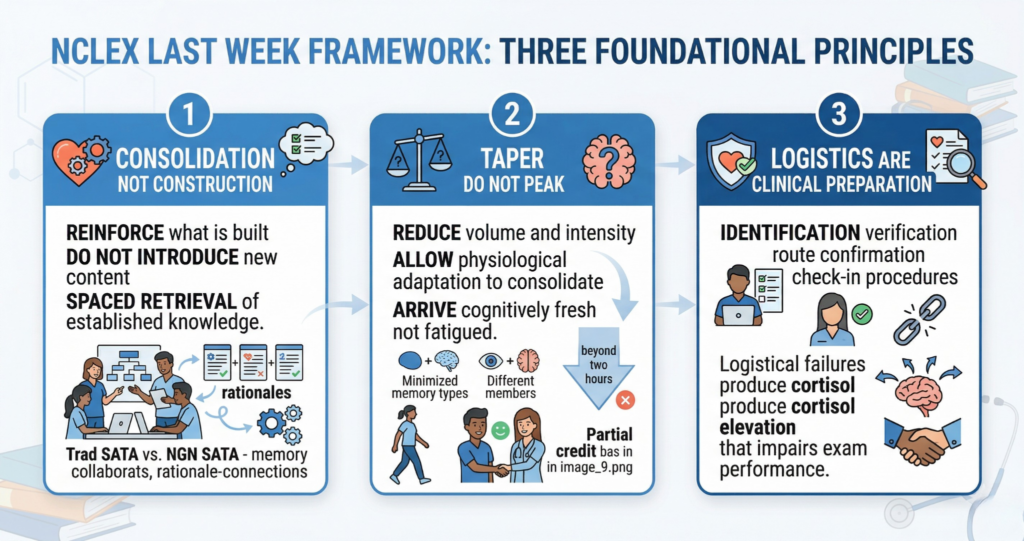
Before the day-by-day protocol, three overarching principles govern every decision made during the NCLEX last week — what to include, what to exclude, and why each choice is made.
Principle 1: Consolidation, Not Construction
The NCLEX last week is a consolidation period — not a construction period. Construction is what the preceding five to seven weeks of preparation accomplished: building clinical reasoning competency, developing content knowledge, accumulating question volume, identifying and closing preparation gaps. Consolidation is what the final week accomplishes: reinforcing what has been built, converting recent-term clinical learning into durable long-term memory through targeted spaced retrieval, and verifying that the clinical reasoning architecture built during preparation is accessible and active rather than assuming it is. The most damaging NCLEX last week behavior is attempting to construct during a period designed for consolidation — introducing new content, studying unfamiliar clinical areas, or trying to cover topics that feel underprepared at the last minute. New content introduced in the final week will not consolidate into usable clinical reasoning before the exam. It will compete with and potentially disrupt the consolidation of the well-established clinical reasoning that six weeks of deliberate preparation built. The final week’s preparation budget is for reinforcing what is known, not for learning what is not.
Principle 2: Taper, Do Not Peak
The NCLEX last week follows the same physiological principle that governs athletic performance preparation: the preparation taper. Elite athletes reduce training volume in the days before a competition not because they are resting from laziness but because the physiological adaptations produced by months of training are consolidated and expressed most fully when the body has adequate recovery time before the performance event. The same principle applies to cognitive preparation. The daily practice question volume, session duration, and preparation intensity of the NCLEX last week should be lower than the week that preceded it — a deliberate taper that allows the cognitive adaptations produced by weeks of clinical reasoning development to consolidate into their most performatively accessible state. A candidate who maintains peak preparation intensity through the day before the exam arrives at the testing center with accumulated cognitive fatigue rather than restored cognitive freshness — which is the physiological state least likely to express the full clinical reasoning competency that preparation built.
Principle 3: Logistics Are Clinical Preparation
Logistical preparation — confirming identification, verifying the testing center route, reviewing check-in procedures, preparing exam-day clothing and nutrition — is clinical preparation during the NCLEX last week because logistical failures on exam day produce cognitive disruption that impairs clinical reasoning performance. A candidate who discovers at check-in that the name on their identification does not precisely match the name on their ATT, or who arrives rushed because traffic was worse than expected, or who realizes they do not know whether the testing center requires a mask, begins the exam from a cortisol-elevated baseline that degrades the working memory and prefrontal function that clinical reasoning requires. These failures are entirely preventable through 30 minutes of logistical confirmation during the NCLEX last week. Treating logistics as administrative detail rather than as preparation is a category error — both determine exam day performance, and both deserve deliberate preparation attention.
Day 7 Before the Exam: Final Full Assessment
Seven days before the exam is the last day for substantive preparation activity — the final opportunity to complete a meaningful assessment session and act on its findings before the taper period begins in earnest.
The Final Full Simulation
Day 7 of the NCLEX last week is the day for the final full practice simulation — 100 questions under exam-realistic timed conditions, no mid-session rationale breaks, exam environment replication. This simulation serves as the definitive readiness confirmation rather than as a training session. After the simulation, apply the five-metric post-simulation scorecard: overall accuracy, NGN versus traditional accuracy split, content category breakdown, pacing milestone data, and the question number at which reasoning quality first noticeably declined. If all four readiness benchmarks are met — overall accuracy above 55 to 60 percent across consecutive simulations with upward trend, no content category below 50 percent, NGN accuracy above 50 percent, and this simulation in the passing range — the proceed decision is confirmed and the NCLEX last week protocol shifts fully to consolidation and calibration. If one benchmark is marginally below threshold, apply one targeted intervention session on day 6 in the specific area before shifting fully to taper. If multiple benchmarks are significantly unmet, the exam date decision should be revisited before the taper protocol begins.
Post-Simulation Analysis and Final Gap Identification
The post-simulation rationale review on day 7 of the NCLEX last week should be the last intensive rationale analysis session of the preparation period. Apply the four-question analytical protocol to every question with specific attention to the transfer question — any clinical principle the simulation’s rationale review teaches that changes how the candidate will approach similar questions becomes a spaced repetition card reviewed in the final Anki sessions of the NCLEX last week rather than a new content study topic. The transfer principle identified through the simulation’s rationale review is a genuine gap; a topic that feels underprepared because the candidate has not studied it recently is almost certainly better-consolidated than the anxiety about it suggests, and studying it at length in the NCLEX last week will produce anxiety rather than additional clinical reasoning competency.
Days 6 and 5 Before the Exam: Targeted Consolidation

Days 6 and 5 of the NCLEX last week are the targeted consolidation days — the period for deliberate reinforcement of the specific clinical areas identified through the final simulation as below standard, alongside spaced retrieval review of the full preparation period’s accumulated clinical reasoning library.
Day 6: Targeted Weak-Area Consolidation
If the day 7 simulation identified one content area below 50 percent, day 6 of the NCLEX last week allocates 45 to 60 minutes to targeted practice in that specific area — 25 to 30 questions filtered to that content category with full rationale review. This is the last targeted intervention session; it should be focused and time-limited rather than expanding to cover adjacent content areas that feel less certain. After the targeted session, complete the daily Anki spaced repetition review of due cards from the full deck — this is the consolidation activity that reinforces the complete clinical reasoning library, not just the weak area. The total active preparation time on day 6 should be 90 minutes maximum. After 90 minutes, preparation for day 6 is complete regardless of how much content still feels uncertain. Continuing beyond 90 minutes on day 6 of the NCLEX last week is construction anxiety rather than consolidation discipline.
Day 5: The NCSBN Official NGN Calibration
Day 5 of the NCLEX last week is reserved for the official NCSBN NGN calibration session — completing the official NGN sample questions available at ncsbn.org. These are the only questions written by the organization that administers the exam, making them the definitive standard for NGN format complexity, CJMM skill mapping, and clinical judgment reasoning depth. Completing them five days before the exam — rather than immediately before — allows any format calibration insights to be integrated into the final days of Anki review rather than producing last-minute anxiety from format discrepancies between third-party practice and the official standard. After the NCSBN calibration session (approximately 30 to 45 minutes), complete the daily Anki review. Total active preparation time on day 5 should be 60 to 75 minutes. Afternoon and evening on day 5 are for non-preparation recovery activities — physical movement, social engagement, and sleep protection.
Anki Spaced Repetition as the Consolidation Engine
Throughout days 6 and 5 of the NCLEX last week, the daily Anki spaced repetition review is the primary consolidation mechanism — not new question practice, not content review, and not additional rationale analysis. The cards due for review in the final week represent clinical principles that the spaced repetition algorithm has calculated are at the optimal interval for their long-term consolidation review. Completing these reviews at their scheduled intervals, in the morning before any other preparation activity, produces the maximum memory consolidation benefit from the clinical reasoning library built across the full preparation period. Missing the Anki reviews during the NCLEX last week allows clinical principles that are approaching their long-term consolidation threshold to decay rather than consolidating — which is the preparation loss that the final week’s reduced question volume would otherwise prevent.
Days 4 and 3 Before the Exam: Calibration and Logistics
Days 4 and 3 of the NCLEX last week shift the preparation focus from clinical content to calibration and logistics — the two preparation dimensions that determine exam day cognitive state as directly as any clinical content session.
Day 4: Reasoning Error Log Review and Anki
Day 4 of the NCLEX last week is dedicated to the reasoning error log review — the preparation activity that converts the preparation period’s documented error patterns into final exam awareness. Review the reasoning error log entries from the most recent four weeks and identify the two or three most frequently recurring error types: the nursing process step that most commonly produces incorrect selections, the priority framework error that appears across the most content areas, or the patient context error pattern that the week’s rationale analysis most frequently revealed. Write a brief, specific correction reminder for each — the behavioral habit that prevents this error: before engaging options, I identify the action verb and name the process step it requires; before engaging options, I scan for ABC threats and unaddressed physiological needs. These reminders are not new content — they are crystallized awareness of the specific reasoning patterns the preparation period identified as the candidate’s most important correction targets. Review them before the exam simulation on day 3 and again on exam morning. After the error log review (approximately 30 minutes), complete the daily Anki review. Total preparation time on day 4: 45 to 60 minutes.
Day 3: Final Mini-Simulation and Logistics Confirmation
Day 3 of the NCLEX last week includes the final active practice session and the logistics confirmation checklist. The final practice session is a mini-simulation of 40 to 50 questions under exam-realistic timed conditions — not a full simulation, which would produce cognitive fatigue three days before the exam, but a session long enough to confirm that clinical reasoning is active, pacing discipline is functioning, and the reasoning error corrections identified from the error log are firing before options are read. After the mini-simulation, apply a brief rationale check — read the full rationale for every incorrect answer and flag any new clinical principles for Anki review, but do not conduct the full four-question protocol for correct answers. The logistics confirmation checklist completed on day 3 covers: ATT accessible and name verified against identification document, testing center location confirmed with route and parking identified, practice commute timing confirmed at the exam appointment time of day, exam-day clothing selected (comfortable, layered for testing center temperature), logistics-confirmed checklist items physically checked off rather than mentally noted. Day 3 total preparation time: 90 minutes for the mini-simulation and logistics confirmation combined.
The What-Not-to-Do List for Days 4 and 3
Days 4 and 3 of the NCLEX last week carry the highest risk of anxiety-driven preparation errors — the temptation to study additional content because the exam feels close and the anxiety of remaining uncertainty feels urgent. The following activities are explicitly excluded from days 4 and 3 of the NCLEX last week: beginning a new review book chapter or content review video on a topic not already studied during the preparation period, completing a full-length simulation that would produce significant cognitive fatigue three days before the exam, reading nursing student forums or social media posts about the NCLEX experience and difficulty, discussing the upcoming exam with peers in ways that generate comparison anxiety rather than mutual support, and reviewing the reasoning error log without the specific correction habit framing that converts the review into actionable awareness rather than anxiety amplification. Each of these activities produces anxiety or fatigue without producing the clinical reasoning development that would justify the cost.
Days 2 and 1 Before the Exam: Recovery and Final Calibration
Days 2 and 1 of the NCLEX last week — the 48 hours immediately preceding the exam — shift preparation almost entirely from clinical activity to physiological and psychological preparation. The clinical work is done. The 48 hours before the exam determine the cognitive state that clinical work is expressed through.
Day 2: Light Review and Physical Preparation
Day 2 of the NCLEX last week — two days before the exam — includes the lightest preparation activity of the entire period. Complete the daily Anki spaced repetition review in the morning (15 to 20 minutes). Review the two or three correction reminders written from the error log on day 4 — not to study them as new content but to read them once, confirm they are memorable, and release them. Beyond these two brief activities, the NCLEX last week day 2 preparation is complete. The remainder of day 2 is dedicated to physical preparation: 30 to 45 minutes of moderate aerobic physical activity to reduce pre-exam cortisol accumulation and activate BDNF that supports memory consolidation during the final sleep cycles before the exam; a real meal with protein and complex carbohydrates; genuine social engagement with someone whose company the candidate enjoys that does not involve nursing content discussion; and early bedtime that allows eight or more hours of sleep before day 1 morning. No content review, no practice questions, no rationale reading, no preparation planning for day 2’s evening. The preparation is complete. Day 2 is for the physiological preparation that will carry it into the exam room.
Day 1: The Day Before the Exam
Day 1 of the NCLEX last week — the day before the exam — has one overriding preparation priority: sleep. Every other activity on this day should be structured to protect the sleep that begins this night. Morning activities: a brief Anki review of due cards (10 to 15 minutes maximum — do not add new cards), followed by a final review of the three correction reminders, followed by a deliberate decision to stop all preparation activity for the day. Afternoon and evening activities: a real meal at a normal time, a genuinely enjoyable activity that has nothing to do with nursing — a film, time with friends or family, a walk in a pleasant environment — and the logistics confirmation final check: ATT confirmed accessible, identification verified, exam appointment time confirmed, route and parking confirmed, alarm set, exam-day clothing laid out. Get into bed at a time that allows eight hours of sleep before the exam morning alarm. If sleep does not come easily, the body at rest is still recovering even without sleep — lying quietly without phone access is more restorative than the anxiety-driven phone use that typically replaces sleep when it does not arrive immediately. No nursing content of any kind after the morning Anki session on the day before the exam.
Managing the Pre-Exam Anxiety of the Final 48 Hours
The anxiety of the NCLEX last week’s final 48 hours is normal, nearly universal, and not predictive of exam performance. The specific anxiety management practices most relevant to the final 48 hours are: the anxiety-as-readiness reframe (this activation means my nervous system recognizes the importance of what I am about to do and is preparing accordingly), the process-focus anchor (the only thing I control during the exam is the quality of reasoning I apply to each question — everything else is managed by the preparation I have already completed), and the preparation evidence inventory (a brief mental review of the preparation completed — total questions, simulations, content areas covered, benchmarks met — to replace the feeling of insufficient preparation with the evidence of preparation completed). Physical grounding practices — feet flat on the floor, hands relaxed, slow breath — should be practiced deliberately during the final 48 hours so that they fire automatically when anxiety arises on exam morning. These are not new skills; they are final activations of the anxiety management habits built during preparation simulations.
Exam Morning: The Final Protocol
Exam morning is not a preparation day — it is a performance activation day. Everything that happens between waking and sitting at the testing station serves the single goal of establishing the physiological and cognitive state that allows the full clinical reasoning competency built during preparation to be expressed at its most accessible and most consistent.
The Morning Routine
Wake up with enough time for a genuine morning routine without any rushing — at minimum 90 minutes before the scheduled appointment time, plus travel time. The NCLEX last week exam morning routine has four components. First, breakfast: a real meal with protein and complex carbohydrates eaten calmly at home rather than grabbed in transit. Sustained glucose release from complex carbohydrates and the satiety of adequate protein prevent the mid-exam energy decline that impairs clinical reasoning in the latter question blocks. Second, brief physical movement: 10 minutes of brisk walking or light stretching reduces pre-exam cortisol more reliably than stillness and activates the physiological state associated with alert, focused cognitive performance. Third, no nursing content of any kind: no flashcard review, no rationale re-reading, no practice question apps, no nursing social media. The preparation is done. Engaging with nursing content on exam morning activates performance evaluation cognition that amplifies anxiety without adding preparation value. Fourth, the process-focus mantra during commute: this question, this reasoning, now — repeated as a deliberate attentional anchor that begins before the first question appears so that it fires automatically when difficulty arises mid-exam.
Arrival and Check-In Protocol
Arrive at the testing center 30 minutes before the scheduled appointment time — not 10 minutes before. The 30-minute buffer eliminates the cortisol spike that rushed arrival produces and provides time for the check-in process (identification verification, biometric check, security review) without time pressure. Use the time between arrival and being called to the testing station for the pre-exam grounding sequence: two to three slow breathing cycles (inhale four counts, exhale six), the desk anchor (hands flat, shoulders released, jaw unclenched), and a final quiet statement of the process-focus mantra. Do not review any nursing content in the waiting area. Do not discuss the upcoming exam with other candidates in the waiting area in ways that generate comparison or performance anxiety — brief friendly acknowledgment is fine; content discussion or shared anxiety amplification is not. The waiting area minutes are physiological preparation minutes, not content preparation minutes.
The Tutorial Period: Final Grounding Before Question One
The tutorial period that precedes the first question in the NCLEX last week exam is the final preparation opportunity — and it is a physiological preparation opportunity rather than a clinical one. Complete the tutorial at a calm pace without rushing to reach the first question sooner. During the tutorial period, apply the pre-exam grounding sequence deliberately: two full slow breathing cycles, the desk anchor, and the process-focus mantra. Make deliberate eye contact with the question screen as the tutorial ends rather than looking away — this is the attentional transition signal that marks the shift from waiting to engaged clinical reasoning. The candidate who enters question one from a grounded, activated, process-focused physiological state has maximized the probability that the first question is answered with the full clinical reasoning capacity that six weeks of deliberate preparation built.
- Final logistics checklist — confirm on day 3 and again on exam morning: ATT accessible (printed or phone). Primary ID name exactly matches ATT name format. Secondary ID with signature. Testing center address confirmed with route and parking. Water in clear container if allowed. Comfortable layered clothing. Alarm set for exam morning.
- What to bring to exam morning breakfast: Protein — eggs, Greek yogurt, nut butter — for satiety and sustained cognitive performance. Complex carbohydrates — oatmeal, whole grain toast — for sustained glucose release rather than the spike-and-crash of refined carbohydrates. Water. No energy drinks or caffeine beyond established personal tolerance — exam day is not the time to test higher doses.
- What not to do on exam morning: Review flashcards or practice questions. Read nursing social media or forums. Discuss the exam with peers in anxiety-generating ways. Rush to arrive at the testing center. Skip breakfast. Consume unfamiliar supplements or high-dose caffeine.
Conclusion
The NCLEX last week is the preparation period that converts everything built during six weeks of clinical reasoning development into the most performatively accessible cognitive state possible for exam day. It does this not through more construction but through consolidation, calibration, and physiological recovery — three preparation functions that are as important to exam performance as any content session and that only the final week can provide. The day-by-day protocol — final simulation on day 7, targeted consolidation on days 6 and 5, error log crystallization and logistics confirmation on days 4 and 3, physiological recovery on days 2 and 1, and grounded exam morning activation — is not a reduced preparation schedule. It is a precisely sequenced preparation protocol designed for the specific cognitive and physiological requirements of the final seven days before a high-stakes adaptive examination.
The candidate who arrives at the testing center after a NCLEX last week executed according to this protocol is rested, cognitively fresh, logistically confirmed, correction-habit activated, and physiologically grounded — which is the state most likely to express the full clinical reasoning competency that the preceding preparation period built. The candidate who arrives exhausted from peak-intensity final-week cramming has spent those seven days building preparation anxiety rather than consolidating preparation competency. Trust the preparation. Execute the final week. Walk into the exam room knowing that everything required has been done.
