

NCLEX maternal newborn nursing is one of the most detail-intensive content areas on the exam, and it consistently catches nursing students off guard. The sheer breadth of the topic — spanning prenatal care, labor and delivery, postpartum assessment, newborn adaptation, and high-risk complications — means there is a lot of ground to cover. But the NCLEX does not test all of it equally, and knowing where to focus makes a significant difference.
According to the NCSBN test plan, health promotion and maintenance — which includes antepartum, intrapartum, postpartum, and newborn care — accounts for approximately 6 to 12 percent of the NCLEX-RN. Beyond that, maternal newborn content also appears within physiological adaptation and reduction of risk potential categories, making it a thread that runs through a meaningful portion of the exam.
This guide covers the highest-yield topics in NCLEX maternal newborn nursing for 2026, from normal labor progression and fetal heart rate interpretation to postpartum complications and newborn assessment. Whether this is a content area you feel confident in or one you have been avoiding, this guide will help you study smarter and walk into exam day fully prepared.
Why NCLEX Maternal Newborn Nursing Requires a Focused Study Approach
NCLEX maternal newborn nursing covers a unique population with normal physiological processes that can rapidly become emergencies. This is what makes it challenging — the line between normal and abnormal is narrow, and recognizing when something is outside expected parameters is exactly what the NCLEX tests.
Students who struggle with maternity questions often have one of two problems: they either memorized normal values without understanding the clinical significance, or they learned the content in isolation without connecting it to the nursing actions and patient outcomes the NCLEX is actually asking about. The most effective preparation treats each maternity topic as a clinical scenario — what does normal look like, what are the warning signs, and what does the nurse do when something changes?
NCLEX maternal newborn nursing also requires strong knowledge of two patients simultaneously: the mother and the newborn. Many questions will ask you to prioritize between maternal and fetal or neonatal concerns, or to recognize how a complication in one affects the other. Building this dual-patient awareness into your studying is essential.
How Maternal Newborn Content Is Distributed on the NCLEX
Maternity and newborn questions appear across multiple NCLEX test plan categories. Antepartum, intrapartum, and postpartum nursing fall primarily under health promotion and maintenance and physiological adaptation. High-risk obstetric conditions appear under reduction of risk potential and physiological adaptation. Newborn care spans health promotion, basic care and comfort, and physiological adaptation. This distribution means you will encounter maternal newborn nursing questions throughout the exam, not in a single concentrated block.
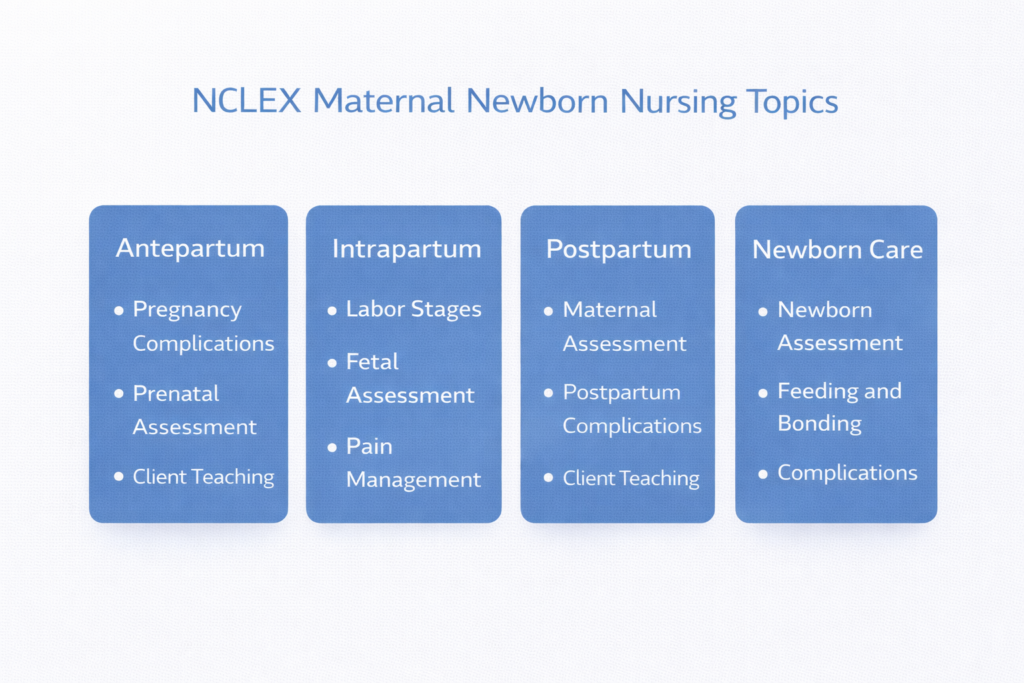
High-Yield Antepartum Topics for NCLEX Maternal Newborn Nursing
Antepartum questions on the NCLEX focus on prenatal assessment, common complications of pregnancy, and the nurse’s role in patient education and monitoring. The following are the highest-yield antepartum topics.
Preeclampsia and Eclampsia
Preeclampsia is among the most heavily tested conditions in NCLEX maternal newborn nursing. You need to know the diagnostic criteria — hypertension at or above 140/90 mmHg on two separate readings after 20 weeks gestation, combined with proteinuria or end-organ involvement — as well as the clinical findings that indicate severe features, including severe-range blood pressure, headache, visual changes, epigastric pain, and decreased urine output. Magnesium sulfate is the medication of choice for seizure prevention, and you must know its therapeutic level, the signs of toxicity, and that calcium gluconate is the antidote. Eclampsia is the onset of seizures in a patient with preeclampsia and represents a nursing emergency.
Gestational Diabetes
NCLEX questions on gestational diabetes focus on nursing education, glucose monitoring, dietary management, and the risks to both mother and fetus. Key fetal risks include macrosomia, hypoglycemia at birth, and respiratory distress syndrome. The nurse’s role in teaching the patient about blood glucose monitoring, dietary adjustments, and the importance of postpartum glucose testing appears frequently in this content area.
Placenta Previa and Placental Abruption
These two conditions are tested as a contrasting pair on the NCLEX. Placenta previa presents with painless, bright red vaginal bleeding and requires avoiding vaginal examinations. Placental abruption presents with painful, dark red vaginal bleeding, often accompanied by a rigid board-like abdomen, and carries a higher immediate risk for both maternal hemorrhage and fetal distress. Knowing the distinguishing features and nursing priorities for each condition is essential for NCLEX maternal newborn nursing questions.
Ectopic Pregnancy and Hyperemesis Gravidarum
Ectopic pregnancy questions focus on recognition — unilateral pelvic pain, referred shoulder pain from diaphragmatic irritation, and a positive pregnancy test — and the understanding that this is a surgical emergency. Hyperemesis gravidarum questions test your knowledge of nursing interventions, fluid and electrolyte monitoring, and the assessment findings that distinguish it from normal morning sickness.

Intrapartum Nursing: Labor, Delivery, and Fetal Monitoring on the NCLEX
Intrapartum content is one of the most heavily tested areas in NCLEX maternal newborn nursing. Questions focus on the stages of labor, fetal heart rate interpretation, nursing interventions during labor, and the recognition and management of obstetric emergencies.
Stages and Phases of Labor
You need to know the four stages of labor and the expected cervical dilation, effacement, and fetal station at each phase. The active phase of the first stage — from 6 centimeters to full dilation at 10 centimeters — is the most commonly tested segment. Knowing the expected rate of progress and the nursing assessment priorities at each stage helps you recognize when labor is deviating from normal.
Fetal Heart Rate Interpretation
Fetal heart rate monitoring is a cornerstone of NCLEX maternal newborn nursing questions. The normal baseline fetal heart rate is 110 to 160 beats per minute. You must be able to distinguish between reassuring and non-reassuring patterns. Early decelerations are a normal vagal response to head compression during contractions and require no intervention. Variable decelerations indicate cord compression and are managed with position changes and oxygen. Late decelerations are the most concerning pattern — they indicate uteroplacental insufficiency and require immediate intervention: stopping oxytocin, repositioning the patient to the left lateral position, administering oxygen by face mask, increasing IV fluids, and notifying the provider.
Obstetric Emergencies During Labor
Several obstetric emergencies are tested regularly in NCLEX maternal newborn nursing. Prolapsed umbilical cord requires the nurse to manually hold the presenting part off the cord and prepare for emergency cesarean delivery. Shoulder dystocia requires the McRoberts maneuver and suprapubic pressure. Uterine rupture presents with sudden severe abdominal pain, cessation of contractions, fetal bradycardia, and maternal hemodynamic instability — this is a surgical emergency. Amniotic fluid embolism is rare but rapidly fatal, presenting with sudden dyspnea, hypotension, and cardiovascular collapse.
Postpartum Assessment and Complications in NCLEX Maternal Newborn Nursing
Postpartum questions on the NCLEX test your ability to assess a new mother systematically, recognize deviations from normal recovery, and intervene appropriately. The BUBBLE-HE acronym — Breasts, Uterus, Bladder, Bowel, Lochia, Episiotomy or incision, Homans sign or lower extremities, and Emotional status — is the framework for postpartum assessment and reflects the structure of many NCLEX questions in this area.
Postpartum Hemorrhage
Postpartum hemorrhage is one of the highest-yield topics in NCLEX maternal newborn nursing. The most common cause is uterine atony — a uterus that fails to contract adequately after delivery. On the NCLEX, you need to recognize a boggy, displaced, or elevated fundus as a sign of uterine atony, know that the first nursing intervention is fundal massage, and understand that oxytocin is the first-line pharmacological treatment. Blood loss exceeding 500 mL after vaginal delivery or 1000 mL after cesarean delivery defines postpartum hemorrhage.
Postpartum Infection
Endometritis is the most common postpartum infection and is characterized by fever above 38 degrees Celsius after the first 24 hours, uterine tenderness, foul-smelling lochia, and tachycardia. NCLEX questions test your ability to recognize these signs and distinguish them from normal postpartum findings. Wound infection, urinary tract infection, and mastitis are also tested, with mastitis specifically associated with unilateral breast tenderness, warmth, and flu-like symptoms in a breastfeeding patient.
Postpartum Mood Disorders
The NCLEX distinguishes between postpartum blues — a normal, self-limiting emotional response in the first two weeks — and postpartum depression, which is more persistent and requires clinical intervention. Postpartum psychosis is the most severe and rare presentation, characterized by hallucinations, delusions, and disorganized behavior, and represents a psychiatric emergency requiring immediate hospitalization.
Newborn Assessment: What NCLEX Maternal Newborn Nursing Questions Test
Newborn content is a distinct and frequently tested component of NCLEX maternal newborn nursing. Questions in this area focus on normal newborn adaptation, APGAR scoring, newborn assessment findings, and the recognition of conditions that require immediate intervention.
APGAR Scoring
The APGAR score assesses five parameters at one minute and five minutes after birth: Appearance (skin color), Pulse (heart rate), Grimace (reflex irritability), Activity (muscle tone), and Respiration. Each parameter is scored from zero to two for a maximum total of ten. A score of seven to ten is normal, four to six indicates the need for some resuscitative measures, and zero to three indicates the need for immediate resuscitation. NCLEX questions frequently ask you to calculate an APGAR score from a clinical description or to identify the appropriate nursing response based on the score.
Normal Newborn Assessment Findings
Understanding what is normal in a newborn is essential because the NCLEX will present both normal variations and true abnormalities, and you must be able to distinguish between them. Normal findings include milia, Mongolian spots, acrocyanosis in the first few hours of life, caput succedaneum, and the presence of the Moro and rooting reflexes. Abnormal findings that require intervention include central cyanosis, respiratory distress, a single palmar crease associated with chromosomal anomalies, and abdominal distension.
Newborn Hypoglycemia and Hyperbilirubinemia
These are two of the most commonly tested newborn conditions in NCLEX maternal newborn nursing. Newborn hypoglycemia is defined as a blood glucose below 40 to 45 mg/dL in the first hours of life and is most common in infants of diabetic mothers, large-for-gestational-age neonates, and preterm infants. Hyperbilirubinemia causes jaundice and is assessed by the timing of onset — physiologic jaundice appears after 24 hours of life, while jaundice appearing within the first 24 hours is pathologic and requires immediate evaluation. Phototherapy is the treatment for elevated bilirubin levels, and NCLEX questions test your knowledge of nursing care during phototherapy, including eye protection, hydration, and frequent position changes.
How to Study NCLEX Maternal Newborn Nursing Effectively in 2026
NCLEX maternal newborn nursing covers a wide range of content, and studying it effectively means being strategic about how you organize and prioritize the material. Here is how to build a preparation plan that works.
Start by mapping out the major topic clusters: antepartum complications, normal and abnormal labor, fetal heart rate interpretation, postpartum assessment and complications, and newborn care. Assign dedicated study time to each cluster rather than jumping between topics. Maternity content builds on itself — understanding preeclampsia makes it easier to understand eclampsia, and understanding normal labor makes it easier to recognize dystocia.
Fetal heart rate interpretation deserves its own focused practice session. This is a visual and pattern-recognition skill that improves significantly with repetition. Work through as many fetal monitoring strips as you can find, practice categorizing them as reassuring or non-reassuring, and rehearse the nursing interventions for each non-reassuring pattern until the sequence feels automatic.
For medications in NCLEX maternal newborn nursing, focus on the drugs that appear most frequently: magnesium sulfate and its toxicity signs, oxytocin and its indications and precautions, terbutaline as a tocolytic, betamethasone for fetal lung maturity, and Rho(D) immune globulin for Rh-negative patients. Know the indication, the key nursing assessment, and the most important patient teaching point for each one.
Conclusion
NCLEX maternal newborn nursing rewards students who prepare with both breadth and precision. The content is wide-ranging, but the exam focuses on the same high-yield topics again and again — preeclampsia, fetal heart rate interpretation, postpartum hemorrhage, APGAR scoring, and the normal versus abnormal findings that distinguish safe recovery from emerging complications.
Approach each topic as a clinical scenario rather than a list of facts. Ask yourself what you would assess, what you would recognize as abnormal, and what you would do first. That reasoning process — applied consistently across antepartum, intrapartum, postpartum, and newborn content — is exactly what NCLEX maternal newborn nursing questions are designed to measure. With focused preparation, this content area becomes one of the most manageable and rewarding sections of your entire NCLEX review.
