


The question of whether you can take the NCLEX online in 2026 is one of the most frequently searched by nursing candidates — and one of the most frequently answered incorrectly across nursing student forums, social media groups, and secondhand preparation advice. The short answer is no: the NCLEX is not currently available as a remote at-home examination in 2026. Every NCLEX exam session is administered at a physical Pearson VUE testing center under proctored, controlled conditions that cannot be replicated in a home or remote environment. This has not changed with the April 2026 test plan update, the NGN format expansion, or any other recent examination modification.
The longer and more practically useful answer addresses what NCLEX online does mean in 2026 — because while the exam itself must be taken in person, virtually every other dimension of NCLEX preparation is available online and many candidates complete their entire preparation journey without purchasing a single physical resource. NCLEX online preparation through digital question banks, virtual tutoring sessions, NGN format practice platforms, streaming content review courses, and online spaced repetition tools is not only possible but is how the majority of 2026 candidates prepare. The distinction between the exam (which requires a testing center) and the preparation (which is overwhelmingly conducted online) is the practical clarification that most candidates searching this question actually need. This guide covers both dimensions fully: the definitive answer on NCLEX online testing availability with the specific reasons the exam cannot be administered remotely, what the testing center experience involves and how to find and schedule one, the complete ecosystem of legitimate NCLEX online preparation resources available in 2026, how to build a fully online preparation system that matches or exceeds the quality of any physical resource-based approach, and what to watch for when evaluating NCLEX online preparation resources to avoid wasting preparation time on low-quality or outdated content.
The Definitive Answer: Can You Take the NCLEX Online?
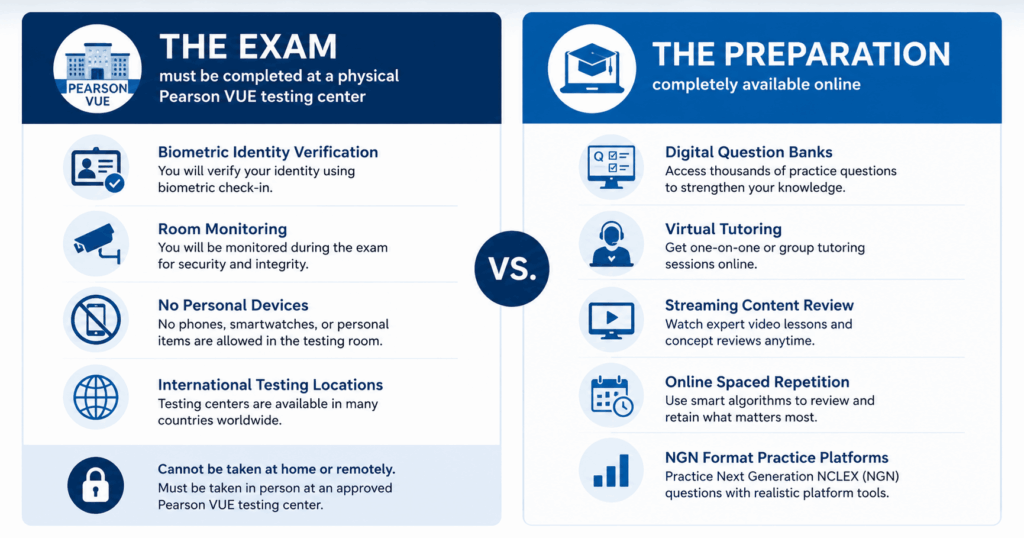
As of 2026, the NCLEX cannot be taken online, at home, or through any remote proctoring arrangement. The examination is administered exclusively through the Pearson VUE testing center network at physical locations across the United States and internationally in designated countries. This is not a temporary restriction or a policy under active review — it reflects the fundamental security and integrity requirements of a high-stakes licensure examination that determines entry into professional nursing practice.
Why the NCLEX Cannot Be Administered Remotely
The security architecture of the NCLEX examination depends on environmental controls that cannot be replicated in home or remote settings. The Pearson VUE testing centers use biometric identity verification — palm vein scanning or fingerprint identification — at check-in and each time a candidate re-enters the testing room after a break, ensuring that the person who registered is the person completing the examination. The testing room environment is physically secured against unauthorized materials, monitored continuously by both in-room cameras and proctors, and designed to eliminate any possibility of assistance from external sources. The CAT algorithm’s item security depends on each question being presented to candidates under conditions that prevent screenshot, recording, or transmission of item content — security that physical testing center environments enforce through device exclusion, room monitoring, and desk-level surveillance that home environments cannot provide. These security requirements are not bureaucratic restrictions — they protect the validity of nursing licensure for every practicing nurse and every patient under their care. An NCLEX online at-home option would fundamentally compromise the examination’s ability to certify that the clinical reasoning competency it measures belongs to the licensed nurse rather than to any assistance they received during the examination.
International Candidates and Remote Areas
The question of NCLEX online testing most frequently comes from international candidates and candidates in remote geographic areas for whom the nearest Pearson VUE testing center involves significant travel. For internationally educated nurses, Pearson VUE administers the NCLEX at authorized testing centers in a number of countries outside the United States — including the Philippines, India, South Korea, Canada, Australia, the United Kingdom, and others. The list of international testing locations is available at pearsonvue.com/nclex and is updated as international testing agreements are established. For candidates in remote areas of the United States where the nearest testing center requires several hours of travel, the practical recommendation is to schedule the exam with a travel plan — arriving the day before, staying near the testing center, and treating the travel as a logistics component of the examination rather than a barrier. The NCLEX 2026 Candidate Bulletin at ncsbn.org provides the current list of authorized Pearson VUE testing locations and the scheduling process for both domestic and international candidates.
What Would Need to Change for NCLEX Online Testing
Remote proctored high-stakes examinations exist in other professional credentialing contexts, and it is reasonable to ask whether NCLEX online administration might become available in the future. For remote NCLEX administration to become feasible, the NCSBN would need to develop remote proctoring technology that matches the security architecture of physical testing centers — including biometric identity verification at exam start and during breaks, environment scanning that confirms the absence of unauthorized materials and persons, and item security protocols that prevent any possibility of content capture or transmission. Several barriers specific to the NCLEX format make this significantly more challenging than for text-based certification examinations: the NGN format’s interactive question types require specific interface security that remote environments complicate, the CAT algorithm’s adaptive item delivery depends on response timing data that remote environments may distort, and the partial credit scoring mechanics of NGN formats require format integrity that is difficult to guarantee without physical environment control. The NCSBN’s official communications as of 2026 do not indicate an active remote testing initiative. Candidates should plan for in-person testing center examination without expectation of a near-term NCLEX online option.
Finding and Scheduling Your Pearson VUE Testing Center
Since the NCLEX must be taken at a physical testing center, knowing how to find the nearest location, what to expect when you arrive, and how to schedule efficiently are the practical logistics every candidate needs to manage before exam day.
Locating Your Nearest Testing Center
Pearson VUE testing centers that administer the NCLEX are searchable at pearsonvue.com/nclex using the test center locator tool, which allows candidates to search by zip code, city, or country. Not every Pearson VUE testing center administers nursing examinations — the locator filters to NCLEX-authorized locations specifically, which is important to confirm before assuming that the nearest general Pearson VUE location offers the NCLEX. Testing centers vary significantly in size, available appointment slots, and scheduling lead times — popular urban testing centers may have limited availability several weeks out while suburban or rural centers may have more immediate openings. Checking multiple centers within a reasonable travel radius often reveals faster appointment availability than the nearest center alone. The testing center locator also displays center hours, which vary by location and day of week, and some centers offer early morning or Saturday appointments that may fit candidates’ schedules better than standard weekday slots.
The Scheduling Process
Scheduling the NCLEX at a Pearson VUE testing center requires first receiving the Authorization to Test from Pearson VUE — issued after both the state board of nursing has approved the licensure application and Pearson VUE has confirmed examination registration and fee payment. Once the ATT is received, scheduling is completed at pearsonvue.com/nclex using the candidate identification number from the ATT. The scheduling interface shows available appointments at testing centers within the candidate’s selected search area. The ATT has an expiration date — typically 90 days from issuance — and the exam must be scheduled and completed before this expiration. The practical recommendation is to schedule within 24 to 48 hours of ATT receipt, selecting the target date based on preparation readiness benchmarks while ensuring the appointment falls before the ATT expiration. Appointments can be rescheduled through the Pearson VUE website without a rescheduling fee if done more than 24 to 30 hours before the scheduled appointment time.
What to Expect at the Testing Center
Arriving at the Pearson VUE testing center for the NCLEX involves a check-in process that typically takes 10 to 15 minutes and includes identification verification (two forms of ID matching the ATT name exactly), biometric palm vein scanning or fingerprinting, photography, and a review and signature of testing policies. Personal items including phones, watches, jewelry beyond simple earrings, bags, wallets, food, and all electronic devices must be stored in a provided locker before entering the testing room. The testing room provides a computer workstation with a monitor, keyboard, mouse, and dry-erase notepad for scratch work. Earplugs are available from the proctor on request. The room is monitored by cameras and proctors throughout the session. Breaks are optional and available at the candidate’s discretion — the five-hour exam clock continues running during breaks. Arriving 30 minutes before the scheduled appointment time provides adequate buffer for the check-in process without clock pressure.
online resources, used systematically alongside a quality question bank, constitute a complete preparation system at a fraction of the cost of comprehensive paid programs.
Building a Fully Online NCLEX Preparation System
A fully online NCLEX preparation system — one that uses no physical resources beyond the candidate’s own computing device — is not only possible but is what the majority of 2026 candidates use. The following framework builds a complete online preparation system from the resources described above.
The Online Diagnostic and Planning Phase
The NCLEX online preparation system begins with two parallel online activities that establish the preparation foundation. First, complete a diagnostic assessment using the selected question bank platform’s mixed-content timed mode — 75 to 100 questions without mid-session rationale review — and extract the content category accuracy breakdown from the platform’s analytics. This online diagnostic establishes the preparation baseline that all subsequent study allocation decisions are based on. Second, complete the NCSBN official NGN samples at ncsbn.org and study the online CJMM framework documentation. Both activities are free and take approximately two hours combined. Together they produce the two pieces of preparation intelligence that the planning phase requires: where clinical content performance currently stands (from the diagnostic) and how the current examination format works (from the NGN orientation). No physical resource is needed for either activity.
The Daily Online Preparation Session Structure
The daily NCLEX online preparation session uses three digital tools in sequence. Morning: the Anki mobile or desktop application for 15 to 20 minutes of spaced repetition review of due cards — clinical reasoning principles built from previous practice session rationale reviews, reviewed at the optimal consolidation intervals the algorithm schedules. Primary session: the selected question bank platform for 50 to 75 questions under timed conditions with 30 to 35 percent NGN format content, followed by full four-question rationale review of every question with error type classification for incorrect answers. End of session: Anki card creation — five to eight new cards built from the clinical reasoning principles the session’s rationale review taught, added to the digital deck for future scheduled review. This three-tool sequence — Anki for consolidation, question bank for clinical reasoning development, Anki for encoding — constitutes a complete daily preparation system accessible from any internet-connected device. The weekly Sunday micro-audit uses the question bank’s built-in analytics dashboard to track the four readiness benchmarks and adjust the following week’s content allocation based on accuracy trend data.
Simulating Testing Center Conditions Online
The most important preparation adaptation for candidates doing entirely NCLEX online preparation is deliberate simulation of testing center conditions during practice sessions — because the exam itself must be taken in person under specific environmental conditions that online preparation does not automatically replicate. Weekly simulation sessions should be conducted at a desk (not a couch or bed), with all personal devices removed from the workspace, with room temperature set slightly cooler than comfortable, with no breaks until the defined milestone intervals, and with a visible timer tracking the 90-second per question average against milestone benchmarks. This environmental simulation — which costs nothing and requires no additional resources — prevents the performance gap between online practice accuracy and testing center accuracy that candidates who always practice in comfortable home environments often experience. The question bank’s full-length timed simulation mode, used weekly under these environmental conditions, produces the practice experience that most closely replicates what the testing center exam demands.
- The most important free NCLEX online resource: The NCSBN official website at ncsbn.org. The Detailed Test Plan, the NGN sample questions, the CJMM documentation, and the Candidate Bulletin are all available free. Every piece of preparation that depends on knowing what the current examination tests, how it is formatted, and what the logistics require should be anchored to ncsbn.org as the primary source — not to forum posts, social media summaries, or preparation provider interpretations of the official documents.
- Evaluating NCLEX online preparation resources: Before investing time or money in any NCLEX online preparation resource, apply three quality checks: does it specify which test plan version it reflects (it should reference the April 2026 test plan or later), does it include NGN format content across all five item types with CJMM skill alignment, and does its content organization support clinical reasoning framework application or primarily content recognition? Resources that pass all three checks are providing current, format-accurate, clinical reasoning-oriented preparation. Resources that fail one or more checks may provide valid supplementary content but should not serve as the primary preparation system.
- Online tutoring versus self-directed online preparation: Self-directed online preparation using a quality question bank, Anki, and free content review resources is sufficient for the majority of candidates who execute it with full rationale quality and consistent accuracy tracking. The preparation gap that online tutoring specifically addresses is the diagnostic ceiling of self-directed preparation — the reasoning patterns and systematic errors that self-directed rationale review cannot identify because the candidate is using the same reasoning process to evaluate rationales that produced the errors. If accuracy has been flat for two or more weeks despite correct gap-type identification and targeted self-directed practice, virtual NCLEX online tutoring is the most efficient next investment regardless of geographic location.
Common Misconceptions About NCLEX Online in 2026
The NCLEX online question generates several persistent misconceptions in nursing candidate communities that are worth addressing directly — because acting on inaccurate information about examination format or preparation resources wastes preparation time and creates unnecessary anxiety.
Misconception 1: The NCLEX Was Made Available Online During COVID and Is Still Remote
During the COVID-19 pandemic, the NCSBN and state boards of nursing implemented various emergency measures to maintain examination access — including temporary modifications to testing center protocols and, in some jurisdictions, limited remote proctored examination pilots. These emergency measures have not continued as permanent examination delivery options. The NCLEX in 2026 is administered exclusively at physical Pearson VUE testing centers under standard proctored conditions. Any information suggesting that pandemic-era remote testing options remain available in 2026 is inaccurate and should be verified at ncsbn.org before being acted upon.
Misconception 2: Taking the NCLEX Online Means Using an Online Prep Course
A significant source of confusion around NCLEX online is the dual meaning of the phrase — candidates searching for NCLEX online are often searching for NCLEX online preparation resources rather than for remote examination delivery, and search results mix both types of content. When nursing preparation resource providers advertise NCLEX online courses, programs, or classes, they are referring to internet-delivered preparation content — question banks, streaming video courses, virtual tutoring — not to online examination delivery. This distinction matters because a candidate who finds an advertisement for an NCLEX online course and concludes from it that online examination is therefore possible has misread a preparation resource advertisement as an examination format update. Online preparation resources are legitimate, widely available, and high-quality — but they are preparation tools, not examination delivery alternatives.
Misconception 3: Passing an Online NCLEX Practice Test Confirms Exam Readiness
A specific NCLEX online misconception with direct preparation implications is the belief that strong performance on an online NCLEX practice test in a comfortable home environment reliably predicts strong performance on the actual examination at a testing center. As discussed in the testing center simulation section above, candidates who always practice online at home under non-exam conditions — comfortable posture, familiar environment, no time pressure replication, phone accessible — and never simulate testing center conditions during preparation consistently show a performance gap between their online practice accuracy and their testing center exam performance. This gap reflects the anxiety, pacing pressure, and environmental unfamiliarity of the testing center rather than a deficiency in clinical knowledge. The preparation response is deliberate testing center simulation during weekly full-length online practice sessions — removing the comfort factors that distinguish home practice from testing center examination.
Conclusion
The NCLEX cannot be taken online in 2026 — it is administered exclusively at physical Pearson VUE testing centers under proctored, controlled conditions that protect the security and integrity of nursing licensure. This will not change without a fundamental development in remote high-stakes examination technology that the NCSBN has not indicated is in active development. Every candidate should plan for a testing center examination and complete the scheduling process promptly after ATT receipt. What can be done online is everything else: the diagnostic assessment, the question bank practice, the rationale review, the spaced repetition consolidation, the content review, the NGN format orientation, the tutoring, the weekly benchmark tracking, and the preparation management. The NCLEX online preparation ecosystem in 2026 is comprehensive, high-quality, and accessible from anywhere with an internet connection. A candidate who uses the right online tools with genuine quality and consistency — full rationale protocol, CJMM skill identification on every NGN question, daily Anki review, weekly benchmark tracking — arrives at the testing center as well-prepared as any candidate using any combination of physical and digital resources. The exam is in person. The preparation is online. Both can be excellent.
