

For NCLEX nursing students approaching their final year of nursing school, the examination that stands between them and registered nurse licensure can feel simultaneously urgent and opaque — an exam everyone talks about but few explain clearly enough to make preparation feel manageable. The NCLEX is not the hardest examination nursing students will ever take in terms of content complexity. It is, however, the examination that most decisively requires a specific type of clinical reasoning that nursing school may not have explicitly taught — and that preparation built on nursing school study habits alone consistently underdelivers.
Understanding what the NCLEX actually is, how it works mechanically, what the 2026 format requires that previous formats did not, and what preparation behaviors are most strongly associated with first-attempt passing — before beginning any intensive study — is the most efficient use of preparation time available to NCLEX nursing students. Every hour of preparation that is directed by accurate understanding of what the exam measures produces more clinical reasoning development than hours spent studying according to assumptions that the exam is simply a harder version of a nursing school final.
This guide is written for NCLEX nursing students who are approaching or have recently completed their nursing program and are beginning to think seriously about examination preparation. It covers everything a nursing student needs to understand before starting: what the NCLEX measures and how it differs from nursing school examinations, the current 2026 format including the NGN clinical judgment questions that have changed the examination significantly since 2023, the registration and scheduling process, what preparation actually involves and how much time it requires, the five most common NCLEX preparation mistakes nursing students make, and the honest truth about what first-attempt passing requires. This is the guide every nursing student should read before opening a question bank for the first time.
What the NCLEX Actually Is — and How It Differs From Nursing School Exams
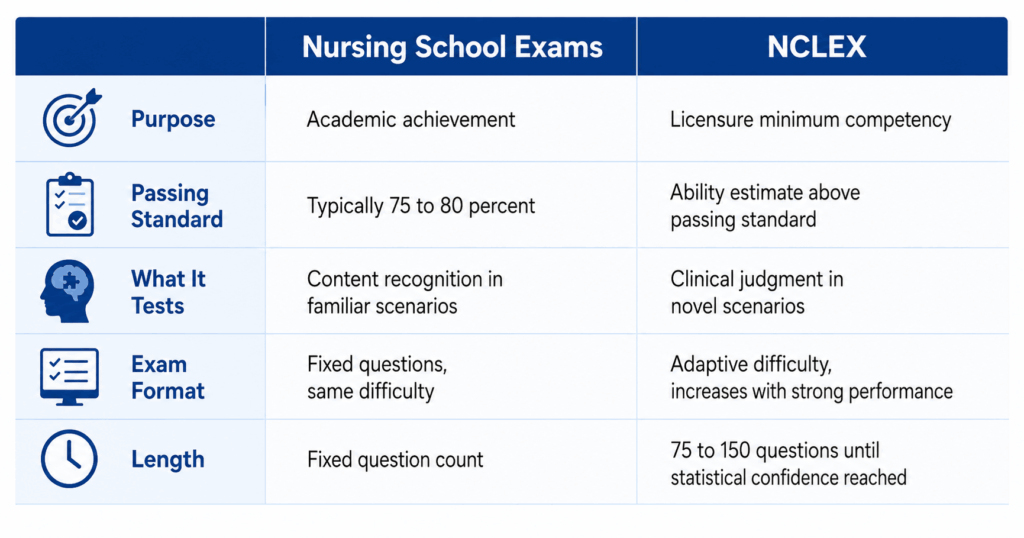
The most important conceptual shift for NCLEX nursing students is understanding how the NCLEX differs from every examination they have taken in nursing school — because the study habits that produce high nursing school exam scores are not the same habits that produce NCLEX passing results.
A Licensure Examination, Not an Academic Achievement Test
Nursing school examinations measure academic achievement — whether students have learned the course content their faculty taught. They are designed with a passing threshold (typically 75 to 80 percent) that reflects the standard for academic progression in a specific course. The NCLEX is a licensure examination — it measures whether a candidate has the minimum clinical reasoning competency required for safe entry-level nursing practice. These are fundamentally different purposes, and they produce fundamentally different examination designs. Nursing school examinations reward students who have studied the course content thoroughly and can recognize the correct answer from a familiar set of options. The NCLEX rewards candidates who can apply clinical reasoning frameworks to novel clinical scenarios they have not encountered before and produce the correct nursing priority action regardless of content familiarity. A nursing student who received excellent grades in nursing school has developed the content knowledge base that NCLEX preparation builds on. They have not necessarily developed the clinical reasoning application skill that the NCLEX measures — and that application skill is what NCLEX preparation must specifically develop.
The Adaptive Testing Format
NCLEX nursing students frequently encounter anxiety about the exam’s Computerized Adaptive Testing format without fully understanding what it means. The CAT format uses Item Response Theory to build a statistical estimate of the candidate’s clinical reasoning ability level from their response pattern rather than counting correct answers as a percentage. The algorithm selects each question to provide the maximum information about whether the candidate’s ability is above or below the passing standard — which means questions get harder as performance improves, not easier. A candidate performing above the passing standard will receive progressively more difficult questions because the algorithm needs to establish exactly how far above the standard their ability sits. This makes a well-performed exam feel hard throughout — which NCLEX nursing students who do not understand this mechanism often interpret as failing when they are actually performing well. The exam ends when the algorithm reaches 95 percent statistical confidence that the candidate’s ability is either above or below the passing standard, between 75 and 150 questions. Exam length does not reliably indicate the result direction. Understanding this before sitting the exam eliminates one of the most anxiety-producing mid-exam experiences NCLEX nursing students report.
Clinical Judgment vs. Content Recognition
The distinction between clinical judgment and content recognition is the foundational NCLEX nursing students preparation insight. Content recognition is what nursing school examinations primarily test: given a scenario that matches a studied clinical pattern, identify the correct management from a list. Clinical judgment is what the NCLEX tests: given a novel clinical scenario with competing priorities and multiple plausible actions, apply a systematic clinical reasoning framework to identify the best nursing action for this specific patient at this specific clinical moment. A nursing student who can recognize that a patient with elevated blood pressure, headache, and visual changes has preeclampsia has content recognition. A nursing student who can also identify that this patient’s clinical priority at this moment — among several competing clinical needs including the blood pressure finding, a reported headache, a fetal heart rate tracing, and a family member asking questions — is the blood pressure assessment followed by provider notification according to the three-tier priority hierarchy has clinical judgment. The second skill is what NCLEX nursing students must specifically develop through preparation, and it is not automatically developed through nursing school study alone.
The 2026 NCLEX Format: What Nursing Students Need to Know
The NCLEX that nursing students will sit in 2026 is meaningfully different from the examination that nurses who graduated before April 2023 took — and preparation resources or peer advice from before that date may not accurately reflect what the current examination requires.
The Next Generation NCLEX and Clinical Judgment
The Next Generation NCLEX launched in April 2023 with a fundamental redesign of how clinical judgment is measured. The previous NCLEX tested clinical judgment primarily through single-best-answer multiple choice questions. The 2026 NCLEX tests clinical judgment through those traditional questions plus five new format types organized around the NCSBN’s Clinical Judgment Measurement Model: unfolding case study sets, bow tie questions, extended multiple response, matrix questions, and trend questions. For NCLEX nursing students, the most important of these is the unfolding case study set — six questions following a single patient through a developing clinical situation, each question testing a specific CJMM cognitive skill from recognizing clinically significant cues through evaluating whether nursing actions produced the intended outcomes. The April 2026 test plan update increased the proportion of these NGN format questions in the adaptive item pool by approximately five to seven percentage points — meaning that NCLEX nursing students sitting in 2026 will encounter more NGN format questions per session than candidates who sat in 2023 or 2024. NGN format practice is not optional for 2026 NCLEX nursing students — it is a primary preparation requirement.
The Six CJMM Cognitive Skills
Every NGN format question on the NCLEX is designed to measure one of the six CJMM cognitive skills that the NCSBN identified as the components of entry-level clinical judgment. Understanding these six skills before beginning NGN format practice gives NCLEX nursing students the conceptual framework that makes the question formats navigable rather than arbitrary. Recognize cues: identifying which clinical data in a scenario is the most relevant and significant. Analyze cues: interpreting what the identified data means about the patient’s clinical condition. Prioritize hypotheses: ranking the possible clinical explanations by urgency rather than by probability. Generate solutions: identifying what nursing interventions are appropriate for the identified clinical priority. Take action: selecting the single most appropriate nursing action for the current clinical moment. Evaluate outcomes: assessing whether the nursing action achieved its intended clinical result. These six skills appear as the action verbs in NGN question stems — identify, interpret, prioritize, generate, take action, evaluate — and recognizing which skill a question tests before reading any answer option is the most important NGN strategy for NCLEX nursing students.
What Has Not Changed
Alongside the NGN format additions and the April 2026 test plan updates, NCLEX nursing students should know what has remained stable — because the stable core of the examination is where the majority of preparation investment should be directed. The three-tier clinical priority hierarchy (ABCs first, Maslow’s physiological and safety needs second, psychosocial needs third) remains the foundational framework governing every priority question regardless of format. The nursing process sequencing principle — assessment before diagnosis, diagnosis before planning, planning before implementation, with assessment before intervention as the most consistently tested application — remains unchanged. Therapeutic communication technique criteria remain identical to previous test plan versions. The four test plan content domains (safe and effective care environment, health promotion and maintenance, psychosocial integrity, physiological integrity) remain the organizing framework. The CAT algorithm and exam length of 75 to 150 questions remain unchanged. NCLEX nursing students who build their preparation on these stable foundations while adding deliberate NGN format preparation on top are positioned for the current examination.
The Registration and Scheduling Process for Nursing Students
NCLEX nursing students who understand the registration pathway before they need it can begin the process at the optimal time rather than discovering the timeline only after graduation and losing preparation momentum to administrative delays.
The Four-Step Registration Pathway
The NCLEX registration pathway for nursing students involves four sequential steps. Step one: apply for licensure with the state board of nursing in the state where you intend to practice. Most state boards accept applications from students who have not yet graduated — applications submitted before graduation are processed conditionally, with the Authorization to Test issued after the board receives confirmation of degree conferral. Step two: register for the NCLEX with Pearson VUE at pearsonvue.com/nclex, paying the examination fee of two hundred dollars and providing personal information that exactly matches the name on the state board application. Step three: receive the Authorization to Test by email after both the state board approval and Pearson VUE registration are confirmed. The ATT contains the candidate identification number required for scheduling and has an expiration date — typically 90 days — by which the exam must be completed. Step four: schedule the exam appointment at a Pearson VUE testing center. The recommendation for NCLEX nursing students is to begin the state board application in the final semester of nursing school — before graduation — so that the ATT arrives as close to graduation as possible and preparation can be oriented toward a concrete exam date from the beginning.
When to Apply as a Nursing Student
The optimal timing for NCLEX nursing students to begin the registration process is approximately two to three months before anticipated graduation. State board applications submitted at this point allow the board’s processing to be largely complete by graduation — with the ATT issued within days to weeks of degree conferral confirmation rather than the several months that would pass if the application were submitted after graduation. Nursing students who wait until after graduation to begin the state board application process often experience a gap of six to ten weeks between graduation and ATT receipt during which they are technically ready to prepare but without a concrete exam date to prepare toward. Beginning the application process in the final semester, even before the application can be fully completed, puts the NCLEX nursing student in the optimal administrative position to transition directly from graduation into a preparation period anchored by a specific exam date.
Choosing Your Licensure State
NCLEX nursing students typically apply for licensure in the state where they intend to begin nursing practice. For students who are uncertain about their initial practice location, several considerations affect the state board selection decision. States vary in their application processing timelines — some process applications within days or weeks while others take months — and the processing timeline directly affects how soon the ATT arrives and therefore how soon a specific exam date can be scheduled. Some states require additional documentation, background check processing, or jurisprudence examinations that add to the application timeline. Nursing licensure obtained in one state can be endorsed to other states without retaking the NCLEX — so the initial state selection is a logistical decision about the fastest path to ATT receipt rather than a permanent practice location commitment. The NCSBN’s member board directory at ncsbn.org provides contact information for every state board, and checking current processing timelines directly with the relevant boards before submitting an application is advisable.
What NCLEX Preparation Actually Involves
The most widespread misconception among NCLEX nursing students who are new to the examination is that NCLEX preparation means studying harder versions of nursing school content. It does not — and understanding what preparation actually involves prevents the most common preparation design mistakes.
The Core Preparation Activities
NCLEX preparation for nursing students centers on six core activities that collectively build the clinical judgment the examination measures. Daily practice question sessions — 50 to 75 questions under timed conditions at 90 seconds per question average, with 30 to 35 percent NGN format content — are the primary clinical reasoning development activity. Full four-question rationale review applied to every question — not just incorrect answers — extracts the maximum clinical reasoning value from each practice session. Error type classification for every incorrect answer (knowledge gap, reasoning pattern error, patient context error, or NGN cognitive skill error) identifies the systematic preparation corrections needed rather than treating every wrong answer as a content coverage gap. Daily Anki spaced repetition review of clinical reasoning principles extracted from practice session rationale reviews consolidates what practice sessions teach into long-term retrievable memory. Weekly full simulations of 100 questions under exam-realistic conditions confirm that practice session performance transfers to exam-length sustained reasoning. Weekly micro-audit tracking of four readiness benchmarks provides the data-based proceed signal that determines when the exam date is appropriate. These six activities, conducted consistently with quality discipline, constitute a complete NCLEX preparation system for nursing students.
The Realistic Time Commitment
NCLEX nursing students frequently underestimate the time commitment that adequate preparation requires — or overestimate the preparation volume needed when the quality of each session is high. The most important understanding is that preparation quality determines clinical reasoning development, not preparation quantity. A nursing student who completes 50 questions per day with full four-question rationale review, error type classification, and Anki card creation is developing more clinical judgment per hour than a student who completes 150 questions per day with answer-checking review. The realistic preparation timeline for most nursing students with consistent daily practice and genuine rationale quality is four to eight weeks from the beginning of intensive preparation to meeting all four readiness benchmarks. Students who begin preparation later, have significant content category gaps identified in the initial diagnostic, or have below-standard NGN accuracy requiring specific format preparation may need eight to twelve weeks. The most efficient NCLEX nursing students preparation is not the most intensive — it is the most qualitatively consistent, beginning as close to graduation as possible with a realistic daily session structure that can be maintained without burnout across the full preparation period.
What Nursing School Preparation Does and Doesn’t Cover
NCLEX nursing students who are still in school have a preparation advantage that post-graduation candidates often underestimate: nursing school is already building the clinical knowledge base that NCLEX preparation converts into clinical judgment. Every clinical nursing course covers content that the NCLEX tests — the cardiovascular, respiratory, pharmacological, and psychiatric clinical content that nursing school covers is the same content that NCLEX questions present in clinical scenarios. What nursing school typically does not explicitly teach is the clinical reasoning framework that the NCLEX uses to organize priority decisions: the three-tier priority hierarchy, the nursing process sequence principle applied under exam conditions, and the therapeutic communication technique criteria that distinguish correct from plausible-but-wrong communication responses. NCLEX nursing students who begin learning these frameworks while still in school — through deliberate framework study and NCLEX-style practice question exposure — arrive at graduation with both the clinical knowledge base and the reasoning framework orientation that intensive preparation can then develop into exam-ready clinical judgment in the shortest possible time.
The Five Most Common NCLEX Mistakes Nursing Students Make
Understanding the preparation mistakes that most commonly produce below-standard first-attempt results for nursing students allows deliberate avoidance of each one before it becomes established as a preparation habit.
Mistake 1: Starting Too Late
The most consequential timing mistake NCLEX nursing students make is waiting until after graduation to begin any NCLEX-oriented preparation. The long-runway preparation approach — beginning modest daily NCLEX practice question sessions in the second year of nursing school — produces significantly better first-attempt outcomes than six weeks of intensive post-graduation preparation, because it allows the clinical reasoning habits, question bank familiarity, and NGN format orientation to develop gradually rather than requiring all of it to be built in a compressed post-graduation sprint. Nursing students who complete 10 to 25 practice questions per day, five days per week, beginning in their second year arrive at graduation with hundreds to thousands of completed questions, established rationale review habits, and NGN format exposure that give the post-graduation intensive preparation a foundation to build on rather than starting from zero. The optimal recommendation for NCLEX nursing students currently in school is to start today — not at a volume that competes with nursing school demands but at a modest daily minimum that builds the preparation infrastructure over time.
Mistake 2: Treating Every Wrong Answer as a Content Gap
NCLEX nursing students who receive incorrect answers in practice sessions almost universally interpret them as evidence that they do not know enough clinical content — which leads to more content review as the primary preparation response to every wrong answer regardless of what actually produced the error. The majority of incorrect answers in NCLEX practice are not produced by missing clinical knowledge. They are produced by reasoning pattern errors: applying the wrong priority framework (psychosocial option selected before physiological needs were addressed), misidentifying the nursing process step (intervention selected when assessment was required), or applying correct clinical knowledge to the wrong patient context (recognizing the condition correctly but misreading the scenario’s specific clinical data). These errors do not respond to more content review — they respond to specific behavioral corrections applied to practice question sessions. NCLEX nursing students who classify every incorrect answer by error type rather than immediately returning to content review develop the preparation intelligence needed to make the corrections that actually close the gaps.
Mistake 3: Ignoring NGN Format Until the Last Minute
A specific preparation mistake that 2026 NCLEX nursing students are at heightened risk of making is deferring NGN format practice until the final weeks of preparation — after intensive traditional multiple choice practice has been the primary preparation activity for weeks. The NGN clinical judgment formats test cognitive skills that are distinct from the pattern recognition that traditional multiple choice builds, and NGN format fluency requires its own deliberate development track. Nursing students who complete their first NGN unfolding case study set in the final week before the exam will find the format structure confusing and time-consuming regardless of their clinical knowledge because the carry-forward integration, CJMM skill identification, and partial credit response mechanics require format-specific familiarity that a single week of practice cannot develop. Integrating 30 to 35 percent NGN format content into daily practice sessions from the beginning of preparation — not as a final-week addition — is the preparation behavior that produces the NGN accuracy above 50 percent that the 2026 examination’s higher NGN proportion makes essential.
Mistake 4: Using Nursing School Accuracy Standards
NCLEX nursing students who track their practice question accuracy against nursing school examination passing standards — expecting 75 to 80 percent accuracy to indicate adequate preparation — systematically overestimate the accuracy level the NCLEX actually requires and produce preparation anxiety from performance that is actually at or near readiness. The practice question accuracy associated with a passing NCLEX result is approximately 55 to 60 percent on a mixed-difficulty question bank — not 75 to 80 percent. This lower accuracy threshold reflects the fact that high-quality question banks present questions at the NCLEX’s adaptive difficulty level, which is specifically calibrated to be challenging at every candidate’s upper competency boundary. A nursing student achieving 58 percent practice accuracy on a quality question bank with an upward trend is at or approaching readiness. A nursing student achieving 78 percent accuracy on a question bank with lower difficulty settings may be significantly underprepared for the actual examination’s difficulty. Calibrate accuracy expectations against the 55 to 60 percent threshold, not nursing school standards.
Mistake 5: Relying on Peer Advice About the Exam
NCLEX nursing students in active preparation environments — nursing school classes, social media groups, online forums — are surrounded by peer advice about the examination that is frequently inaccurate, outdated, or based on individual experiences that do not generalize. A classmate who passed with 75 questions and says the exam was not that hard may have encountered a different adaptive difficulty profile than a classmate who sat the same week, answered 120 questions, and found it extraordinarily challenging — both could be reporting accurately about their experience while their experiences reflect completely different ability estimate trajectories. Advice about which content areas to focus on, which question banks are best, what the exam felt like, and what preparation strategies worked is highly variable between individuals and frequently reflects pre-2023 exam experiences that the NGN format transition has made less applicable. The authoritative source for current NCLEX nursing students guidance is the NCSBN’s official documentation at ncsbn.org — not peer reports, social media posts, or preparation community consensus.
- The single best thing a nursing student currently in school can do for NCLEX preparation: Begin 10 to 25 NCLEX-style practice questions per day on a quality question bank with full rationale review — right now, even if graduation is a year away. The long-runway preparation approach that starts in nursing school produces dramatically better first-attempt pass rates than intensive post-graduation preparation started from zero. Every week of consistent modest practice builds the clinical reasoning habits and question bank familiarity that post-graduation intensive preparation accelerates rather than builds from scratch.
- The single most important preparation resource for understanding the current examination: The NCSBN official website at ncsbn.org. Before beginning any commercial preparation program, every NCLEX nursing student should download and read the current NCLEX Detailed Test Plan, complete the official NGN sample questions and tutorial, and review the CJMM framework documentation. These free official resources take approximately two hours to review and provide the foundational understanding of what the current examination tests that makes every subsequent preparation hour more efficient.
- How to evaluate any NCLEX preparation resource: Ask three questions before investing time or money in any preparation resource: does it reflect the April 2026 or later test plan? Does it include NGN format questions across all five item types? Does it teach clinical reasoning framework application or primarily content recognition? Resources that answer yes to all three are providing current, format-accurate, clinical reasoning-oriented preparation. Resources that answer no to any of the three are providing content that may be valuable but incomplete for 2026 NCLEX nursing students.
Conclusion
NCLEX nursing students who understand what the examination actually measures — clinical judgment applied to novel clinical scenarios through a systematic reasoning framework — are in the strongest possible position to prepare efficiently and pass on their first attempt. The examination is not a harder nursing school final. It is a licensure examination with its own specific format, its own specific passing standard, and its own specific preparation requirements. The 2026 NCLEX includes a significant proportion of NGN clinical judgment format questions that require deliberate preparation. The registration process benefits from early initiation during nursing school. The preparation timeline is four to eight weeks of consistent quality practice for most students. The accuracy standard is 55 to 60 percent on a quality question bank — not nursing school passing standards. And the preparation behaviors that most strongly predict first-attempt passing are quality-focused rather than volume-focused.
The nursing students who pass the NCLEX on their first attempt are not those who studied the most hours or purchased the most resources. They are those who understood what the exam tests, began preparation with enough lead time to build clinical reasoning habits gradually, applied full rationale review quality to every practice session, tracked their progress against realistic benchmarks, and arrived at the testing center with the clinical judgment the examination measures — not the content familiarity that nursing school examinations rewarded. This guide has given you the foundation. The preparation is yours to build.
