
If your NCLEX ended at NCLEX 85 questions, the honest answer to what that means is: the computer became confident quickly. It does not tell you which direction it became confident in.
This is the most persistent piece of folklore in NCLEX preparation. Ending at the minimum feels like it should mean something, and forums are full of people insisting it does. It does not. You can pass at 85 and you can fail at 85, and the number by itself carries no information about which happened to you.
What is genuinely interesting is why 85 is the floor at all, because that number is not arbitrary and the reason behind it explains a good deal about how the exam is built.
Quick Answer
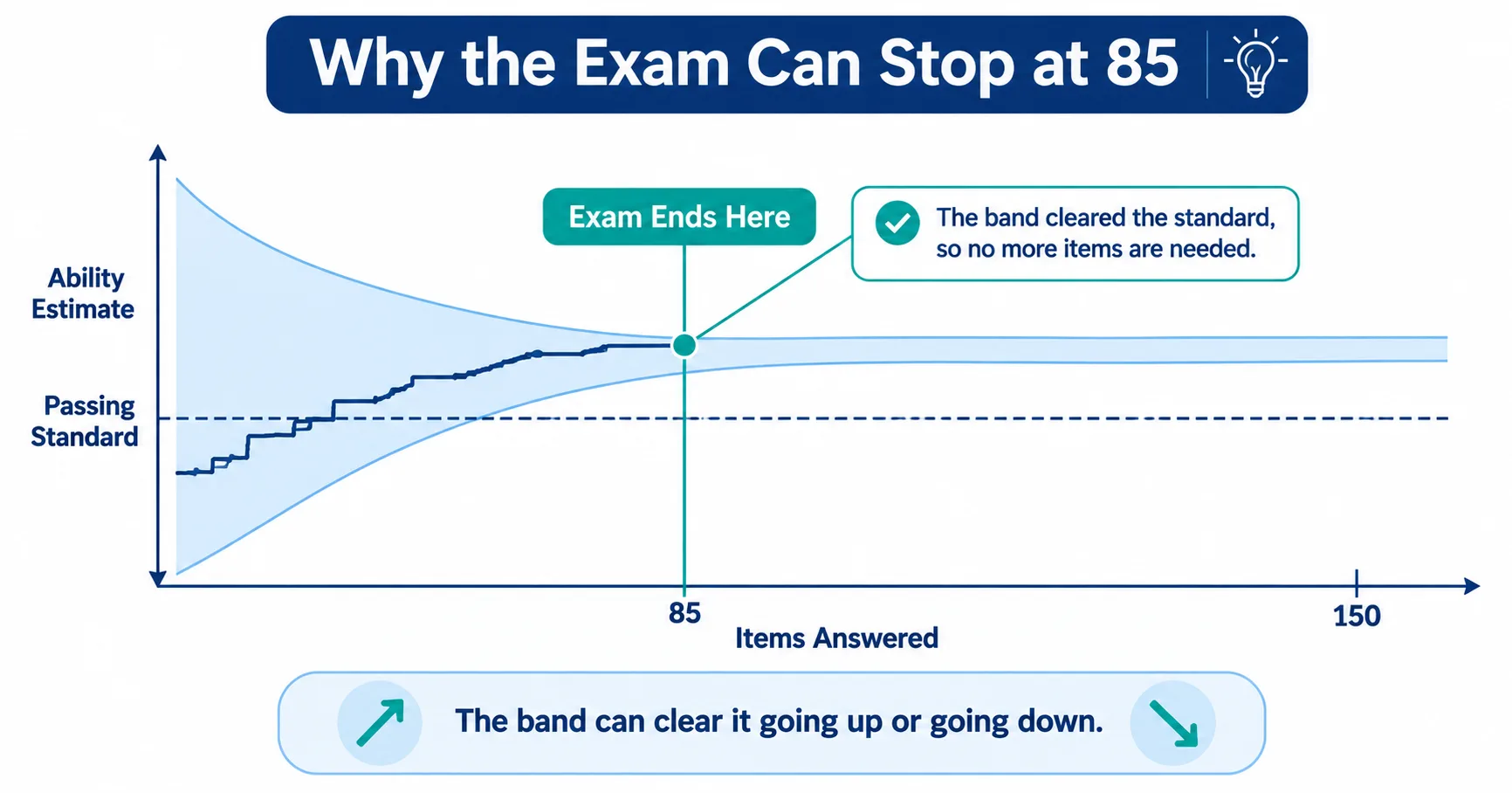
The NCLEX ends at NCLEX 85 questions when the computer reaches 95% certainty that your ability is clearly above or clearly below the passing standard at the earliest possible point. That certainty can be reached in either direction, so ending at NCLEX 85 questions does not indicate a pass. The 85-item minimum exists because the exam needs that many items to cover the test plan: 52 content area items, 18 case study items, and 15 unscored pretest items.
Why 85 Specifically?
Most articles tell you 85 is the minimum. Very few explain why it is 85 rather than 60 or 100.
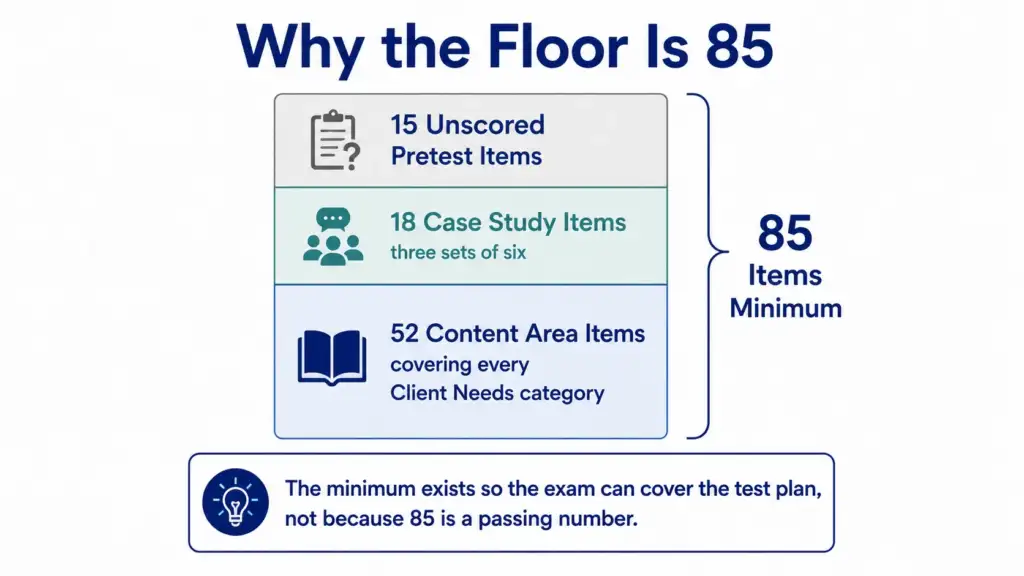
The number comes from what the exam has to cover before it can produce a valid result. Breaking down a minimum-length NCLEX-RN:
| Component | Items |
|---|---|
| Content area items, spanning the Client Needs categories | 52 |
| Clinical judgment case study items, three sets of six | 18 |
| Unscored pretest items | 15 |
| Total | 85 |
Each piece is doing necessary work. The 52 content items have to sample across every Client Needs category, because a licensure exam that measured only some areas of nursing would not support a licensure decision. The 18 case study items are fixed on every exam regardless of length. The 15 pretest items are how NCSBN gathers performance data on new items before they count for anyone.
So the minimum is not a statistical threshold and it is certainly not a passing number. It is the point at which the exam has covered its own blueprint. Below that, there is not enough breadth to justify a decision no matter how clear your performance looks.
The same 85-item minimum and 150-item maximum apply to both the NCLEX-RN and the NCLEX-PN, within a five-hour appointment that includes all breaks.
What Ending at 85 Actually Means
The exam ends under one of three rules. If yours stopped at 85, the rule that applied was almost certainly the 95% confidence interval rule: the computer stops administering items when it is 95% certain that your ability is clearly above or clearly below the passing standard.
Read that phrase again, because the whole myth lives in it. The rule fires in both directions. It fires the moment the evidence separates cleanly from the standard, and separating cleanly downward triggers it exactly as fast as separating cleanly upward.
So ending at 85 tells you one thing: your answers produced a clear signal quickly. A candidate performing consistently well and a candidate performing consistently poorly both produce clear signals quickly. The two look identical from inside the test centre.
Can You Fail at 85 Questions?
Yes. And you can pass at 150.
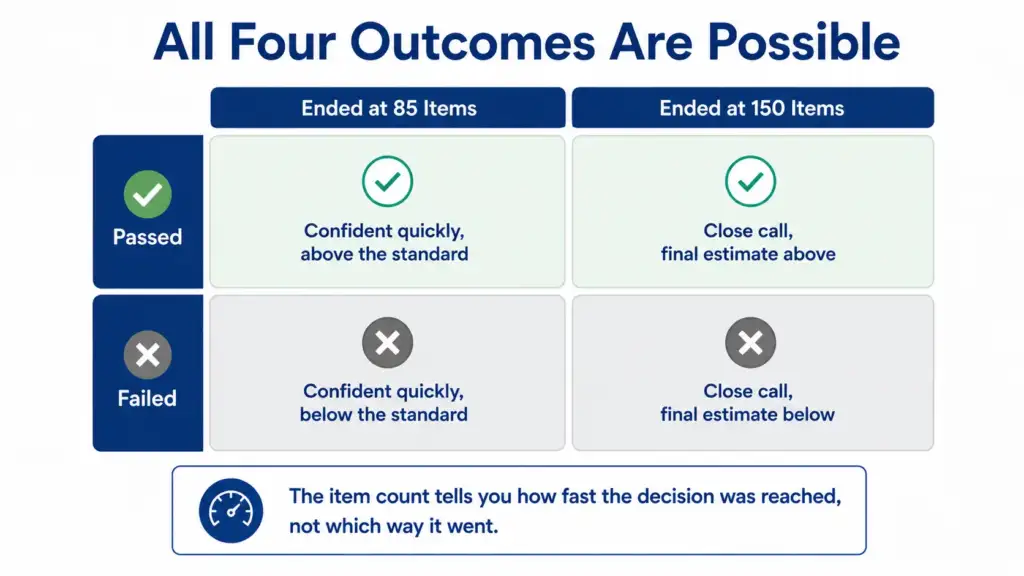
All four combinations happen:
| Ended at 85 | Ended at 150 | |
|---|---|---|
| Passed | The estimate cleared the standard early | A close call, resolved above the standard |
| Failed | The estimate fell clearly below early | A close call, resolved below the standard |
A long exam is not a punishment and it is not a bad sign. Under the maximum-length rule, reaching the maximum simply means your ability estimate stayed too close to the standard for the confidence rule to resolve. At that point the computer sets the confidence requirement aside and looks only at your final ability estimate. At or above the standard, you pass.
Candidates who reach the maximum are, by definition, the borderline group. Some of them pass and some do not, which is exactly what you would expect.
There is a second reason a long exam is not bad news, and it is worth sitting with if you tested recently and went the distance. The confidence rule failing to fire means the evidence never separated clearly downward either. You were never obviously below the line. That is not nothing.
Should You Count Questions During the Exam?
No, and the reason is practical rather than superstitious.
Counting costs attention. Every second spent tracking your item number and calculating how close you are to 85 is a second not spent reading the item in front of you. On an exam where each answer directly updates the estimate that decides your result, that trade is bad.
There is also nothing to gain. The count cannot tell you how you are doing, because the item you are on carries no information about your ability estimate. Neither does the difficulty of the items, incidentally: NCSBN states that candidates should find each item challenging, because each item is targeted to their ability. Everyone should find it hard, including candidates who are passing comfortably.
Some candidates report noticing the exam continue past 85 and treating it as bad news, then losing focus for the next twenty items. That reaction can genuinely change the result, which makes it the one exam-day superstition with real consequences.
The useful posture is to answer every item as though it is the last one you will get and as though there are sixty more coming, because either could be true.
What Happens After the Screen Closes

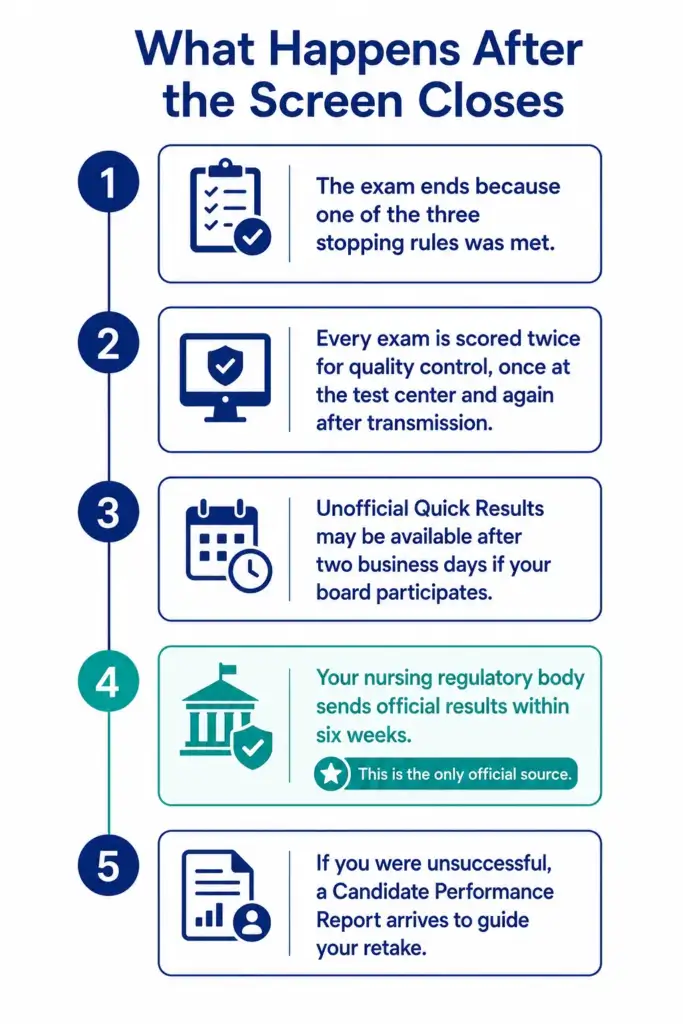
The exam ends abruptly. There is no summary screen and no indication of what happened. Here is the actual sequence.
Your exam is scored twice. For quality control, every NCLEX is scored once by the computer at the test centre, and again after the exam record has been transmitted to Pearson. This dual scoring is one reason results are not handed to you on the spot even though the decision was reached before you stood up.
Unofficial Quick Results may be available after two business days. Some nursing regulatory bodies offer the Quick Results service, which lets candidates seeking US licensure access an unofficial result as early as two business days after the exam, for a fee of $7.95. Two points matter here. Not every board participates, so the option may simply not appear for you. And the word business is doing work: testing on a Friday usually means waiting until the following week. NCSBN describes the timeline as an estimate rather than a guarantee.
Quick Results does not authorise you to practise as a licensed nurse. It is an early read, not a licence.
Official results come from your nursing regulatory body within six weeks. This is the only official channel. NCSBN, Pearson Candidate Services, and the test centres cannot give you your result, and calling them will not speed anything up. If more than six weeks pass without a result, contact your board.
If you were unsuccessful, you receive a Candidate Performance Report showing how you performed in each content area relative to the passing standard, intended as a guide for preparing to retake.
About the Pearson VUE Trick
It will come up, so it is worth addressing plainly.
The so-called Pearson VUE trick is an unofficial method candidates have used for years to guess their result early, based on how the registration system responds when they attempt to re-register. It is not endorsed by NCSBN or Pearson, it is not a scoring feature, and it has never been documented as reliable by anyone with access to the actual results data.
Two practical cautions. It requires entering payment card details into a live registration flow, which is a real risk if anything about the process has changed. And a wrong read produces days of unnecessary distress in either direction, which is a meaningful cost when you are already waiting.
If you want an early answer and your board participates, Quick Results is the legitimate route and it costs less than eight dollars.
Common Misconceptions
“85 questions means I passed.” It means the computer became confident quickly, in one direction or the other.
“150 questions means I failed.” It means the decision was close. Close resolves both ways.
“The exam stopped early because I was doing badly.” Or well. The rule fires in both directions at the same speed.
“The questions got easier, so I was failing.” Perceived difficulty tracks which content you drew as much as anything else, and NCSBN says every item should feel challenging regardless.
“The last question tells you something.” It does not. There is no meaningful signal in the final item.
“There’s a minimum passing percentage.” There is no percentage at all. The exam compares an ability estimate against a fixed standard.
“Everyone who ends at 85 in my cohort passed, so it must mean something.” Candidates who pass talk about it more than candidates who do not. The sample you hear about is not the sample that exists.
What to Do While You Wait
Two days to six weeks is a genuinely difficult stretch, and there is no version of this where analysis helps.
You cannot reconstruct your result from memory of the exam. Candidates consistently misremember which items they answered well, partly because the items designed to be hardest for you are the ones that stick. Reviewing content you saw on the exam produces nothing except confirmation that you did not know something, which tells you nothing about the estimate.
Practical suggestions that do not involve the exam: set a specific day to check Quick Results rather than checking repeatedly, tell one or two people your timeline so you are not fielding the question constantly, and put something in the calendar for the waiting period that requires your attention.
If the result is not what you hoped for, the Candidate Performance Report and a proper diagnosis of what went wrong are a far better starting point than a rushed retake booking. Repeat candidates who change their preparation do meaningfully better than those who repeat it more intensively.
Key Takeaways

- Ending at 85 questions does not indicate a pass. The 95% confidence rule fires in both directions.
- The 85-item minimum exists so the exam can cover the test plan: 52 content area items, 18 case study items, and 15 unscored pretest items.
- The 85 minimum and 150 maximum apply to both the NCLEX-RN and NCLEX-PN, within a five-hour appointment including breaks.
- You can pass at 85, fail at 85, pass at 150, or fail at 150.
- A long exam means the decision was close, not that it went against you.
- Counting questions during the exam costs attention and gains nothing.
- Every NCLEX is scored twice for quality control.
- Quick Results is unofficial and may be available after two business days for $7.95 if your board participates. Official results come only from your board, within six weeks.