

NCLEX pediatric nursing is a content area that many nursing students underestimate during their exam preparation. Because pediatric clinical rotations are shorter than medical-surgical rotations, students often feel less confident with child health content — and that gap in confidence can translate directly into lost points on exam day.
According to the NCSBN test plan, health promotion and maintenance — which includes growth and development, pediatric assessment, and child health promotion — accounts for approximately 6 to 12 percent of the NCLEX-RN. Beyond that, pediatric conditions appear across physiological adaptation, reduction of risk potential, and pharmacological and parenteral therapies, making pediatric content a thread that runs through a meaningful portion of the entire exam.
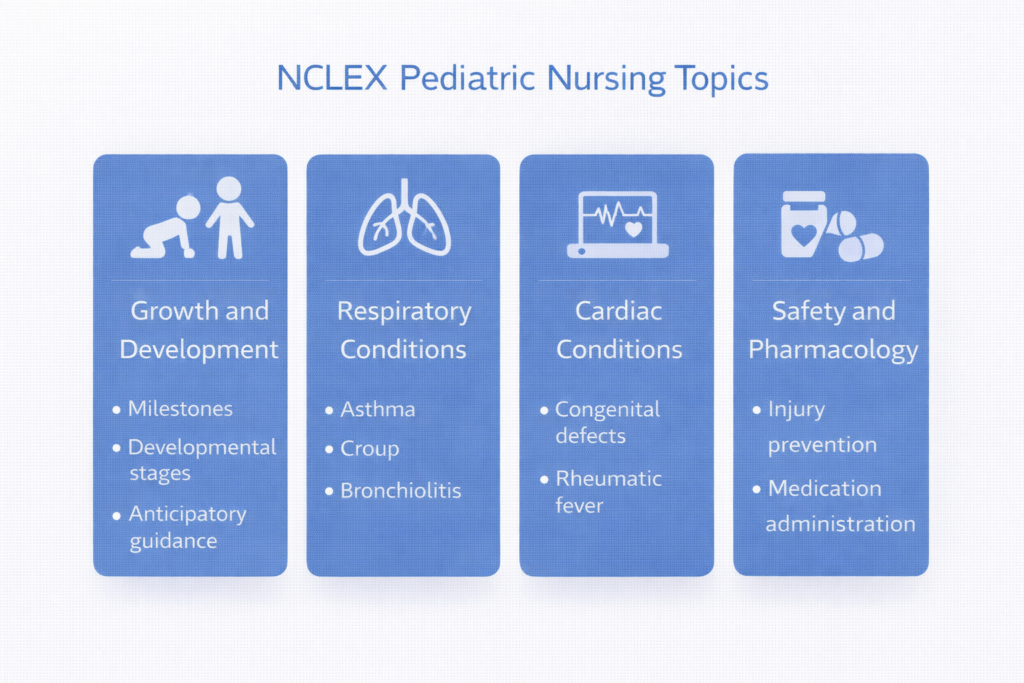
This guide covers the highest-yield topics in NCLEX pediatric nursing for 2026, from growth and development milestones to respiratory emergencies, cardiac conditions, child safety, and pediatric medication calculations. Whether you feel confident in this content area or have been putting off reviewing it, this guide will help you focus your preparation where it matters most.
Why NCLEX Pediatric Nursing Questions Require a Different Mindset
NCLEX pediatric nursing questions are built around a fundamental principle that makes them distinct from adult nursing questions: children are not small adults. Their anatomy, physiology, pharmacokinetics, developmental stage, and communication needs are all different — and the NCLEX tests whether you understand those differences and can apply them clinically.
The most common mistake students make with pediatric questions is applying adult nursing reasoning to a child. Normal vital sign ranges differ significantly by age group. A heart rate of 100 beats per minute is tachycardic in an adult but normal in a toddler. A respiratory rate of 30 is abnormal in a school-age child but expected in a neonate. Applying adult reference ranges to pediatric patients is one of the fastest ways to select the wrong answer on this section of the exam.
NCLEX pediatric nursing also requires you to consider the family unit as the context for care. Family-centered care is a foundational principle that appears throughout pediatric questions — the nurse’s role includes educating and supporting parents and caregivers, not just treating the child. Questions that ask about patient teaching in a pediatric scenario almost always include the parent or guardian as the target of that education.
How Pediatric Content Is Distributed Across the NCLEX
Pediatric nursing content appears across multiple NCLEX test plan categories. Growth and development, immunizations, and anticipatory guidance fall under health promotion and maintenance. Acute pediatric conditions — respiratory illnesses, cardiac defects, and neurological emergencies — appear under physiological adaptation and reduction of risk potential. Pediatric pharmacology is embedded in the pharmacological and parenteral therapies category. This broad distribution means you will encounter NCLEX pediatric nursing questions throughout the exam rather than in a single concentrated section.
Growth and Development: A Core Foundation for NCLEX Pediatric Nursing
Growth and development is one of the most consistently tested topics in NCLEX pediatric nursing. Questions in this area test your knowledge of expected developmental milestones by age group, Erikson’s psychosocial stages, and the nursing implications of normal versus delayed development.
Key Developmental Milestones by Age Group
Infant milestones tested on the NCLEX include holding the head steady by two months, rolling over by four to six months, sitting without support by six to eight months, pulling to stand by nine to twelve months, and walking independently by twelve to fifteen months. Language development is also tested: infants should coo and babble by three to four months, say single words by twelve months, and use two-word phrases by twenty-four months. Any significant delay in these milestones is a nursing concern that warrants further assessment and referral.
For toddlers, the NCLEX focuses on the development of autonomy, parallel play, and the emergence of language. Preschoolers are tested in the context of initiative versus guilt — they engage in imaginative play, begin to understand simple rules, and ask frequent questions. School-age children are assessed for industry versus inferiority, with a focus on peer relationships, logical thinking, and the ability to follow complex instructions. Adolescents are tested in the context of identity formation, risk-taking behavior, and the nurse’s role in providing confidential, non-judgmental care.
Erikson’s Psychosocial Stages in Pediatric Questions
Erikson’s stages appear regularly in NCLEX pediatric nursing questions as the framework for understanding a child’s behavioral and emotional responses to illness and hospitalization. Trust versus mistrust in infancy means that consistent, responsive caregiving is the nursing priority. Autonomy versus shame in toddlerhood means allowing choices wherever possible. Initiative versus guilt in preschoolers means encouraging participation in care. Understanding these stages helps you select the correct nursing approach when a question describes a child’s behavior in a clinical setting.

High-Yield Respiratory Conditions in NCLEX Pediatric Nursing
Respiratory conditions are among the most heavily tested topics in NCLEX pediatric nursing. Children are especially vulnerable to respiratory compromise because of their smaller airways, faster respiratory rates, and higher metabolic demand for oxygen. Recognizing respiratory distress in a child and knowing the correct nursing response is a critical competency the NCLEX tests repeatedly.
Croup and Epiglottitis
Croup and epiglottitis are tested as a contrasting pair in NCLEX pediatric nursing. Croup is a viral condition causing subglottic swelling, characterized by a distinctive barking cough, inspiratory stridor, and a gradual onset typically worse at night. It is managed with cool mist humidification, racemic epinephrine for moderate to severe cases, and corticosteroids to reduce inflammation. Epiglottitis is a bacterial emergency with sudden onset high fever, drooling, a muffled or hot-potato voice, and the classic tripod positioning. The nurse must never attempt to examine the throat or place anything in the mouth of a child with suspected epiglottitis, as this can precipitate complete airway obstruction.
Bronchiolitis and Asthma
Bronchiolitis — most commonly caused by respiratory syncytial virus (RSV) — primarily affects infants under two years old and presents with wheezing, tachypnea, nasal flaring, and intercostal retractions. Nursing management focuses on supportive care: positioning the head of the bed at 30 to 45 degrees, suctioning nasal secretions, monitoring oxygen saturation, and ensuring adequate hydration. Palivizumab is the prophylactic medication for high-risk infants. Asthma in the pediatric patient is tested in terms of trigger identification, proper inhaler technique, the difference between rescue and controller medications, and the signs of status asthmaticus requiring emergency intervention.
Respiratory Distress Signs in Children
The NCLEX expects you to recognize the universal signs of respiratory distress in a child across all age groups: nasal flaring, intercostal and subcostal retractions, grunting on expiration, use of accessory muscles, tachypnea above the normal range for age, and declining oxygen saturation. In infants, head bobbing is an additional sign of significant respiratory effort. Any child showing these signs requires immediate nursing assessment and intervention.
Congenital Heart Defects and Cardiac Conditions in NCLEX Pediatric Nursing
Congenital heart defects are high-yield content in NCLEX pediatric nursing and one of the areas students find most difficult. The key to mastering this content is organizing defects into two categories — acyanotic and cyanotic — and understanding the hemodynamic principle behind each one.
Acyanotic Defects: Left-to-Right Shunts
Acyanotic defects allow oxygenated blood to shunt from the left side of the heart to the right side, increasing pulmonary blood flow. The most commonly tested acyanotic defects are ventricular septal defect, atrial septal defect, and patent ductus arteriosus. Children with these defects may present with a heart murmur, frequent respiratory infections, poor weight gain, and signs of congestive heart failure. Nursing priorities include monitoring for heart failure, promoting adequate nutrition, and preparing the family for surgical or catheter-based repair.
Cyanotic Defects: Right-to-Left Shunts
Cyanotic defects shunt deoxygenated blood into the systemic circulation, causing visible cyanosis. Tetralogy of Fallot is the most commonly tested cyanotic defect on the NCLEX. It consists of four anatomical abnormalities: pulmonary stenosis, ventricular septal defect, overriding aorta, and right ventricular hypertrophy. A key nursing concept for Tetralogy of Fallot is the tet spell — an episode of acute hypoxia triggered by crying, feeding, or defecation. The nursing intervention for a tet spell is to place the child in the knee-chest position, which increases systemic vascular resistance and improves pulmonary blood flow. Transposition of the great arteries is another cyanotic defect tested in the context of immediate neonatal emergency and prostaglandin E1 administration to maintain ductal patency until surgery.
Child Safety, Immunizations, and Pharmacology in NCLEX Pediatric Nursing
Child safety, immunization schedules, and pediatric pharmacology are practical, application-based topics that appear regularly in NCLEX pediatric nursing questions and are highly amenable to focused study.
Child Safety by Developmental Stage
Safety anticipatory guidance is a major component of NCLEX pediatric nursing health promotion questions. Each developmental stage carries specific safety priorities. For infants, the highest-yield topics are sudden infant death syndrome prevention — including back-sleeping position, firm mattress, and no loose bedding — and prevention of falls and aspiration. For toddlers, the priorities are poisoning prevention including safe medication storage, drowning prevention, and car seat safety. For school-age children, bicycle helmet use and pedestrian safety are commonly tested. Adolescent safety questions focus on motor vehicle accidents, substance use, and sexual health education.
Pediatric Immunization Schedule
The NCLEX tests your knowledge of the recommended childhood immunization schedule and the contraindications for specific vaccines. Key vaccines and their timing include hepatitis B at birth, DTaP at two, four, six, and fifteen to eighteen months, MMR at twelve to fifteen months, varicella at twelve to fifteen months, and meningococcal vaccine at eleven to twelve years. Live vaccines — MMR, varicella, and rotavirus — are contraindicated in immunocompromised children. The nurse must also be able to identify and manage common post-vaccination reactions, including low-grade fever, injection-site soreness, and the rare but serious anaphylactic response.
Pediatric Pharmacology and Weight-Based Dosing
Pediatric medication questions on the NCLEX frequently require weight-based dose calculations. The standard approach is to calculate the safe dose range in milligrams per kilogram per day, determine whether the ordered dose falls within that range, and identify the correct nursing response if it does not. Beyond calculations, NCLEX pediatric nursing pharmacology questions test your knowledge of age-specific medication considerations — aspirin is contraindicated in children due to the risk of Reye syndrome, codeine is not recommended in children under twelve, and certain antibiotics carry specific pediatric warnings.
How to Study NCLEX Pediatric Nursing Effectively in 2026
NCLEX pediatric nursing covers a wide breadth of content, but it rewards students who study it systematically. The following approach will help you build both the knowledge base and the clinical reasoning skills this content area demands.
Begin your pediatric review by building a solid foundation in normal values by age group. Create a reference card for normal vital sign ranges — heart rate, respiratory rate, blood pressure, and oxygen saturation — across the major pediatric age groups: neonate, infant, toddler, preschooler, school-age, and adolescent. This reference becomes the baseline against which you evaluate every NCLEX pediatric nursing scenario. Without it, you cannot accurately identify what is abnormal.
For high-yield conditions like croup versus epiglottitis, acyanotic versus cyanotic heart defects, and bronchiolitis versus asthma, study them as comparison pairs. The NCLEX frequently presents two conditions that share surface-level similarities but require completely different nursing responses. Knowing the distinguishing features and the priority nursing intervention for each side of the comparison is the most reliable way to answer these questions correctly.
Practice applying Erikson’s developmental stages to clinical scenarios. When a question describes a four-year-old refusing to take medication or a toddler crying inconsolably when parents leave, the correct nursing response flows directly from your understanding of that child’s developmental stage. Integrating this framework into your thinking as you read pediatric scenarios will significantly improve your accuracy on NCLEX pediatric nursing questions.
Conclusion
NCLEX pediatric nursing is a content area that rewards precision, pattern recognition, and a clear understanding of how children differ from adult patients at every stage of development. The exam does not require you to know everything about pediatric nursing — it requires you to know the highest-yield topics deeply and to apply them correctly under clinical reasoning pressure.
Build your foundation in normal pediatric values, master the key developmental milestones, know your respiratory and cardiac conditions as comparison pairs, and stay sharp on immunizations and weight-based pharmacology. Approach every NCLEX pediatric nursing question as a clinical scenario that asks you to think like a nurse caring for a child and a family — and you will be well positioned to perform confidently on this section of the exam.
