

NCLEX question banks are the most widely used paid preparation resource among nursing students — and the category where the quality difference between platforms has the most direct impact on exam outcomes. A high-quality question bank does not just give you questions to answer; it builds the clinical reasoning patterns that produce correct answers under the pressure of the actual exam. A low-quality one gives you false confidence through poorly written distractors, shallow rationales, and question formats that do not reflect what the NCLEX actually looks like in 2026.
The stakes of choosing the wrong NCLEX question bank are higher now than they were before the Next Generation NCLEX launched in 2023. Platforms that have not genuinely updated their question sets and delivery systems to reflect the new NGN formats — unfolding case studies, bow tie questions, extended multiple response, matrix items, and enhanced hot spot highlighting — are preparing candidates for an exam that no longer exists. A candidate who completes three thousand questions from a platform with inadequate NGN coverage will arrive at the testing center prepared for a significant portion of the exam but genuinely underprepared for the NGN formats that appear throughout it.
This guide evaluates the best NCLEX question banks available in 2026 against the criteria that actually determine preparation value: question quality, NGN format coverage, rationale depth, performance analytics, adaptive delivery, and overall value. For each platform, it explains what the question bank does best, where its limitations lie, and which candidate profile gets the most value from it. The goal is to give you the clearest possible picture of which NCLEX question banks are worth your preparation time and money in 2026 — and how to use whichever platform you choose to its maximum effect.
What Separates the Best NCLEX Question Banks From the Rest
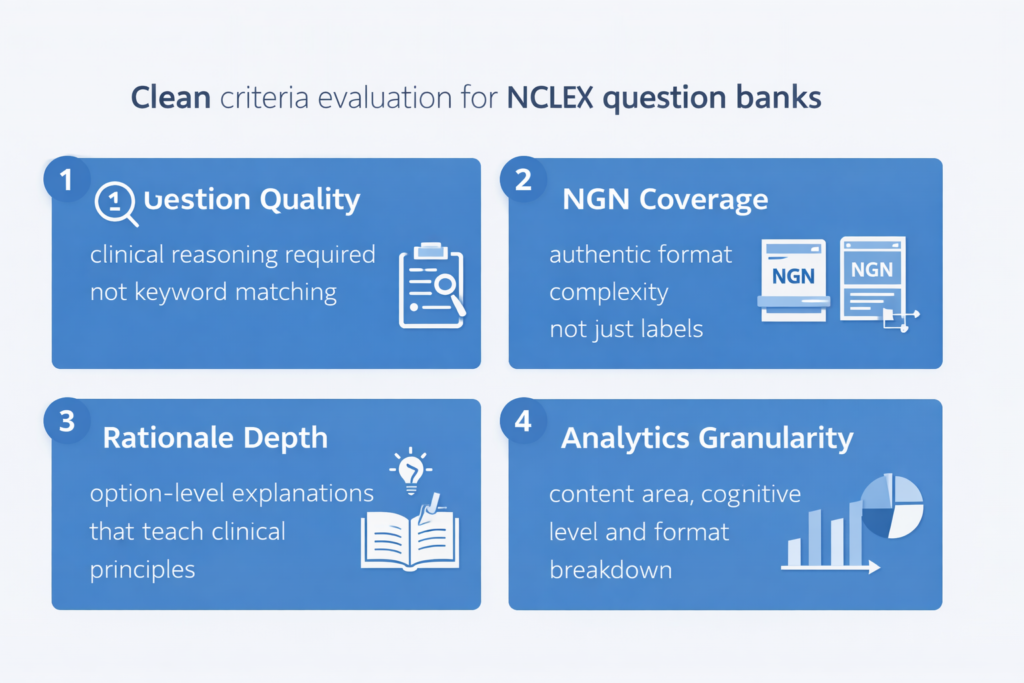
Not all NCLEX question banks are built to the same standard, and the differences that matter most are not always visible from a platform’s marketing page. Before comparing specific platforms, understanding the criteria that define genuine preparation value helps you evaluate any question bank — including options that launch after this guide is published.
Question Quality and Clinical Authenticity
The foundation of any NCLEX question bank is the quality of its questions. High-quality questions present realistic clinical scenarios with sufficient detail to require genuine clinical reasoning — not simple pattern matching or keyword recognition. The correct answer must be defensible through explicit clinical logic, and the distractors must be constructed from real clinical misconceptions rather than obviously wrong options. The clearest signal of question quality is whether a question requires you to think through a clinical situation or whether you can identify the correct answer without fully processing the scenario. NCLEX question banks whose questions can be answered by keyword recognition rather than clinical reasoning are training a test-taking habit that fails on the actual exam, where question complexity is specifically designed to prevent keyword shortcuts.
NGN Format Coverage and Authenticity
NGN coverage in NCLEX question banks varies from genuinely comprehensive to superficially labeled. Genuine NGN coverage means that unfolding case studies present evolving clinical scenarios across six questions that map to the CJMM cognitive skills in sequence, that bow tie questions use the authentic three-section structure, that extended multiple response items include appropriate partial credit scoring mechanics, and that matrix questions require independent row-by-row clinical evaluation. Superficial NGN coverage means a handful of questions labeled as NGN that do not replicate the actual format complexity. The distinction is visible only by working through the NGN questions themselves — platform marketing language is not a reliable guide to coverage quality.
Rationale Depth and Clinical Teaching
The rationale system is where the most meaningful quality difference between NCLEX question banks is expressed. Top-tier platforms provide a separate clinical explanation for every answer option — not just the correct one — that teaches the underlying reasoning principle rather than simply confirming or rejecting the selection. Platforms that provide only a correct-answer explanation and a brief content summary produce weaker learning outcomes because they do not address the clinical misconception that generated the incorrect selection. When evaluating NCLEX question banks, answer a practice question incorrectly and read the full rationale — if it does not explain specifically why your chosen option was wrong and what clinical principle the correct option reflects, the rationale system is not building the clinical reasoning the exam requires.
Performance Analytics Granularity
The performance analytics built into NCLEX question banks determine how effectively you can identify and close your preparation gaps. The minimum useful analytics level is accuracy broken down by content area. The best NCLEX question banks go significantly further: accuracy by cognitive level (knowledge, application, analysis), accuracy by question format (traditional multiple choice, SATA, NGN formats separately), performance trends over time for each content area, and comparison against a passing benchmark or peer percentile. The more granular the analytics, the more precisely you can direct your preparation time — which is the most direct path to efficient improvement.
The Best NCLEX Question Banks for 2026: Platform-by-Platform Analysis

The following platforms represent the most widely used and most consistently recommended NCLEX question banks among nursing students and educators for the current exam. Each analysis covers question quality, NGN coverage, rationale system, analytics, adaptive functionality, and value — along with the candidate profile that gets the most preparation benefit from each platform.
UWorld Nursing — Best Overall
UWorld is the most widely used of all NCLEX question banks and the platform most consistently cited by recent passers as their primary preparation resource. Its question quality is the highest available — scenarios are clinically realistic, distractors are constructed from genuine clinical misconceptions, and the correct answer requires explicit clinical reasoning that mirrors the cognitive demand of actual NCLEX questions. The rationale system is the most thorough in the category: every answer option receives a separate clinical explanation, pathophysiology diagrams and clinical illustrations accompany complex concepts, and the teaching depth extends well beyond confirming the correct selection. UWorld’s analytics are exceptionally granular — content area accuracy, cognitive level breakdown, NGN versus traditional format accuracy, performance trends over time, and a percentile ranking against peers preparing for the same exam. NGN coverage is integrated throughout the question bank rather than segregated into a separate section, with all five NGN formats represented at a complexity level that authentically reflects the current exam. UWorld’s primary limitation is cost — it is among the more expensive NCLEX question banks available. The free trial provides a limited but meaningful question set. For candidates who can afford one paid question bank, UWorld is the most defensible investment in the category.
Nurse Achieve — Best for NGN Focus
Nurse Achieve was built with explicit NGN alignment from the ground up, making it the strongest alternative to UWorld among NCLEX question banks for candidates whose primary preparation gap is NGN format competency. The platform includes robust unfolding case study sets, authentic bow tie questions, extended multiple response with partial credit mechanics, and matrix items that accurately reflect the current exam’s format complexity. Rationale quality is solid — explanations address incorrect options and are grounded in clinical reasoning principles — though slightly less detailed than UWorld’s illustration-supported system. Analytics include content area breakdown and separate NGN performance tracking, which makes it easier to identify whether NGN-specific accuracy is lagging behind traditional format performance. Nurse Achieve is priced below UWorld, making it a strong value choice for candidates who prioritize comprehensive NGN coverage at a lower cost. For candidates who have worked primarily with pre-NGN question banks and need to build genuine NGN competency, Nurse Achieve is the most targeted platform available.
Kaplan NCLEX-RN Qbank — Best for Test-Taking Strategy
Kaplan’s NCLEX question banks stand apart from other platforms through their integration of explicit test-taking strategy instruction alongside question practice. The Kaplan Decision Tree — a structured clinical reasoning framework for systematic answer elimination — is embedded throughout the question rationale system, making it the only major platform that consistently teaches candidates how to approach questions rather than just which answer was correct. The qBank includes adaptive delivery, a substantial question pool, and NGN content that has improved significantly in recent updates. Analytics include content area accuracy and performance trending. Kaplan’s question quality is strong, though the complexity of individual questions is slightly lower than UWorld’s at the highest difficulty levels. The platform is most effective for candidates who have solid clinical content knowledge but consistently struggle to translate that knowledge into correct answers — a pattern where strategy instruction produces faster improvement than additional content review. Among NCLEX question banks primarily serving candidates who need to think more systematically under pressure, Kaplan delivers the most targeted value.
NCSBN Learning Extension — Best for Official Calibration
The NCSBN Learning Extension is the only one of the major NCLEX question banks developed directly by the organization that writes and administers the exam. Its questions are written by NCSBN item developers, which means they represent the most authoritative possible calibration of what actual exam questions look and feel like. NGN coverage is definitionally accurate — the NCSBN’s own practice questions for NGN formats reflect exactly how those formats work on the real exam, without the subtle format variations that sometimes appear in third-party platforms. Analytics include content area performance tracking and a structured review curriculum alongside the question bank. The platform’s limitations relative to UWorld and Nurse Achieve are a smaller overall question pool and a less polished user interface. However, for any candidate who wants to ensure their preparation is calibrated precisely to the actual exam standard, the NCSBN Learning Extension belongs in their NCLEX question banks toolkit — either as a primary resource or as a calibration check alongside a larger third-party platform.
Archer Review — Best Value for Budget-Conscious Candidates
Archer Review has established a strong reputation among NCLEX question banks for delivering high-quality question and rationale content at a price point significantly below the major platforms. The question quality is strong — clinical scenarios are realistic, distractors reflect genuine clinical misconceptions, and rationales address the reasoning behind incorrect options with meaningful depth. NGN coverage has been updated for the current exam and includes all five NGN formats with authentic format complexity. Analytics include content area performance breakdown and performance trending. Archer’s user interface is less polished than UWorld or Kaplan, and the question pool, while substantial, is smaller than the largest platforms. For candidates whose preparation budget is limited but who need a high-quality question bank that goes beyond free resources, Archer Review is the strongest value option among paid NCLEX question banks in 2026.
Saunders Online Review — Best as a Book-Companion Platform
The Saunders Online Review question bank is the digital companion to the Saunders Comprehensive Review book and shares its primary strength: exceptional breadth of content coverage across every area of the NCSBN test plan. For candidates who use the Saunders book as their primary review text, the online question bank provides seamless integration — questions are organized by the same content categories as the book chapters, making it easy to complete chapter-level practice immediately after reading. The question pool is among the largest of any NCLEX question banks, exceeding five thousand items. NGN content is present in the updated edition, though NGN depth is more limited than dedicated platforms like UWorld or Nurse Achieve. Analytics are functional but less granular than the top-tier platforms. Saunders Online Review is most effective as a companion to the review book rather than as a standalone primary question bank.
How to Use NCLEX Question Banks to Maximize Your Pass Rate
The platform you choose matters less than how deliberately and systematically you use it. The following strategies apply to any of the NCLEX question banks reviewed above and represent the practices that most consistently separate candidates who improve rapidly from those who plateau despite completing high question volumes.
Start With a Diagnostic Block, Not a Content Block
The most efficient way to begin using any NCLEX question banks platform is with a diagnostic question block — a mixed-content session of 75 to 100 questions drawn from across all content areas with no filtering. Do this before you begin any targeted content review or content-filtered question sessions. The diagnostic block establishes your baseline accuracy profile across all content areas simultaneously, revealing your strongest and weakest areas in a single session. Without this baseline, you cannot allocate your preparation time intelligently — you are studying by instinct rather than data. Every subsequent content-area decision should be anchored to what your diagnostic block reveals, not to what you feel least confident about.
Read Every Rationale as a Clinical Teaching Document
The rationale system in NCLEX question banks is the core learning mechanism — not the questions themselves. A question tells you whether your current reasoning is correct; the rationale teaches you the clinical principle that should have guided your reasoning. To extract maximum value from any rationale, read the explanation for every answer option regardless of whether you answered correctly, identify the specific clinical principle the rationale is teaching, and ask yourself whether that principle would change how you approach a similar question in the future. NCLEX question banks that you use primarily for question completion without deep rationale engagement produce weaker preparation outcomes than platforms used at lower volume with thorough rationale review. Fewer questions reviewed thoroughly outperform more questions reviewed superficially every time.
Filter by Weak Area, Not by Comfort Area
One of the most common misuses of NCLEX question banks is filtering question sessions toward content areas where performance is already strong. Strong-area practice feels productive — accuracy is high, confidence increases — but it contributes minimally to closing the preparation gaps that are most likely to affect the actual exam outcome. Filter your daily sessions toward the two or three content areas with the lowest accuracy in your analytics. Practice in weak areas feels uncomfortable because accuracy is lower, but discomfort is the signal that real learning is occurring. Reserve mixed-content sessions for weekly simulation rather than for daily targeted practice, and let your analytics data — not your comfort level — determine what content area each practice session covers.
Track NGN Accuracy Separately From Traditional Format Accuracy
Among the most important analytics to monitor in your NCLEX question banks platform is the split between your NGN format accuracy and your traditional format accuracy. Many candidates who show strong overall accuracy are masking significantly weaker NGN performance — their traditional multiple choice scores are high enough to raise the overall average above where their NGN performance alone would sit. Identifying this split early allows you to allocate additional NGN-specific practice before the imbalance becomes a problem on exam day. If your platform does not break out NGN accuracy separately, create your own tracking by recording NGN question results in a separate column of your performance spreadsheet.
How Many Questions Do You Need? A Realistic Target for 2026
Question volume is one of the most discussed and most misunderstood topics in NCLEX preparation. Candidates frequently ask how many questions they need to complete before they are ready for the exam — and the answer is more nuanced than any single number can capture.
The research-supported range cited most consistently by nursing educators and NCLEX preparation specialists is 3,000 to 5,000 questions completed before the exam, with daily practice of at least 50 questions per day increasing to 75 to 100 questions per day in the final two weeks. At this volume, most candidates have encountered sufficient clinical scenario variety to develop the pattern recognition that supports clinical judgment, and have generated enough performance data for their analytics to reliably identify preparation gaps.
However, question volume is only meaningful if it is accompanied by rationale review. A candidate who completes 5,000 questions without reviewing rationales has built question-answering habits but not clinical reasoning — and on a sophisticated adaptive exam like the NCLEX, habits without reasoning fail at the difficulty levels the CAT algorithm targets. A candidate who completes 3,000 questions with thorough rationale review and deliberate weak-area targeting will almost always outperform a candidate who completes 5,000 questions with superficial rationale engagement, on NCLEX question banks and on the actual exam.
Pacing Across a Six-Week Preparation Timeline
For a six-week preparation timeline, the following pacing distributes question volume effectively across the preparation period. Weeks one and two focus on establishing the daily question habit and completing the diagnostic baseline — 50 questions per day, full rationale review, content-area tracking established. Weeks three and four shift to targeted weak-area practice — 75 questions per day, sessions filtered toward low-accuracy content areas, NGN formats included in every session. Weeks five and six shift to simulation mode — 75 to 100 questions per day, mixed-content sessions, at least one full timed simulation of 100 or more questions per week, and NGN-specific calibration using the NCSBN Learning Extension or another officially sourced NGN practice set. This pacing produces approximately 2,500 to 3,500 questions over six weeks — within the research-supported effective range — with the distribution weighted toward high-value targeted practice rather than uniform volume across the preparation period.
Common Mistakes When Using NCLEX Question Banks
Even candidates using the highest-quality NCLEX question banks make predictable preparation errors that limit the value they extract from the platform. Recognizing these patterns helps you avoid them.
- Completing questions without reviewing rationales: The most consequential misuse of any NCLEX question banks platform is answering questions without reading the full rationale. This produces question completion without clinical reasoning development — the equivalent of taking practice tests without learning from the results. Every question is only complete after the full rationale has been read, including the explanations for all incorrect options. This rule applies to questions you answered correctly as well as incorrectly.
- Treating high practice scores as exam readiness: A consistently high score within NCLEX question banks does not guarantee exam readiness — particularly if that score is driven by strong performance in your best content areas and masked weak-area performance. Evaluate your readiness based on your weakest content area accuracy and your NGN-specific accuracy, not your overall average. The NCLEX’s adaptive algorithm will find your ceiling, and that ceiling is set by your weakest areas, not your strongest ones.
- Using multiple question banks simultaneously without depth: Subscribing to three NCLEX question banks at once and splitting daily practice time across all three prevents any single platform’s analytics from accumulating the question volume needed to identify meaningful performance patterns. Choose one primary platform and use it with enough consistency to generate informative analytics before adding a secondary resource for a specific purpose.
- Avoiding NGN question formats in filtered sessions: Many candidates filter their NCLEX question banks sessions to exclude NGN formats because lower NGN accuracy reduces their session scores. This is the precise opposite of the preparation behavior that closes the NGN performance gap. Include NGN formats in every daily session, accept lower accuracy on these formats in the early preparation weeks, and track their improvement over time. The discomfort of lower NGN scores is the signal that the format requires more practice — not less.
- Starting content-filtered sessions before completing a diagnostic baseline: Jumping directly into targeted content-area practice before establishing a diagnostic baseline means filtering toward the content areas you already think are weak rather than the content areas your data shows are weak. These are often not the same. Complete a full diagnostic block before filtering any sessions, and let your analytics drive every subsequent content-area decision.
Building Your Complete NCLEX Question Banks Preparation System
NCLEX question banks produce their highest preparation value when integrated into a complete system rather than used as the sole preparation activity. The following framework positions your question bank within a preparation ecosystem that covers every dimension of exam readiness.
- Pair your question bank with a content review resource: NCLEX question banks are designed to test and sharpen clinical reasoning — they are most effective when the candidate already has a foundational content knowledge base. If your diagnostic block reveals consistently low accuracy across an entire content area, the solution is content review from a review book, video resource, or tutoring session — not more questions from the same platform without first addressing the underlying knowledge gap.
- Use official NCSBN NGN samples as your NGN calibration standard: Regardless of which NCLEX question banks you use for daily practice, complete the official NGN sample questions published by the NCSBN at the beginning of your preparation. These are the only officially validated NGN questions available and establish the correct mental model for each format before you encounter third-party approximations. Return to the official samples in your final preparation week to confirm that your NGN reasoning is calibrated to the actual exam standard.
- Schedule weekly full-length simulations: Daily practice sessions of 50 to 75 questions build content knowledge and question-answering fluency, but they do not build the cognitive stamina required to sustain accurate clinical reasoning across the full exam. Once per week, use your NCLEX question banks platform to complete a full timed simulation of 100 or more questions without interruption, without mid-session rationale review, and without reference materials. This builds the concentration span, time management discipline, and sustained reasoning accuracy that daily sessions alone cannot develop.
- Review your analytics weekly and adjust your preparation accordingly: Performance analytics in NCLEX question banks are only valuable if you act on them regularly. At the end of every week, review your content area accuracy trends, identify which areas have improved in response to targeted practice and which have plateaued despite additional question volume, and adjust your preparation strategy accordingly. Plateau performance in a specific area — accuracy that is not improving despite sustained practice — signals that a different approach is needed, not more of the same. This weekly analytics review is what prevents preparation from becoming inefficient repetition rather than targeted improvement.
Conclusion
The best NCLEX question banks in 2026 are the platforms that combine clinical-grade question quality, authentic NGN format coverage across all five item types, option-level rationale depth, and granular performance analytics — and UWorld, Nurse Achieve, Kaplan, the NCSBN Learning Extension, Archer Review, and Saunders Online each deliver specific versions of that combination for different candidate profiles and budgets. Choosing the right platform matters, but using it correctly matters more.
Start with a diagnostic block to establish your performance baseline. Read every rationale as a clinical teaching document. Filter sessions toward weak areas, not comfort areas. Track NGN accuracy separately from traditional format accuracy. Build toward weekly full simulations. Review your analytics every week and adjust your preparation based on what the data shows rather than what your instincts suggest. With a high-quality NCLEX question banks platform used deliberately within a complete preparation system, you build the clinical reasoning competency that the exam measures — and the confidence that comes from knowing your preparation has been driven by data, not guesswork.
