

Choosing among the top NCLEX prep courses is one of the most consequential preparation decisions a nursing candidate makes — and one that most candidates make based on peer recommendation, brand recognition, or price rather than on a structured comparison of what each program actually provides. A course that produces excellent results for one candidate can be largely ineffective for another, not because either candidate is more capable but because the course format, instructional approach, and clinical reasoning development model do not match the second candidate’s learning profile, preparation gaps, or schedule.
The market for NCLEX prep courses in 2026 is more varied and more sophisticated than it has ever been. Programs range from self-paced adaptive question bank platforms used daily across a six-week preparation period to live cohort programs with instructor-led sessions, from visual learning platforms built around illustrated clinical mnemonics to comprehensive hybrid systems combining video instruction, question banks, and live coaching. Each of the leading NCLEX prep courses has genuine strengths, genuine limitations, and a specific candidate profile for which it delivers the highest preparation value. The candidates who select the right course for their specific situation and use it with deliberate, structured engagement consistently outperform those who select the most popular or most expensive option and use it passively.
This guide provides a direct, profile-matched comparison of the top NCLEX prep courses available in 2026. It covers the four criteria that define genuine preparation value in any course, an honest analysis of six leading programs with their strengths, limitations, and best-fit candidate profiles, the learning style profiles that determine which course format works best, and a decision framework that makes the final selection specific to your individual preparation situation rather than generic to the category. The goal is not to declare a single winner — it is to give you the tools to identify the right winner for you.
The Four Criteria That Define the Best NCLEX Prep Courses in 2026
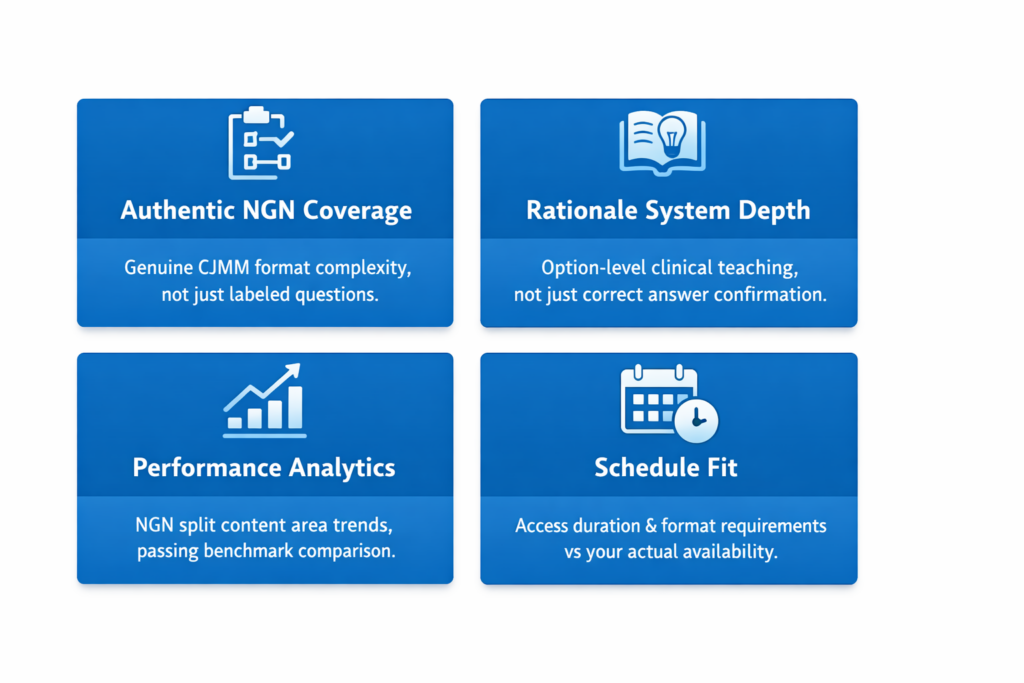
Before comparing specific programs, the four criteria that define genuine preparation value in any NCLEX prep course must be clearly established — because these criteria are what separate a program that produces measurable clinical reasoning improvement from one that produces question familiarity without exam performance gains.
Criterion 1: Authentic NGN Coverage
The single most important quality criterion for NCLEX prep courses in 2026 is whether NGN coverage is authentic rather than superficially labeled. The Next Generation NCLEX introduced five formats — unfolding case studies, bow tie questions, extended multiple response, matrix questions, and enhanced hot spot highlighting — that test clinical judgment across the CJMM cognitive skill framework. NCLEX prep courses that label a handful of standard questions as NGN without replicating the actual format complexity, the CJMM cognitive skill mapping, or the partial credit scoring mechanics of polytomous items are not preparing candidates for the current exam. Evaluate NGN coverage by completing a sample of the course’s NGN content before purchasing — the structural complexity and clinical judgment demand of the questions themselves, not the marketing language, reveals whether coverage is genuine or cosmetic.
Criterion 2: Rationale System Depth
The rationale system is where the most meaningful quality difference between NCLEX prep courses is expressed in practice. High-quality rationales explain why each answer option is correct or incorrect using the clinical reasoning principle that applies beyond the specific question — they teach the underlying logic rather than simply confirming or rejecting selections. Programs with shallow rationale systems — confirming the correct answer and providing a brief content summary without addressing why each distractor fails — produce familiarity with answer patterns rather than development of clinical reasoning capacity. When evaluating any NCLEX prep courses program, answer a practice question incorrectly and read the full rationale: if it does not explain specifically why your chosen option was wrong and what clinical principle makes the correct option right, the rationale system is not building the reasoning the exam measures.
Criterion 3: Performance Analytics
The analytics built into NCLEX prep courses determine how efficiently candidates can identify and close their preparation gaps. Minimum useful analytics include accuracy by content category. Leading programs provide accuracy by cognitive level, accuracy by question format with NGN tracked separately from traditional, performance trends over time per content area, and comparison against a passing benchmark. Granular analytics transform a question bank from a practice tool into a precision preparation management system — allowing candidates to direct study time based on evidence rather than intuition. NCLEX prep courses with aggregate-only analytics or no trend data force preparation decisions by comfort level rather than by performance data, which consistently produces preparation time spent in strong areas rather than weak ones.
Criterion 4: Fit With Your Actual Schedule
The best NCLEX prep courses on paper will not produce the best results if the format does not fit the candidate’s actual schedule. A live cohort program requiring attendance at scheduled sessions three times per week does not work for a candidate working rotating shifts. A self-paced platform requiring daily self-directed discipline does not work for a candidate who needs external accountability to maintain consistent study. Evaluate access duration against your realistic preparation timeline — a 30-day subscription for a candidate who needs 8 weeks is a mismatch regardless of course quality. Match the format’s requirements to your honest assessment of your available hours and self-direction capacity before making any financial commitment.
Top NCLEX Prep Courses in 2026: Program-by-Program Analysis

The following six programs represent the most widely used and most consistently recommended NCLEX prep courses among nursing students and educators for the 2026 exam. Each analysis applies the four criteria above alongside an honest assessment of strengths, limitations, and the candidate profile that benefits most.
UWorld Nursing — Best Overall Clinical Reasoning Platform
UWorld is the most widely used of all NCLEX prep courses and the platform most consistently cited by recent passers as their primary preparation resource. Its question quality is the highest available — clinical scenarios are realistic, distractors are built from genuine misconceptions, and every answer option receives a separate rationale explanation that teaches the underlying clinical principle rather than confirming the selection. Pathophysiology diagrams and clinical illustrations integrate directly into rationale explanations at both desktop and mobile scales. NGN coverage is distributed throughout the question pool rather than segregated, with all five NGN formats represented at complexity levels that authentically reflect the current exam. Analytics are the most granular in the NCLEX prep courses category: content area accuracy, NGN versus traditional format splits, cognitive level breakdown, performance trending, and peer percentile comparison. The primary limitation is cost — UWorld is among the more expensive platforms. For candidates who can commit to one primary resource and use it with depth and consistency, UWorld delivers the strongest overall preparation value in the category. Best-fit profile: independent learners with adequate content foundations who need clinical reasoning development and precision analytics above all else.
Hurst Review — Best for Content Mastery and Conceptual Foundation
Hurst Review occupies a distinct position among NCLEX prep courses because its primary instructional model is conceptual content mastery — teaching the underlying physiological and clinical principles that make nursing content memorable and applicable — rather than leading with question bank practice. The Hurst approach emphasizes understanding why clinical findings occur and why nursing actions are correct at the mechanistic level, building a conceptual knowledge architecture that the rationale review of clinical scenario questions then reinforces. Live and on-demand video instruction is the program’s primary delivery mode, with instructors known for plain-language explanations of complex pathophysiology. The companion question bank is solid but not the program’s primary value. NGN content has been updated for the current exam. Hurst’s limitation is that candidates who need advanced clinical reasoning development on top of a strong content foundation may find the program’s content emphasis less targeted to their specific gap than a question-bank-primary platform would be. Best-fit profile: candidates whose nursing school performance reflected content comprehension challenges — who struggle to understand why clinical findings occur rather than simply what they are — and recent graduates who need a conceptual rebuild before clinical reasoning practice.
Kaplan NCLEX-RN — Best for Test-Taking Strategy Integration
Kaplan stands apart from other NCLEX prep courses through its explicit test-taking strategy instruction integrated into question practice. The Kaplan Decision Tree — a structured clinical reasoning framework for systematic answer elimination — is embedded in the rationale interface after every question, reinforcing the strategic approach alongside the clinical content. This integration is particularly valuable for candidates who have solid content knowledge but consistently fail to translate that knowledge into correct answers under timed exam pressure — a reasoning-strategy gap that content exposure alone cannot close. The question bank is substantial, adaptive delivery adjusts difficulty based on performance, and NGN content has improved significantly in recent updates. Live online and on-demand instruction covers all major test plan content areas. Analytics include content area breakdown and performance trending. Kaplan’s limitation is that question complexity at the highest difficulty levels is slightly lower than UWorld, and the decision tree framework, while valuable for strategy-gap candidates, adds less marginal value for candidates whose primary gap is clinical reasoning depth rather than systematic approach. Best-fit profile: candidates with strong content knowledge who consistently underperform on timed scenario questions — strategy integration produces faster improvement for this profile than additional content exposure.
Archer Review — Best Value Comprehensive Platform
Archer Review has built a strong reputation among NCLEX prep courses as the highest-value option for candidates whose preparation budget is constrained but who need a quality platform that goes substantially beyond free resources. Question quality is strong — clinical scenarios are realistic, distractors reflect genuine clinical misconceptions, and rationales address the reasoning behind incorrect options with meaningful depth across all content areas. NGN coverage has been authentically updated for the current exam and includes all five formats with genuine complexity. Analytics include content area performance breakdown and trend tracking. The platform offers both question bank and video content components, making it a genuine hybrid option at a significantly lower price point than premium platforms. Archer’s interface is less polished than UWorld or Kaplan, and the question pool, while substantial, is smaller. The video content depth is less comprehensive than dedicated content programs like Hurst. Best-fit profile: budget-conscious candidates who need a quality clinical reasoning practice platform with genuine NGN coverage and do not require the premium analytics depth or interface polish of higher-cost alternatives.
Saunders Comprehensive Review — Best for Breadth of Content Coverage
Saunders Comprehensive Review occupies a content breadth position in the NCLEX prep courses landscape that no other program matches — its question bank exceeds 5,000 items organized by every content category in the NCSBN test plan, and its companion review textbook provides the most comprehensive written content coverage available in a single resource. For candidates whose preparation gap is breadth of content knowledge rather than clinical reasoning depth — who have specific knowledge blind spots across multiple content categories that more targeted programs leave unaddressed — Saunders provides systematic coverage of every area the exam tests. The question bank’s rationale system is functional but less clinically teaching-oriented than UWorld’s. NGN coverage has been updated but is less comprehensive than dedicated platforms. Analytics are basic relative to the category leaders. Best-fit profile: candidates who need comprehensive content coverage across all test plan areas — particularly those whose diagnostic assessment reveals multiple below-standard categories spanning different body systems — who benefit most from breadth before depth in their preparation sequence.
NCSBN Learning Extension — Best for Official Exam Calibration
The NCSBN Learning Extension is the only one of the major NCLEX prep courses developed directly by the organization that administers the exam. Its questions are written by NCSBN item developers, which makes it the most authoritative available calibration of actual exam question format and cognitive demand. NGN coverage is definitionally accurate — NCSBN’s own practice questions for each NGN format reflect exactly how those formats function on the real exam, without the format approximations that third-party platforms inevitably introduce. A structured review curriculum accompanies the question bank. Analytics include content area performance tracking. The primary limitations relative to UWorld and Archer are a smaller overall question pool and a less polished interface. Best-fit profile: any candidate who wants authoritative NGN format calibration — the NCSBN Learning Extension belongs in every candidate’s preparation regardless of which other platform they use as their primary resource. It is most valuable as a supplement rather than as a sole primary NCLEX prep course, specifically for official NGN format orientation at the beginning of preparation and calibration verification in the final week.
Matching NCLEX Prep Courses to Your Learning Style Profile
Platform quality matters — but the right platform is the one that fits how you actually learn and retain clinical information, not the one with the highest overall reputation. The following four learning style profiles map to the NCLEX prep courses that produce the strongest preparation outcomes for each.
The Independent Analytical Learner
Independent analytical learners retain clinical information most effectively through deep engagement with clinical scenario practice, detailed rationale analysis, and data-driven performance feedback. They have strong self-discipline, can maintain consistent daily study habits without external accountability, and become frustrated by programs that do not provide sufficient analytical depth or performance granularity. For this profile, the NCLEX prep courses that deliver the most value are UWorld as the primary platform — its rationale depth, analytics granularity, and adaptive difficulty precisely match this learning profile — supplemented by the NCSBN Learning Extension for official NGN calibration. The independent analytical learner extracts the maximum available clinical reasoning development from UWorld’s rationale system and uses analytics data to drive every preparation decision. They do not need a live cohort structure or video-based content instruction — they need the highest-quality question and rationale system available.
The Conceptual Foundation Learner
Conceptual foundation learners struggle not with clinical reasoning application but with understanding the underlying mechanisms that make clinical findings and nursing actions logically connected. They can recognize correct answers from answer pattern familiarity but cannot explain why those answers are correct at the physiological level — which means harder questions with more sophisticated clinical presentations expose the gap. For this profile, NCLEX prep courses that lead with conceptual instruction before clinical reasoning practice are most effective: Hurst Review as the primary platform for its conceptual mastery approach, followed by UWorld or Archer as the clinical reasoning practice platform once the content foundation is established. The sequencing matters — conceptual foundation learners who go directly to question bank practice without first building mechanistic understanding will plateau at the same accuracy level regardless of question volume.
The Structured Accountability Learner
Structured accountability learners know their clinical content but cannot maintain consistent self-directed preparation without external structure, defined progress checkpoints, and the accountability of a cohort or instructor relationship. Left to self-directed preparation, they drift toward comfortable content areas, skip study sessions under life pressure, and lose momentum when they encounter preparation blocks without support. For this profile, NCLEX prep courses with live cohort components — Kaplan’s live online program or similar structured live-session programs — provide the external organization that compensates for the self-direction challenge. The live session commitment mechanism creates consistent preparation attendance that self-paced alternatives cannot generate for this learning profile. Kaplan’s decision tree integration is an additional advantage for this profile because the explicit strategy framework gives structure not just to the schedule but to the reasoning process within each question session.
The Visual and Auditory Learner
Visual and auditory learners retain clinical content most effectively through illustrated explanations, animated pathophysiology diagrams, and spoken instruction rather than text-based reading. They find review books difficult to retain and benefit significantly from NCLEX prep courses that deliver the majority of instructional content through visual and auditory channels. Hurst Review’s video instruction model with plain-language explanations is the strongest fit for this profile’s instructional content needs. SimpleNursing as a supplemental platform provides short-format video explanations particularly effective for pharmacology and pathophysiology concepts. For clinical reasoning practice, UWorld’s pathophysiology diagrams integrated into rationale explanations provide visual reinforcement that text-only rationale systems do not. The most effective preparation stack for this profile is Hurst or SimpleNursing for content instruction paired with UWorld or Archer for clinical reasoning practice.
How to Evaluate Any NCLEX Prep Course Before You Buy
With the criteria established and the profiles matched, the following evaluation process applies before committing to any NCLEX prep courses investment — regardless of brand recognition, peer recommendation, or price point.
Complete a Substantive Free Trial First
Any NCLEX prep courses program worth purchasing offers a meaningful free trial — at minimum 25 to 50 questions across multiple content areas and at least one example of each NGN format type. A trial of this scope provides the direct experience needed to evaluate question quality, rationale depth, interface usability, and NGN format authenticity before committing. A program that offers only a homepage video and a testimonial page as its free trial is asking for financial commitment based on marketing rather than direct product experience. The specific evaluation to perform during any free trial: answer a question incorrectly and read every word of the rationale — if the rationale does not explain specifically why each incorrect option fails and what clinical principle makes the correct option right, the rationale system is not building clinical reasoning at the level the exam requires.
Verify NGN Coverage Directly
Do not rely on marketing language to evaluate NGN coverage in NCLEX prep courses. Complete at least one unfolding case study, one bow tie question, one extended multiple response item, and one matrix question from the platform’s content before purchasing. Evaluate whether the unfolding case study maps questions to recognizably different CJMM cognitive skills across the six-question set. Evaluate whether the bow tie uses the authentic three-section structure. Evaluate whether the extended multiple response rationale addresses the partial credit mechanics. If the platform does not provide examples of all five NGN formats in its free trial, ask the support team directly how many questions of each NGN format type are in the full question pool — a program with fewer than 50 questions of each NGN type does not provide sufficient volume for genuine format competency development.
Ask the Six Pre-Purchase Questions
- NGN format counts: How many questions of each NGN format type are in the full question pool — unfolding case studies, bow tie, extended multiple response, matrix, and enhanced hot spot separately?
- CJMM alignment: Do the unfolding case study sets map questions to the six CJMM cognitive skills in sequence? Is clinical judgment taught as an explicit framework or embedded implicitly in question practice?
- Rationale system: Does the rationale explain why each incorrect option fails, or only why the correct option is correct? Are rationales written by clinically current nursing educators?
- Analytics depth: Does the platform report NGN and traditional format accuracy separately? Does it show content area accuracy trends over time? Can I see a sample analytics dashboard before purchasing?
- Access duration: How long does the subscription remain active after purchase? Is there an extension option if preparation requires more time than initially planned?
- Free trial scope: Can I access at least 25 to 50 questions across content areas and one of each NGN format type before committing to purchase?
Getting Maximum Value From Your Chosen NCLEX Prep Courses
Selecting the right program from the available NCLEX prep courses is the first decision — using it correctly is what determines whether the investment produces a passing result. The following practices apply to any program and represent the behaviors that consistently separate candidates who improve through their preparation from those who complete a course without measurable progress.
One Primary Platform, Used Deeply
The most common misuse of NCLEX prep courses is purchasing two or three subscriptions simultaneously and splitting practice time across all of them. A question bank’s analytics are only informative when sufficient question volume has accumulated in a single platform to produce reliable performance trends — splitting 3,000 questions across three platforms leaves each with 1,000 questions, insufficient for any platform’s analytics to produce the granular data that drives effective preparation decisions. Choose one primary platform based on the criteria and profile matching in this guide, add the NCSBN Learning Extension for official NGN calibration, and direct all daily practice into those two resources. Add a third resource only when a specific, data-identified gap in coverage is confirmed by your performance analytics — not because the resource was recommended or because more feels like better.
The Diagnostic Before Content Study
Regardless of which NCLEX prep courses you choose, the first meaningful activity in any preparation period is a 75 to 100 question diagnostic assessment completed before any directed content study. This diagnostic establishes your baseline performance profile across all content categories, revealing which areas are below standard and which are already adequate — allowing every subsequent preparation decision to be evidence-based rather than intuition-based. Run the diagnostic in your chosen platform immediately after completing the free trial or immediately after purchase. Rank content categories by accuracy from lowest to highest and build your first two weeks of content-filtered practice sessions around that ranking. Without this baseline, preparation is organized around what you feel least confident about rather than what the data shows needs the most work — and those two things frequently do not align.
Measuring Progress Against Benchmarks, Not Feelings
Progress through NCLEX prep courses should be measured against the four readiness benchmarks that correlate most reliably with passing performance — not against the subjective feeling of readiness, which frequently lags behind actual preparation progress and arrives unreliably. The benchmarks: overall accuracy trending toward 55 to 60 percent across a minimum of 1,500 completed questions with an upward trend; accuracy above 50 percent in every major test plan content category; NGN-specific accuracy above 50 percent tracked separately from traditional format accuracy; and a passing-range result on a full 100-plus question timed simulation completed within two weeks of the exam date. A candidate who meets all four benchmarks after completing a quality NCLEX prep courses program is ready, regardless of how anxious they feel. A candidate who has not met the benchmarks after completing the program either needs targeted additional preparation or a different preparation approach — and the benchmarks identify which situation applies.
- Week 1 target: Diagnostic completed and analyzed, content priority ranking established, daily study schedule committed to in writing, primary platform oriented.
- Week 2 to 3 target: Lowest-accuracy content categories showing upward accuracy trends, error log established with error type tracking, Anki cards accumulating from session clinical principles.
- Week 4 to 5 target: Overall accuracy trending above 52 percent, NGN format accuracy tracked separately and above 45 percent, weekly full simulation completed with post-session rationale review block.
- Week 6 target: All four readiness benchmarks met or within measurable range, NCSBN official NGN samples completed for final calibration, exam logistics confirmed.
Special Considerations: Repeat Candidates and Working Nurses
Two candidate populations have specific NCLEX prep courses selection considerations that differ from the general first-time candidate framework: repeat candidates preparing for a second or subsequent attempt, and working nurses preparing while managing full or part-time employment obligations.
Repeat Candidates: A Structurally Different Approach
Repeat candidates represent the population that most needs NCLEX prep courses to be genuinely different from their previous preparation rather than simply more of the same. A candidate who used UWorld for 3,000 questions and did not pass is not well-served by subscribing to UWorld again and completing 3,000 more questions on the same platform with the same engagement approach. The first action for any repeat candidate is requesting the Candidate Performance Report from the NCSBN — the document that shows performance relative to the passing standard across all content categories. If the CPR shows persistent below-standard performance in the same content categories across multiple attempts, the preparation gap is a clinical reasoning pattern that question volume has not corrected, not a content knowledge gap that more questions will address. For this scenario, the NCLEX prep courses most likely to produce a different result are those that explicitly address clinical reasoning error correction — Kaplan for its strategy integration, or structured NCLEX tutoring for precision reasoning diagnosis. Switching to a different question bank without changing the preparation approach rarely produces a different outcome.
Working Nurses: Schedule-Adapted Preparation
Working nurses — candidates preparing for the NCLEX while managing part-time or full-time employment — need NCLEX prep courses with genuine schedule flexibility and a preparation architecture that accommodates variable daily availability without creating compounding preparation debt. Self-paced platforms (UWorld, Archer) that allow study sessions whenever the candidate has available time are structurally more compatible with working nurse schedules than live cohort programs requiring attendance at scheduled sessions. The specific adaptation for working nurse NCLEX prep courses use is a weekend-heavy session structure: longer, more comprehensive sessions on days off (Saturday as a primary content and simulation day, 4 to 6 hours), and shorter maintenance sessions on work days (30 to 50 questions with rationale review, 45 to 75 minutes). This structure maintains daily clinical reasoning practice without the burnout risk of attempting full preparation sessions after 8 to 12 hour shifts. Total preparation time extends to 10 to 14 weeks rather than 6, but the daily quality is maintained throughout — which consistently produces better outcomes than compressed full-time preparation that degrades in quality by week three.
Conclusion
The best NCLEX prep courses in 2026 are not defined by brand recognition, price, or peer popularity — they are defined by authentic NGN format coverage, rationale systems that teach clinical reasoning rather than confirm answer choices, analytics that make preparation decisions evidence-based rather than intuitive, and formats that fit how individual candidates actually learn and maintain consistent study habits. UWorld leads the category on clinical reasoning development and analytics depth. Hurst Review leads on conceptual content instruction. Kaplan leads on test-taking strategy integration. Archer Review leads on preparation value per dollar. Saunders leads on content breadth coverage. The NCSBN Learning Extension leads on official exam calibration. Each is the best NCLEX prep courses option for a specific candidate profile — none is universally best for every candidate.
Identify your learning style profile honestly, complete your diagnostic assessment to establish your content gap priorities, apply the four criteria to any program you consider, complete a substantive free trial before committing, and ask the specific NGN and analytics questions this guide provides. Use whichever program you select with depth, consistency, and active engagement — the course is the vehicle, and the deliberate preparation you bring to it every day is what determines whether it takes you to a passing result.
