

NCLEX exam day mindset is a performance variable — not a personality trait, not a fixed attitude, and not something some candidates have naturally while others do not. It is a set of specific cognitive orientations and psychological practices that can be deliberately built during the preparation period and that have measurable effects on clinical reasoning performance under exam conditions. A candidate who enters the testing center believing their preparation is adequate, trusting the clinical reasoning frameworks they have practiced, and approaching each question with process-focused attention rather than outcome-focused anxiety will consistently perform closer to their actual clinical reasoning competency than a candidate who enters with identical preparation but a mindset of inadequacy, self-doubt, and catastrophic outcome focus.
The challenge is that the NCLEX preparation experience is structurally designed to undermine confidence. Practice question accuracy rarely reaches the percentages candidates believe indicate true readiness. The adaptive CAT algorithm delivers increasingly difficult questions to candidates who are performing well, making strong performance feel like struggling. Content gaps surface repeatedly in rationale review, reinforcing the sense that there is always more to know. Every week of preparation reveals new clinical reasoning errors that the previous week did not expose, creating the impression of declining competency rather than expanding awareness of previously invisible gaps. All of these experiences are preparation system features — they are signs of an effective preparation process — but they consistently generate the subjective experience of being less prepared than is actually the case. This guide builds NCLEX exam day mindset from the ground up: what confidence actually is and is not in an examination context, why the NCLEX preparation experience systematically undermines the subjective sense of readiness regardless of actual readiness, the specific cognitive reframes that replace inadequacy narratives with accurate preparation assessments, the evidence-based practices for building psychological resilience across the preparation period, the pre-exam mindset protocol that activates optimal performance state on exam morning, and the in-exam mindset practices that maintain confidence and clinical reasoning quality across a full adaptive exam session.
What Confidence Actually Is in an NCLEX Context
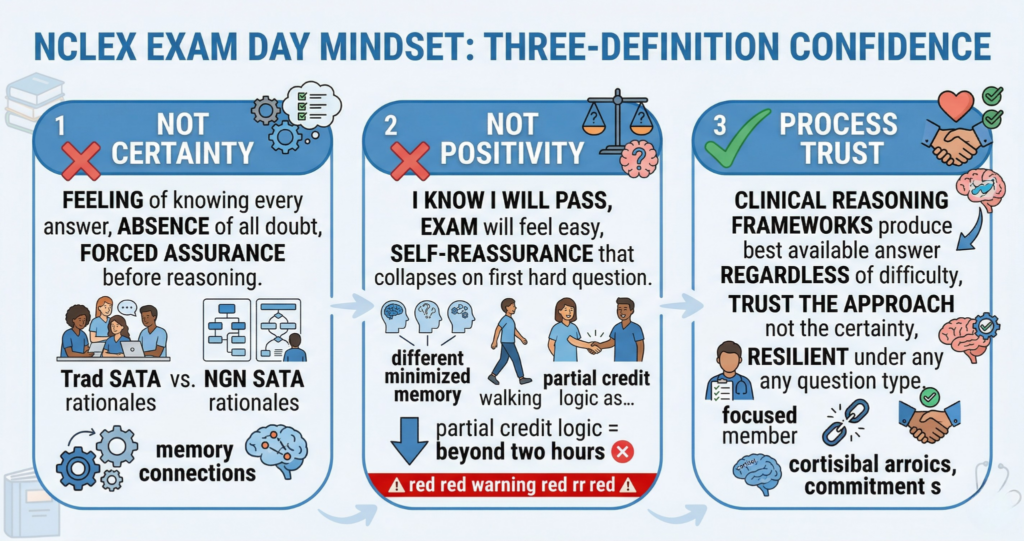
Building NCLEX exam day mindset requires a precise understanding of what examination confidence is — because the most common conception of it is both inaccurate and counterproductive.
Confidence Is Not Certainty
The most damaging misconception about NCLEX exam day mindset is that confidence means certainty — the feeling of knowing the answer before reading the options, of never experiencing doubt during a question, of approaching every clinical scenario with complete assurance. This conception of confidence is not only unrealistic — it is counterproductive. Clinical reasoning under uncertainty is the skill the NCLEX measures. A candidate who feels certain about every question has either encountered only questions well below their ability level or is experiencing the false certainty of confident misconceptions. Genuine clinical competency involves the ability to reason through uncertainty to a well-supported conclusion, not the elimination of uncertainty before reasoning begins. NCLEX exam day mindset confidence is not the absence of doubt — it is the trust that the clinical reasoning frameworks built during preparation will produce the best available answer even when the scenario is unfamiliar, even when two options appear equally defensible, and even when the correct answer cannot be known with certainty.
Confidence Is Not Positivity
NCLEX exam day mindset is also not the forced positivity of telling oneself that everything will be fine, that passing is guaranteed, or that the exam will feel easy. Forced positivity is psychologically fragile — it collapses at the first difficult question, the first series of challenging items, or the first moment when the exam feels harder than the self-reassurance promised it would be. Confidence built on forced positivity is more unstable than the honest acknowledgment of difficulty alongside trust in the ability to handle it. The most psychologically resilient NCLEX exam day mindset is not I know I will pass — it is I have done the preparation and my clinical reasoning frameworks apply to every question regardless of difficulty. This orientation is accurate (it reflects the true capability that preparation has built), resilient (it does not depend on the exam feeling easy to remain intact), and directive (it tells the candidate what to do in every moment — apply the framework — rather than only what to feel).
Confidence Is Process Trust
The most accurate and most functional conception of NCLEX exam day mindset confidence is process trust — the confidence that the clinical reasoning process practiced during preparation will produce reliable answers when applied deliberately to each question, regardless of content familiarity or question difficulty. Process trust does not depend on knowing the answer; it depends on trusting the approach that produces the answer. A candidate who trusts the three-tier priority hierarchy, the nursing process sequence identification, the therapeutic communication technique criteria, and the framework fallback for unfamiliar content does not need certainty about any individual question to perform at their genuine competency level. The process is reliable. The frameworks apply universally. The answer that emerges from systematic framework application is the best available answer regardless of how confident or uncertain the clinical reasoning felt during the application. Building NCLEX exam day mindset means building process trust — not certainty, not positivity, but the genuine conviction that the process works.
Why NCLEX Preparation Systematically Undermines Confidence

Understanding the specific mechanisms by which the NCLEX preparation experience undermines subjective confidence — regardless of actual preparation quality — allows candidates to recognize those experiences accurately rather than interpreting them as evidence of genuine inadequacy.
The Accuracy Expectation Gap
Most nursing candidates enter NCLEX preparation expecting that adequate preparation will produce practice question accuracy in the 70 to 80 percent range — a standard derived from nursing school examination performance, where passing typically requires 75 percent or above. The NCLEX passing standard corresponds to approximately 50 percent accuracy on questions at the passing difficulty level — which translates to approximately 55 to 60 percent accuracy on the mixed-difficulty question sets that practice platforms use. A candidate with 58 percent practice accuracy who expects 75 percent will feel significantly underprepared despite being at or above the readiness threshold. This accuracy expectation gap is one of the most common sources of NCLEX exam day mindset damage across the preparation period — the persistent feeling of falling short of a standard that is itself incorrect. Correcting the accuracy expectation — from nursing school examination standards to NCLEX-specific readiness benchmarks — eliminates an entire category of false inadequacy signals that preparation performance generates.
The CAT Algorithm’s Confidence Effect
The adaptive nature of the NCLEX CAT algorithm produces a specific and consistent confidence effect that candidates who do not understand it interpret as a sign of failing. As a candidate’s ability estimate rises above the passing standard, the algorithm selects increasingly difficult questions — questions at the upper boundary of the candidate’s competency where the probability of a correct answer is close to 50 percent. A candidate performing well will experience the exam as progressively harder rather than progressively easier, because strong performance triggers harder questions not easier ones. Many well-prepared candidates interpret this increasing difficulty as evidence that they are failing — that the exam is getting harder because they are getting answers wrong rather than because they are getting answers right. Understanding this algorithm dynamic before the exam transforms a potentially devastating confidence effect into a readiness-confirming reframe: a hard exam means the algorithm is tracking an ability estimate above the passing standard. The NCLEX exam day mindset implication is direct: difficulty is not failure, difficulty is tracking.
The Preparation Gap Illusion
A third mechanism by which NCLEX preparation undermines NCLEX exam day mindset is the preparation gap illusion — the sense, intensifying as the exam approaches, that there is always more to know and that the gaps being discovered each week through rationale review represent ever-expanding inadequacy rather than the narrowing of a finite knowledge base. Every incorrect answer in rationale review reveals a clinical principle not previously applied correctly. Every new content area studied surfaces new clinical connections not previously made. This progressive revelation of previously invisible gaps creates the subjective impression of a preparation deficit that is growing rather than shrinking — even as the actual clinical reasoning competency is consistently improving. The accurate interpretation is the opposite of the impression: the discovery of a gap is only possible if the clinical reasoning process is operating well enough to identify it. Candidates who cannot identify their gaps are not performing better than candidates who can — they are operating with less clinical reasoning awareness. Visible gaps are evidence of a functioning clinical reasoning development process, not of preparation failure.
Building NCLEX Exam Day Mindset During Preparation
NCLEX exam day mindset is not built in the days before the exam — it is built throughout the preparation period through specific practices that progressively strengthen the psychological orientation the exam requires.
The Preparation Evidence Inventory
The preparation evidence inventory is a NCLEX exam day mindset practice conducted weekly — a deliberate review of the concrete preparation evidence accumulated in the previous seven days, recorded in writing rather than held as mental impressions. Each Sunday, alongside the weekly micro-audit, record: total questions completed this week, overall accuracy and trend direction, content areas that moved from below standard to standard this week, the most important clinical reasoning principle learned from this week’s rationale reviews, and the specific error type that appeared most frequently and the correction habit applied in response. This inventory converts the abstract feeling of studying into a concrete preparation record — which is far more reliable as a confidence foundation than subjective preparation impressions. A candidate who reviews six weeks of preparation evidence records — 2,400 questions completed, eight content categories now above standard, 156 Anki cards created from documented gaps — has objective preparation evidence that replaces the anxiety-generated feeling of inadequacy with data-grounded NCLEX exam day mindset.
The Reframe Practice: Accurate Interpretation of Preparation Signals
The reframe practice is a deliberate NCLEX exam day mindset habit of replacing inaccurate preparation signal interpretations with accurate ones in real time — at the moment the negative interpretation arises rather than allowing it to accumulate into a chronic confidence deficit. The three core reframes are: when practice accuracy feels low, the reframe is my accuracy is at or approaching the NCLEX readiness threshold, not nursing school examination standards; when a difficult question series makes the exam feel hard, the reframe is difficulty means the algorithm is tracking strong performance, not failure; when a new clinical gap is discovered through rationale review, the reframe is discovering this gap means my clinical reasoning is working well enough to identify it, which means preparation is doing what it is designed to do. These reframes are not denials of difficulty — they are accurate clinical interpretations of signals that the anxiety-state mind interprets inaccurately. Practicing them deliberately when the negative interpretation arises — writing the reframe, stating it aloud, or at minimum consciously applying it before the negative interpretation becomes a settled belief — builds the cognitive habit that fires automatically on exam day when anxiety interprets the first hard question as a failing signal.
The Mastery Moments Log
The mastery moments log is a NCLEX exam day mindset preparation tool that specifically counteracts the negativity bias of rationale review — the tendency to notice and remember incorrect answers far more vividly than correct ones. Every week, record three to five instances of genuine clinical reasoning mastery from the week’s practice sessions: a question whose clinical scenario was unfamiliar but whose correct answer was derived through systematic framework application, a pharmacology question whose mechanism was reasoned through rather than memorized, a multi-patient triage question whose correct answer was identified through systematic category elimination before any comparison occurred, an NGN unfolding case study whose CJMM skill sequence was correctly identified and applied across all items in the set. These recorded mastery moments are the evidence of clinical reasoning competency development that rationale review’s gap-focus consistently obscures. Reviewing the mastery moments log in the final week of preparation — alongside the preparation evidence inventory — provides the NCLEX exam day mindset with a balanced and accurate picture of preparation progress that the exclusively gap-focused mindset of intensive preparation cannot generate.
The Pre-Exam Mindset Protocol
The pre-exam mindset protocol is the specific psychological preparation sequence applied in the days before and the morning of the exam to activate the NCLEX exam day mindset state rather than allowing the anxiety-state to set the cognitive orientation from which the first question is approached.
Three Days Before: The Confidence Activation Review
Three days before the exam, the confidence activation review consolidates the NCLEX exam day mindset foundation built across the preparation period. Sit quietly for 20 minutes and complete three written exercises. First, review the preparation evidence inventory from the full preparation period — total questions, accuracy trend, content categories now above standard, number of Anki cards created. Read this record deliberately and allow the scale of the preparation to register rather than scanning it quickly. Second, review the mastery moments log entries from the preparation period — the specific instances of clinical reasoning competency that the preparation process produced. Third, write one paragraph — addressed to yourself on exam morning — that describes the preparation that has been completed, the clinical reasoning capabilities that have been built, and the specific process trust that will govern how every question is approached. This paragraph is a psychological preparation document written from full awareness of the preparation evidence. It is read again on exam morning as the final pre-exam mindset activation.
The Night Before: Release and Rest
The NCLEX exam day mindset work for the night before the exam is not a psychological preparation exercise — it is a deliberate release of preparation responsibility. Every candidate who has done the preparation reaches a point the night before the exam where there is nothing more that can be prepared and where continued psychological engagement with preparation produces anxiety without adding readiness. The night before activity that most directly serves NCLEX exam day mindset is genuine disengagement from nursing and examination content — an enjoyable activity that activates parasympathetic nervous system tone (relaxation, laughter, connection with people the candidate values), adequate nutrition, and early bedtime. The candidate who falls asleep the night before the exam with a genuinely relaxed nervous system rather than a preparation-activated one will wake with more prefrontal cortex availability for the clinical reasoning the first questions require than the candidate who spent the evening reviewing content or managing exam anxiety.
Exam Morning: The Activation Sequence
The exam morning NCLEX exam day mindset activation sequence has four steps applied in order before arriving at the testing station. First, read the confidence activation paragraph written three days before — this is the preparation evidence document that replaces the anxiety-state’s feeling of inadequacy with the accurate preparation record. Second, complete the physical grounding sequence: feet flat on the floor, slow exhale, shoulders deliberately released, jaw unclenched. Third, state the process-focus mantra — this question, this reasoning, now — at least three times during the commute, as a deliberate attentional anchor that begins establishing the process-focused orientation before the first question demands it. Fourth, in the testing center waiting area, apply one final slow breathing cycle — inhale four counts, exhale six counts — before being called to the testing station. These four steps take approximately three minutes in total and have been practiced across the preparation period such that by exam day they are conditioned performance activation signals rather than novel psychological techniques being attempted for the first time under high-stakes conditions.
In-Exam Mindset: Maintaining Confidence Through the Session
The NCLEX exam day mindset must be actively maintained across the full exam session — not just activated at the beginning and assumed to persist without management. The following practices address the specific mindset challenges that arise during the exam itself.
The Interquestion Reset as Mindset Maintenance
The interquestion reset practiced during preparation simulations serves dual functions on exam day: it clears cognitive residue from the previous question and it resets the NCLEX exam day mindset anchor between every item. After submitting each answer, before reading the next stem — eyes closed briefly, one slow breath, hands flat, process-focus mantra applied silently — the mindset is returned to the present-question-focused orientation rather than carrying forward the evaluation anxiety (was that right?), the difficulty interpretation (this is too hard), or the performance narrative (I am doing badly) that unmanaged inter-question intervals accumulate. A candidate who applies the interquestion reset consistently is not just managing cognitive residue — they are actively maintaining the NCLEX exam day mindset orientation across every question in the session rather than allowing it to degrade as the session progresses.
The Difficulty Reframe In Real Time
When the NCLEX exam day delivers a series of questions that feel genuinely difficult — as the CAT algorithm will for a candidate performing above the passing standard — the difficulty reframe must be applied in real time rather than after the session. The in-exam difficulty reframe is brief, specific, and practiced: this is hard, which means the algorithm is tracking strong performance, which means I apply my frameworks and move forward. This three-part internal statement — acknowledgment, accurate interpretation, directive action — takes five seconds and prevents the difficulty experience from becoming a performance narrative that compounds across questions. The NCLEX exam day mindset practice of difficulty labeling without catastrophizing, built during the preparation period through deliberate difficult-question exposure, is what allows this brief reframe to be applied cleanly under exam pressure rather than requiring extended deliberate reasoning that competes with clinical reasoning for working memory resources.
Managing the Variable Exam Length
One of the most significant NCLEX exam day mindset challenges is the variable exam length — the exam ends at any point between 75 and 150 questions, and the ending point carries no reliable information about the result. A common mindset disruption occurs when the exam continues past 75 questions — the candidate who expected the exam to end at 75 begins interpreting continued questions as evidence of failing performance rather than as the continuation of an adaptive examination that is gathering additional information to make a statistically confident pass or fail determination. The accurate NCLEX exam day mindset orientation toward exam length is: I answer each question to the best of my clinical reasoning ability, and the algorithm determines when sufficient confidence has been established. Exam length is not my performance signal — question quality is. A candidate who maintains this orientation regardless of question count reaches question 100, question 125, or question 150 from the same process-focused mindset they maintained at question 25, rather than from the accumulating anxiety of an extended exam that the length-as-failure narrative generates.
- Mindset practice during simulations: Every preparation simulation is a NCLEX exam day mindset training opportunity. Practice the interquestion reset after every question in every simulation. Practice the difficulty reframe the moment a question feels hard. Practice the process-focus mantra during the simulation setup. By exam day, these practices are conditioned responses rather than deliberate techniques — they fire automatically when the conditions that have always preceded them appear.
- The comparison detox as mindset protection: Social comparison — reading accounts of other candidates’ exam experiences, comparing question counts and difficulty perceptions, discussing the exam content with others after sitting — is the most direct source of NCLEX exam day mindset damage from outside the exam room. Every candidate’s exam is adaptive and unique. Another candidate’s account of their exam experience carries no reliable information about anyone else’s performance. The most protective mindset decision is deliberate disengagement from comparison-generating information sources in the final week before the exam and after the exam itself while awaiting results.
- Seeking professional support is a preparation strength: If the psychological challenges of NCLEX preparation — the anxiety, the self-doubt, the fear of failure — are significantly impairing preparation quality or daily functioning, seeking support from a counselor, a student mental health service, or a trusted mentor is a preparation decision and a demonstration of the same clinical judgment that the NCLEX is designed to measure. Clinical awareness of when a situation requires resources beyond what is currently available — and accessing those resources appropriately — is a core nursing competency. Apply it to your own preparation.
Conclusion
NCLEX exam day mindset is built — not found, not borrowed from encouragement, and not assumed to arrive on its own. It is constructed through six weeks of deliberate preparation practices that build process trust, replace inaccurate preparation signal interpretations with accurate reframes, document the concrete preparation evidence that anxiety obscures, and condition the psychological activation sequence that converts exam morning anxiety into focused clinical reasoning engagement. The confidence that walks into the testing center on exam day is the product of everything that happened in the weeks before it: the question volume accumulated, the gaps identified and closed, the frameworks practiced until automatic, and the mindset practices applied consistently enough to become conditioned responses rather than effortful deliberate techniques.
If you are reading this guide and feeling the NCLEX exam day mindset challenges that most candidates experience — the persistent sense of inadequacy, the anxiety about difficulty, the fear that preparation is insufficient — the most important thing to understand is this: those feelings are the expected output of a preparation process that is working correctly. They are not evidence of inadequacy. They are the normal psychological experience of a candidate who is aware enough of clinical reasoning complexity to recognize the gaps that remain and honest enough about the stakes to take them seriously. That awareness and that honesty are preparation assets, not liabilities. Trust the frameworks. Trust the preparation. Trust that the clinical reasoning competency built across six weeks of deliberate practice is present and accessible. Walk in and apply it.
