

The free NCLEX review resources available to candidates in 2026 represent a substantially more complete preparation system than most candidates realize — and the assumption that adequate NCLEX review requires a paid subscription significantly underestimates what no-cost resources can provide when selected carefully and used with full preparation discipline. The April 2023 NGN launch and the April 2026 test plan update have changed the free NCLEX review landscape in one important way: resources created before April 2023 that have not been updated for the NGN format are no longer adequate preparation regardless of their other qualities, which means the free resource landscape requires more careful currency evaluation than it did before the format transition. Beyond that currency requirement, the free resources available in 2026 — from the NCSBN’s own official documentation to well-curated YouTube channels to free spaced repetition platforms — address every preparation component that a complete NCLEX review system requires.
This guide is organized as a curated directory of free NCLEX review resources evaluated against the three criteria that determine whether a free resource is worth incorporating into a 2026 preparation system: currency (does it reflect the current April 2026 or later test plan, including all five NGN format types?), quality (does it teach clinical reasoning framework application rather than only clinical content recognition?), and role (what specific preparation component does it address, and how does it fit into a complete preparation system?). Not every free resource passes all three criteria, and understanding which ones do — and what role each plays — is the evaluation intelligence that converts a scattered collection of free materials into a purposeful, complete free NCLEX review system.
The guide closes with a complete free NCLEX review system built from the resources assessed throughout — a specific, ordered, daily-structured preparation approach that costs nothing while addressing every preparation component that the 2026 examination’s clinical judgment measurement model requires.
Category 1: Official NCSBN Free Resources — The Non-Negotiable Foundation
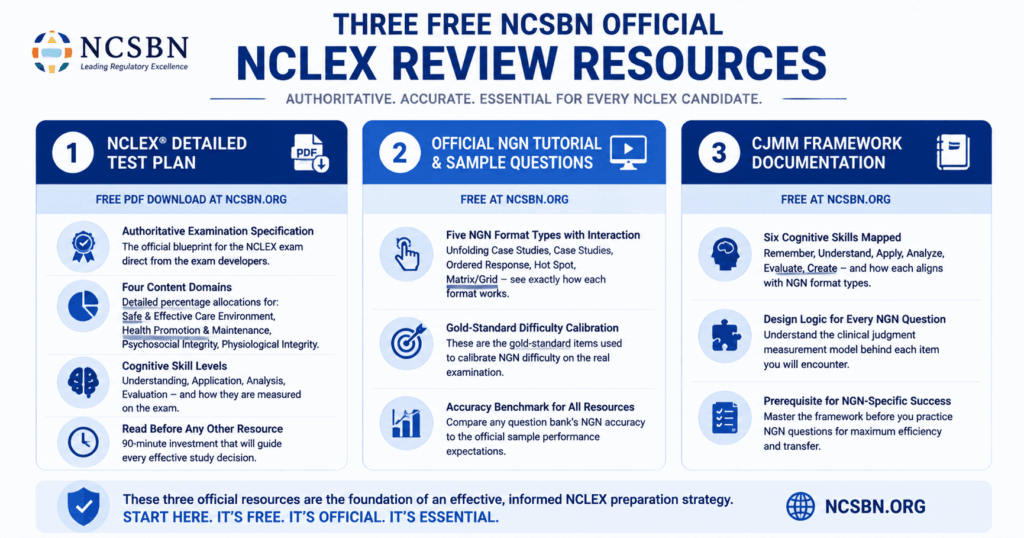
The NCLEX Detailed Test Plan
The NCSBN Detailed Test Plan is the single most important free NCLEX review resource available — more important than any question bank, any content video library, or any review book — because it is the authoritative specification of exactly what the current examination tests, at what proportions, across what content domains, and with what cognitive depth. Available as a free PDF download at ncsbn.org, the current Detailed Test Plan specifies the four content domains, their percentage allocations, the cognitive skill levels tested within each domain, and the clinical judgment competencies the examination measures. Any preparation resource — free or paid — should be evaluated against the test plan’s specifications: if a resource does not cover what the test plan says the examination tests, the resource is providing incomplete preparation regardless of its other qualities. Every candidate beginning NCLEX review should download and read the current Detailed Test Plan before engaging any other preparation resource. This takes approximately 90 minutes and provides the preparation scope intelligence that every subsequent study decision should reference.
The Official NGN Tutorial and Sample Questions
The NCSBN provides a free interactive NGN tutorial and official sample questions at ncsbn.org that represent the single most important free resource for understanding what the 2026 NCLEX review format actually requires. These samples are written by the organization that administers the examination using the same content development standards as the actual examination — which means they provide difficulty calibration accuracy and format authenticity that no third-party resource can replicate by definition. The NGN tutorial walks candidates through each of the five NGN format types with interaction, providing the format familiarization that is the prerequisite for all subsequent NGN-specific NCLEX review practice. The official sample questions demonstrate the clinical scenario complexity, CJMM cognitive skill depth, and question stem construction that the actual examination uses — serving as the gold-standard calibration reference against which any paid or free question bank should be compared. Completing the official NGN tutorial and sample questions should be the second step in any 2026 NCLEX review approach, immediately after reading the Detailed Test Plan.
The CJMM Framework Documentation
The NCSBN’s Clinical Judgment Measurement Model documentation — also available free at ncsbn.org — provides the conceptual framework that makes every NGN format question intelligible rather than arbitrary. The CJMM documentation explains the six cognitive skills (recognize cues, analyze cues, prioritize hypotheses, generate solutions, take action, evaluate outcomes), how they are mapped to specific NGN format types, and what each skill requires the candidate to demonstrate in the question’s correct option. A candidate who begins NGN-specific NCLEX review without understanding the CJMM framework will find NGN questions structurally confusing because the design logic — each question explicitly tests a named cognitive skill through a format type calibrated to that skill — is invisible without the framework. A candidate who has read the CJMM documentation understands each NGN question’s design logic before reading the first option, which is the strategic advantage the framework provides in a 2026 NCLEX review approach.
Category 2: Free Question Banks and Practice Resources
NCSBN Official Sample Questions — The Calibration Anchor
The official NCSBN sample questions available through the NGN tutorial at ncsbn.org are not just format familiarization tools — they are the calibration anchor for the entire free NCLEX review practice system. Every free (and paid) question bank should be compared against these official samples: complete the official samples, note your accuracy, then complete an equivalent number of questions from any other question source and compare the accuracy. A significant accuracy discrepancy in either direction indicates a calibration mismatch between the question source and the actual examination difficulty. Because the official samples are written by the examination’s administrator, they represent the most accurate available approximation of actual examination difficulty at zero cost. Candidates building a free NCLEX review system should complete the official samples at the beginning, midpoint, and final week of preparation as preparation calibration checkpoints rather than one-time familiarization exercises.
RegisteredNurseRN and NursingBird Free Question Banks
RegisteredNurseRN.com and NursingBird.com both offer free NCLEX-style practice questions with rationale explanations that can supplement the official NCSBN samples in a free NCLEX review system. These free banks provide larger question volumes than the official samples alone, extending the daily practice session capability of a zero-cost approach. Before relying on either as a primary question source, verify their NGN format coverage and current test plan alignment — free question banks vary in how consistently they have been updated for the April 2026 test plan, and older question content that has not been updated may test clinical content weighting or format types that the current examination has moved beyond. Use the NCSBN official sample accuracy as a calibration reference: if these free banks produce accuracy more than 10 percentage points above official sample accuracy, their difficulty calibration is below the current examination standard. The practical NCLEX review approach for free question banks is to treat them as a question volume supplement rather than a primary readiness measurement tool, using the official samples as the accurate readiness gauge.
Nursing School Institutional Access — The Most Overlooked Free Resource
Before using any question bank — free or paid — every nursing graduate should check whether their nursing school’s institutional subscription provides free access to premium question banks during a post-graduation eligibility window. UWorld, Kaplan, and ATI all have institutional licensing arrangements with nursing programs, and many graduates are eligible for continued access through their school’s license for six to twelve months post-graduation without any individual purchase. This institutional access is the most frequently overlooked free NCLEX review resource available — candidates who pay for individual subscriptions to premium question banks without checking institutional eligibility are paying for resources their school’s subscription already provides. Contact the nursing program’s academic resources office or check the student portal specifically before purchasing any question bank subscription.
Category 3: Free Content Review — YouTube and Beyond
Level Up RN — Framework-Oriented Clinical Review
Level Up RN is among the most consistently recommended free NCLEX review YouTube channels for the quality of its clinical reasoning framework application alongside clinical content — the distinction that separates useful NCLEX review content from general nursing content that happens to be presented on YouTube. Level Up RN’s content covers major NCLEX clinical categories with attention to how examination questions test clinical reasoning rather than only what clinical content the examination includes. The channel has produced NGN-specific content addressing the current format’s clinical judgment skill requirements — making it more current than many free review resources that predated the 2023 NGN launch without subsequent updates. The most effective use of Level Up RN in a free NCLEX review system is as a targeted content review resource for CPR-identified or diagnostic-identified content gaps rather than as a systematic cover-all comprehensive review — watching a Level Up RN cardiovascular module when the weekly micro-audit identifies cardiovascular as a below-50-percent content category is a more efficient use of the resource than watching all modules sequentially as a preparation warm-up.
Simple Nursing — Pharmacology and Pathophysiology Clarity
Simple Nursing has established a strong reputation in the NCLEX review community specifically for simplifying complex pharmacology and pathophysiology content into memorable frameworks that nursing students and candidates find more accessible than textbook presentations. Its mnemonic-based pharmacology content and its systematic approach to explaining disease pathophysiology in terms that connect directly to nursing priority actions make it particularly useful for candidates whose diagnostic assessment identifies pharmacology or pathophysiology as a below-standard content area. Simple Nursing content is best used as a targeted content comprehension resource rather than as a framework application NCLEX review tool — it builds the clinical content understanding that clinical reasoning framework application then operates on, rather than directly teaching the framework application that the examination tests. Candidates who use Simple Nursing for pharmacology clarity and then immediately apply the clinical reasoning framework to pharmacology-specific NCLEX questions are using the resource correctly.
Khan Academy Nursing — Health and Medicine Foundation Content
Khan Academy’s health and medicine content library provides free, high-quality explanations of the biological and physiological foundations underlying clinical nursing content — explanations of cardiovascular physiology, respiratory mechanics, renal function, and pharmacological mechanisms that support the clinical application content that NCLEX review practice requires. Khan Academy nursing and health content is most useful for candidates who find that clinical scenarios in practice questions reveal gaps in the foundational biological understanding that clinical content builds on — when a cardiovascular prioritization question is missed not because the priority framework was misapplied but because the underlying cardiac physiology was not sufficiently understood for the clinical reasoning to operate correctly. Khan Academy does not teach NCLEX examination strategy or clinical judgment framework application — it teaches the foundational science that clinical nursing knowledge builds on, which makes it a valuable supplement for candidates with foundational science gaps rather than a primary NCLEX review resource.
Selecting YouTube Content Against the Quality Criterion
The NCLEX review YouTube ecosystem includes hundreds of channels with varying quality, currency, and examination relevance — ranging from genuinely excellent framework-application content to general nursing content with NCLEX branding that teaches clinical facts rather than clinical reasoning. The selection criterion for any YouTube NCLEX review channel is whether it teaches clinical reasoning application alongside or instead of content coverage: does the channel explain why one option is correct and three others are incorrect for a specific patient, does it teach the priority hierarchy applied to specific clinical scenarios, does it address NGN format types with CJMM skill instruction? Channels that walk through specific examination questions with framework-oriented rationale analysis are providing NCLEX review value. Channels that provide clinical content summaries with a note that this content appears on the NCLEX are providing clinical knowledge that still requires framework application to convert into correct answers. Favor the former and use the latter only when foundational content comprehension is the identified gap.
Category 4: Free Spaced Repetition and Memory Consolidation
Anki — The Essential Free Spaced Repetition Platform
Anki is the single most important free tool in a complete NCLEX review system after the NCSBN official resources — a free spaced repetition application available on desktop (Windows, Mac, Linux) and Android that provides the memory consolidation infrastructure that converts practice session learning into long-term retrievable clinical reasoning competency. Anki’s spaced repetition algorithm schedules card reviews at the optimal interval for each card based on the candidate’s performance on previous reviews — showing cards more frequently when they are recently learned and spacing them further apart as they become more reliably recalled. This mechanism is the most efficient available approach to clinical reasoning principle consolidation, producing more durable long-term memory encoding per review minute than any passive review method. The Anki desktop and Android applications are completely free; only the iOS application carries a one-time purchase cost. Candidates who have access to a computer or an Android device can build and use a complete Anki-based spaced repetition system for their NCLEX review at zero cost.
Building the NCLEX Review Anki Deck — Personalized Over Shared
The most effective use of Anki in a free NCLEX review system is building a personalized deck from the candidate’s own practice session rationale reviews rather than downloading a pre-built shared deck from the Anki community. Pre-built NCLEX Anki decks available through AnkiWeb at no cost contain thousands of cards covering broad clinical content — and they are useful for general content orientation at the beginning of preparation. For active preparation, however, a personalized deck of 200 to 400 cards built from the specific clinical reasoning principles identified as gaps through practice session rationale analysis provides 100 percent relevance to the individual candidate’s specific preparation profile, while a shared deck’s thousands of cards include content the candidate already knows that dilutes the consolidation focus on genuine gaps. The personalized deck builds five to eight new cards per practice session, each encoding a clinical reasoning chain (scenario context on the front, three-component reasoning chain on the back including the clinical principle, the priority action it produces, and the distractor type that would attract an incorrect selection). This card format encodes reasoning application patterns rather than clinical content facts, which is the preparation investment aligned with what the 2026 NCLEX review examination tests.
Quizlet — For Content Recall, Not Clinical Reasoning
Quizlet is a free flashcard platform with a large existing library of NCLEX-related card sets created by nursing students and graduates. Its value in a free NCLEX review system is specifically for clinical content recall — drug classes and their mechanisms, normal lab value ranges, disease presentation characteristics — not for clinical reasoning framework application, which requires the scenario-and-reasoning-chain card format that Anki’s personalized deck provides better than Quizlet’s term-and-definition format. Quizlet’s existing NCLEX card sets are useful for rapid content fact review in specific clinical areas where the diagnostic assessment or weekly micro-audit has identified knowledge gaps — quickly reviewing the antihypertensive drug classes and their nursing considerations before a pharmacology-focused practice session, for example. Quizlet should not be the primary spaced repetition tool for NCLEX review because its term-and-definition card format builds content recall rather than the clinical reasoning chain application that Anki’s personalized format encodes.
The Currency Evaluation: Which Free Resources Pass the 2026 Test
The Two Currency Requirements for Any 2026 NCLEX Review Resource
Every free NCLEX review resource — regardless of how well it was regarded before April 2023 — should be evaluated against two specific currency requirements before being incorporated into a 2026 preparation system. First: does the resource reflect the current April 2026 or later NCLEX test plan? Resources created before April 2023 that have not been updated for the NGN launch are missing the five NGN format types entirely. Resources updated for the 2023 NGN launch but not for the April 2026 test plan update may have outdated content weighting in health promotion, community care, and social determinants of health. The currency check is not about rejecting all older resources but about identifying which components of each resource are current and which require supplementation from more current sources. Second: does the resource include all five NGN format types with CJMM framework instruction? A resource that covers only traditional multiple choice NCLEX review without NGN format instruction is providing preparation for 65 to 70 percent of the current examination — adequate as a component of a complete system that adds NGN-specific instruction from other sources, inadequate as a standalone preparation resource.
Applying the Currency Check to Specific Free Resources
NCSBN official resources pass both currency requirements automatically — they are updated by the examination’s administrator as specifications change and are always the most current available description of the current examination. Level Up RN has produced NGN-specific content that addresses the format’s clinical judgment requirements alongside its traditional NCLEX review content — verify its NGN content is current by checking the channel’s most recent NGN-specific videos against the NCSBN official NGN tutorial’s format descriptions. Simple Nursing has addressed pharmacology and pathophysiology content that is largely stable across test plan updates but should be supplemented with NGN format instruction from more current sources. Khan Academy health and medicine content covers foundational science that does not change with test plan updates. RegisteredNurseRN and NursingBird free question banks should be verified against the NCSBN official samples for difficulty calibration and against the Detailed Test Plan for NGN format coverage before treating them as primary question sources. Any YouTube channel whose most recent NCLEX review content predates April 2023 without subsequent NGN updates is providing preparation for the pre-2023 examination regardless of how comprehensive its traditional content is.
Building a Current Free NCLEX Review System From Verified Resources
A complete free NCLEX review system verified against the 2026 currency requirements uses three resource tiers in combination: official NCSBN resources (always current, zero cost) as the authoritative foundation for examination specification, NGN format instruction, and difficulty calibration; curated current YouTube channels (Level Up RN for framework-application content review, Simple Nursing for pharmacology and pathophysiology clarity) as the targeted clinical content review supplement activated by diagnostic data rather than sequential comprehensive coverage; and Anki (free on desktop and Android) as the personalized spaced repetition consolidation system built from practice session rationale reviews. This three-tier free NCLEX review system addresses examination specification, format instruction, calibration, clinical reasoning framework application, clinical content foundation, and memory consolidation — every preparation component a complete system requires — at zero cost when the self-directed preparation discipline (four-question rationale protocol, error type classification, weekly micro-audit, exam-condition simulation) is applied consistently to each tier’s resources.
- The one thing that determines whether free NCLEX review resources are adequate: Preparation discipline — the consistent application of the full four-question rationale protocol to every practice question, error type classification for every incorrect answer, and the weekly micro-audit that tracks all four readiness benchmarks and produces the following week’s preparation prescription. Free resources used with this discipline produce clinical reasoning development that is competitive with premium resources used without it. No NCLEX review resource — free or paid — provides this discipline automatically. It is applied by the candidate to whatever resources they access, and it is the single variable that most reliably predicts whether a given resource set will produce first-attempt passing results.
- How to quickly audit a free NCLEX review resource for 2026 currency: Apply the three-question currency audit to any free resource before investing preparation time in it. One: does this resource explicitly mention the April 2026 or later NCLEX test plan, or does it specify the NGN launch in 2023 or a previous version? Two: does this resource include content on all five NGN format types — unfolding case study, bow tie, extended multiple response, matrix, and trend questions? Three: does it teach the CJMM six cognitive skills — recognize cues, analyze cues, prioritize hypotheses, generate solutions, take action, evaluate outcomes — or does it teach clinical content without explicit cognitive skill framework? Resources that pass all three questions are current enough for a 2026 NCLEX review system. Resources that fail any question should be used with awareness of their gap and supplemented from more current sources.
- What free NCLEX review cannot replace: The one preparation component that free resources cannot fully provide is a well-calibrated, large-volume question bank with consistently deep rationale quality. The NCSBN official samples provide the most accurate calibration but in limited quantity. Free question banks supplement volume but with less consistent calibration and rationale depth than the major commercial platforms. For candidates who find that free question banks are producing accuracy significantly above the official samples, the calibration gap suggests their readiness signal is inflated — which is the specific situation where the $30 to $75 investment in a low-cost well-calibrated question bank (NCSBN Learning Extension or a monthly commercial subscription) produces the highest return in any NCLEX review budget.
Conclusion
The free NCLEX review resources available in 2026 — when selected for currency against the April 2026 test plan requirements, evaluated for clinical reasoning orientation rather than content coverage alone, and integrated into a complete three-tier preparation system — provide every preparation component that the 2026 examination’s clinical judgment measurement model requires. NCSBN official resources provide the authoritative examination specification, format instruction, and calibration anchor. Curated YouTube channels provide targeted clinical content review activated by diagnostic data. Anki provides personalized spaced repetition consolidation built from documented preparation gaps. The system costs nothing and is limited primarily by the question bank calibration quality that free question banks provide less consistently than paid alternatives — a limitation addressable with a $30 to $75 investment in the NCSBN Learning Extension or a monthly commercial subscription for candidates who find the calibration gap is producing inflated readiness signals.
The investment that the free NCLEX review system most requires is not financial — it is the preparation discipline that converts free resources into clinical reasoning competency: the full four-question rationale protocol applied to every practice question, error type classification for every incorrect answer, weekly micro-audit tracking all four readiness benchmarks, and exam-condition simulation weekly. Apply that discipline to the curated free resources in this guide and the preparation system is complete, current, and capable of producing the first-attempt passing result that the 2026 examination is designed to confirm.
