

NCLEX computer adaptive testing does not score you as a percentage. There is no number of questions you need to get right, no 75% to clear, and no running tally you could check if you were allowed to.
What the exam does instead is estimate your ability after every single item, compare that estimate against a fixed standard, and keep going until it is confident enough to decide. The decision is about certainty, not about a score.
Understanding this properly removes most of the exam-day superstitions students carry in with them, and it explains why the things candidates try to read into their experience during the test tell them almost nothing.
Quick Answer
Understanding NCLEX Computer Adaptive Testing
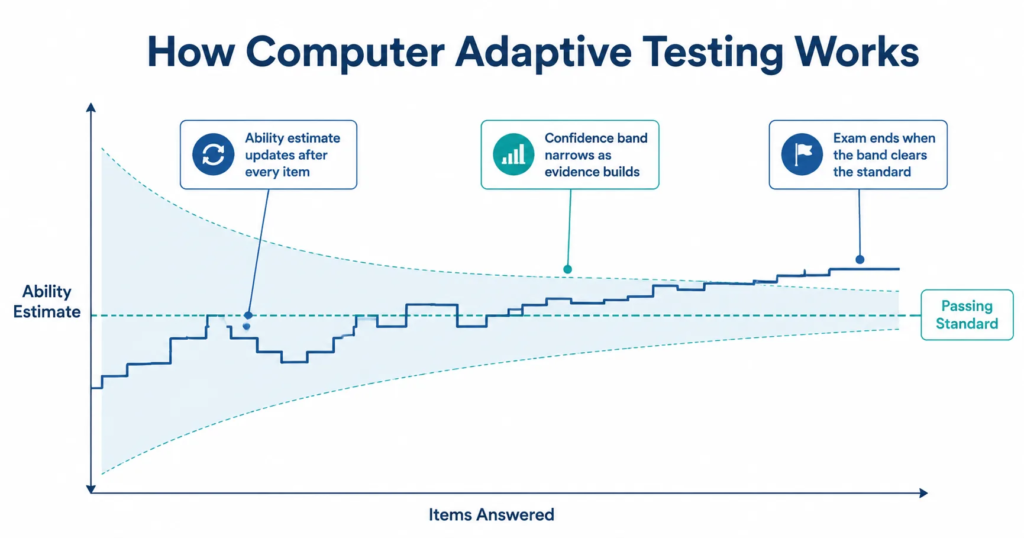
The NCLEX uses computerized adaptive testing. After each answer, the computer re-estimates your ability based on all your previous responses and the difficulty of those items, then selects the next item targeted to that estimate. Your ability estimate is compared against a fixed passing standard measured in logits: 0.00 for the NCLEX-RN and −0.18 for the NCLEX-PN, both effective through 31 March 2029. The exam ends under one of three rules, and you pass if your ability estimate is at or above the standard.
What the Computer Is Actually Doing
Every time you answer an item, the computer re-estimates your ability based on all of your previous answers and the difficulty of those items. It then selects the next item that is most optimal given everything you have done so far, so that the item is neither too easy nor too hard and yields the maximum information about your ability.
With each item answered, that estimate becomes more precise.
Think of it as the exam narrowing in on you. Early on it has very little information and its estimate could be badly wrong in either direction. As items accumulate, the range of plausible values for your true ability tightens. The exam is not accumulating points. It is reducing uncertainty.
Four terms make the rest of this article readable:
- Candidate ability is the level of entry-level nursing knowledge, skills and abilities you actually have.
- Ability estimate is the level the computer has worked out that you have.
- Passing standard is a cut point along the ability range marking the minimum ability required to practise nursing safely and effectively at entry level.
- Logit is the unit used to express the difference between candidate ability estimates and item difficulties.
The distinction between the first two is the whole exam. Your true ability is fixed and unknown. The estimate is what the computer knows about it, and every item makes that estimate sharper.
What the Passing Standard Actually Is
The passing standards reflect the amount of nursing ability currently required to practise competently at entry level, and the NCSBN Board of Directors reevaluates them every three years alongside the test plan review.
The current standards:
| Exam | Passing standard | Effective through |
|---|---|---|
| NCLEX-RN | 0.00 logits | 31 March 2029 |
| NCLEX-PN | −0.18 logits | 31 March 2029 |
The NCSBN Board voted in December 2022 to uphold both, so the bar has not moved and will not move before April 2029.
Setting that standard is not arbitrary. NCSBN considers a criterion-referenced standard-setting exercise conducted by a Panel of Judges, the historical record of passing standards and candidate performance since CAT was implemented in 1994, an annual survey of employers and educators about the competence of current entry-level nurses, and data on the educational readiness of high school graduates interested in nursing.
Two consequences worth stating plainly. There is no fixed percentage of candidates who pass, because the standard is a fixed ability level rather than a quota. And the number is not a score you can aim for, because you will never see your ability estimate. It is useful only for understanding what the exam is comparing against.
The Three Rules That End Your Exam
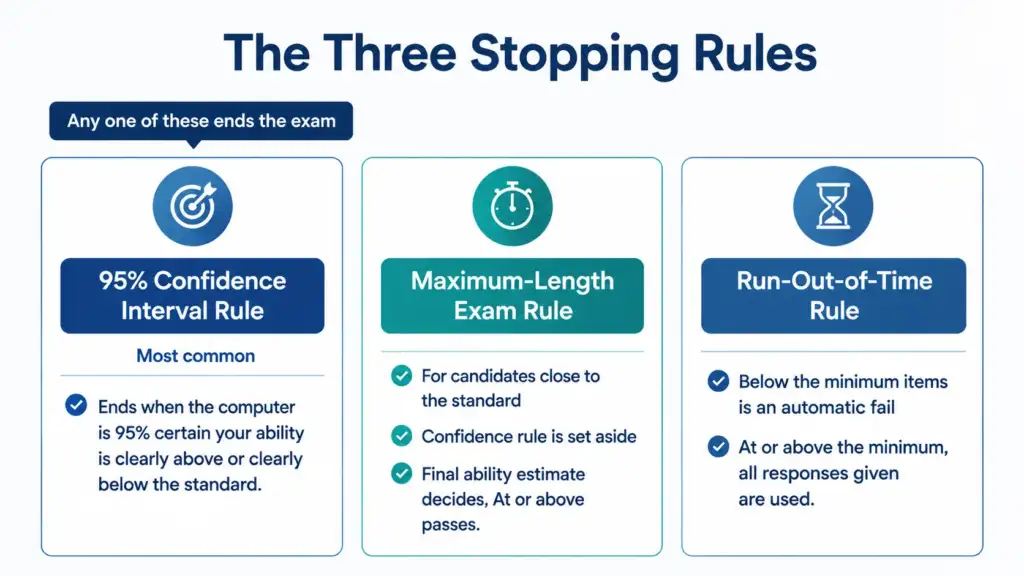
The computer decides pass or fail using one of three rules.
1. The 95% confidence interval rule
This is the most common outcome. The computer stops administering items when it is 95% certain that your ability is clearly above or clearly below the passing standard.
The word “clearly” is doing real work. It is not enough for your estimate to sit above the line. The whole plausible range around it has to sit above the line. That is why two candidates with similar estimates can receive very different numbers of items: it depends on how cleanly their answers separated from the standard.
2. The maximum-length exam rule
Some candidates have ability levels very close to the passing standard. When that happens, the confidence interval never clears the line in either direction, so the computer keeps administering items until it reaches the maximum.
At that point it sets the 95% confidence rule aside and considers only the final ability estimate based on responses to all items in the exam. If that estimate is at or above the passing standard, you pass. If it is below, you fail.
Note the wording: at or above passes. Landing exactly on the standard is a pass, not a fail. Some study material gets this backwards.
3. The run-out-of-time rule
If time runs out before you reach the maximum number of items and the computer has not reached 95% certainty either way, alternate criteria apply.
- If you have not answered the minimum number of required items, you automatically fail.
- If you have answered at least the minimum, your final ability estimate is calculated from all responses given before time expired. At or above the standard, you pass. Otherwise you fail.
This rule is widely misunderstood in two directions. Running out of time is not an automatic fail, provided you reached the minimum. But failing to reach the minimum is an automatic fail regardless of how well you were doing, which is the strongest argument there is for maintaining a steady pace rather than perfecting early items.
One further point: the current NCSBN description says the final estimate is based on all responses given before time expired. Older NCLEX material describing a calculation based only on a final block of items does not match how the rule is currently published.
Why Every Question Feels Hard
This is the single most useful thing in this article, and it contradicts advice students hear constantly.
NCSBN states that candidates should find each item challenging, because each item is targeted to their ability.
That is by design. The algorithm deliberately avoids items that are too easy or too hard for you, because those tell it very little. An easy item answered correctly by a strong candidate provides almost no information. So the exam feeds you items right at the edge of what you can do, continuously, for the entire exam.
Which means:
“The questions felt hard, so I must have been doing well” is not a reliable signal. Everyone should find the items challenging, including candidates who are failing.
“The questions got easier, so I must be failing” is not reliable either. Perceived difficulty depends on which content areas you happened to draw as much as on item difficulty.
Getting several items wrong in a row does not mean you have failed. Because items are targeted near your ability, you should expect to get a substantial proportion wrong throughout. That is what the algorithm is designed to produce.
Candidates spend enormous mental energy during the exam trying to read these signals, and the energy is entirely wasted. The one thing you can control is answering the item in front of you carefully.
What Happens After Every Answer
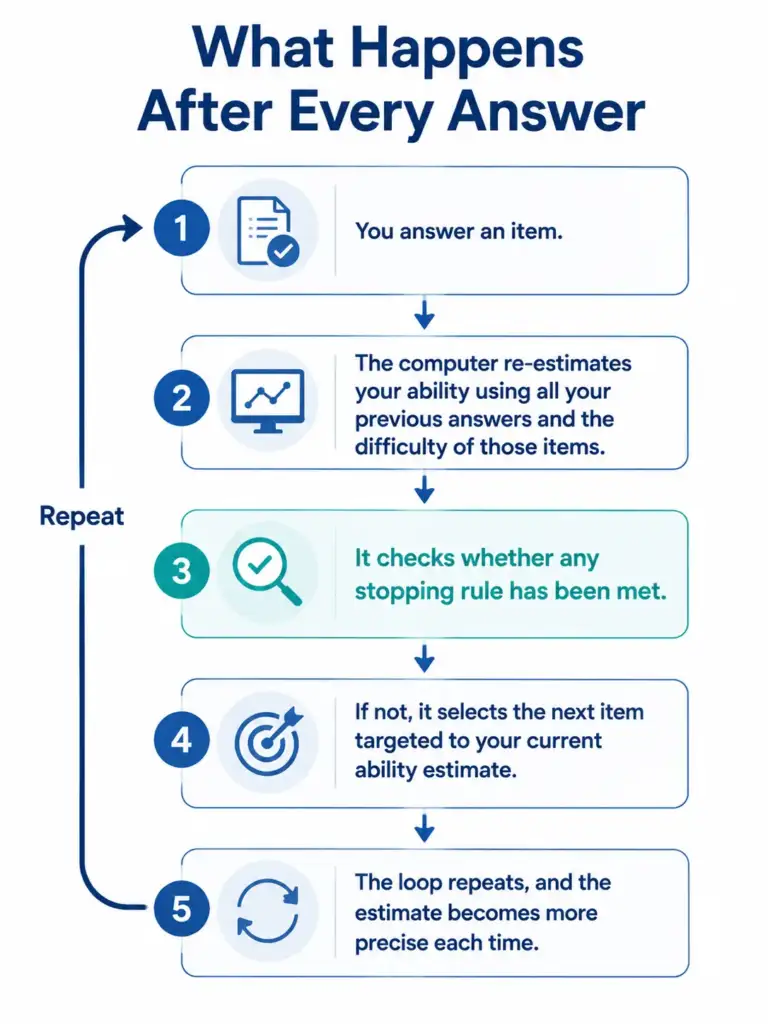
The loop is simple:
- You answer an item.
- The computer re-estimates your ability using all previous answers and the difficulty of those items.
- It checks whether any stopping rule has been met.
- If not, it selects the next item targeted to your current estimate.
- The loop repeats, and the estimate becomes more precise each time.
Two things sit outside that loop. Fifteen items on your exam are unscored pretest items, indistinguishable from scored ones, and they do not contribute to your ability estimate. And once you confirm an answer you cannot return to it, because the algorithm has already used it to select what comes next.
A Worked Example: Two Candidates
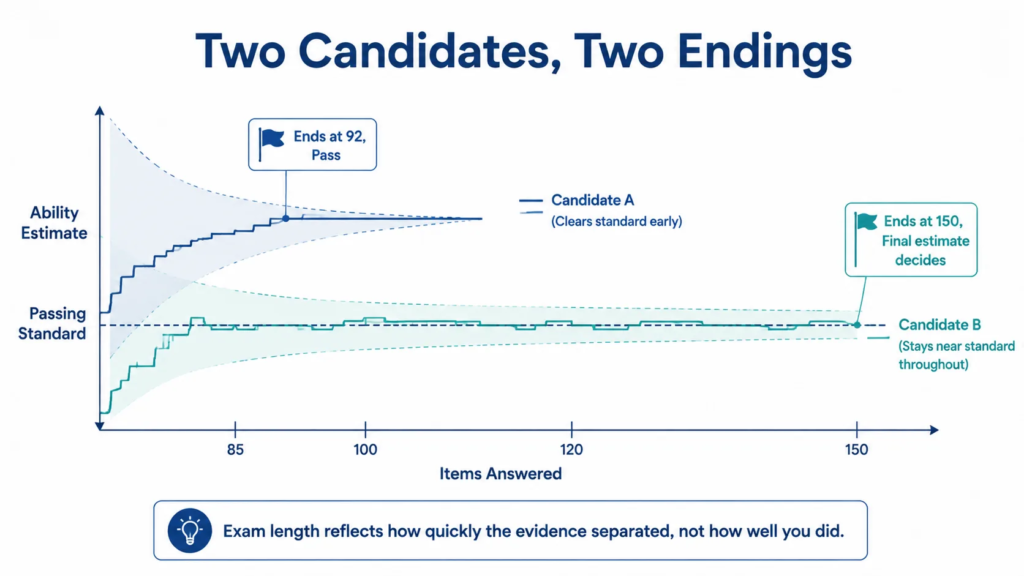
The following illustrates the mechanism. The specific item counts are illustrative, not data.
Candidate A answers the early items strongly. By item 60 the estimate has settled well above the standard, and the plausible range around it is tightening. At item 92 that entire range sits clearly above the passing standard. The 95% confidence rule triggers and the exam stops. Candidate A passes with 92 items.
Candidate B is genuinely close to the standard. Their estimate hovers just above the line, then just below, then just above. Every item narrows the range slightly, but the range keeps straddling the standard, so the confidence rule never fires. The exam continues to the maximum. At that point the maximum-length rule applies, the confidence requirement is set aside, and the final estimate alone decides. If it lands at or above the standard, Candidate B passes.
What this shows: Candidate B did not get a longer exam as a punishment. They got a longer exam because their performance sat in the region where more evidence was needed. A long exam means the decision was close, and close cuts both ways. Candidates finishing at the maximum have passed and failed in roughly the proportions you would expect from a genuinely borderline group.
The exam length question deserves its own treatment, and this article is not the place for it. What matters here is the mechanism: length reflects how quickly the evidence separated, not how good the evidence was.
Common Misconceptions About CAT
“There’s a passing score I need to hit.” There is a passing standard expressed in logits, but no percentage and no score you can work toward. You will never see your ability estimate.
“Hard questions mean I’m doing well.” NCSBN says every candidate should find every item challenging. Difficulty is not a signal.
“Running out of time is an automatic fail.” Only if you did not reach the minimum number of items.
“A long exam means I failed.” It means the decision was close.
“The exam only counts my last set of questions.” The current rules use all your responses.
“I can tell how I’m doing from the item types.” The formats reflect the content and clinical judgment step being measured, not your performance level.
“A fixed percentage of candidates pass.” There is no quota. The standard is a fixed ability level.
What This Means for How You Prepare

Three things follow from how CAT works, and none of them are about knowing more nursing content.
Every item matters equally, so pace evenly. There is no time limit on any individual item, but the appointment is fixed. The run-out-of-time rule punishes only one thing severely, which is failing to reach the minimum item count. Candidates who over-invest in early items to get them perfect are trading a small gain for a genuine risk.
Practise at full length. Your ability estimate is built from your performance across the entire exam, including the part where you are tired. A candidate who is sharp for 60 items and degraded for the next 60 is producing evidence about both. Full-length timed sessions are the only way to find out which candidate you are.
Stop trying to read the exam while taking it. This is a skill you can practise. When you do practice sets, deliberately refuse to evaluate how you are doing until the set is finished. The habit of monitoring your own performance mid-exam costs attention that the current item needs.
If you are preparing systematically, a review program that builds reasoning rather than teaching test-taking shortcuts fits what CAT actually measures, because the algorithm is estimating ability rather than rewarding technique. Programs like NCLEX High Yield that focus on clinical judgment instruction work on the thing being measured.
Key Takeaways
- The NCLEX has no percentage score. It compares an ability estimate against a fixed passing standard.
- The passing standard is 0.00 logits for the NCLEX-RN and −0.18 logits for the NCLEX-PN, both effective through 31 March 2029.
- After every answer, the computer re-estimates your ability and selects the next item targeted to that estimate.
- Three rules end the exam: the 95% confidence interval rule, the maximum-length rule, and the run-out-of-time rule.
- Under the maximum-length rule, an ability estimate at or above the standard passes.
- Running out of time fails you automatically only if you did not reach the minimum item count.
- NCSBN states every item should feel challenging, so difficulty tells you nothing about your performance.
- There is no fixed percentage of candidates who pass.